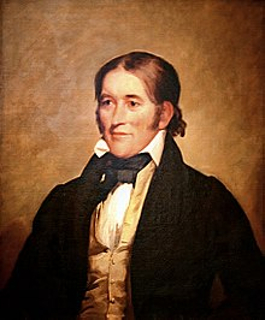
The Crockett family is of mostly French–Huguenot ancestry, although the family settles in Ireland before migrating to the Americas. Crockett is born in what is now Greene County, Tennessee (at the time part of North Carolina), close to the Nolichucky River and near the community of Limestone. He grows up in East Tennessee, where he gains a reputation for hunting and storytelling.
Crockett is made a colonel in the militia of Lawrence County, Tennessee and is elected to the Tennessee state legislature in 1821. In 1827, he is elected to the United States Congress where he vehemently opposes many of the policies of President Andrew Jackson, especially the Indian Removal Act. His opposition to Jackson’s policies leads to his defeat in the 1831 elections. He is re-elected in 1833, then narrowly loses in 1835, prompting his angry departure shortly thereafter to Texas, then the Mexican state of Tejas.
All that is certain about the fate of Crockett is that he dies fighting in the Battle of the Alamo in the Texas Revolution on the morning of March 6, 1836. According to many accounts, between five and seven Texans surrender during the battle, possibly to General Manuel Fernández Castrillón. General Antonio López de Santa Anna has ordered the Mexicans to take no prisoners, and he is incensed that those orders have been ignored. He demands the immediate execution of the survivors, but Castrillon and several other officers refuse to do so. Staff officers who had not participated in the fighting draw their swords and kill the unarmed Texians.
Crockett becomes famous during his lifetime for larger-than-life exploits popularized by stage plays and almanacs. After his death, he continues to be credited with acts of mythical proportion. In the 20th century these lead to television and movie portrayals, and he becomes one of the best-known American folk heroes.
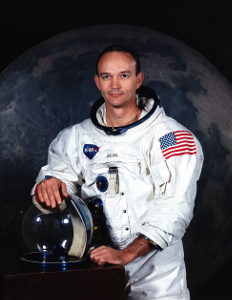
Collins makes the decision to become an astronaut after watching John Glenn‘s Mercury-Atlas 6 flight. He applies for the second group of astronauts that same year but is not accepted. Disappointed, but undaunted, Collins enters the USAF Aerospace Research Pilot School as the Air Force begins to research space. That year, NASA once again calls for astronaut applications, and Collins is more prepared than ever. In 1963 he is chosen by NASA to be part of the third group of astronauts.
Collins makes two spaceflights. The first, on July 18, 1966, is the Gemini 10 mission, where Collins performs a spacewalk. The second is the Apollo 11 mission on July 20, 1969, the first lunar landing in history. Collins, accompanied by Neil Armstrong and Edwin “Buzz” Aldrin, remains in the Command Module while his partners walk on the moon’s surface. Collins continues circling the moon until July 21, when Armstrong and Aldrin rejoin him. The next day, he and his fellow astronauts leave lunar orbit. They land in the Pacific Ocean on July 24. Collins, Armstrong and Aldrin are all awarded the Presidential Medal of Freedom by Richard Nixon. However, Aldrin and Armstrong end up receiving a majority of the public credit for the historic event, although Collins is also on the flight.
Collins leaves NASA in January 1970, and one year later, he joins the administrative staff of the Smithsonian Institution in Washington, D.C. In 1980, he enters the private sector, working as an aerospace consultant. In his spare time, Collins says he stays active and spends his days “worrying about the stock market” and “searching for a really good bottle of cabernet under ten dollars.”
Collins and his wife, Patricia Finnegan, have three children. The couple lived in both Marco Island, Florida, and Avon, North Carolina until her death in April 2014.
On April 28, 2021, Collins dies of cancer at his home in Naples, Florida, at the age of 90. Buzz Aldrin, who becomes the last survivor of Apollo 11, says that “wherever [Collins has] been or will be, you will always have the Fire to Carry us deftly to new heights and the future.”
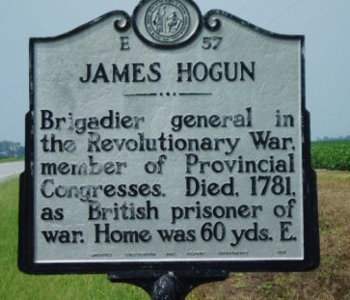
Born in Ireland around 1721, Hogun migrates to North Carolina, then a British colony, in 1751. Settling in Halifax County, he raises a family and establishes himself as a prominent local figure.
In November 1779, Hogun is sent south in command of the North Carolina Brigade to the aid of General Benjamin Lincoln, who is facing an anticipated British assault at Charleston, South Carolina. The march south, through one of the worst winters ever, is a severe one and Hogun’s numbers are reduced by the time he reached Charleston on March 3, 1780. Before the end of the month, British General Henry Clinton’s men are besieging the city. The Americans, though outnumbered more than two to one, have a few successes but soon they are running low on food and ammunition.
At a council of war May 11, the decision is made to surrender. The surrender the following day is one of the worst American defeats of the war — more than 2,500 men become British prisoners. The British hastily build a prison on Haddrel’s Point, a peninsula in Charleston’s harbor, to hold the prisoners, but the site is incomplete, and conditions are harsh.
Generals McIntosh, Lincoln, and Scott, and other high-ranking officers accept parole from the British and depart. Generals William Moultrie and Hogun refuse, preferring to stay with their men. The British are trying to recruit colonial soldiers to serve them in the West Indies. In spite of his flagging health, Hogun fears some of his men might weaken if he departs.
As winter sets in, Hogun’s condition worsens. On January 4, 1781, he passes away and was buried near the prison. Like so many other Irish-born soldiers before and after him, James Hogun had given his last full measure of devotion to his adopted country.
Gilmore is born in Ballygar, County Galway, on December 25, 1829. He starts his music career at age fifteen and spends time in Canada with an English band. Already a fine cornet player, he settles in Boston, Massachusetts in 1848, becoming leader of the Suffolk, Boston Brigade, and Salem bands in swift succession. He also works in the Boston music store of John P. Ordway and founds Ordway’s Aeolians, a group of blackfaceminstrels. With the Salem Band, Gilmore performs at the 1857 inauguration of President James Buchanan.
In 1858, Gilmore founds “Gilmore’s Band,” and at the outset of the American Civil War the band enlists with the 24th Massachusetts Volunteers, accompanying General Ambrose Burnside to North Carolina. After the temporary discharge of bands from the field, Governor John Albion Andrew of Massachusetts entrusts Gilmore with the task of re-organizing military music-making. General Nathaniel P. Banks creates him Bandmaster-general.
When the war ends, Gilmore is asked to organize a celebration, which takes place in New Orleans. That success emboldens him to undertake two major music festivals in Boston, the National Peace Jubilee in 1869 and the World’s Peace Jubilee and International Musical Festival in 1872. These feature monster orchestras of massed bands with the finest singers and instrumentalists, including the only American appearance by “waltz king” Johann Strauss II, and cements Gilmore’s reputation as the leading musical figure of the age. Coliseums are erected for the occasions, holding 60- and 120,000 persons. Grateful Bostonians present Gilmore with medals and cash, but in 1873 he moves to New York City, as bandmaster of the 22nd Regiment. Gilmore takes this band on acclaimed tours of Europe.
On September 24, 1892, back in the United States preparing an 1892 musical celebration of the quadricentennial anniversary of Christopher Columbus‘ voyage of discovery, Gilmore collapses and dies in St. Louis. He is buried in Calvary Cemetery, Queens, New York, where his wife is later interred.
In many ways Gilmore can be seen as the principal figure in 19th-century American music. He holds the first “Promenade Concert in America” in 1855, the forerunner to today’s Boston Pops. He sets up “Gilmore’s Concert Garden,” which becomes Madison Square Garden. He is the Musical Director of the Nation in effect, leading the festivities for the 1876 Centennial celebrations in Philadelphia and the dedication of the Statue of Liberty in 1886. In 1888 he starts the tradition of seeing in the New Year in Times Square.


 seamus dubhghaill