Shillington originally plans to join the Northern Ireland Civil Service, however he wants a more varied career. He joins the Royal Ulster Constabulary on February 8, 1933, as a cadet officer. He completes his training at the Newtownards depot in County Down. He is promoted to district inspector in 1935, and serves as officer in charge of D District in Belfast. In 1944, he is promoted to 1st Class District Inspector and is posted to Derry, County Londonderry.
In 1953, after nine years in Derry, Shillington is promoted to County Inspector and returns to Belfast. There, he joins the Inspector General’s Headquarters and serves in an administrative post. On January 16, 1961, he is appointed Commissioner of Belfast City.
In 1969, Shillington is appointed Deputy Inspector-General of the RUC, as second-in-command to the Inspector-General, Anthony Peacocke, who, like Shillington, had been educated at Sedbergh and Cambridge. When the Battle of the Bogside breaks out in Derry in August 1969, he requests permission to use CS gas for the first time in the United Kingdom. When that does not halt the rioting, he requests that the British Army be brought in. He telephones Peacocke on August 13 in order to persuade him of this. Peacocke, who has long denied the need for army involvement, eventually agrees, but his reputation never recovers and following the publication of the Hunt Report in October he resigns as Inspector-General.
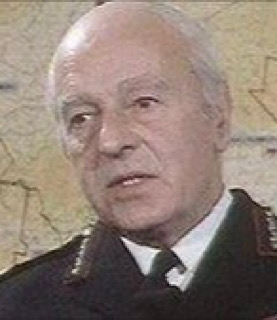
Shortly thereafter, Sir Arthur Young is seconded from the City of London Police to be the last Inspector-General and the first Chief Constable of the RUC. James Callaghan, then Home Secretary, sends him to implement the Hunt Report. Young’s measures introduce the standard British rank system for police officers in Northern Ireland and disbands the Ulster Special Constabulary (USC). Shillington remains as Young’s deputy, and when the latter returns to the mainland in 1970 he succeeds him to become the RUC’s second Chief Constable.
Shillington marries Mary (Peggy) Bulloch in 1935. They have two sons and a daughter. He dies on August 14, 2001, at the age of 90, in a County Armagh nursing home.
Henry is born in Belfast on January 15, 1902, the daughter of the tea merchant George Adams Henry. She attends Mount Pottinger National School, and Victoria College, before expanding her studies at night classes at the Belfast School of Art.
Henry completes an apprenticeship at Clokey Stained Glass Studios founded by Walter Francis Clokey where she is to work for over fifty years designing stained glass windows. Her appointment in the autumn of 1919 comes by a chance visit to Victoria College by the firm’s owner who is seeking a suitable apprentice. She retires from the firm at Easter 1972.
Henry exhibits at the Belfast Art Society for the first time in 1928. She exhibits four works, all landscapes in oil, and then a further two works in the following year. In 1931, she shows a further two works with the successor to the Belfast Art Society, the Ulster Academy of Arts. In 1932, she shows A Derbyshire Village, described by one critic as “a delightful English rural scene.” Between 1931 and 1942 she shows with more than twenty paintings at the Ulster Academy of Arts, exhibiting at each annual show in that time.
Henry has a keen interest in photography from an early age and wins various awards for her photographs. In 1934, she wins the August prize from the Photographic Dealers’ Association for a shot of a child playing with toys in the bath, having received a consolation prize of five shillings in September of the previous year for a shot of a traditional market scene in Boulogne. She goes on to write a regular column for Amateur Photographer throughout the 1930s.
In January 1935, Henry is appointed leader of a local sketching group by the Youth Hostel Association. In December 1935, she is commended for a sketch called River Pool, submitted to a competition judged by James Humbert Craig on behalf of the Youth Hostel Association, presented alongside Port Muckin a show with the sketching group. Maurice Canning Wilks contributes Skernaghan Point, Brown’s Bay to the same show.
The Robinson and Cleaver Art Gallery stages a display of works from Four Ulster Artists in 1936 consisting of paintings from Henry, her sister Marjorie, Theo Gracey and F. H. Hummel. She contributes Green Boat, which she had presented earlier in the year to the Ulster Academy of Arts, and includes Off the Scilly Isles among pictures from Brittany and Bavaria. The reviewer in Belfast’s News Letter refers to her style as “Post-Impressionism.”
In 1937, Henry is elected an Associate of the Ulster Academy of Arts and presents three watercolours to the institution the following year. The exhibition is opened by Oliver St. John Gogarty with participants such as John Luke, Maurice Wilks, James Humbert Craig, Rosamund Praeger and Colin Middleton, who shows three Surrealist works including Angelus.
The Royal Hibernian Academy displays two small works, Flight, 1941 and Lakeside, among an unusually large contingent of Ulster artists in the annual exhibition in the spring of 1942. The Ulster Academy of Arts is united in their commitment to raise funds for the bomb damaged Ulster Hospital for Children and Women in their Spring Exhibition of 1942. Henry displays a sense of humour in her use of black-out paint, roadblocks and air raid shelters in one of the watercolours on show.
Henry is a regular exhibitor with the Water Colour Society of Ireland, and contributes more than one hundred works to their exhibitions between 1943 and 1986.
Henry joins Violet McAdoo in a joint exhibition at the Belfast Museum and Art Gallery in 1944. McAdoo presents with watercolours, however, Henry also presents oils. The paintings are primarily of landscapes but included a number urban scenes.
In 1945, Henry and her sister Margaret join Arthur and George Campbell, Colin Middleton, Gladys and Max Maccabe, Thomas Carr, Maurice Wilks, James McIntyre and others, in the only official exhibition from the Ulster branch of the Artists’ International Association sponsored by the Council for the Encouragement of Music and the Arts (NI) at the Belfast Museum.
The MacGaffin Gallery at Pottinger’s Entry is the venue for a group exhibition of experimental and modernist works with Nevill Johnson, Aaron McAfee and the MacCabes in 1946, where Henry exhibits seven paintings. Quayside is one of three pictures that she presents at the Ulster Academy in 1946. She also shows it with the Water Colour Society of Ireland in the following year and at CEMA’s Some Ulster Paintings exhibition in that same year.
In 1946, the Council for the Encouragement of Music and Art (CEMA) purchases a painting by Henry, in addition to works by other contemporary Ulster artists. Twenty-four of the works from the CEMA collection, including her painting, are later presented at their Donegall Place gallery in 1954.
Henry debuts at the 1948 Irish Exhibition of Living Art with one painting and returns in each of the subsequent ten years with a total of 20 paintings. She is also elected as an Honorary Academician of the Ulster Academy of Arts in 1948.
Henry displays one work, Harbour, Northern Ireland, with Violet McAdoo at the 88th exhibition of the Society of Women Artists at the Royal Institute Galleries in London during the summer of 1949. Just a few months later her work is back in London for the United Society of Artists annual exhibition where she shows Gossip and Shell and Sail.
Henry is awarded a travel scholarship from the Soroptomists of Belgium in 1957, which enables her to study stained glass in the country. She is the President of Soroptomist Club of Belfast from 1960 to 1961, where she had been a member since its foundation in 1932.
Upon her return from Belgium, CEMA stages a solo exhibition with thirty-five of Henry’s oils and watercolours at their Belfast gallery. The exhibition is arranged at short notice when another is unexpectedly cancelled. Writer Nesca Robb opens the exhibition where it is claimed a new painting technique, “monopainting,” is revealed, described as paint drawn through a gauze over glass. The exhibition includes a ‘Breton’ series, Kerry Tangle, Ship Pattern, Barrack Shapes, Lough Shapes, and Backs. In addition, she displays In the Park, an oil previously seen at the Royal Ulster Academy in 1955 and at the Irish Exhibition of Living Art in 1956, and a second oil, City Lunch Hour, exhibited at the Royal Ulster Academy in 1956.
The Ulster Society of Women Artists is founded in 1957 by Gladys Maccabe with the support of Henry and a number of others at a time when no arts societies are accepting female artists into their ranks. The main objective is to ensure the development of quality art and women artists in Ulster. The organisation begins with ten invited artists. Henry exhibits with the society throughout her life.
Henry receives a mention in the local press referring to her exhibits in the Royal Ulster Academy show of 1959 with Kenneth Jamison comparing her work with that of Deborah Brown, “Olive Henry is more decadent by instinct, a fine formaliser. Her pictures Man and Ropes and Riviera Port, well defined and carefully abstracted, contrast in form with Deborah Brown’s freer Oil Over Tempra,[sic] 1959.”
A group exhibition in 1964 at the New Gallery in Belfast includes work from Henry alongside Neil Shawcross, Max Maccabe, Kathleen Bell, Richard Croft and Helen Ross. Among other works she shows Easter and Long Garden.
In 1981, the Ulster Society of Womens Artists elects Henry as President. A retrospective of her studio works is hosted by the Shambles Gallery in Hillsborough, County Down in 1986, some thirty years since her last solo exhibition. Henry shows at the Royal Ulster Academy Annual Exhibition in 1987 for the last time.
Henry dies on November 8, 1989, at Crawfordsburn, County Down. Her paintings are held in the collections of the Northern Ireland Civil Service, Ulster Museum, Irish Linen Centre & Lisburn Museum, and the Royal Ulster Academy of Arts Diploma Collection.
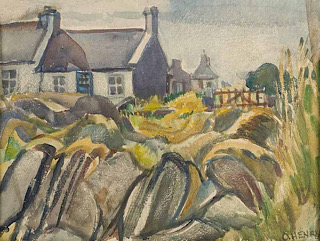
(Pictured: “The Gardener,” watercolour by Olive Henry)
(Robert John) Douglas Gageby, one of the pre-eminent Irish newspaper editors of his generation, dies on June 24, 2004, following a lengthy illness. His life is well documented and a book of essays about him, Bright Brilliant Days: Douglas Gageby and the Irish Times, written by many of his colleagues, some of whom had attained fame for their literary achievements, is published in 2006.
Gageby is educated at Belfast Royal Academy and Trinity College Dublin, where he is elected a scholar in Modern Languages (French and German) in 1940. He is also actively involved with the student newspaper, Trinity News. He enlists in the Irish Army as a private soldier at the outbreak of World War II. He is commissioned later, and he serves as an intelligence officer. He reports from post-war Germany for The Irish Press and goes on to work under Conor Cruise O’Brien in the Irish News Agency. In 1954 he is the first editor of the Evening Press. In 1963 he becomes editor of The Irish Times, a post he holds until 1986, having been brought back from a short retirement in 1974. He is credited with moving The Irish Times from a Unionist organ into a successful Irish journal of record.
In 2003 it is revealed that a director, and later Chairman, of The Irish Times, Major Thomas Bleakley McDowell, had referred to Gageby as a “white nigger” for his views and role in the paper during the Northern Ireland civil rights movement‘s campaign in the 1960s. The comment appears in a letter from the British Ambassador to Dublin, Sir Andrew Gilchrist, to Kelvin White, head of the Irish Section of the British Foreign Office and is dated October 2, 1969. Gilchrist is referring to conversations which he had with McDowell where the latter professes himself to be fully behind the British government in the North and hostile to Gageby’s coverage of the civil rights movement. However, historian Mark O’Brien notes, “Despite his contacts with London, McDowell’s actions did not interfere with Gageby’s editorials on Northern Ireland”, due to the fact McDowell believes in editorial independence (even though McDowell strongly disagrees with Gageby’s nationalist views), and because Gageby is making the newspaper commercially successful. Under the 30 year rule, this letter is made available to newspapers on December 22 and 23, 1999, but no newspaper publishes it at that time.
The communiqué is later discovered by the historian Jack Lane and published in the Irish Political Review, a small magazine strongly antagonistic to The Irish Times, in January 2003. He brings it to the attention of The Irish Times editor, Geraldine Kennedy, on January 10, 2003, and she replies on January 15, 2003 saying she is “unable to confirm the veracity of it” and does not publish it. When, on January 26, 2003, the Sunday Independent (Ireland) publishes the story, The Irish Times finally follows the next day, January 27. Nonetheless, on April 24, 2004, Kennedy defends her position by saying, “The contents of the letter in question were published on January 27, 2003, as soon as its existence was drawn to my attention.”
Gageby dies on June 24, 2004, following a two year illness. His private funeral is conducted by Rev. Terence McCaughey, a family friend. The Irish Times endows an annual Douglas Gageby Fellowship for young journalists and a stand of trees is planted in his memory at Moynalty. His papers are presented to Dublin City University (DCU).
Having joined the Civil Service in 1952, Bloomfield is appointed Permanent Secretary to the power sharing executive in 1974. After the collapse of the executive, he goes on to become Permanent Secretary for the Department of the Environment and the Department of Economic Development, and finally Head of the Northern Ireland Civil Service on December 1, 1984. In that capacity he is the most senior advisor to successive Secretaries of State for Northern Ireland and other Ministers on a wide range of issues. He retires from the post in April 1991.
Since retiring from the Civil Service, Bloomfield has embarked on a life of involvement in a diverse range of organisations. He has taken up roles such as Chairman for the Northern Ireland Legal Services Commission and his alma mater, the Royal Belfast Academical Institution. He has also been involved in the political reform of the States of Jersey and spearheaded the Association for Quality Education, which is fighting to retain academic selection in the Northern Ireland education system. In December 1997 he is asked by the Secretary of State for Northern Ireland, Mo Mowlam, to become the Northern Ireland Victims Commissioner for a fixed term. His role is to produce a report on the way forward for Victims issues in Northern Ireland. His report entitled We Will Remember Them is published in April 1998. From 1991 to 1999 he serves as the BBC‘s National Governor for Northern Ireland.



 seamus dubhghaill