seamus dubhghaill

Promoting Irish Culture and History from Little Rock, Arkansas, USA


Leave a comment

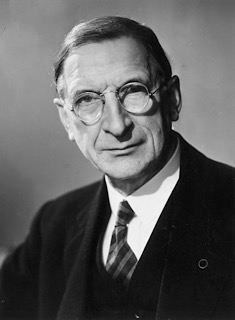
Birth of Éamon de Valera, Third President of Ireland

Éamon de Valera, Irish politician and patriot, is born George de Valero on October 14, 1882, in Lennox Hill, a neighborhood on the Upper East Side of Manhattan in New York City. He serves as Taoiseach (1932–48, 1951–54, 1957–59) and President of Ireland (1959–73). An active revolutionary from 1913, he becomes president of Sinn Féin in 1917 and founds the Fianna Fáil party in 1926. In 1937, he makes his country a sovereign state, renamed Ireland, or Éire. His academic attainments also inspire wide respect. He becomes chancellor of the National University of Ireland in 1921.

De Valera is the son of Catherine Coll, who is originally from Bruree, County Limerick, and Juan Vivion de Valera, described on the birth certificate as a Spanish artist born in 1853. His father dies when he is two years old. He Is then sent to his mother’s family in County Limerick, and studies at the local national school and at Blackrock College, Dublin. He graduates from the Royal University of Ireland and becomes a teacher of mathematics and an ardent supporter of the Irish language revival. In 1913, he joins the Irish Volunteers, which had been organized to resist opposition to Home Rule for Ireland.

In the 1916 Easter Rising in Dublin, de Valera commands an occupied building and is the last commander to surrender. Because of his American birth, he escapes execution by the British but is sentenced to penal servitude. Released in 1917 but arrested again and deported in May 1918 to England, where he is imprisoned, he is acclaimed by the Irish as the chief survivor of the uprising and in October 1917 is elected president of the Irish republican and democratic socialist Sinn Féin political party, which wins three-fourths of all the Irish constituencies in December 1918.

After a dramatic escape from HM Prison Lincoln in February 1919, de Valera goes in disguise to the United States, where he collects funds. He returns to Ireland before the Irish War of Independence ends with the truce that takes effect on July 11, 1921, and appoints plenipotentiaries to negotiate in London. He repudiates the Anglo-Irish Treaty of December 6, 1921, that they signed to form the Irish Free State, however, primarily because it imposes an oath of allegiance to the British crown.

After Dáil Éireann ratifies the treaty by a small majority in 1922, de Valera supports the republican resistance in the ensuing Irish Civil WarW. T. Cosgrave’s Irish Free State ministry imprisons him, but he is released in 1924 and then organizes a republican opposition party that does not sit in Dáil Éireann. In 1927, however, he persuades his followers to sign the oath of allegiance as “an empty political formula,” and his new Fianna Fáil (“Soldiers of Destiny”) party then enters the Dáil, demanding abolition of the oath of allegiance, of the governor-general, of the Seanad Éireann (senate) as then constituted, and of land-purchase annuities payable to Great Britain. The Cosgrave ministry is defeated by Fianna Fáil in 1932, and de Valera, as head of the new ministry, embarks quickly on severing connections with Great Britain. He withholds payment of the land annuities, and an “economic war” results. Increasing retaliation by both sides enables de Valera to develop his program of austere national self-sufficiency in an Irish-speaking Ireland while building up industries behind protective tariffs. In the new Constitution of Ireland, ratified by referendum in 1937, the Irish Free State becomes Ireland, a sovereign, independent democracy tenuously linked with the British Commonwealth (under the Executive Authority (External Relations) Act 1936) only for purposes of diplomatic representation.

De Valera’s prestige is enhanced by his success as president of the council of the League of Nations in 1932 and of its assembly in 1938. He also enters negotiations with British Prime Minister Neville Chamberlain in which he guarantees that he will never allow Ireland to be used as a base for attacking Britain in the event of war. This culminates in the Anglo-Irish defense agreement of April 1938, whereby Britain relinquishes the naval bases of Cobh, Berehaven, and Lough Swilly (retained in a defense annex to the 1921 treaty), and in complementary finance and trade treaties that end the economic war. This makes possible de Valera’s proclamation in September 1939, upon the outbreak of World War II, that Ireland will remain neutral and will resist attack from any quarter. In secret, however, de Valera also authorizes significant military and intelligence assistance to both the British and the Americans throughout the war. He realizes that a German victory will imperil Ireland’s independence, of which neutrality is the ultimate expression. By avoiding the burdens and destruction of the war, de Valera achieves a relative prosperity for Ireland in comparison with the war-torn countries of Europe, and he retains office in subsequent elections.

In 1948, a reaction against the long monopoly of power and patronage held by de Valera’s party enables the opposition, with the help of smaller parties, to form an interparty government under John A. Costello. Ironically, this precarious coalition collapses within three years after Ireland becomes a republic by means of the repeal of the Executive Authority (External Relations) Act 1936 and the severance of all ties with the British Commonwealth, an act de Valera had avoided. De Valera resumes office until 1954, when he appeals unsuccessfully for a fresh mandate, and Costello forms his second interparty ministry. No clearly defined difference now exists between the opposing parties in face of rising prices, continued emigration, and a backward agriculture. De Valera claims, however, that a strong single-party government is indispensable and that all coalitions must be weak and insecure. On this plea he obtains, in March 1957, the overall majority that he demands.

In 1959, de Valera agrees to stand as a candidate for the presidency. He resigns his position as Taoiseach and leader of the Fianna Fáil party. In June he is elected president, and is reelected in 1966. He retires to a nursing home near Dublin in 1973 and dies there on August 29, 1975.

De Valera’s career spans the dramatic period of Ireland’s modern cultural and national revolution. As an anticolonial leader, a skillful constitutionalist, and a symbol of national liberation, he dominates Ireland in the half century following the country’s independence.

(From: “Éamon de Valera, president of Ireland,” Encyclopedia Britannica, http://www.britannica.com, last updated August 14, 2025)
Leave a comment

The Execution of Fenian Michael Barrett

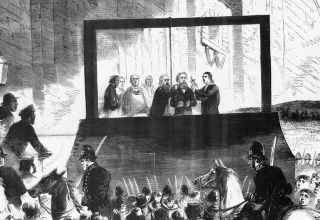
Michael Barrett, Irish activist and a member of the Fenians, is executed on May 26, 1868, for his part in the Clerkenwell Gaol explosion in December 1867. From all the evidence, it is likely he is not guilty. He is the last man to be publicly hanged in England.

Barrett is born in 1841 in Drumnagreshial in the Ederney area of County Fermanagh. As a young man and in search of work, he moves to Glasgow where, at the age of 27, he joins the Irish Republican Brotherhood (IRB), often referred to as Fenians. In the 1860s, the IRB is a political movement that dominates Irish Republican politics and defies the Catholic Church, middle-class nationalists who advocate milder approaches and Irish Unionists. Tens of thousands of Irishmen in both Ireland and Great Britain are recruited into its ranks.

The Clerkenwell bombing is the most infamous action carried out by the Fenians in mainland Britain. It results in a long-lived backlash that foments much hostility against the Irish community in Britain.

The events that lead up to the bombing start with the arrest in November 1867 of Ricard O’Sullivan Burke, a senior Fenian arms agent who planned the “prison-van escape” in Manchester a few months earlier. O’Sullivan-Burke is subsequently imprisoned on remand in the Middlesex House of Detention, Clerkenwell. On December 13, an attempt to rescue him is made by blowing a hole in the prison wall. The explosion is seriously misjudged. It demolishes not only a large section of the wall, but also a number of tenement houses opposite in Corporation Lane (now Corporation Row), killing 12 people and wounding up to 120 more.

The bombing has a traumatic effect on British working-class opinion. The radical, Charles Bradlaugh, condemns the incident in his newspaper, the National Reformer, as an act “calculated to destroy all sympathy, and to evoke the opposition of all classes.”

The day before the explosion, Prime Minister Benjamin Disraeli bans all political demonstrations in London in an attempt to put a stop to the weekly meetings and marches that are being held in support of the Fenians. He fears that the ban might be challenged, but the explosion has the effect of turning public opinion in his favour.

Months earlier, Barrett had been arrested in Glasgow for illegally discharging a firearm and allegedly false evidence is used to implicate him in the Clerkenwell Prison explosion. In court, he produces witnesses who testify that he had been in Scotland on the date of the incident. The main case against him rests on the evidence of Patrick Mullany, a Dubliner known to have given false testimony before and whose price is a free passage to Australia, who tells the court that Barrett had informed him that he had carried out the explosion with an accomplice by the name of Murphy. After two hours of deliberation the jury pronounces Barrett guilty. On being asked if he has anything to say before sentence is passed, he delivers an emotional speech from the dock.

Many people, including a number of radical MPs, press for clemency. In Fermanagh, Barrett’s aged mother walks several miles in the snow to appeal to the local Irish Conservative Party MP, Captain Mervyn Edward Archdale, a staunch Orangeman, who rejects her.

Barrett is executed outside the walls of Newgate Prison on May 26, 1868, before a crowd of two thousand who boo, jeer and sing “Rule, Britannia!” and “Champagne Charlie” as his body drops. His execution is the last public hanging to take place in England. The hangman is William Calcraft.

Until their transfer to the City of London Cemetery, Barrett’s remains lay for 35 years in a lime grave inside the walls of Newgate Prison. When the prison is demolished in 1903 his remains are taken to their present resting place. Today the grave is a place of Fenian pilgrimage and is marked by a small plaque.

After the explosion, the Prime Minister Disraeli advocates the suspension of the Habeas Corpus Act 1862 in Great Britain, as is already the case in Ireland. Greater security measures are quickly introduced. Thousands of special constables are enrolled to aid the police and at Scotland Yard a special secret service department is established to meet the Fenian threat. Although a number of people are arrested and brought to trial, Barrett is the only one to receive the death sentence.

Within days of the explosion, the Liberal Party leader, William Ewart Gladstone, then in opposition, announces his concern about Irish Nationalist grievances and says that it is the duty of the British people to remove them. Later, he says that it is the Fenian action at Clerkenwell that turned his mind towards Home Rule. When Gladstone discovers at Hawarden later that year that Queen Victoria had invited him to form a government, he famously states, “my mission is to pacify Ireland.”


Leave a comment

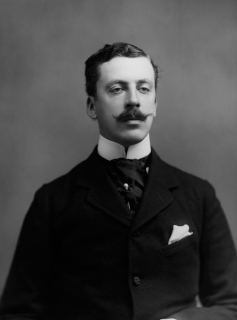
Death of James Hamilton, 3rd Duke of Abercorn

James Albert Edward Hamilton, 3rd Duke of Abercorn, dies on September 12, 1953 in London, England.

Hamilton is born in Hamilton Place, Piccadilly, London, on November 30, 1869. Styled Marquess of Hamilton between 1885 and 1913, he is a British peer and Unionist politician. He serves as the first Governor of Northern Ireland, a post he holds between 1922 and 1945. He is a great-grandfather of Diana, Princess of Wales.

Hamilton is the eldest son of James Hamilton, 2nd Duke of Abercorn, and godson of the Prince of Wales. His mother, Lady Mary Anna, is the fourth daughter of Richard Curzon-Howe, 1st Earl Howe. He is educated at Eton College and subsequently serves first in the Royal Inniskilling Fusiliers until 1892 when he joins the 1st Life Guards. He is later transferred as major to the North Irish Horse.

In early 1901 he accompanies his father on a special diplomatic mission to announce the accession of King Edward to the governments of Denmark, Sweden and Norway, Russia, Germany, and Saxony.

In the 1900 United Kingdom general election in Ireland, Hamilton stands successfully as Unionist candidate for Londonderry City, and three years later he becomes Treasurer of the Household, a post he holds until the fall of Arthur Balfour‘s Conservative administration in 1905. After serving for a time as an Opposition whip, Hamilton succeeds his father as third Duke of Abercorn in 1913. In 1922, he is appointed governor of the newly created Northern Ireland. He also serves as Lord Lieutenant of Tyrone from 1917 until his death, having previously been a Deputy Lieutenant for County Donegal. Hamilton proves a popular royal representative in Northern Ireland and is reappointed to the post in 1928 after completing his first term of office. In 1931, he declines the offer of the governor generalship of Canada, and three years later he is again reappointed governor for a third term. He remains in this capacity until his resignation in July 1945.

Hamilton is made the last non-royal Knight of the Most Illustrious Order of Saint Patrick in 1922. In 1928 he becomes a Knight of the Most Noble Order of the Garter and is also the recipient of an honorary degree from the Queen’s University Belfast. He receives the Royal Victorian Chain in 1945, the same year he is sworn of the Privy Council.

Hamilton marries Lady Rosalind Cecilia Caroline Bingham, only daughter of Charles George Bingham, 4th Earl of Lucan and his wife Lady Cecilia Catherine Gordon-Lennox at St. Paul’s Church, Knightsbridge, on November 1, 1894. They have three daughters and two sons.

Hamilton dies at his London home on September 12, 1953, and is buried at Baronscourt in County Tyrone.

(Pictured: “James Albert Edward Hamilton, 3rd Duke of Abercorn” by Alexander Bassano, Collodion Negative, 1894, Photographs Collection, National Portrait Gallery, London)


Leave a comment

Birth of James Hamilton, First Governor of Northern Ireland

james-hamilton

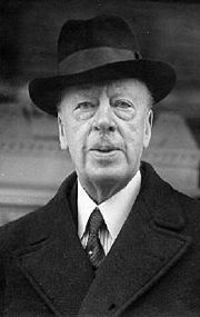
James Albert Edward Hamilton, 3rd Duke of Abercorn, is born in Hamilton Place, Piccadilly, London, on November 30, 1869. Styled Marquess of Hamilton between 1885 and 1913, he is a British peer and Unionist politician. He serves as the first Governor of Northern Ireland, a post he holds between 1922 and 1945. He is a great-grandfather of Diana, Princess of Wales.

Hamilton is the eldest son of James Hamilton, 2nd Duke of Abercorn, and godson of the Prince of Wales. His mother, Lady Mary Anna, is the fourth daughter of Richard Curzon-Howe, 1st Earl Howe. He is educated at Eton College and subsequently serves first in the Royal Inniskilling Fusiliers until 1892 when he joins the 1st Life Guards. He is later transferred as major to the North Irish Horse.

In early 1901 he accompanies his father on a special diplomatic mission to announce the accession of King Edward to the governments of Denmark, Sweden and Norway, Russia, Germany, and Saxony.

In the 1900 general election, Hamilton stands successfully as Unionist candidate for Londonderry City, and three years later he becomes Treasurer of the Household, a post he holds until the fall of Arthur Balfour‘s Conservative administration in 1905. After serving for a time as an Opposition whip, Hamilton succeeds his father as third Duke of Abercorn in 1913. In 1922, he is appointed governor of the newly created Northern Ireland. He also serves as Lord Lieutenant of Tyrone from 1917 until his death, having previously been a Deputy Lieutenant for County Donegal. Abercorn proves a popular royal representative in Northern Ireland and is reappointed to the post in 1928 after completing his first term of office. In 1931, he declines the offer of the governor generalship of Canada, and three years later he is again reappointed governor for a third term. He remains in this capacity until his resignation in July 1945.

Abercorn is made the last non-royal Knight of the Most Illustrious Order of Saint Patrick in 1922. In 1928 he becomes a Knight of the Most Noble Order of the Garter and is also the recipient of an honorary degree from the Queen’s University Belfast. He receives the Royal Victorian Chain in 1945, the same year he is sworn of the Privy Council.

Abercorn marries Lady Rosalind Cecilia Caroline Bingham, only daughter of Charles Bingham, 4th Earl of Lucan and his wife Lady Cecilia Catherine Gordon-Lennox at St. Paul’s Church, Knightsbridge, on November 1, 1894. They have three daughters and two sons.

Abercorn dies at his London home on September 12, 1953, and is buried at Baronscourt in County Tyrone.