seamus dubhghaill

Promoting Irish Culture and History from Little Rock, Arkansas, USA


Leave a comment

The Poor Relief (Ireland) Act 1838 Receives Royal Assent

The Poor Relief (Ireland) Act 1838 (1 & 2 Vict, c. 56), an Act of the Parliament of the United Kingdom that creates the system of poor relief in Ireland, receives royal assent on July 31, 1838. The legislation is largely influenced by the English Poor Law Amendment Act 1834.

Following its enactment, one hundred and thirty poor law unions (PLU) are established throughout the country. Each Union has a workhouse, financed by the payment of rates on landholders in the Union district. The administration of the poor law unions in Ireland is overseen by the Poor Law Commissioners who maintain control by setting up strict accounting and recording systems. Each PLU is managed locally by a board of Guardians who meet weekly to oversee the running of the workhouse (indoor) and relief work schemes (outdoor).

The vast bulk of the surviving PLU records comprises Minute and Rate Books. To a much lesser degree indoor and outdoor relief registers and records such as death registers and porter’s books survive.

Minute Books contain the records of each weekly meeting of the Board of Guardians. They take account of the finances of the Union, procurement of provisions, hiring of staff, management of inmates, and any other issues that may arise regarding the week-to-week running of the Workhouse. The Minute Books also record the number of inmates in the workhouse, numbers admitted or left in the week as well as distinguishing between sexes, adults, and children. They also record the number of sick inmates and the number of deaths each week.

Rate Books account for the rates paid by occupiers of property and the nature of the property they occupy.

Registers account for persons receiving relief from the Union. Indoor registers list the name, age, sex, religion, previous address, condition on entering, and date of entry and leaving the workhouse for each inmate.


Leave a comment

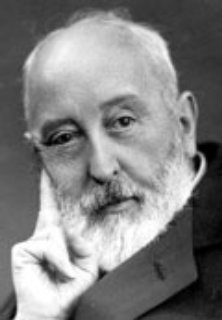
Birth of Timothy Michael Healy, Politician, Journalist, Author & Barrister

Timothy Michael “Tim” Healy, Irish nationalist politician, journalist, author, barrister, and one of the most controversial Irish Members of Parliament (MPs) in the House of Commons of the United Kingdom of Great Britain and Ireland, is born in Bantry, County Cork on May 17, 1855.

Healy is the second son of Maurice Healy, clerk of the Bantry Poor Law Union, and Eliza Healy (née Sullivan). His elder brother, Thomas Healy (1854–1924), is a solicitor and Member of Parliament (MP) for North Wexford and his younger brother, Maurice Healy (1859–1923), with whom he holds a lifelong close relationship, is a solicitor and MP for Cork City.

Healy’s father is transferred in 1862 to a similar position in Lismore, County Waterford. He is educated at the Christian Brothers school in Fermoy, and is otherwise largely self-educated, in 1869, at the age of fourteen, he goes to live with his uncle Timothy Daniel Sullivan in Dublin.

Healy then moves to England in 1871, working first as a railway clerk and then from 1878 in London as parliamentary correspondent of The Nation, writing numerous articles in support of Charles Stewart Parnell, the newly emergent and more militant home rule leader, and his policy of parliamentary obstructionism. Healy takes part in Irish politics and becomes associated with Parnell and the Irish Parliamentary Party. After being arrested for intimidation in connection with the Irish National Land League, he is promptly elected as member of Parliament for Wexford Borough in 1880.

In Parliament, Healy becomes an authority on the Irish land question. The “Healy Clause” of the Land Law (Ireland) Act 1881, which protects tenant farmers’ agrarian improvements from rent increases imposed by landlords, not only makes him popular throughout nationalist Ireland but also wins his cause seats in Protestant Ulster. He breaks with Parnell in 1886 and generally remains at odds with subsequent leaders of the Irish Parliamentary Party, though he is a strong supporter of proposals for Irish Home Rule. Meanwhile, he is called to the Irish bar in 1884 and becomes a queen’s counsel in 1899.

Dissatisfied with both the Liberals and the Irish Nationalists after the Easter Rising in 1916, Healy supports Sinn Féin after 1917. He returns to considerable prominence in 1922 when, on the urging of the soon-to-be Irish Free State‘s Provisional Government of W.T. Cosgrave, the British government recommends to King George V that Healy be appointed the first “Governor-General of the Irish Free State,” a new office of representative of the Crown created in the 1921 Anglo-Irish Treaty and introduced by a combination of the Irish Free State Constitution and Letters Patent from the King.

Healy believes that he has been awarded the Governor-Generalship for life. However, the Executive Council of the Irish Free State decides in 1927 that the term of office of Governors-General will be five years. As a result, he retires from the office and public life in January 1928 and publishes his extensive two volume memoirs later in that year. Throughout his life he is formidable because he is ferociously quick-witted, because he is unworried by social or political convention, and because he knows no party discipline. Towards the end of his life, he becomes more mellowed and otherwise more diplomatic.

Healy dies on March 26, 1931, at the age of 75, in Chapelizod, County Dublin. He is buried in Glasnevin Cemetery in Dublin.


Leave a comment

The Doolough Tragedy

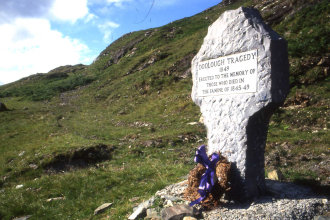
doolough-tragedy-memorial

The Doolough Tragedy is an event that took place during the Great Famine close to Doo Lough in southwest County Mayo.

On Friday, March 30, 1849 two officials of the Westport Poor Law Union arrive in Louisburgh to inspect those people in receipt of outdoor relief to verify that they should continue to receive it. The inspection, for some reason, does not take place and the two officials go on to Delphi Lodge, a hunting lodge, 19 kilometres (12 miles) south of Louisburgh where they intend to spend the night. The people who had gathered for the inspection, or later did so, are consequently instructed to appear at Delphi Lodge at 7:00 the following morning if they wish to continue receiving relief. For much of the night and day that follows seemingly hundreds of destitute and starving people have to undertake what for them, given their existing state of debilitation, is an extremely fatiguing journey, in very bad weather.

A letter-writer to The Mayo Constitution reports shortly afterwards that the bodies of seven people, including women and children, are subsequently discovered on the roadside between Delphi and Louisburgh overlooking the shores of Doo Lough and that nine more never reach their homes. Local folklore maintains the total number that perished because of the ordeals they had to endure is far higher.

A cross and an annual Famine Walk between Louisburgh and Doolough commemorates this event. The monument in Doolough valley has an inscription from Mahatma Gandhi: “How can men feel themselves honoured by the humiliation of their fellow beings?”

(Pictured: The memorial to the victims in Doolough valley, photo by Felix O, June 2009, CC BY-SA 2.0)