Patrick Scott, Irish artist, is born in Kilbrittain, County Cork, on January 24, 1921. He is perhaps best known for his gold paintings, abstracts incorporating geometrical forms in gold leaf against a pale tempura background. He also produces tapestries and carpets.
He has his first exhibition in 1944, but trains as an architect and does not become a full-time artist until 1960. He works for fifteen years for the Irish architect Michael Scott, assisting, for example, in the design of Busáras, the central bus station in Dublin. He is also responsible for the orange livery of Irish intercity trains.
His paintings are in several important collections including the Museum of Modern Art in New York City. He wins the Guggenheim Award in 1960 and represents Ireland in the 1960 Venice Biennale. The Douglas Hyde Gallery holds a major retrospective of his work in 1981 and the Hugh Lane Gallery in Dublin holds a major survey in 2002. His works are distinguished by their purity and sense of calm, reflecting his own interest in Zen Buddhism.
In October 2013, Scott weds his companion of 30 years, Eric Pearce, in a civil ceremony at the Dublin Registry Office.
On July 11, 2007, Scott, who is a founding member of Aosdána, is conferred with the title of Saoi, the highest honour that can be bestowed upon an Irish artist. The President of Ireland, Mary McAleese, makes the presentation, placing a gold torc, the symbol of the office of Saoi, around his neck. No more than seven living members may hold this honour at any one time.
Patrick Scott dies in Ballsbridge, Dublin, on February 14, 2014 at the age of 93. He is survived by his partner.
The amendment deletes the entirety of Article 44.1.2 which allowed the State to recognise the special position of the Holy Catholic Apostolic and Roman Church as the guardian of the Faith professed by the great majority of the citizens.
In drafting the Irish constitution in 1936 and 1937, Éamon de Valera and his advisers choose to reflect what has been a contemporary willingness by constitution drafters and lawmakers in Europe to mention and in some ways recognise religion in explicit detail. This contrasts with many 1920s constitutions, notably the Constitution of the Irish Free State of 1922, which, following the secularism of the initial period following World War I, simply prohibits any discrimination based on religion or avoids religious issues entirely.
De Valera, his advisers, and the men who put words to de Valera’s concepts for the constitution face conflicting demands in his drafting of the article on religion. In contemporary terms, the Amendment marks a defeat for conservative Catholics and Pope Pius XI explicitly withholds his approval from it.
Though perceived in retrospect as a sectarian article, Article 44 is praised in 1937 by leaders of Irish Protestant churches, notably the Church of Ireland Archbishop of Dublin, and by Jewish groups. Conservative Catholics condemn it as “liberal.”
When the contents of Article 44 are put to Pope Pius XI by Cardinal Eugenio Pacelli, then Cardinal Secretary of State, later Pope Pius XII, the pope states in diplomatic language, “We do not approve, nor do we not disapprove – we will remain silent.” It is said that the Vatican is privately more appreciative of the constitution, and Pius XII later praises it.
The Fifth Amendment is introduced by the Fianna Fáil government of Jack Lynch and supported by every other major political party. The Catholic Church does not voice any objection to the amendment, but it is opposed by some conservative Catholics. Some leading members of the Church of Ireland and the Jewish Community say during the campaign that while they appreciate the Article’s recognition of their existence in 1937, it is no longer needed in the 1970s and has lost its usefulness.
The referendum on the amendment occurs on the same day as the referendum on the Fourth Amendment which lowers the voting age to eighteen. The Fifth Amendment is approved by 721,003 (84.4%) in favour and 133,430 (15.6%) against.
Having completed its passage through the Oireachtas and been adopted by the people, it is enacted by being signed into constitutional law by the President of Ireland, the man who had drafted the original article, Éamon de Valera.
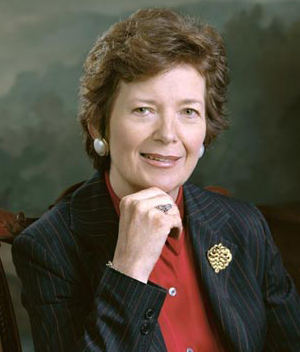
Mary Robinson becomes the first woman to be elected President of the Republic of Ireland on November 7, 1990. She becomes the first Labour Party candidate, the first woman, and the first non-Fianna Fáil candidate in the history of contested presidential elections to win the presidency.
Brian Lenihan, the Tánaiste and Minister for Defence is chosen by Fianna Fáil as their candidate, though he faces a late challenge for the party nomination from another senior minister, John P. Wilson, TD. Lenihan is popular and widely seen as humorous and intelligent. He has delivered liberal policy reform (relaxed censorship in the 1960s) and is seen as a near certainty to win the presidency.
Fine Gael, after trying and failing to get former TaoiseachGarret FitzGerald and former Tánaiste Peter Barry to run, ultimately nominate the former civil rights campaigner and Social Democratic and Labour Party (SDLP) member Austin Currie. Currie is elected to Dáil Éireann in the 1989 general election and has been a minister in Brian Faulkner‘s power-sharing executive in Northern Ireland from 1973–1974. However, Currie has little experience in the politics of the Republic and is widely seen as the party’s last choice, nominated only when no one else is available.
The Labour Party lets it be known that it would for the first time run a candidate. Along with the Workers’ Party, Labour nominates the independent candidate Mary Robinson, SC, a former Labour Party member and senator, and liberal campaigner. Robinson is a former Reid Professor of Law in the Trinity College, Dublin. She is previously involved in the Campaign for Homosexual Law Reform and the campaign to save Wood Quay.
Lenihan enters the race as odds-on favourite. No Fianna Fáil candidate has ever lost a presidential election. However, Lenihan is derailed when he confirms in an on-the-record interview with freelance journalist and academic researcher Jim Duffy that he has been involved in controversial attempts to pressurise the President, Patrick Hillery, over a controversial parliamentary dissolution in 1982. As a result of the contrast between his public denials during the campaign and his confirmation during an earlier interview recorded in May, he is dismissed from the Irish government.
At this point a cabinet colleague, Pádraig Flynn, launches a controversial personal attack on Mary Robinson “as a wife and mother,” an attack that is itself attacked in response as “disgraceful” on live radio by Michael McDowell, a senior member of the Progressive Democrats, then in coalition with Fianna Fáil and up to that point supporting Lenihan’s campaign. Flynn’s attack is a fatal blow to Lenihan’s campaign, causing many female supporters of Lenihan to vote for Robinson in a gesture of support.
Lenihan nonetheless receives a plurality of first-choice votes. Mary Robinson beats Austin Currie, forcing Fine Gael’s candidate into third place. Under Ireland’s system of single transferable vote, Robinson receives over 75% of the transfers when Austin Currie is eliminated, beating Lenihan into second place and becoming the seventh President of Ireland.
While the role of the presidency in day-to-day politics is a very limited one, the Robinson presidency is regarded by many observers as a watershed in Irish society, symbolising the shift away from the conservative ultra-Catholic male-dominated Ireland which existed up until the end of the 1980s to the more liberal society symbolised by Robinson.
Robinson is generally credited with raising the profile of the office of president, which has been considered little more than an honorary figurehead position under her predecessors. Prior to Mary Robinson’s presidency it was not unusual to hear commentators advocating the abolition of the office of president, a viewpoint that is almost never advanced nowadays.
On July 24, 1997, Robinson announces her intention to resign as President of Ireland. The Irish Government states that her announcement “was not unexpected” and wishes her “every success.” She resigns by addressing a message to the Ceann Comhairle of Dáil Éireann and it takes effect at 1:00 PM on September 12.
Upon her resignation as President, the role of President is transferred to the Presidential Commission, which is comprised of the Chief Justice, the Ceann Comhairle, and the Cathaoirleach of the Seanad Éireann, from September 12 until November 11, 1997, when Mary McAleese is sworn in as the new President.
Media reports suggest that Robinson has been head-hunted for the post by Secretary General of the United NationsKofi Annan to assume an advocacy as opposed to administrative role, in other words to become a public campaigner outlining principles rather than the previous implementational and consensus-building model. The belief is that the post has ceased to be seen as the voice of general principles and has become largely bureaucratic. Robinson’s role is to set the human rights agenda within the organisation and internationally, refocusing its appeal.
Robinson is the first High Commissioner for Human Rights to visit Tibet, making her trip in 1998. During her tenure she criticises the Irish system of permits for non-EU immigrants as similar to “bonded labour” and criticises the United States’ use of capital punishment.
In 2001, Robinson chairs the Asia Regional Preparatory Meeting for the World Conference against Racism, Racial Discrimination, Xenophobia and related intolerances, which is held in Tehran, Iran. Representatives of the Simon Wiesenthal Centre, a Jewish group, and the Baha’i International Community are not permitted to attend. Robinson wears a headscarf at the meeting in conformance to the Iranians edict that all women attending the conference must wear a headscarf. Women who do not wear the headscarf are criticized, which Robinson says plays into the hands of religious conservatives.
She extends her intended single four-year term by a year following an appeal by Secretary General Annan to preside over the World Conference against Racism 2001 in Durban, South Africa. The conference proves controversial, and under continuing pressure from the United States, Robinson resigns her post in September 2002.
The Eighth Amendment of the Constitution of Ireland, which introduces a constitutional ban on abortion by recognizing a right to life of an unborn child, is approved by referendum on September 7, 1983, and signed into law on October 7 of the same year. It is often referred to as the Irish Pro-Life Amendment.
The amendment is adopted during the Fine Gael–Labour Party coalition government led by Garret FitzGerald but is drafted and first suggested by the previous Fianna Fáil government of Charles Haughey. The amendment is supported by Fianna Fáil and some of Fine Gael and is generally opposed by the political left. Most of those opposed to the amendment, however, insist that they are not in favour of legalising abortion. The Roman Catholic hierarchy supports the amendment, but it is opposed by the other mainstream churches. After an acrimonious referendum campaign, the amendment is passed by 67% voting in favour to 33% voting against.
Under sections 58 and 59 of the Offences against the Person Act 1861, abortion is already illegal in Ireland. However, anti-abortion campaigners fear the possibility of a judicial ruling in favour of allowing abortion. In McGee v. Attorney General (1973), the Supreme Court of Ireland had ruled against provisions of the Criminal Law Amendment Act 1935 prohibiting the sale and importation of contraception on the grounds that the reference in Article 41 to the “imprescriptable rights, antecedent and superior to all positive law” of the family conferred upon spouses a broad right to privacy in marital affairs. In the same year, the Supreme Court of the United States ruled on similar grounds in Roe v. Wade to find a right to an abortion grounded on privacy.
The Pro-Life Amendment Campaign (PLAC) is founded in 1981 to campaign against a ruling in in Ireland similar to Roe. Prior to the 1981 general election, PLAC lobbies the major Irish political parties – Fianna Fáil, Fine Gael, and the Labour Party – to urge the introduction of a Bill to allow the amendment to the constitution to prevent the Irish Supreme Court so interpreting the constitution as giving a right to abortion. The leaders of the three parties – respectively Charles Haughey, Garret FitzGerald, and Frank Cluskey – agree although there is little consultation with any of their parties’ ordinary members. All three parties are in government over the following eighteen months, but it is only in late 1982, just before the collapse of a Fianna Fáil minority government, that a proposed wording for the amendment is produced.
The referendum is supported by PLAC, Fianna Fáil, some members of Fine Gael, and the Roman Catholic hierarchy and opposed by various groups under the umbrella name of the Anti-Amendment Campaign (AAC), including Labour senator, and future President of Ireland, Mary Robinson, feminist campaigners, and trade unions.
There is currently a campaign for repeal of the Eighth Amendment in Ireland. This is led by both a coalition of human rights and pro-choice groups and has widespread support from a number of legal academics and members of the medical profession. In the run up to the 2016 general election, a number of parties commit to a referendum to repeal the Eighth Amendment and a group of feminist law academics publish model legislation to show what a post-Eighth Amendment abortion law could look like. In June 2016, Minister for HealthSimon Harris states his support for a referendum on repealing the 8th.
On July 27, 2016, the government appoints Supreme Court judge Mary Laffoy as chair of a Citizens’ Assembly to consider a number of topics, including the Eighth Amendment.
Éamon de Valera, prominent politician in twentieth-century Ireland, dies at the age of 92 in Linden Convalescent Home, Blackrock, County Dublin on August 29, 1975. His wife, Sinéad de Valera, four years his senior, had died the previous January, on the eve of their 65th wedding anniversary.
De Valera’s political career spans over half a century, from 1917 to 1973. He serves several terms as head of government and head of state. He also leads the introduction of the Constitution of Ireland.
Assessments of de Valera’s career are varied. He has often been characterised as a stern, unbending, devious, and divisive Irish politician. Biographer Tim Pat Coogan sees his time in power as being characterised by economic and cultural stagnation, while Diarmaid Ferriter argues that the stereotype of de Valera as an austere, cold and even backward figure is largely manufactured in the 1960s and is misguided.
On September 2, 1975, Éamon de Valera makes his final journey through the streets of Dublin to his final resting place at Glasnevin Cemetery. De Valera’s body is taken from St. Patrick’s Hall in Dublin Castle, where it has lain in state, to the the St. Mary’s Pro-Cathedral, where a requiem Mass is celebrated by his grandson, Father Seán Ó Cuív, and then on to Glasnevin Cemetery.
On a day of national mourning, over 200,000 people pay tribute to the statesman along the three-mile funeral route from Dublin city centre to Glasnevin. The Army No. 1 Band plays Wrap the Green Flag Round Me as de Valera is carried into Glasnevin Cemetery.
In attendance at the funeral are family, friends, colleagues, politicians, dignitaries, diplomats, veterans of the 1916 Easter Rising, and citizens who want to pay their respect. The final prayers are recited at the graveside by Father Ó Cuív. The firing party of young cadets from the Curragh fire a final volley in tribute over the grave.
Her debut album, The Water is Wide, is released in Europe in 2000 and in North America in 2006. In 2005, she is featured on The Duggans album Rubicon along with peers Moya Brennan and other members of Clannad.
In 2004, Fallon sends a demo offer to composer David Downes, who is then working on the concept of Celtic Woman. Due to her unique vocal abilities, Downes contacts Fallon and asks if she would like to be a part of Celtic Woman, at the time envisaged to be only a one-night show. Fallon agrees, and becomes one of the founding members of the group. In some songs, such as Isle of Innisfree and Carrickfergus, Fallon plays the harp as well as sings. She also plays the harp in fellow Celtic Woman member Chloë Agnew‘s performance of Guun’s Ave Maria.
Fallon is featured in the self-titled debut album Celtic Woman, Celtic Woman: A Christmas Celebration, and Celtic Woman: A New Journey, as well as in the tie-in PBS television specials and DVDs filmed in 2004, 2007, and 2006 respectively. She also tours with the group in 2005 on the inaugural North American Tour, the 2006-2007 A New Journey tour, and again in 2007-2008 on the second A New Journey tour.
In 2009, Fallon announces that she is leaving Celtic Woman to have a full break and spend time with her family. She is replaced by actress and vocalist Alex Sharpe.
In 2009, Fallon appears as a guest vocalist on Jim Brickman‘s It’s a Beautiful World tour and PBS special, and releases her second album Distant Shore in September of that year. This is followed in March 2010 with her third album Music of Ireland: Welcome Home. Fallon’s first Christmas album, Winter, Fire & Snow: A Celtic Christmas Collection, is released in September 2010. In December 2010, Fallon releases a PBS Celtic Christmas special and tie-in CD, titled Órla Fallon’s Celtic Christmas, the first time any former Celtic Woman member has starred in their own PBS special.
In March 2011, Fallon releases another album, Órla Fallon: My Land, which ties in with another PBS special. Another solo album, Lullaby Time, is released in 2012.
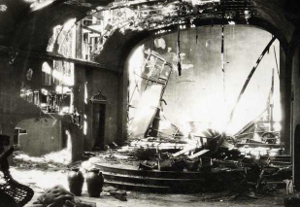
Fire destroys the Abbey Theatre in Dublin on July 17, 1951, with only the Peacock, a small experimental theatre in the ground floor of the main theatre surviving intact. The play earlier in the evening closes with soldiers on stage singing Keep the Home Fires Burning.
In February 1961, the ruins of the Abbey are demolished. The board has plans for rebuilding with a design by the Irish architect Michael Scott. On September 3, 1963, the President of Ireland, Éamon de Valera, lays the foundation stone for the new theatre. The Abbey reopens on July 18, 1966, at its new location at 26 Lower Abbey Street, Dublin 1.
The Abbey Theatre first opens its doors to the public on December 27, 1904. Despite the loss of the original building to the 1951 fire, it has remained active to the present day. The Abbey is the first state-subsidized theatre in the English-speaking world. From 1925 onwards it receives an annual subsidy from the Irish Free State.
In its early years, the theatre is closely associated with the writers of the Irish Literary Revival, many of whom are involved in its founding and most of whom have plays staged there. The Abbey serves as a nursery for many of the leading Irish playwrights and actors of the 20th century, including William Butler Yeats, Lady Gregory, Seán O’Casey, and John Millington Synge. In addition, through its extensive programme of touring abroad and its high visibility to foreign, particularly American, audiences, it has become an important part of the Irish tourist industry.
There are two main motivations for replacing the constitution in 1937. Firstly, the Irish Free State constitution of 1922 is, in the eyes of many, associated with the controversial Anglo-Irish Treaty. The second motive for replacing the original constitution is primarily symbolic. De Valera wants to put an Irish stamp on the institutions of government and chooses to do this in particular through the use of Irish nomenclature.
The framers of the 1937 Constitution decide that it will be enacted not by an elected body but by the people themselves by means of a plebiscite. The preamble to the 1937 Constitution is thus written in the name not of the legislature but of “We, the people of Éire.” On June 2, 1937, the Oireachtas passes the Plebiscite (Draft Constitution) Act 1937, which mandates the holding of a plebiscite on the draft constitution on the same date as the next general election. The Dáil is dissolved on June 14, 1937, as soon as it has approved the draft constitution. The ensuing general election is held on July 1, 1937, and the plebiscite is held in parallel. The question put to voters is simply “Do you approve of the Draft Constitution which is the subject of this plebiscite?” It is passed by a plurality – 56% of voters are in favour, comprising 38.6% of the entire electorate.
Neither the Dáil resolution approving the draft Constitution nor the Plebiscite (Draft Constitution) Act 1937 provide for the plebiscite establish how the Constitution would come into force. It is the Constitution itself which states that this will occur 180 days after its approval, and that the 1922 Constitution will simultaneously be repealed. This happens on December 29, 1937, one hundred eighty days after the July 1 plebiscite.
Consequential acts are passed between July and December to provide for the establishment of, and holding elections for, the new Seanad and the Presidency, as well as for other adaptations. The Presidential Establishment Act, 1938 is passed after the Constitution has come into effect but before the first President, Douglas Hyde, takes office.
Robinson first rises to prominence as an academic, barrister, campaigner, and member of the Irish Senate (1969–1989). Running as an Independent candidate nominated by the Labour Party, the Workers’ Party, and independent senators, Robinson defeats Fianna Fáil‘s Brian Lenihan and Fine Gael‘s Austin Currie in the 1990 presidential election becoming the first elected president in the office’s history not to have had the support of Fianna Fáil.
Robinson is widely regarded as a transformative figure for Ireland, and for the Irish presidency, revitalising and liberalising a previously conservative, low-profile political office. She resigns the presidency two months before the end of her term in office in order to take up her post in the United Nations. During her UN tenure, she visits Tibet in 1998, the first High Commissioner to do so. She criticises Ireland’s immigrant policy and criticises the use of capital punishment in the United States. She extends her intended single four-year term by a year to preside over the World Conference against Racism 2001 in Durban, South Africa. The conference proves controversial, and under continuing pressure from the United States, Robinson resigns her post in September 2002.
After leaving the UN in 2002, Robinson forms Realizing Rights: The Ethical Globalization Initiative, which comes to a planned end at the end of 2010. Its core activities are fostering equitable trade and decent work, promoting the right to health and more humane migration policies, and working to strengthen women’s leadership and encourage corporate social responsibility. The organisation also supports capacity building and good governance in developing countries. Robinson returns to live in Ireland at the end of 2010, and sets up The Mary Robinson Foundation – Climate Justice, which aims to be “a centre for thought leadership, education, and advocacy on the struggle to secure global justice for those many victims of climate change who are usually forgotten – the poor, the disempowered, and the marginalised across the world.”
In July 2009, Robinson is awarded the Presidential Medal of Freedom, the highest civilian honour awarded by the United States. In presenting the award to Robinson, U.S. President Barack Obama says, “Mary Robinson learned early on what it takes to make sure all voices are heard. As a crusader for women and those without a voice in Ireland, Mary Robinson was the first woman elected President of Ireland, before being appointed U.N. High Commissioner for Human Rights. When she traveled abroad as President, she would place a light in her window that would draw people of Irish descent to pass by below. Today, as an advocate for the hungry and the hunted, the forgotten and the ignored, Mary Robinson has not only shone a light on human suffering but illuminated a better future for our world.”