seamus dubhghaill

Promoting Irish Culture and History from Little Rock, Arkansas, USA


Leave a comment

Birth of Father Willie Doyle

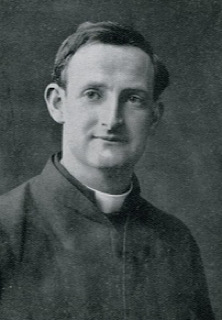
William Joseph Gabriel DoyleSJMC, an Irish Catholic priest, is born in Dalkey, County Dublin, on March 3, 1873. He is killed in action while serving as a military chaplain to the Royal Dublin Fusiliers during the World War I. He is a candidate for sainthood in the Catholic Church.

Doyle is the youngest of seven children of Hugh and Christine Doyle (née Byrne). He is educated at Ratcliffe College, a Catholic boarding school in Leicester, England.

After reading St. Alphonsus‘ book Instructions and Consideration on the Religious State, he is inspired to enter the priesthood. In March 1891, he enters the Society of Jesus (Jesuits) in Ireland. He then enters St. Stanislaus College in Tullabeg, Rahan, County Offaly. Having completed his novitiate, for his regency he is assigned to teach. He teaches at Belvedere College, Dublin, and at Clongowes Wood College, County Kildare, between 1894 and 1898. He then studies philosophy at Collège Saint-Augustin in Enghien, Belgium, and Stonyhurst College, England. From 1904 to 1907, he studies theology at Milltown College and University College Dublin (UCD).

He was ordainedCatholic priest on July 28, 1907. He then undertakes his tertianship at Drongen AbbeyDrongen, Belgium. He takes his final vows on February 2, 1909. From 1909 until 1915 he serves on the Jesuit mission team, traveling around Ireland and Britain preaching parish missions and conducting retreats. In 1914 he is involved in the foundation of a Colettine Poor Clares monastery in Cork, County Cork. He is an early member of the Pioneer Total Abstinence Association and is considered a future leader of the organisation by its founder, Fr. James Cullen.

Doyle volunteers to serve in the Royal Army Chaplains’ Department of the British Army during World War I. He is appointed as a chaplain with the 16th (Irish) Division. He is assigned to the 8th Battalion, Royal Irish Fusiliers, and is posted with them to the Western Front. During the Battle of Loos he is caught in a German gas attack and for his conduct is mentioned in dispatches. A recommendation for a Military Cross is rejected as “he had not been long enough at the front.” He is presented with the “parchment of merit” of the 49th (Irish) Brigade instead. On August 16, 1917, he is killed in action at the Battle of Langemarck “while administering the last rites to his stricken countrymen.”

Doyle is awarded the Military Cross for his bravery during the assault on the village of Ginchy during the Battle of the Somme in 1916. He is also posthumously recommended for both the Victoria Cross and the Distinguished Service Order, but is awarded neither. It is possible that  anti-Catholicism played a role in the British Army’s decision not to grant him both awards.

General William Hickie, the commander-in-chief of the 16th (Irish) Division, describes Father Doyle as “one of the bravest men who fought or served out here.”

Doyle’s body is never recovered but he is commemorated at Tyne Cot Commonwealth War Graves Cemetery and Memorial to the Missing in the Ypres Salient on the Western Front.

Doyle is proposed for canonisation in 1938, but this is not followed through. His papers can be found in the Jesuit archives, Leeson Street, Dublin.

A stained glass window dedicated to Doyle’s memory is present in St. Finnian’s Church, Dromin, County Louth.

Despite his troubled relationship with the Catholic Church in Ireland, Irish author and playwright Brendan Behan is known to have always felt a great admiration for Doyle. He praises Doyle in his 1958 memoir Borstal BoyAlfred O’Rahilly‘s biography of the fallen chaplain is known to have been one of Behan’s favorite books.

Irish folk singer Willie ‘Liam’ Clancy is named after Doyle due to his mother’s fondness for him, although they never meet.

In August 2022, the Father Willie Doyle Association is established to petition the Catholic Church to introduce a cause for canonisation for Doyle. In January 2022, the Supplex Libellus, the formal petition, is presented to Bishop Thomas Deenihan. Having consulted with the Irish Bishops’ Conference and the Dicastery for the Causes of Saints, Deenihan issues an edict on October 27, 2022, announcing the opening of a cause. The Opening Session takes place on November 20, 2022, at the Cathedral of Christ the King, Mullingar.


Leave a comment

Birth of Kevin Myers, Journalist & Writer

Kevin Myers, English-born Irish journalist and writer, is born in Leicester, England on March 30, 1947. He has contributed to the Irish Independent, the Irish edition of The Sunday Times, and The Irish Times‘s column An Irishman’s Diary. He is known for his controversial views on a number of topics, including single mothers, aid for Africa, and the Holocaust.

Myers grows up in England. His father, an Irish GP, dies when he is 15 and away at Ratcliffe College, a Catholic boarding school. His father’s early death creates financial difficulties, though he manages to stay at the school with the help of both the school and the Local Education Authority (LEA). He moves to Ireland to go to university, and graduates from University College Dublin (UCD) in 1969.

Myers subsequently works as a journalist for Irish broadcaster RTÉ, and reports from Northern Ireland during the height of the Troubles. He later works for three of Ireland’s major newspapers, The Irish Times, the Irish Independent, and the Irish edition of The Sunday Times. In 2000, a collection of his An Irishman’s Diary columns is published, with a second volume following in 2007. He is also a presenter of the Challenging Times television quiz show on RTÉ during the 1990s.

In 2001, Myers publishes Banks of Green Willow, a novel, which is met with negative reviews. In 2006, he publishes Watching the Door, about his time as a journalist in Northern Ireland during the 1970s. The book receives positive reviews in The Times, The Guardian, and the New Statesman, while The Independent publishes a more mixed review that wonders whether there is “an element of hyperbole” in Myers’ account.

Myers is a regular contributor to radio programmes on News Talk 106, particularly Lunchtime with Eamon Keane and The Right Hook. He regularly appears on The Last Word on Today FM. He is also a member of the Film Classification Appeals Board, formerly known as the Censorship Board.

Myers is a fervent critic of physical-force Irish republicanism. In 2008, he writes a column condemning the anniversary commemorations of the 1916 Easter Rising. He describes the Larne gun-running by Ulster Volunteers in 1914 as “high treason, done in collaboration with senior figures in the British army and the Conservative Party.” He has also written that it is a “myth” to say, when discussing Irish republicanism and Ulster loyalism, that “one side is as bad as the other.”

In 2005, Myers attracts considerable criticism for his column, An Irishman’s Diary, in which he refers to children of unmarried mothers as “bastards.” Former Minister of State Nuala Fennell describes the column as “particularly sad.” She says the word “bastard” is an example of pejorative language that is totally unacceptable. Myers issues an unconditional apology two days later. The Irish Times editor, Geraldine Kennedy, also apologises for having agreed to publish the article.

In July 2008, Myers writes an article arguing that providing aid to Africa only results in increasing its population, and its problems. This produces strong reactions, with the Immigrant Council of Ireland making an official complaint to the Garda Síochána alleging incitement to hatred. Hans Zomer of Dóchas, an association of NGOs, and another complainant, take a complaint to the Press Council on the grounds that it breaches four principles of the Council’s Code of Practice: accuracy, fairness and honesty, respect for rights, and incitement to hatred.

At the end of July 2017, Myers contributes an article entitled “Sorry, ladies – equal pay has to be earned” to the Irish edition of The Sunday Times about the BBC gender-pay-gap controversy. He further alleges that Claudia Winkleman and Vanessa Feltz are higher paid than other female presenters because they are Jewish. The editor of the Irish edition, Frank Fitzgibbon, issues a statement saying in part “This newspaper abhors anti-Semitism and did not intend to cause offence to Jewish people.” Martin Ivens, editor of The Sunday Times, says the article should not have been published. Ivens and Fitzgibbon apologise for publishing it. After complaints from readers and the Campaign Against Antisemitism, the article is removed from the website. The newspaper announces that Myers will not write for The Sunday Times again. Myers is defended by the chair of the Jewish Representative Council of Ireland, Maurice Cohen, who states, “Branding Kevin Myers as either an antisemite or a Holocaust denier is an absolute distortion of the facts.”

Myers is married to Rachel Nolan and lives in County Kildare. He is the brother-in-law of TV presenter, producer and UK Big Brother housemate Anna Nolan.


Leave a comment

Birth of Actor Patrick Joseph McGoohan

patrick-joseph-mcgoohan

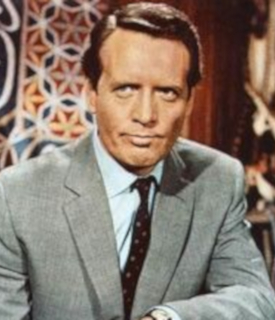
Patrick Joseph McGoohan, American-born actor who is raised in Ireland and Great Britain, is born in Astoria, Queens, New York on March 19, 1928. He establishes an extensive stage and film career.

McGoohan is the son of Rose (Fitzpatrick) and Thomas McGoohan, who are living in the United States after emigrating from Ireland to seek work. He is brought up as a Catholic. Shortly after he is born, his parents move back to Mullaghmore, County Leitrim. Seven years later they emigrate to Sheffield, England.

McGoohan attends St. Vincent’s School and De La Salle College in Sheffield. During World War II, he is evacuated to Loughborough, Leicestershire. There he attends Ratcliffe College, where he excels in mathematics and boxing. He leaves school at the age of 16 and returns to Sheffield, where he works as a chicken farmer, a bank clerk, and a lorry driver before getting a job as a stage manager at Sheffield Repertory Theatre. When one of the actors becomes ill, McGoohan is substituted for him, launching his acting career.

McGoohan is most closely identified with two 1960s British television series, Danger Man and The Prisoner. The espionage drama Danger Man, which runs in the United States as Secret Agent, runs for 86 episodes during 1960–1961 and 1964–1967. The cult hit The Prisoner runs for 17 episodes in 1967–1968.

In Danger Man McGoohan puts a new spin on the secret agent formula by refusing to allow his character, John Drake, to carry a gun or indulge in sexual dalliances. The show’s success makes him Britain’s highest-paid TV actor.

McGoohan is one of several actors considered for the role of James Bond in Dr. No. While McGoohan turns down the role on moral grounds, the success of the Bond films is generally cited as the reason for Danger Man being revived in 1964. He is later considered for the Bond role in Live and Let Die but again turns it down.

The success of Danger Man provides McGoohan the leverage he needs to produce The Prisoner, an allegorical Kafkaesque series in which he portrays Number Six, an unnamed agent, thought by many to represent Drake, who angrily resigns and is then held captive in a superficially banal place called The Village, where the mysterious unseen Number One, the ever-changing Number Two, and others try to overcome the fiercely individualistic Number Six’s escape attempts and pry information from him.

McGoohan’s later works include the short-lived medical mystery series Rafferty (1977), such films as Ice Station Zebra (1968), Escape from Alcatraz (1979), and Braveheart (1995), the Broadway spy drama Pack of Lies (1985), and a record four guest-villain appearances on the American detective series Columbo, two of which earned him Emmy Awards. He also directs and writes several episodes of The Prisoner and Columbo. One of his last roles is as Number Six in a 2000 episode of the animated TV comedy The Simpsons.

Patrick McGoohan dies on January 13, 2009, at Saint John’s Health Center in Santa Monica, California, following a brief illness. His body is cremated.


Leave a comment

Death of Father Willie Doyle

father-willie-doyle

Father Willie Doyle, an Irish Jesuit priest, is killed in action on August 16, 1917, during the World War I.

Born William Joseph Gabriel Doyle in Dalkey, County Dublin, on March 3, 1873, Doyle is the youngest of seven children of Hugh and Christine Byrne Doyle. He is educated at Ratcliffe College, Leicester. After reading St. Alphonsus’ book Instructions and Consideration on the Religious State he is inspired to enter the priesthood and is ordained a Jesuit priest in 1907. He serves for five years on the mission staff.

Doyle serves in the Royal Army Chaplains’ Department of the British Army during World War I, appointed as a chaplain to 48 Brigade of the 16th Irish Division. During the Battle of Loos Doyle is caught in a German gas attack and for his conduct is mentioned in dispatches. A recommendation for a Military Cross is rejected as “he had not been long enough at the front.” Instead, Doyle is presented with the parchment of merit of the 49th Infantry Brigade (Irish). He is killed in the Battle of Langemarck, on August 16, 1917. Father Doyle’s body is never recovered but he is commemorated at Tyne Cot Memorial in Belgium.

General William Bernard Hickie, the commander-in-chief of the 16th Irish Division, describes Doyle as “one of the bravest men who fought or served out here.” Doyle is awarded the Military Cross for his bravery during the assault on the village of Ginchy. He is recommended for a posthumous Victoria Cross and Distinguished Service Order but is awarded neither. Doyle is proposed for canonisation in 1938, but this is not followed through.

A stained-glass window dedicated to his memory is present in St. Finnian’s Church, Dromin, County Louth.