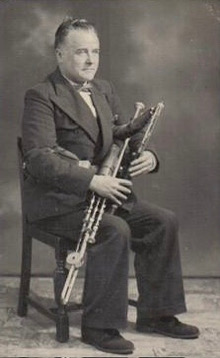
Leo Rowsome, renowned Irish uilleann piper, teacher, and pipe maker, dies on September 20, 1970. He is celebrated for his virtuosity and contributions to Irish traditional music.
Rowsome, born Martin Leo Rowsome on April 5, 1903, in Harold’s Cross, Dublin, is the third son among seven sons and one daughter of William Rowsome, a carpenter, and Bridget Ann Rowsome (née Murphy). He comes from a distinguished line of uilleann pipers. His grandfather, Samuel Rowsome, ensures that his sons receive formal musical training from a German teacher in Ferns, County Wexford. Observing his father’s craftsmanship, he learns the art of pipe making and instrument repair from an early age.
Rowsome’s talent develops rapidly, and by 1919, at the age of sixteen, he is appointed teacher of the uilleann pipes at Dublin’s Municipal School of Music (now Dublin Institute of Technology Conservatory of Music and Drama), a position he holds for fifty years. He also teaches at Dublin’s Pipers’ Club, where he is a founder member and president, contributing to the formation of Comhaltas Ceoltóirí Éireann in 1950.
He is the first uilleann piper to perform on Irish National Radio in the early 1920s, both solo and in duets with other musicians, and later performs with his “All Ireland Trio.” He is a multiple All-Ireland prizewinner in the 1920s and frequently broadcasts lectures on piping, helping preserve and promote traditional Irish music.
Rowsome is also a master pipe maker and reed maker, known for his meticulous craftsmanship and ability to maintain instruments in perfect tune. His workshop in Dublin is a hub of creativity, where he combines traditional knowledge from his father and grandfather with his own innovations. He trains numerous pupils, including notable musicians like Paddy Moloney and Liam O’Flynn, ensuring the continuation of the uilleann piping tradition.
Rowsome dies suddenly while adjudicating The Fiddler of Dooney Competition in Riverstown, County Sligo, on September 20, 1970. To commemorate the centennial of his birth in 2003, his daughter, Helena Grimes, has some of his original manuscripts published by Waltons; “The Leo Rowsome Collection of Irish Music” consists of 428 reels, jigs, airs, and hornpipes.
Rowsome is remembered as a cheerful, patient, and dedicated father, who creates a lively and musical household. His daughter recalls the vibrant atmosphere of his workshop and the care he took in crafting and testing his instruments.
Rowsome’s style is free and flowing, leaving a lasting impact on contemporary Irish music and uilleann piping. He is one of the last of a small group of traditional pipe makers, and his expertise in tuning, reed making, and performance has been widely celebrated. Even decades after his death his name remains synonymous with the uilleann pipes and Irish musical heritage.