Sir Henry Sidney, English soldier, politician and Lord Deputy of Ireland from 1565 to 1571 and from 1575 to 1578, is born on July 20, 1529, probably in London. He cautiously implements Queen Elizabeth I’s policy of imposing English laws and customs on the Irish.
Sidney is the eldest son of Sir William Sidney of Penshurst, England and Anne Pakenham. William Sidney is a prominent politician and courtier during the reigns of Henry VIII and Edward VI, from both of whom he receives extensive grants of land, including the manor of Penshurst in Kent, which becomes the principal residence of the family.
Sidney is brought up at court as the companion of Prince Edward, afterward King Edward VI, and continues to enjoy the favour of the Crown, serving under Mary I of England and then, particularly, throughout the reign of Queen Elizabeth I. He is instrumental in the Elizabethan conquest of Ireland, serving as Lord Deputy three times. His career is controversial both at home and in Ireland.
Appointed Lord Deputy by Elizabeth in 1565, Sidney faces a major rebellion in Ulster led by the powerful chieftain Shane O’Neill. Failing to subdue O’Neill by force, he intrigues against him with his enemies, the O’Donnells of Tyrconnell and the MacDonnells of Antrim. Finally, O’Neill is assassinated by the MacDonnells in 1567. Nevertheless, Sidney is still not strong enough to destroy completely the power of Ulster’s native chieftains. He does, however, persuade a number of Irish chiefs to submit to Elizabeth’s authority, and he establishes English presidents of Munster and Connacht to control the chiefs. In addition, by refraining from introducing anti-Roman Catholic legislation in the Parliament of Ireland of 1569–71, he makes possible the containment and ultimate defeat in 1573 of a rebellion of Munster Catholics led by James FitzMaurice FitzGerald.
Resenting the Queen’s failure to provide him with an adequate military force, Sidney resigns in 1571, but is reappointed Lord Deputy four years later. His arbitrary taxation arouses popular resentment and leads to his recall in 1578. Thereafter he serves only as president of the Council of Wales and the Marches, living chiefly at Ludlow Castle for the remainder of his life, dying there at the age of 56 on May 5, 1586.
The Battle of Glentaisie is fought in the north of Ulster on May 2, 1565. The result is a victory for Shane O’Neill over the Clan MacDonald of Dunnyveg. The conflict is a part of the political and military struggle for control of the north of Ireland, involving the English and occasionally the Scots. Although the MacDonalds are a Scottish family, based principally on the island of Islay in the Hebrides, they have long been associated with the Gaelic polity rather than the Kingdom of Scotland.
O’Neill assembles his army for the attack on the MacDonnells at the tower house of Feadan, at Fathom Mountain, near Newry. Traditionally, he “kept Easter” at Feadan, and an assembly of his clan would be unremarked until its size draws notice.
The MacDonnells expect O’Neill’s sizeable army to take some weeks to reach their territory on the Antrim coast. They start gathering as many warriors in the Highlands and Islands as they can muster. However, O’Neill advances with unprecedented speed. Within a week his army arrives at Edenduffcarrick.
Sorley Boy MacDonnell gathers a small holding force at a forward base at Cloughdonaghy. He attempts to stop O’Neill’s advancing army at Knockboy, a wooded pass in the hills above Broughshane. O’Neill sweeps Sorley’s ambush away, takes Cloughdonaghy and sends a force of cavalry to seize James MacDonald of Dunnyveg’s recently constructed Red Bay Castle. With the landing beaches at Waterfoot and Cushendall now controlled by O’Neill’s army, the first several hundred of MacDonnell’s men are compelled to land farther north. They land at Ballycastle beach to await the locally raised MacDonnnell army. Their plan is to await the arrival of their brother Alexander, the MacDonnell seneschal of Cantyre, who is assembling a second army composed from late comers to James of Dunnyveg’s army.
O’Neill does not permit the MacDonnells any time for their reinforcement to arrive. His advance guard continues to press the retreating MacDonnell army, who fall back from the beach through Ballycastle. They are driven past the area of the modern Diamond and well away from the river Tow, denying them the necessary water supply for a sizeable army.
Both armies set up camp for the night. O’Neill’s army occupies land at the centre of modern Ballycastle, between the modern Diamond and the river Tow, giving them full access to water. The combined MacDonnell army of around five hundred men occupy the exposed higher ground at Ramon, the ridge at the head of modern Castle Street, Ballycastle, where the Presbyterian Church now stands, with only a small well for their needs.
At very first light, O’Neill attacks uphill with a sudden onslaught led by his heavy Gallowglassinfantry. By forgoing the customary exchange of spears, darts, and arrows by the light infantry kernagh and Scots archers that customarily precede the usually decisive deployment of the Gallowglass corrughadh, or battalions, O’Neill surprises the MacDonnell army. The MacDonnell leaders try to rally their men, but after a violent interlude of some confusion, they break and flee over Knocklayd mountain in the direction of Glenshesk, heading back toward the beach at Cushendun. James of Dunnyveg is seriously wounded in the early fighting and his brother Angus MacDonnell is killed.
The attempt to flee by the old mountain road between Greenan and Ballypatrick Forest in an attempt to reach a possible landing place for their birlinns at Cushendun beach is finally stopped at a hollow at Legacapple. Sorley Boy and James are both taken prisoner. James dies of his wounds two months later at Castle Crocke, near Strabane. Their brother Alistair Og MacDonnell had landed at Rathlin, with the final levies raised in the Highlands and Islands, reputed to be nine hundred men. However, in the immediate aftermath of O’Neill’s decisive victory, Alistair can achieve nothing without a base on the mainland. O’Neill marches on along the north coast to mop up the MacDonnell garrisons and deny Alistair any foothold from which to launch a MacDonnell recovery. Dunseverick and Dunluce fall within a few days, and Alistair returns to Scotland.
Brady is born in 1527, but his parentage is uncertain, as are most of the details of his early life. He is said to be a graduate of the University of Oxford and later a professor of divinity there, but there is no evidence of this in the college registers.
Brady’s first patron is Edmund Grindal, Bishop of London, under whose auspices he secures a prestigious appointment to the rectorship of St. Mary Aldermary, London, in early 1561. Over the next two years he becomes acquainted with a relative and chief advisor of Queen Elizabeth I, William Cecil. He is eager to return to Ireland and is appointed Bishop of Meath on October 21, 1563, while still in England. He is ideally qualified for this role, being a native of the diocese and a skilled preacher fluent in English and Irish. Arriving in Dublin on December 3, 1563, he is consecrated on December 19, being made a member of the Privy Council of Ireland soon thereafter.
On reaching his diocese, Brady is dismayed at its dilapidated state. His diocesan income scarcely exceeds £60 a year, many of the churches are in ruins, his clergy are uneducated and largely pro-Catholic, and the right to appoint clergy to many parish churches is in the hands of Catholic landowners. Further, the rival Catholic Bishop of Meath, William Walsh, is dedicated, capable, and popular. Although Walsh is belatedly arrested in 1565, his willingness to lead by example and suffer persecution for his beliefs stiffens Catholic resistance in Meath.
Brady is always diligent in attendance at Council meetings. He is vigorous in beating off raids on his diocese by Shane O’Neill, the effective ruler of Ulster. He enjoys the friendship of Sir Henry Sidney, the Lord Deputy of Ireland, who praises his sound judgment, hospitality and blameless private life. His good qualities lead Sidney and Adam Loftus, Archbishop of Armagh, to propose Brady as Archbishop of Dublin, after they have lobbied successfully for the recall of Archbishop Hugh Curwen. However, soon after, Brady and Loftus quarrel, and Loftus blocks Brady’s nomination in order to obtain the See of Dublin for himself.
Nonetheless, Brady retains Sidney’s confidence and finds a new ally in 1567 when Robert Weston becomes Lord Chancellor of Ireland. Weston sympathises with his educational and evangelical bent while gaining the respect of the querulous Loftus, thereby defusing the animosity between Ireland’s leading Protestant clergy.
In 1569, Brady’s diocese is amalgamated with the diocese of Clonmacnoise. He now heads a sprawling diocese that includes Gaelic areas where the crown has very little authority. In practice, he appears to have largely ignored Clonmacnoise. In Meath, a government inquiry in 1575 shows that he has made little headway in spreading the Protestant faith or in restoring the fabric and finances of the church. He has found clergy for nearly every church in the diocese, but most are of a poor standard. He contributes to the diocese’s worsening finances by alienating church land to family and associates. The free school he establishes is also forced to close due to a lack of suitable premises.
Following Sidney’s dismissal as Lord Deputy of Ireland in 1578, Protestant hard-liners begin to dominate the Irish government, causing Brady to lose influence. He complains in 1581 that his letters to London are being opened and read by his colleagues and sometimes being suppressed. His influence declines in Meath also as discontent with the government increases. In 1577, his men capture a number of friars at Navan but are attacked by locals and forced to free their captives. Thereafter, local officials and landowners routinely defy his authority. His conciliatory policies totally discredited, he stays away from Dublin and resides mainly at his episcopal palace at Ardbraccan.
From 1582 Brady suffers from ill health, forcing him to curtail his preaching. He dies on February 14, 1584, and is buried near the parish church at Dunboyne.
Brady marries twice, but little is known of his first wife. In 1568, following the death of his first wife, he marries Weston’s daughter Alice. They had at least four children, including Luke, their eldest son, and Nicholas, grandfather of his namesake the poet. After Brady’s death, his widow marries Sir Geoffrey Fenton and has further issue, including Catherine, Countess of Cork. The poet Nicholas Brady is the bishop’s great-grandson. Maziere Brady, Lord Chancellor of Ireland, is a nineteenth-century descendant of the bishop.
Shane O’Neill had, in the previous 20 years, eliminated his rivals within the O’Neills and asserted his authority over neighbouring clans (or “septs“) the MacDonnells of Antrim in battle and O’Donnells by kidnapping the O’Donnell leader Calvagh, in Donegal. In 1566, the English Lord Deputy of Ireland, Henry Sidney, gives support to the O’Donnells by ransoming the long tortured Calvagh O’Donnell, against O’Neill who is regarded as a destabilising and anti-English power in the north of Ireland. O’Neill forces out these English troops, but the new O’Donnell chieftain, Hugh O’Donnell, who takes over after the long tortured Calvagh dies, takes the opportunity to assert his independence and raids O’Neill’s lands at Strabane. In response, O’Neill musters his armed forces and marches into O’Donnell territory.
O’Neill crosses into Tir Connell (O’Donnell territory) the traditional way by crossing the River Swilly at an Fearsaid mhór (known as Porterfields today), about 3 km (2 miles) east of the modern town of Letterkenny. O’Donnell has advance warning of this impending incursion so has prepared for the forthcoming attack by dispatching messengers to all his people. Both sides are not equal in size. O’Neills army is estimated at 2,000 men and are composed of cavalry (Nobility), Gallowglass, kearn and a small body of English soldiers who have deserted to him to provide modern weapon skills to his host. O’Donnell’s initial force is only about 40-foot and 80 horse (his personal guard).
O’Donnell’s horsemen harass O’Neill’s men immediately after his fording of the river, leaving O’Donnell a short breathing space to locate his small force in a more defensible position, at Magherennan (near today’s entrance to the Letterkenny Rugby club). When their lord is in position the O’Donnell cavalry withdraws and there O’Donnell awaits his reinforcements. While his opponent waits, O’Neill sets up his camp in Cluain Aire beside the river to cover the ford. When O’Donnell’s troops finally arrive, they number 400 Gallowglass from all the MacSweeney septs. With this virtual parity in the usually decisive heavy infantry, the O’Donnell host proceeds to advance on O’Neill’s camp. When first perceiving their attack, Shane says, “It is very wonderful and amazing to me that those people should not find it easier to make full concessions to us, and submit to our awards, than thus come forward to us to be immediately slaughtered and destroyed.”
This statement, made just as the armies meet, is possibly a late attempt to put heart into his own surprised army. Significantly, the main O’Donnell war host has employed rising ground to successfully cover their advance until it is far too late for O’Neill to deploy his own Gallowglass spars into proper line of battle to hold the enemy while the O’Neill horse mount up. The O’Neill army are caught utterly unprepared, in much the same way as O’Neill himself had taken a MacDonnell host by surprise at Glentaisie in 1565. Despite the element of surprise and O’Neill’s lack of manoeuvre room, the resistance of the surprised O’Neill Gallowglass in this encounter battle is at first successful for the Four Masters state that the action lasted “for a long time.” Eventually, with their loose protective screen of Gallowglass cut down, a panicked rout of Shane’s force ensues. The O’Donnell pressure of attack continues so fiercely that the broken O’Neill host is forced back on the ford and attempts to recross the Swilly. As the tide is now coming in, many of them drown in the speeding rush of waters. O’Neill’s losses are estimated by their enemies at 1,400 men killed and no prisoners are mentioned, although the English sources note a more credible total of 680 dead. With many of his most senior commanders and advisors killed amid the chaos of the first onslaught, O’Neill himself escapes the final slaughter with the timely aid of a party of the Gallaghers. They guide him to Ath an Tairsi (Ford of protection), near Crieve Smith in Oldtown today, where they escort him to his own territory and relative safety.
Many of the Donnelleys, Shane’s foster family and the source of his strongest support, defend him to the last and are decimated at Farsetmore. Abandoned by his tanisté and all of his Urríthe, literally under-kings, and with the destruction of his army, the “most powerful force Gaelic Ireland had yet witnessed,” Shane begins looking for a mercenary force to sustain him until he can make good his losses. With all other options closed, he turns to a warband hired to fight against him the previous winter by William Piers from among the MacDonald’s of Dunnyveg. He arrives at their camp at Cushendun with a small retinue and during their negotiations an altercation occurs, in which Shane is killed. Despite being engineered by Piers, this assassination has gone down in history as retribution for Shane’s military action against the MacDonalds in 1565. Shane is buried in a place called CrossSkern Church at Ballyterrim townland in the hills above Cushendun. Later his remains are exhumed with his head then being sent to Dublin.
(Pictured: An artist’s impression of an O’Donnell gallowglass dispatching an O’Neill kern in the waters of the Swilly, with Glebe Hill in the background, May 8, 1567)
Hugh Roe O’Donnell (Aodh Rua ÓDomhnaill), sixteenth century Irish nobleman also known as Red Hugh O’Donnell, dies at Simancas Castle in Valladolid, Spain, on September 10, 1602. Evidence suggests he might have been poisoned by an English spy.
O’Donnell is born on October 30, 1572, in Lifford (which is in present-day County Donegal) and is the son of Hugh McManus O’Donnell, the Gaelic Lord of Tyrconnell, a territory which takes in most of the present-day county of Donegal except for the Inishowen peninsula. His mother, Aodh MacManus’ second wife, is the formidable and extremely well-connected Scottish lady, Fionnuala Nic Dhomhnaill, known to history as the Iníon Dubh or The Dark Daughter. A daughter of James Mac Donald she had been raised at the Scottish court.
In 1587, at the age of fifteen, O’Donnell marries Rose O’Neill, the daughter of Hugh O’Neill, Earl of Tyrone, a nephew of Turlough Lynagh O’Neill who is recognised by the Irish as The O’Neill. He is, therefore, a bridge between two traditional enemies, the O’Donnell’s and the O’Neills.
The English Lord Deputy of Ireland, Sir John Perrot, recognises the importance of the young O’Donnell prince and decides to secure him as a hostage thus giving him power over the O’Donnell clan and preventing them from forming a treaty with the O’Neills. In 1587, when he is sixteen, O’Donnell and two friends, a MacSweeney and an O’Gallagher, are persuaded to board a ship at Rathmullan which has been disguised as a Spanish wine barque. Once onboard they are carried off to Dublin Castle as prisoners. The O’Donnell’s offer to pay a large ransom and the Iníon Dubh also gives up 25 Spaniards rescued from the Armada. The English agree to this but as soon as the Spaniards are handed over, they are beheaded. The agreement is not kept.
Perrot has his hostage but a most reluctant one. The young man continuously seeks ways to escape. His first opportunity comes at Christmas in 1590 when a rope is smuggled in to the prince. He escapes and flees into the Wicklow Mountains. He seeks shelter with Phelim O’Toole who has him returned to the English as he fears the anger of the infamous Perrot.
A year later, at Christmas in 1591, O’Donnell makes his second attempt at escape, this time by crawling through the Dublin Castle sewers. With him are Henry and Art O’Neill, two sons of Shane O’Neill (Shane the Proud). This time the escapees make their way to the Glenmalure stronghold of Fiach McHugh O’Byrne. Unfortunately, the winter is very severe and Art O’ Neill dies from exposure just as the O’Byrne rescue party finds them. Both Red Hugh and Henry O’Neill suffer severe frostbite but are safely returned to Ulster.
While O’Donnell is held prisoner by the English, his father becomes senile. In 1592, when O’Donnell is sufficiently recovered, he is inaugurated as the O’Donnell and England, for her treachery, has an avowed and implacable enemy.
In 1595 O’Donnell ambushes an English force in the Curlew Mountains, killing 500 of them including their commander. However, the tide is turning against the Irish now. England is flooding the country with armies and many of the leading Gaelic families are beginning to make deals with them.
In 1601 the Spanish land in Kinsale and the English besiege them. O’Neill and O’Donnell march south from Ulster and Ballymote Castle in Sligo in an attempt to break the siege. This turns into a debacle causing the Irish to scatter and the Spanish to surrender. O’Neill marches back north and O’Donnell is sent to Spain to ask for more troops from Phillip III. In Spain, he is treated like a royal. He petitions aid from the King who gives him a promise of another Spanish force.
It is, however, unlikely that O’Donnell is poisoned. A more probable cause of death is the tapeworm that Simancas documents of the time state to be the cause of his demise. His Last Will and Testament, written in his dying moments with his loyal retinue, is an extremely evocative and moving document. One original is preserved in Simancas and the other in the Chancellery archive in Valladolid.
O’Donnell is buried in the chapter of the Franciscanmonastery in Valladolid. Though the building is demolished in 1837, the exact location of the tomb may have been discovered following a Spanish archaeological dig in May 2020.
O’Donnell is succeeded as chieftain of his clan and prince of Tyrconnell by his brother Rory.
(Pictured: Statue of Gaelic Chieftain Red Hugh O’Donnell in County Donegal)
By 1590 English rule is, with the exception of Ulster, firmly secured throughout Ireland. The CatholicGaels and Old English of Munster, Leinster, and Connacht have been more or less brought to heel, and Presidencies are established over each of them.
English law is dominant, and Protestant English planters are laying claim to the lands seized from the Catholics. The present-day counties are already taking shape, land divisions modeled on the shires of Great Britain. Queen Elizabeth I feels that the time is right to bolster up English civility and in 1592 she grants the city of Dublin a charter to establish a university.
The university is to be named The College of the Holy and Undivided Trinity of Queen Elizabeth, juxta Dublin. It has been commonly called Trinity College Dublin ever since.
The lands and buildings of the college are donated by the city corporation and are originally those of the Augustinian All Hallows Priory which had been suppressed in 1583. This property is situated about half a mile from the city walls.
In Dublin Loftus is appointed the dean of St. Patrick’s Cathedral and in 1567 he is appointed to the See of Dublin. He has opposition from the Lord Deputy of Ireland Sir John Perrot who had sought to have the university put to St. Patrick’s Cathedral. However, at this time Perrot is under suspicion for having verbally abused her majesty’s legitimacy and is to die in the Tower of London in September 1592.
Within two years of its foundation, Trinity College, consisting of a small square, is up and running with some fellows and a handful of students. Its raison d’etre is to provide a Protestant education and to consolidate the Tudor monarchy. Catholics and Dissenting Christians are not permitted entrance unless they convert to the Anglican faith. Those who do attend are the children of the New English and the children of Old English and native Irish who have abandoned their ancestors’ faith, for reasons of dogma or, as is more likely, in order to retain their lands and wealth.
Trinity is, over the next three centuries, to grow into a wealthy establishment. It receives appropriated properties and has annuities paid in from the government. In later years it is to be the the alma mater of many famous men. Sons of the Protestant Ascendency consider it their own during the 17th and 18th centuries but in the 20th century Trinity manages to adapt to the new Irish state with which it is fully involved in all aspects of Irish education and Irish life, and it is much loved by the Irish people.
(From: “The Founding of Trinity College Dublin 1592,” YourIrishCulture, http://www.yourirish.com)
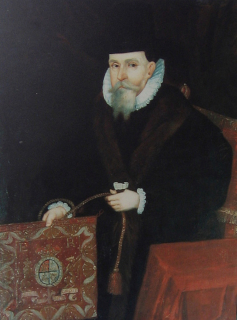
Loftus is born in 1533, the second son of a monastic bailiff, Edward Loftus, in the heart of the English Yorkshire Dales. He embraces the Protestant faith early in his development. He is an undergraduate at Trinity College, Cambridge, where he reportedly attracts the notice of the young Queen Elizabeth, as much by his physique as through the power of his intellect. Although this encounter may never have happened, Loftus certainly meets with the Queen more than once, and she becomes his patron for the rest of her reign. At Cambridge Loftus takes holy orders as a Catholic priest and is appointed rector of Outwell St. Clement in Norfolk. He comes to the attention of the Catholic Queen Mary, who names him vicar of Gedney, Lincolnshire. On Elizabeth’s accession in 1558 he declares himself Anglican.
Loftus makes the acquaintance of the Queen’s favourite Thomas Radclyffe, 3rd Earl of Sussex and serves as his chaplain in Ireland in 1560. In 1561 he becomes chaplain to Alexander Craike, Bishop of Kildare and Dean of St. Patrick’s Cathedral in Dublin. Later that year he is appointed rector of Painstown in Meath and evidently earns a reputation as a learned and discreet advisor to the English authorities in Dublin. In 1563, he is consecrated Archbishop of Armagh at the unprecedented age of 28 by Hugh Curwen, Archbishop of Dublin.
Following a clash with Shane O’Neill, the real power in Ulster during these years, he comes to Dublin in 1564. To supplement the meager income of his troubled archbishopric he is temporarily appointed to the Deanery of St. Patrick’s Cathedral by the queen in the following year. He is also appointed president of the new commission for ecclesiastical causes. This leads to a serious quarrel with the highly respected Bishop of Meath, Hugh Brady.
In 1567 Loftus, having lobbied successfully for the removal of Hugh Curwen, who becomes Bishop of Oxford, and having defeated the rival claims of the Bishop of Meath, is appointed Archbishop of Dublin, where the queen expects him to carry out reforms in the Church. On several occasions he temporarily carries out the functions of Lord Keeper of the Great Seal, and in August 1581 he is appointed Lord Chancellor of Ireland after an involved dispute with Nicholas White, Master of the Rolls in Ireland. He is constantly occupied in attempts to improve his financial position by obtaining additional preferment and is subject to repeated accusations of corruption in public office.
In 1582 Loftus acquires land and builds a castle at Rathfarnham, which he inhabits from 1585. In 1569–1570 the divisions in Irish politics take on a religious tinge with the First Desmond Rebellion in Munster and Pope Pius V‘s 1570 papal bullRegnans in Excelsis. The bull questions Elizabeth’s authority and thereafter Roman Catholics are suspected of disloyalty by the official class unless they are discreet.
Loftus takes a leading part in the execution of Dermot O’Hurley, Archbishop of Cashel. When O’Hurley refuses to give information, Francis Walsingham suggests he should be tortured. Although the Irish judges repeatedly decide that there is no case against O’Hurley, on June 19, 1584, Loftus and Sir Henry Wallop write to Walsingham “We gave warrant to the knight-marshal to do execution upon him, which accordingly was performed, and thereby the realm rid of a most pestilent member.”
Between 1584 and 1591 Loftus has a series of clashes with Sir John Perrot on the location of an Irish University. Perrot wants to use St. Patrick’s Cathedral, Dublin as the site of the new University, which Loftus seeks to preserve as the principal place of Protestant worship in Dublin, as well as a valuable source of income for himself. The archbishop wins the argument with the help of his patron, Queen Elizabeth I, and Trinity College, Dublin is founded at its current location, named after his old college at Cambridge, leaving the Cathedral unaffected. Loftus is named as its first Provost in 1593.
The issue of religious and political rivalry continues during the two Desmond Rebellions (1569–83) and the Nine Years’ War (1594–1603), both of which overlap with the Anglo-Spanish War (1585–1604), during which some rebellious Irish nobles are helped by the Papacy and by Elizabeth’s arch-enemy Philip II of Spain. Due to the unsettled state of the country Protestantism makes little progress, unlike in Celtic Scotland and Wales at that time. It comes to be associated with military conquest and is therefore hated by many. The political-religious overlap is personified by Loftus, who serves as Archbishop and as Lord Chancellor of Ireland. An unlikely alliance forms between Gaelic Irish families and the Norman “Old English“, who had been enemies for centuries but who now mostly remain Roman Catholic.
Adam Loftus dies in Dublin on April 5, 1605, and is interred in the building he had helped to preserve for future generations, while many of his portraits hang today within the walls of the University which he helped found. Having buried his wife Jane (Purdon) and two sons (of their 20 children) in the family vault at St. Patrick’s, Loftus dies at his Episcopal Palace in Kevin Street “worn out with age” and joins his family in the same vault. His zeal and efficiency are commended by James I upon the king’s accession.
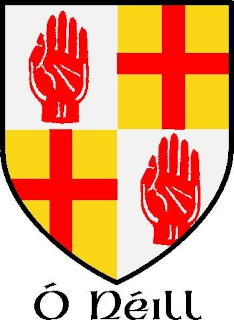
O’Neill, the eldest legitimate son of Conn O’Neill, 1st Earl of Tyrone, is a chieftain whose support the English consider worth gaining. However, he rejects overtures from Thomas Radclyffe, 3rd Earl of Sussex, the Lord Deputy of Ireland, and refuses to help the English against the Scottish settlers on the coast of Antrim. He allies himself instead with the MacDonnells, the most powerful of these immigrants. Nevertheless, Queen Elizabeth I of England is disposed to come to terms with O’Neill who, after his father’s death, is de facto chief of the O’Neill clan. She recognizes his claims to the chieftainship, thus throwing over a kinsman, Brian O’Neill. O’Neill, however, refuses to put himself in the power of Sussex without a guarantee for his safety and his claims are so exacting that Elizabeth determines to restore Brian. An attempt to incite the O’Donnells against him, however, is frustrated.
Elizabeth, who is not prepared to undertake the subjugation of the Irish chieftain, urgently desires peace with O’Neill, especially when the devastation of his territory by Sussex brings him no nearer to submission. Sussex is not supported by the queen, who sends Gerald FitzGerald, 11th Earl of Kildare to arrange terms with O’Neill. The latter agrees to present himself before Elizabeth. Accompanied by Thomas Butler, 10th Earl of Ormond and Kildare, he reaches London on January 4, 1562. Elizabeth temporizes but, finding that O’Neill is in danger of becoming a tool in the hands of Spanish intriguers, permits him to return to Ireland, recognizing him as “the O’Neill,” and chieftain of Tyrone.
There are at this time three powerful contemporary members of the O’Neill family in Ireland — O’Neill, Turlough Lynagh O’Neill, and Matthew Ó Néill, 1st Baron Dungannon. Turlough had schemed to supplant O’Neill during his absence in London. The feud does not long survive O’Neill’s return to Ireland, where he reestablishes his authority and renews his turbulent tribal warfare. Elizabeth at last authorizes Sussex to take the field against O’Neill, but two expeditions fail. O’Neill then lays the entire blame for his lawless conduct on the lord deputy’s repeated alleged attempts on his life. Elizabeth consents to negotiate, and practically all of O’Neill’s demands are conceded.
O’Neill then turns his hand against the MacDonnells, claiming that he is serving the Queen of England in harrying the Scots. He fights an indecisive battle with Sorley Boy MacDonnell near Coleraine in 1564, and in 1565 he routs the MacDonnells and takes Sorley Boy prisoner near Ballycastle. This victory strengthens O’Neill’s position, but the English make preparations for his subjugation.
Failing in an attempt to arrange terms, and also in obtaining the help which he solicited from France, O’Neill is utterly routed by the O’Donnells at the Battle of Farsetmore near Letterkenny and, seeking safety in flight, throws himself on the mercy of his enemies, the MacDonnells. Attended by a small body of gallowglass, and taking his prisoner Sorley Boy with him, he presents himself among the MacDonnells near Cushendun, on the Antrim coast, hoping to propose an alliance. Here, on June 2, 1567, he is killed by the MacDonnells and his headless body is buried at Crosskern Church at Ballyterrim above Cushendun. His body is possibly later moved to Glenarm Abbey. Unbeknownst to O’Neill, The Scots had already come to an agreement with Henry Sidney and William Piers, Seneschal of Clandeboye, commander of the English garrison at Carrickfergus. The English Government tries to pass this off as a “drunken brawl” turned savage. Piers travels to Cushendun to take O’Neill’s head and send it to Dublin Castle.





 seamus dubhghaill