seamus dubhghaill

Promoting Irish Culture and History from Little Rock, Arkansas, USA


Leave a comment

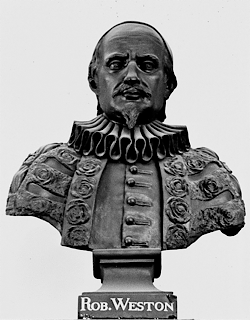
Death of Robert Weston, Civil Lawyer & Lord Chancellor of Ireland

Robert Weston of Lichfield, Staffordshire, England, an English civil lawyer, who is Dean of the Arches and Lord Chancellor of Ireland in the time of Queen Elizabeth I, dies in Ireland on May 20, 1573.

Weston is born in Hampshire, England, in 1515, the third son of John Weston, of Weeford, Staffordshire, and Cecilia Neville, daughter of Ralph Neville, 3rd Earl of Westmorland, and sister of Ralph Neville, 4th Earl of Westmorland. His nephew is Knight Simon Weston, son of his brother James Weston, MP for Lichfield.

The Weston family of Gloucestershire, who produce another senior Irish judge in William Weston, are probably cousins of Robert. He enters All Souls College, Oxford and is elected Fellow in 1536. He studies Civil Law and attains the degree of Bachelor of Civil Law (BCL) on February 17, 1538 and Doctor of Civil Law (DCL) on July 20, 1556. 

From 1546 to 1549, Weston is a principal of Broadgates Hall (afterwards Pembroke College), and at the same time deputy reader in civil law at the university, under Dr. John Story. He is not a clergyman, and his later appointment to two lucrative deaneries greatly troubles his conscience.

Weston is elected Member of Parliament for Exeter in March 1553 and for Lichfield in 1558 and 1559.

On January 12, 1559, Weston is created Dean of the Arches and is a commissioner for administering the oaths required of ecclesiastics under the Act of Uniformity 1558. He is consulted in regard to the Queen’s Commission issued on December 6, 1559, for confirming Matthew Parker as Archbishop of Canterbury and is included in a commission issued on November 8, 1564, to inquire into complaints of piratical depredations committed at sea on the subjects of the King of Spain.

The Lord Deputy of Ireland, Sir Henry Sidney, requests that Weston be nominated for the post of Lord Chancellor of Ireland in succession to Hugh CurwenArchbishop of Dublin, in April 1566. After a year, on June 10, 1567, Queen Elizabeth I tells Sidney that after good deliberation she has made the “choice for the supply of room of Chancellor by naming thereunnto our trusty well-beloved Doctor Weston, dean of the arches here, a man for his learning and approved integrity thoroughly qualified to receive and possess the same” and “that for some increase of his living whilst he remaineth in our service there she was pleased to give unto him the Deanery of St. Patrick’s, whereof the Bishop of ArmaghAdam Loftus, is now dean and yet to leave it at our order, as we know he will.”

Weston arrives in Dublin early in August and is sworn into office on August 8, 1567. He is conscientious in performing his duties, and greatly respected for his integrity, although ill-health (he is plagued by gout and gallstones) hampers his effectiveness. He is appalled by the laziness and inefficiency of many of the Irish judges and urges Elizabeth I to replace them with Englishmen wherever possible. He is equally shocked at the poverty and ignorance of many of the Protestant clergy in Ireland. His zeal for reform leads him, though a layman, to become an effective leader of the Church of Ireland for a few years. He cooperates with Adam Loftus, now Archbishop of Dublin, in purging the Archdiocese of Dublin of crypto-Catholics, but is opposed to the persecution of the Roman Catholic majority, or any efforts to forcibly convert them.

Weston and Sir William FitzWilliam, the Vice-Treasurer of Ireland, are sworn Lords Justices in Christ Church Cathedral, Dublin on October 14, and he becomes a member of the Privy Council of Ireland. He addresses the Irish Parliament when it is summoned on January 17, 1568. In addition to being Dean of St. Patrick’s, he is Dean of Wells from 1570 to 1573, but his health is failing.

Weston dies on May 20, 1573, and is buried beneath the altar in St. Patrick’s Cathedral, Dublin, “leaving behind him an excellent character for uprightness, judgment, learning, courtesy, and piety.”

Weston marries Alice Jenyngs, daughter of Richard Jenyngs of Great Barr, Staffordshire. They have a son, John, and three daughters, of whom most of known of Alice, who marries firstly Hugh BradyBishop of Meath, by whom she has numerous children including Luke and Nicholas, and secondly Sir Geoffrey Fenton, by whom she is the mother of Catherine, who marries Richard Boyle, 1st Earl of Cork, and of Sir William Fenton.

Weston is the 7th great-grandfather of the American firearms industrialist Daniel B. Wesson, who cofounds Smith & Wesson with Horace Smith. Hus great-grandson, John Wesson, immigrates to the Massachusetts Bay Colony around 1644 and settles in Reading, Massachusetts.


3 Comments

Hugh Brady Appointed Church of Ireland Bishop of Meath

Hugh Brady, a native of Trim, County Meath, is appointed Church of Ireland Bishop of Meath on October 21, 1563. He serves in this position until his death on February 14, 1584.

Brady is born in 1527, but his parentage is uncertain, as are most of the details of his early life. He is said to be a graduate of the University of Oxford and later a professor of divinity there, but there is no evidence of this in the college registers.

Brady’s first patron is Edmund Grindal, Bishop of London, under whose auspices he secures a prestigious appointment to the rectorship of St. Mary Aldermary, London, in early 1561. Over the next two years he becomes acquainted with a relative and chief advisor of Queen Elizabeth I, William Cecil. He is eager to return to Ireland and is appointed Bishop of Meath on October 21, 1563, while still in England. He is ideally qualified for this role, being a native of the diocese and a skilled preacher fluent in English and Irish. Arriving in Dublin on December 3, 1563, he is consecrated on December 19, being made a member of the Privy Council of Ireland soon thereafter.

On reaching his diocese, Brady is dismayed at its dilapidated state. His diocesan income scarcely exceeds £60 a year, many of the churches are in ruins, his clergy are uneducated and largely pro-Catholic, and the right to appoint clergy to many parish churches is in the hands of Catholic landowners. Further, the rival Catholic Bishop of Meath, William Walsh, is dedicated, capable, and popular. Although Walsh is belatedly arrested in 1565, his willingness to lead by example and suffer persecution for his beliefs stiffens Catholic resistance in Meath.

Brady is always diligent in attendance at Council meetings. He is vigorous in beating off raids on his diocese by Shane O’Neill, the effective ruler of Ulster. He enjoys the friendship of Sir Henry Sidney, the Lord Deputy of Ireland, who praises his sound judgment, hospitality and blameless private life. His good qualities lead Sidney and Adam Loftus, Archbishop of Armagh, to propose Brady as Archbishop of Dublin, after they have lobbied successfully for the recall of Archbishop Hugh Curwen. However, soon after, Brady and Loftus quarrel, and Loftus blocks Brady’s nomination in order to obtain the See of Dublin for himself.

Nonetheless, Brady retains Sidney’s confidence and finds a new ally in 1567 when Robert Weston becomes Lord Chancellor of Ireland. Weston sympathises with his educational and evangelical bent while gaining the respect of the querulous Loftus, thereby defusing the animosity between Ireland’s leading Protestant clergy.

In 1569, Brady’s diocese is amalgamated with the diocese of Clonmacnoise. He now heads a sprawling diocese that includes Gaelic areas where the crown has very little authority. In practice, he appears to have largely ignored Clonmacnoise. In Meath, a government inquiry in 1575 shows that he has made little headway in spreading the Protestant faith or in restoring the fabric and finances of the church. He has found clergy for nearly every church in the diocese, but most are of a poor standard. He contributes to the diocese’s worsening finances by alienating church land to family and associates. The free school he establishes is also forced to close due to a lack of suitable premises.

Following Sidney’s dismissal as Lord Deputy of Ireland in 1578, Protestant hard-liners begin to dominate the Irish government, causing Brady to lose influence. He complains in 1581 that his letters to London are being opened and read by his colleagues and sometimes being suppressed. His influence declines in Meath also as discontent with the government increases. In 1577, his men capture a number of friars at Navan but are attacked by locals and forced to free their captives. Thereafter, local officials and landowners routinely defy his authority. His conciliatory policies totally discredited, he stays away from Dublin and resides mainly at his episcopal palace at Ardbraccan.

From 1582 Brady suffers from ill health, forcing him to curtail his preaching. He dies on February 14, 1584, and is buried near the parish church at Dunboyne.

Brady marries twice, but little is known of his first wife. In 1568, following the death of his first wife, he marries Weston’s daughter Alice. They had at least four children, including Luke, their eldest son, and Nicholas, grandfather of his namesake the poet. After Brady’s death, his widow marries Sir Geoffrey Fenton and has further issue, including Catherine, Countess of Cork. The poet Nicholas Brady is the bishop’s great-grandson. Maziere Brady, Lord Chancellor of Ireland, is a nineteenth-century descendant of the bishop.


Leave a comment

Birth of Sir Maziere Brady, 1st Baronet & Lord Chancellor of Ireland

Sir Maziere Brady, 1st Baronet, PC (Ire), Irish judge, notable for his exceptionally long, though not particularly distinguished tenure as Lord Chancellor of Ireland, is born on July 20, 1796.

Brady is born on Parliament Street, Dublin, the second son of Francis Tempest Brady of Booterstown, a manufacturer of gold and silver thread, and his wife Charlotte Hodgson, daughter of William Hodgson of Castledawson, County Londonderry. He is baptised at St. Werburgh’s Church, Dublin. He is the brother of Sir Nicholas Brady, Lord Mayor of Dublin, and uncle of the eminent ecclesiastical historian William Maziere Brady.

The Bradys are an old and distinguished Munster family who are particularly associated with the town of Bandon, County Cork. Probably the most celebrated of his ancestors is the poet and psalmist Nicholas Brady (1659–1726), who collaborated with Nahum Tate, the Poet Laureate, on New Version of the Psalms of David.

Other notable forebears include Hugh Brady, the first Protestant Bishop of Meath (d. 1584), his father-in-law Robert Weston who, like Maziere serves as Lord Chancellor of Ireland, and the judge and author Luke Gernon (d. 1672), who is now best remembered for his work A Discourse of Ireland (1620), which gives a detailed and (from the English colonial point of view) not unsympathetic picture of the state of Ireland in 1620.

Brady is educated at Trinity College Dublin and takes his Bachelor of Arts degree in 1816. He enters the Middle Temple in 1816, is called to the Bar in 1819 and becomes King’s Counsel in 1835.

In politics Brady is a Liberal and supports Catholic emancipation. He sits on a commission of inquiry into Irish municipal corporations in 1833. He is appointed Solicitor-General for Ireland in 1837 and Attorney-General for Ireland the following year. In 1840 he is appointed Lord Chief Baron of the Irish Exchequer. In 1846 he is appointed Lord Chancellor of Ireland and serves in that office, with short intervals, for the next 20 years. He retires in 1866 and is made a baronet, of Hazelbrook in the County of Dublin, in 1869. His appointment ends the practice which grew after the Acts of Union 1800 of appointing only English lawyers as Lord Chancellor of Ireland. He sits on the Government Commission on Trinity College Dublin in 1851 and is nominated as Vice-Chancellor of Queen’s University Belfast in 1850. All through his life he shows a keen interest in education.

According to Elrington Ball, Brady’s Lord Chancellorship is notable for its length but for nothing else. Ball calls him “a good Chief Baron spoiled to make a bad Chancellor.” By general agreement he had been an excellent Chief Baron of the Exchequer, having a reputation for being fair-minded, courteous and approachable, but in Ball’s view the more onerous (and partly political) office of Lord Chancellor is beyond his capacity. Unlike some judges whose training had been in the common law, he never quite masters the separate code of equity. Delaney takes a somewhat more favourable view of Brady as Lord Chancellor, arguing that while his judgements do not show any great depth of learning they do show an ability to identify the central issue of any case and to apply the correct legal principle to it.

An anonymous pamphlet from 1850, which is highly critical of the Irish judiciary in general, describes Brady as being unable to keep order in his Court, and easily intimidated by counsel, especially by that formidable trio of future judges, Jonathan Christian, Francis Alexander FitzGerald, and Abraham Brewster. The author paints an unflattering picture of Brady as sitting “baffled and bewildered” in a Court where he is “a judge but not an authority.” On the other hand, Jonathan Christian, who had often clashed with Brady in Court, later praises him as “no ordinary man” despite his shortcomings as a judge. He describes him as “independent-minded, patriotic, natural and unaffected.”

Brady is a founder member of the Stephen’s Green Club and a member of the Royal Dublin Society and the Royal Irish Academy. In addition to the arts, he shows a keen interest in science, especially after his retirement. Like most judges of the time, he has both a town house in central Dublin and a place some distance from the city centre. His country house is Hazelbrook, Terenure, Dublin. He changes his town house several times, settling finally in Pembroke Street.

Brady marries firstly Elizabeth Anne Buchanan, daughter of Bever Buchanan, apothecary of Dublin, and his wife Eleanor Hodgson, in 1823 and they have five children. Elizabeth dies in 1858. In 1860, Brady marries Mary Hatchell, daughter of John Hatchell, Attorney-General for Ireland and Elizabeth Waddy, who survives him. He dies at his house in Pembroke Street on April 13, 1871. He is buried in Mount Jerome Cemetery.