seamus dubhghaill

Promoting Irish Culture and History from Little Rock, Arkansas, USA


1 Comment

6th Louisiana Infantry Regiment Organized into Confederate Service

A lesser-known Irish Brigade of the American Civil War, the 6th Louisiana Infantry Regiment, is mustered into Confederate service at Camp Moore on June 4, 1861. It is part of the Louisiana Tigers. At a time when an estimated 20,000 Irish live in New Orleans, it is not surprising that the 6th Louisiana comprises a high percentage of Irish soldiers. It begins its service with 916 men and ends with 52 after surrendering after the Battle of Appomattox Court House in April 1865.

The regiment’s 916 men are organized into 10 companies designated with the letters A–I and K. Most of the companies are organized in Orleans Parish, although Company D is from Tensas Parish, Company C from St. Landry Parish, and Company A from Union Parish and Sabine Parish. The unit’s first colonel is Isaac Seymour, its first lieutenant colonel is Louis Lay, and its first major is Samuel L. James. Over half of the unit’s men with known places of birth are born outside of the United States, primarily from Ireland. In its early days, the unit has a reputation for being disorderly and hard to control. Seymour has to publicly rebuke several officers in late 1861 for drunkenness.

Sent to the fighting in Virginia and stationed at Centreville, the regiment guards supplies and is not involved in the First Battle of Bull Run on July 21, 1861. In August, it is added to a brigade commanded by William H. T. Walker consisting of the 7th Louisiana Infantry Regiment, the 8th Louisiana Infantry Regiment, the 9th Louisiana Infantry Regiment, and the 1st Louisiana Special Battalion. The brigade spends the next winter in the vicinity of Centreville, and Orange Court House before being transferred to the Shenandoah Valley in early 1862, where it fights under Stonewall Jackson. James resigns on December 1, 1861, and is replaced by George W. Christy, who is dropped from the regiment’s rolls on May 9, 1862, and replaced with Arthur MacArthur. Lay resigns on February 13 and is replaced by Henry B. Strong.

On May 23, 1862, the regiment sees action in the Battle of Front Royal and captures two Union battle flags in a skirmish at Middletown the next day. May 25 sees the regiment engage in the First Battle of Winchester, where MacArthur is killed, and on June 9 it fights in the Battle of Port Republic, in which 66 of its men are killed or wounded. MacArthur’s role as major is then filled by Nathaniel G. Offutt. After Port Republic, Jackson’s men are transferred to the Virginia Peninsula to take part in the Seven Days Battles, and the 6th Louisiana skirmishes at Hundley’s Corner on June 26 before fighting in the Battle of Gaines’ Mill the next day. Seymour leads the brigade at Gaines’ Mill, since Richard Taylor is ill. The Louisianans, known as the Louisiana Tigers, become bogged down in Boatswain’s Swamp, are repulsed with loss, and withdraw from the battle. Seymour is killed during the charge and is replaced by Strong. Offutt takes over Strong’s position as lieutenant colonel, and William Monaghan becomes colonel.

Moving north with Jackson in August, the regiment fights in the Manassas Station Operations at Bristoe Station, Virginia on August 26 and Kettle Run, Virginia the following day. At Kettle Run, the regiment holds off a Union advance while the 8th Louisiana burns a bridge, and then the two regiments, joined by the 60th Georgia Infantry Regiment and the 5th Louisiana Infantry Regiment, fight against the Union Army‘s Excelsior Brigade and the brigade of Colonel Joseph Bradford Carr. It then fights in the Second Battle of Bull Run on August 29-30, 1862. At Second Bull Run, it is part of the brigade of Colonel Henry Forno. On the first day of the battle, Forno’s brigade helps repulse James Nagle‘s Union brigade. On the morning on 30 August 30, it is sent to the rear for supplies and does not rejoin the fighting that day.

After Second Bull Run, the 6th Louisiana fights in the Battle of Chantilly on September 1, 1862, where the Louisiana brigade is routed with the 5th, 6th, 8th, and 14th Louisiana regiments suffering the heaviest casualties in the Confederate army, and on September 17 sees action in the Battle of Antietam. At Antietam, the regiment is part of Harry T. Hays‘s brigade. During the fighting, Hays’s brigade charges toward the Miller’s Cornfield and is cut to pieces, with the brigade suffering 61 percent casualties. The 6th Louisiana loses 52 men killed or wounded, including Colonel Strong, who is killed and replaced with Offutt. All 12 officers of the 6th Louisiana that see action at Antietam are killed or wounded. Monaghan becomes lieutenant colonel and is replaced as major by Joseph Hanlon. Offutt in turn resigns on November 7 and is replaced by Monaghan. Hanlon becomes lieutenant colonel, and Manning is promoted to major. The regiment is held in reserve at the Battle of Fredericksburg on December 13, 1862, and is not directly engaged, although it does come under Union artillery fire.

An inspection in January 1863 rates the 6th Louisiana as having “poor” discipline and moderately good at performance in drills. Along with the 5th Louisiana Infantry, the regiment contests a Union crossing of the Rappahannock River on April 29, 1863. Union troops are able to force a crossing, and the 6th Louisiana has 7 men killed, 12 wounded, and 78 captured. It then fights in the Second Battle of Fredericksburg on May 3, 1863, where 27 of the unit’s men are captured. While part of the regiment is captured, most of the unit is able to withdraw from the field in better condition than the other Confederate units positioned near it. It then fights at the Battle of Salem Church the next day. Altogether, the 6th Louisiana Infantry sustains losses of 14 killed, 68 wounded, and 99 captured at the Battle of Chancellorsville. It next sees combat on June 14, 1863, in the Second Battle of Winchester, where it joins its brigade of other Louisiana units in capturing a Union fort.,

At the Battle of Gettysburg on July 1-3, 1863, the 6th Louisiana is still in Hays’ brigade. On July 1, the brigade is part of a Confederate charge that sweeps the Union XI Corps from the field, although it is less heavily engaged than some of the other participating Confederate brigades. Entering the town of Gettysburg, the brigade captures large numbers of disorganized Union troops. On the evening of the following day, the brigade is part of a failed attack against the Union position on Cemetery Hill. It then spends July 3, the final day of the battle, skirmishing. The Confederates, who are defeated at Gettysburg, withdraw from the field on July 4. The regiment takes 232 men into the fighting at Gettysburg and suffers 61 casualties.

Back in Virginia, the 6th Louisiana fights in the Bristoe campaign in October 1863 and is overrun in the Second Battle of Rappahannock Station on November 7, losing 89 men captured. In the spring of 1864, it fights in Ulysses S. Grant‘s Overland Campaign. On May 5, 1864, in the Battle of the Wilderness, the regiment helps repulse a Union attack, after Hays’ brigade had been repulsed and badly bloodied earlier in the battle. It then fights in the Battle of Spotsylvania Court House on May 9-19, 1864. On May 12, the regiment is part of its brigade’s fighting at the Mule Shoe. The brigade is badly wrecked at the Mule Shoe, and only 60 men are present at the 6th Louisiana’s roll call the next morning. From June through October, it is detached as part of Jubal Early‘s command to fight in the Valley campaigns of 1864. Monaghan is killed in battle in late August and is not replaced as colonel. At the Battle of Cedar Creek in October 1864, one company of the 6th Louisiana sees both men present shot. After the battle, the 5th, 6th, and 7th are consolidated into a single company when the brigade is reorganized due to severe losses. Taking part in the Siege of Petersburg, the 6th Louisiana’s survivors fight at the Battle of Hatcher’s Run on February 6, 1865, and at the Battle of Fort Stedman on March 25.

The 6th Louisiana’s remnants end their military service when Robert E. Lee‘s Confederate army surrenders on April 9, after the Battle of Appomattox Court House. At the time of the surrender, the 6th Louisiana has been reduced to 52 officers and men. Over the course of its existence, 1,146 men serve in the unit. Of that total, 219 are combat deaths, 104 die of disease, one man drowns, five die accidentally, one man is executed, and at least 232 desert. Desertions are particularly heavy in three companies that primary consist of men born outside of the United States.

(Pictured: National colors of the “Orleans Rifles” or Company H, Sixth Louisiana Infantry Regiment during the American Civil War)
Leave a comment

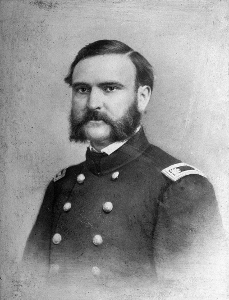
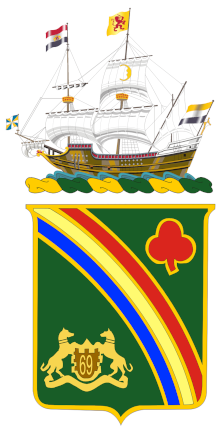
Irish 69th New York Infantry Regiment Fights at the First Battle of Bull Run

On July 21, 1861, at the First Battle of Bull Run, the first major engagement of the American Civil War, the Irish 69th New York Infantry Regiment fights under the green flag of Erin and the Stars and Stripes for the first time. The unit is in a brigade commanded by Col. William Tecumseh Sherman, whose name is now one of the most well-known of the war. He is not, however, well loved by the 69th New York.

The battle, called the Battle of First Manassas by the Confederate State Army, is fought in Prince William County, Virginia, just north of the city of Manassas and about thirty miles west-southwest of Washington, D.C. The Union Army is slow in positioning themselves, allowing Confederate reinforcements time to arrive by rail. Each side has about 18,000 poorly trained and poorly led troops. The Union army suffers an ignominious defeat that day, but the 69th is among a handful of Union regiments that perform well during the battle. Held in reserve at first, the 69th soon advances and routs the 4th Alabama. But when the brigade meets stiffer opposition, Sherman attacks with one regiment at a time, wasting his numbers. The battle is followed by a disorganized post-battle retreat of the Union forces.

Just months after the start of the war at Fort Sumter, the northern public clamors for a march against the Confederate capital of Richmond, Virginia, which is expected to bring an early end to the Confederacy. Yielding to political pressure, Brigadier General Irvin McDowell leads his unseasoned Union Army across Bull Run against the equally inexperienced Confederate Army of Brigadier General P. G. T. Beauregard, whose forces are camped near Manassas Junction. McDowell’s ambitious plan for a surprise flank attack on the Confederate left is poorly executed; nevertheless, the Confederates, who had been planning to attack the Union left flank, find themselves at an initial disadvantage.

Confederate reinforcements under Brigadier General Joseph E. Johnston arrive from the Shenandoah Valley by railroad, and the course of the battle quickly changes. A brigade of Virginians under a relatively unknown brigadier general from the Virginia Military Institute, Thomas J. Jackson, stands its ground, which results in Jackson receiving his famous nickname, “Stonewall.” The Confederates launch a strong counterattack, and as the Union troops begin withdrawing under fire, many panic and the retreat turns into a rout. McDowell’s men frantically run without order in the direction of Washington, D.C.

One of the last regiments off the field, the 69th loses 38 men that day, the first being Capt. James Haggerty from Donegal, and 59 wounded. Ninety-five are sent to Confederate prison camps, including its Sligo-born colonel, Michael Corcoran. One of the last men off the field is Waterford‘s Thomas Francis Meagher, captain of Company K, who eventually swims the last yards to safety across Bull Run creek. It is a rough beginning, but the regiment has begun a storied history that soon earns them the sobriquet “Fighting 69th.”

Both armies are sobered by the fierce fighting and the many casualties and realize that the war is going to be much longer and bloodier than anticipated. The First Battle of Bull Run highlights many of the problems and deficiencies that are typical of the first year of the war. Units are committed piecemeal, attacks are frontal, infantry fails to protect exposed artillery, tactical intelligence is minimal, and neither commander is able to employ his whole force effectively. McDowell, with 35,000 men, can commit only about 18,000, and the combined Confederate forces, with about 32,000 men, also commit 18,000.


Leave a comment

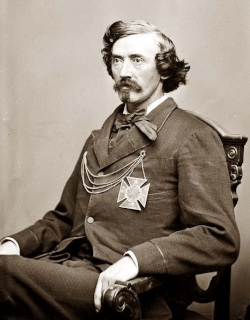
Death of James A. Mulligan, Union Army Colonel

James Adelbert Mulligan, a colonel of the 23rd Illinois Infantry Regiment in the Union Army during the American Civil War, dies on July 26, 1864, of wounds sustains at the Second Battle of Kernstown three days earlier.

Mulligan is born on June 30, 1830, in Utica, New York. His parents had immigrated from Ireland and his father died when he was a child. His mother remarries a Michael Lantry of Chicago, Illinois, and moves there with her son, who later attends the St. Mary’s on the Lake College of North Chicago. From 1852–54 he reads law in the offices of Isaac N. Arnold, U.S. Representative from the city. He is admitted to the bar in 1856 and commissioned a second lieutenant in the “Chicago Shield Guards.”

At the onset of the American Civil War, Mulligan raises the 23rd Illinois Infantry Regiment in 1861, which is locally known as the “Irish Brigade” (not to be confused with a New York unit by the same name). This unit includes the Chicago Shield Guards. In September 1861, he leads his troops toward Lexington, Missouri, as word had been received that this vital river town will be attacked by the pro-Confederate Missouri State Guard under Major General Sterling Price.

The First Battle of Lexington, often referred to as the Battle of the Hemp Bales, commences on September 13, 1861, when 12,500 soldiers of the Missouri State Guard begin a siege of Mulligan’s diminutive command, entrenched around the town’s old Masonic College. On September 18, Price’s army mounts an all-out assault on Mulligan’s works, which fails. Cannon fire continues through September 19. On the 20th, units of Price’s army use hemp bales soaked in the Missouri River as a moving breastwork to work their way up the river bluffs toward Mulligan’s headquarters. By 2:00 PM, Mulligan has surrendered. Combined casualties are 64 dead, and 192 wounded. Price is reportedly so impressed by Mulligan’s demeanor and conduct during and after the battle that he offers him his own horse and buggy and orders him safely escorted to Union lines.

Mulligan is commander of Camp Douglas, a prisoner of war camp in Chicago, from February 25, 1862, to June 14, 1862. The camp had been constructed as a short-term training camp for Union soldiers but is converted to a prisoner of war camp for captured Confederate soldiers after the fall of Fort Donelson.

Mulligan and his regiment are assigned to the Railroad Division of the Middle Department between December 17, 1862, and March 27, 1863. Then they are assigned to 5th Brigade, 1st Division, VIII Corps in the Middle Department between March 27, 1863, and June 26, 1863.

Between August and December 1863, Mulligan oversees the construction of Fort Mulligan, an earthworks fortification located in Grant County, West Virginia. This fort remains one of the best-preserved Civil War fortifications in West Virginia and has become a local tourist attraction.

On July 3, 1864, only three weeks before his death, Mulligan distinguishes himself in the Battle of Leetown, fought in and around Leetown, Virginia. Federal troops are retreating in the face of Major General Jubal Early‘s relentless Confederate advance down the Shenandoah Valley during the Second Valley Campaign. Hoping to buy time to concentrate Union forces and supplies, Major General Franz Sigel orders him to hold Leetown for as long as possible and then conduct a fighting retreat as slowly as possible to cover the other withdrawing Union units. He manages to hold Leetown for the entire day before being compelled to retreat, albeit very slowly. He continues to battle Early’s troops all the way from Leetown to Martinsburg, West Virginia, buying valuable time for Union commanders to concentrate their forces in the Valley.

On July 24, 1864, Mulligan leads his troops into the Second Battle of Kernstown, near Winchester, Virginia. Late in the afternoon, Major General John B. Gordon’s Confederate force attacks Mulligan’s 1,800 soldiers from ground beyond Opequon Church. Mulligan briefly holds off Gordon’s units, but Confederate Major General John C. Breckinridge leads a devastating flank attack against the Irishmen from the east side of the Valley Pike. Sharpshooters then attack his right flank from the west. Now encompassed on three sides, the Union battle line falls apart.

With Confederates closing from all around, Mulligan orders his troops to withdraw. As he stands up in his saddle to spur his men on, Confederate sharpshooters concealed in a nearby stream bed manage to hit the Union commander. His soldiers endeavor to carry him to safety, but the unyielding Confederate fire make this an impossible task. He is well aware of his situation, and the danger his men are in, and so he famously orders, “Lay me down and save the flag.” His men reluctantly comply. Confederate soldiers capture him and carry the mortally wounded colonel into a nearby home, where he dies two days later on July 26, 1864. He is buried in Calvary Cemetery, Evanston, Illinois.

On February 20, 1865, the United States Senate confirms the posthumous appointment of Mulligan to the rank of brevet brigadier general of U.S. Volunteers to rank from July 23, 1864, the day before he is mortally wounded at the Second Battle of Kernstown.


1 Comment

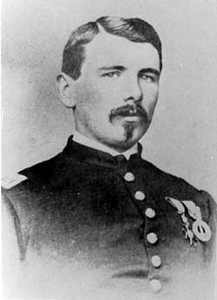
Death of Myles Walter Keogh, Last Man Killed at the Battle of Little Big Horn

Myles Walter Keogh, soldier in the United States Army, is the last man killed at the Battle of Little Big Horn on June 25, 1876, according to the Sioux. His horse is the only U.S. survivor.

Keogh is born in Orchard House in Leighlinbridge, County Carlow, on March 25, 1840. He attends the National School in Leighlinbridge and is long thought to have attended St. Patrick’s College in Carlow but that college has no record of his attendance. It is possible that he attends St. Mary’s Knockbeg College.

By 1860, a twenty-year-old Keogh volunteers, along with over one thousand of his countrymen, to rally to the defence of Pope Pius IX following a call to arms by the Catholic clergy in Ireland. By August 1860, Keogh is appointed second lieutenant of his unit in the Battalion of St. Patrick, Papal Army under the command of General Christophe Léon Louis Juchault de Lamoricière. Once the fighting is over and duties of the Pontifical Swiss Guard become more mundane, Keogh sees little purpose in remaining in Rome. In March 1862, with civil war raging in America, he resigns his commission in the Company of St. Patrick and sets out for New York City, arriving on April 2.

Keogh actively participates in several prominent American Civil War battles including the Shenandoah Valley, the Battle of Antietam, the Battle of Fredericksburg, and the Battle of Gettysburg.

Perhaps the strongest testimony to Keogh’s bravery and leadership ability comes at the Battle of the Little Bighorn, also known as Custer’s Last Stand, on June 25, 1876. The senior captain among the five companies wiped out with General George Armstrong Custer that day, and commanding one of two squadrons within the Custer detachment, Keogh dies in a “last stand” of his own, surrounded by the men of Company I. When the sun-blackened and dismembered dead are buried three days later, Keogh’s body is found at the center of a group of troopers. The slain officer is stripped but not mutilated, perhaps because of the “medicine” the Indians see in the Agnus Dei (“Lamb of God”) he wears on a chain about his neck or because many of Sitting Bull‘s warriors are believed to be Catholic. Keogh’s left knee has been shattered by a bullet that corresponds to a wound through the chest and flank of his horse, indicating that horse and rider may have fallen together prior to the last rally.

The badly injured animal is found on the fatal battlefield and nursed back to health as the 7th Cavalry’s regimental mascot, which he remains until his death in 1890. This horse, Comanche, is considered the only U.S. military survivor of the battle, though several other badly wounded horses are found and destroyed at the scene. Keogh’s bloody gauntlet and the guidon of his Company I are recovered by the army three months after Little Bighorn at the Battle of Slim Buttes.

Originally buried on the battlefield, Keogh’s remains are disinterred and taken to Auburn, New York as he had requested in his will. He is buried at Fort Hill Cemetery on October 26, 1877, an occasion marked by citywide official mourning and an impressive military procession to the cemetery.

Tongue River Cantonment in southeastern Montana is renamed after him to be Fort Keogh. The fort is first commanded by Nelson A. Miles. The 55,000-acre fort is today an agricultural experiment station. Miles City, Montana is located two miles from the old fort.


Leave a comment

The Battle of Port Republic

battle-of-port-republic

As part of Confederate States Army Maj. Gen. Thomas J. “Stonewall” Jackson‘s campaign through the Shenandoah Valley, the Irish 6th Louisiana fight in the Battle of Port Republic in Rockingham County, Virginia on June 9, 1862, during the American Civil War. The battle is a fierce contest between two equally determined foes and is the costliest battle fought by Jackson’s Army of the Valley during its campaign.

During the night of June 8–9, 1862, Brig. Gen. Charles S. Winder‘s Stonewall Brigade is withdrawn from its forward position near Bogota, a large house owned by Gabriel Jones, and rejoins Jackson’s division at Port Republic. Winder’s brigade is assigned the task of spearheading the assault against Union Army forces east of the river. Brig. Gen. Isaac R. Trimble‘s brigade and elements of Col. John M. Patton, Jr.’s, are left to delay Maj. Gen. John C. Frémont‘s Union forces at Cross Keys, while the rest of Maj. Gen. Richard S. Ewell‘s division march to Port Republic to be in position to support Winder’s attack.

Brig. Gen. Erastus B. Tyler‘s brigade joins Col. Samuel S. Carroll‘s brigade north of Lewiston on the Luray Road. The rest of Brig. Gen. James Shields‘s (a native of County Tyrone) division is strung out along the muddy roads back to Luray. General Tyler, in command on the field, advances at dawn on June 9 to the vicinity of Lewiston. He anchors the left of his line on a battery positioned on the Lewiston Coaling, extending his infantry west along Lewiston Lane to the South Fork near the site of Lewis’s Mill. The right and center are supported by artillery, 16 guns in all.

Winder’s brigade crosses the river by 5:00 AM and deploys to attack east across the bottomland. He sends two regiments, the 2nd Virginia Infantry and 4th Virginia Infantry, into the woods to flank the Union line and assault the Coaling. When the main Confederate battle line advances, it comes under heavy fire from the Union artillery and is soon pinned down. Confederate batteries are brought forward onto the plain but are outgunned and forced to seek safer positions. Ewell’s brigades are hurried forward to cross the river. Seeing the strength of the Union artillery at the Coaling, Jackson sends Richard Taylor‘s brigade, including the famed Louisiana Tigers, to the right into the woods to support the flanking column that is attempting to advance through the thick underbrush.

Winder’s brigade renews its assault on the Union right and center, taking heavy casualties. General Tyler moves two regiments from the Coaling to his right and launches a counterattack, driving Confederate forces back nearly half a mile. While this is occurring, the first Confederate regiments probe the defenses of the Coaling but are repulsed.

Finding resistance fiercer than anticipated, Jackson orders the last of Ewell’s forces still north of Port Republic to cross the rivers and burn the North Fork bridge. These reinforcements begin to reach Winder, strengthening his line and stopping the Union counterattack. Taylor’s brigade reaches a position in the woods across from the Coaling and launches a fierce attack, which carries the hill, capturing five guns. Tyler immediately responds with a counterattack, using his reserves. These regiments, in hand-to-hand fighting, retake the position. Taylor shifts a regiment to the far right to outflank the Union battle line. The Confederate attack again surges forward to capture the Coaling. Five captured guns are turned against the rest of the Union line. With the loss of the Coaling, the Union position along Lewiston Lane becomes untenable, and Tyler orders a withdrawal about 10:30 AM. Jackson orders a general advance.

William B. Taliaferro‘s fresh Confederate brigade arrives from Port Republic and presses the retreating Federals for several miles north along the Luray Road, taking several hundred prisoners. The Confederate army is left in possession of the field. Shortly after noon, Frémont’s army begins to deploy on the west bank of the South Fork, too late to aid Tyler’s defeated command, and watches helplessly from across the rain-swollen river. Frémont deploys artillery on the high bluffs to harass the Confederate forces. Jackson gradually withdraws along a narrow road through the woods and concentrates his army in the vicinity of Mt. Vernon Furnace. Jackson expects Frémont to cross the river and attack him on the following day, but during the night Frémont withdraws toward Harrisonburg.

Together, the Battles of Cross Keys and Port Republic are the decisive victories in Jackson’s Valley campaign, forcing the Union armies to retreat and leaving Jackson in control of the upper and middle Shenandoah Valley and free to reinforce Gen. Robert E. Lee for the Seven Days Battles outside Richmond, Virginia.

The Civil War Trust, a division of the American Battlefield Trust, and its partners have acquired and preserved 947 acres of the Port Republic battlefield in seven transactions since 1988. The battlefield is located about three miles east of Port Republic at U.S. Route 340 and Ore Bank Road. It retains its wartime agrarian appearance. The Port Republic Battle Monument is on Ore Bank Road beside the site of The Coaling, a key battlefield feature. The Coaling is the first land acquisition of the modern Civil War battlefield preservation movement. The 8.55-acre site is donated to the Trust’s forerunner, the Association for the Preservation of Civil War Sites by the Lee-Jackson Foundation in 1988.


Leave a comment

Birth of General Philip Henry Sheridan

philip-sheridan

Irish American General Philip Henry Sheridan, career United States Army officer and a Union general in the American Civil War, is born in Albany, New York on March 6, 1831.

Sheridan is the third child of six by John and Mary Meenagh Sheridan, immigrants from the parish of Killinkere, County Cavan. Fully grown, he reaches only 5 feet 5 inches in height, a stature that leads to the nickname “Little Phil.” Abraham Lincoln describes his appearance in a famous anecdote, “A brown, chunky little chap, with a long body, short legs, not enough neck to hang him, and such long arms that if his ankles itch, he can scratch them without stooping.”

Sheridan’s career is noted for his rapid rise to major general and his close association with General-in-chief Ulysses S. Grant, who transfers Sheridan from command of an infantry division in the Western Theater to lead the Cavalry Corps of the Army of the Potomac in the East. In 1864, he defeats Confederate forces in the Shenandoah Valley and his destruction of the economic infrastructure of the Valley, called “The Burning” by residents, is one of the first uses of scorched earth tactics in the war. In 1865, his cavalry pursues General Robert E. Lee and is instrumental in forcing his surrender at Appomattox Court House.

In later years, Sheridan fights in the Indian Wars of the Great Plains. Comanche Chief Tosahwi reputedly tells Sheridan in 1869, “Me, Tosahwi; me good Injun,” to which Sheridan supposedly replies, “The only good Indians I ever saw were dead.” Sheridan denies he had ever made the statement. Biographer Roy Morris Jr. states that, nevertheless, popular history credits Sheridan with saying “The only good Indian is a dead Indian.” This variation “has been used by friends and enemies ever since to characterize and castigate his Indian-fighting career.” In Bury My Heart at Wounded Knee, Dee Brown attributes the quote to Sheridan but does not provide documentation to support his contention, so the quote may be more apocryphal than real.

Both as a soldier and private citizen, Sheridan is instrumental in the development and protection of Yellowstone National Park. The protection of the Yellowstone area is Sheridan’s personal crusade. He authorizes Lieutenant Gustavus Doane to escort the Washburn Expedition in 1870 and for Captain John W. Barlow to escort the Hayden Expedition in 1871. Barlow names Mount Sheridan, a peak overlooking Heart Lake in Yellowstone, for the general in 1871. As early as 1875, Sheridan promotes military control of the area to prevent the destruction of natural formations and wildlife.

In 1883, Sheridan is appointed general-in-chief of the U.S. Army, and in 1888 he is promoted to the rank of General of the Army during the term of President Grover Cleveland. Sheridan serves as the ninth president of the National Rifle Association.

Sheridan suffers a series of massive heart attacks two months after sending his memoirs to the publisher. After his first heart attack, the U.S. Congress quickly passes legislation to promote him to general and he receives the news from a congressional delegation with joy, despite his pain. His family moves him from the heat of Washington, D.C. and he dies of heart failure in his summer cottage in the Nonquitt section of Dartmouth, Massachusetts on August 5, 1888.

His body is returned to Washington, and he is buried on a hillside facing the capital city near Arlington House in Arlington National Cemetery. The burial helps elevate Arlington to national prominence.


Leave a comment

Death of Charles G. Halpine, Journalist, Author & Soldier

Charles Graham Halpine (Halpin), Irish journalist, author and soldier during the American Civil War, dies on August 3, 1868, in New York City.

Born at Oldcastle, County Meath, on November 20, 1829, Halpine is the son of the Rev. Nicholas John Halpin. He is educated at Trinity College, Dublin, until 1846, with original intentions for the medical profession, but ultimately prefers the law. In his leisure time he writes for the press. The sudden death of his father and his own early marriage compel him to adopt journalism as a profession.

In 1851 he emigrates to the United States, and takes up residence in Boston, where he becomes assistant editor of The Boston Post, and, with Benjamin Penhallow Shillaber, commences a humorous journal called The Carpet Bag, which is unsuccessful. Afterwards he resides in Washington, D.C., where he acts as the correspondent of The New York Times.

After moving back to New York, he secures employment with the New York Herald, and in a few months establishes relations with several periodicals. He undertakes a great variety of literary work, most of which is entirely ephemeral. He next becomes associate editor of The New York Times, for which he writes in 1855 and 1856 the Nicaragua correspondence at the time of William Walker‘s filibustering expedition. In 1857 he becomes principal editor and part proprietor of the New York Leader, which under his management rapidly increases in circulation.

At the beginning of the American Civil War in April 1861, he enlists in the 69th New York Infantry, in which he is soon elected a lieutenant, and serves during the three months for which he has volunteered. He is then transferred to the staff of General David Hunter as assistant-adjutant-general with the rank of major, and soon afterwards goes with him to Missouri to relieve General John Charles Frémont. He accompanies General Hunter to Hilton Head, and while there writes a series of burlesque poems in the assumed character of an Irish private. Several of them are contributed to the New York Herald in 1862 under the pseudonym of “Miles O’Reilly,” and with additional articles are issued in two volumes entitled Life and Adventures, Songs, Services, and Speeches of Private Miles O’Reilly, 47th Regiment New York Volunteers (1864), and Baked Meats of the Funeral, a Collection of Essays, Poems, Speeches, and Banquets, by Private Miles O’Reilly, late of the 47th Regiment New York Volunteer Infantry, 10th Army Corps. Collected, revised, and edited, with the requisite corrections of punctuation, spelling, and grammar, by an Ex-Colonel of the Adjutant-General’s Department, with whom the Private formerly served as Lance-Corporal of Orderlies (1866).

Halpine is subsequently assistant-adjutant-general on General Henry W. Halleck‘s staff with the rank of colonel in 1862 and accompanies General David Hunter as a staff-officer on his expedition up the Shenandoah Valley in the spring of 1864. On his return to New York, he resigns his commission in consequence of his bad eyesight, receiving the brevet of brigadier-general of volunteers.

He then makes New York his home and resumes his literary work. He becomes editor and, later, proprietor of the Citizen, a newspaper issued by the citizens’ association to advocate reforms in the civil administration of New York City. In 1867 he is elected registrar of the county of New York by a coalition of republicans and democrats. Incessant labour brings on insomnia. He has recourse to opiates, and his death in New York City on August 3, 1868, is caused by an undiluted dose of chloroform.


Leave a comment

Birth of Myles Walter Keogh, Last Man Killed at the Battle of Little Big Horn

Myles Walter Keogh, soldier in the United States Army, is born in Orchard House in LeighlinbridgeCounty Carlow, on March 25, 1840. It is said by the Sioux that he is the last man killed at the Battle of Little Big Horn, where his horse is the only U.S. survivor.

Keogh attends the National School in Leighlinbridge and is long thought to have attended St. Patrick’s College in Carlow but that college has no record of his attendance. It is possible that he attends St. Mary’s Knockbeg College.

By 1860, a twenty-year-old Keogh volunteers, along with over one thousand of his countrymen, to rally to the defence of Pope Pius IX following a call to arms by the Catholic clergy in Ireland. By August 1860, Keogh is appointed second lieutenant of his unit in the Battalion of St. Patrick, Papal Army under the command of General Christophe Léon Louis Juchault de Lamoricière. Once the fighting is over and duties of the Pontifical Swiss Guard become more mundane, Keogh sees little purpose in remaining in Rome. In March 1862, with civil war raging in America, he resigns his commission in the Company of St. Patrick and sets out for New York City, arriving on April 2.

Keogh actively participates in several prominent American Civil War battles including the Shenandoah Valley, the Battle of Antietam, the Battle of Fredericksburg, and the Battle of Gettysburg.

Perhaps the strongest testimony to Keogh’s bravery and leadership ability comes at the Battle of the Little Bighorn, also known as Custer’s Last Stand, on June 25, 1876. The senior captain among the five companies wiped out with General George Armstrong Custer that day, and commanding one of two squadrons within the Custer detachment, Keogh dies in a “last stand” of his own, surrounded by the men of Company I. When the sun-blackened and dismembered dead are buried three days later, Keogh’s body is found at the center of a group of troopers. The slain officer is stripped but not mutilated, perhaps because of the “medicine” the Indians see in the Agnus Dei (“Lamb of God”) he wears on a chain about his neck or because many of Sitting Bull‘s warriors are believed to be Catholic. Keogh’s left knee has been shattered by a bullet that corresponds to a wound through the chest and flank of his horse, indicating that horse and rider may have fallen together prior to the last rally.

The badly injured animal is found on the fatal battlefield, and nursed back to health as the 7th Cavalry’s regimental mascot, which he remains until his death in 1890. This horse, Comanche, is considered the only U.S. military survivor of the battle, though several other badly wounded horses are found and destroyed at the scene. Keogh’s bloody gauntlet and the guidon of his Company I are recovered by the army three months after Little Bighorn at the Battle of Slim Buttes.

Originally buried on the battlefield, Keogh’s remains are disinterred and taken to Auburn, as he had requested in his will. He is buried at Fort Hill Cemetery on October 26, 1877, an occasion marked by citywide official mourning and an impressive military procession to the cemetery.

Tongue River Cantonment in southeastern Montana is renamed after him to be Fort Keogh. The fort is first commanded by Nelson A. Miles. The 55,000-acre fort is today an agricultural experiment station. Miles City, Montana is located two miles from the old fort.


Leave a comment

Death of General Philip Henry Sheridan

philip-sheridan

Irish American General Philip Henry Sheridan, career United States Army officer and a Union general in the American Civil War, dies of heart disease in Dartmouth, Massachusetts, on August 5, 1888.

Sheridan is born in Albany, New York, the third child of six by John and Mary Meenagh Sheridan, immigrants from the parish of Killinkere, County Cavan. Fully grown, he reaches only 5 feet 5 inches in height, a stature that leads to the nickname “Little Phil.” Abraham Lincoln describes his appearance in a famous anecdote, “A brown, chunky little chap, with a long body, short legs, not enough neck to hang him, and such long arms that if his ankles itch, he can scratch them without stooping.”

Sheridan’s career is noted for his rapid rise to major general and his close association with General-in-chief Ulysses S. Grant, who transfers Sheridan from command of an infantry division in the Western Theater to lead the Cavalry Corps of the Army of the Potomac in the East. In 1864, he defeats Confederate forces in the Shenandoah Valley and his destruction of the economic infrastructure of the Valley, called “The Burning” by residents, is one of the first uses of scorched earth tactics in the war. In 1865, his cavalry pursues General Robert E. Lee and is instrumental in forcing his surrender at Appomattox Court House.

In later years, Sheridan fights in the Indian Wars of the Great Plains. Comanche Chief Tosahwi reputedly tells Sheridan in 1869, “Me, Tosahwi; me good Injun,” to which Sheridan supposedly replies, “The only good Indians I ever saw were dead.” Sheridan denies he had ever made the statement. Biographer Roy Morris Jr. states that, nevertheless, popular history credits Sheridan with saying “The only good Indian is a dead Indian.” This variation “has been used by friends and enemies ever since to characterize and castigate his Indian-fighting career.” In Bury My Heart at Wounded Knee, Dee Brown attributes the quote to Sheridan but does not provide documentation to support his contention, so the quote may be more apocryphal than real.

Both as a soldier and private citizen, Sheridan is instrumental in the development and protection of Yellowstone National Park. The protection of the Yellowstone area is Sheridan’s personal crusade. He authorizes Lieutenant Gustavus Doane to escort the Washburn Expedition in 1870 and for Captain John W. Barlow to escort the Hayden Expedition in 1871. Barlow names Mount Sheridan, a peak overlooking Heart Lake in Yellowstone, for the general in 1871. As early as 1875, Sheridan promotes military control of the area to prevent the destruction of natural formations and wildlife.

In 1883, Sheridan is appointed general-in-chief of the U.S. Army, and in 1888 he is promoted to the rank of General of the Army during the term of President Grover Cleveland. Sheridan serves as the ninth president of the National Rifle Association.

Sheridan suffers a series of massive heart attacks two months after sending his memoirs to the publisher. After his first heart attack, the U.S. Congress quickly passes legislation to promote him to general and he receives the news from a congressional delegation with joy, despite his pain. His family moves him from the heat of Washington, D.C. and he dies of heart failure in his summer cottage in the Nonquitt section of Dartmouth, Massachusetts.

His body is returned to Washington, and he is buried on a hillside facing the capital city near Arlington House in Arlington National Cemetery. The burial helps elevate Arlington to national prominence.