seamus dubhghaill

Promoting Irish Culture and History from Little Rock, Arkansas, USA


Leave a comment

Death of Mary Carryl, Servant of the Ladies of Llangollen

Mary Carryl, an Irish-born loyal servant and friend of the celebrated Ladies of Llangollen, dies on November 22, 1809. She serves them up to her death. When the Ladies die, they share the same grave.

Carryl is brought up in a poor family in RossCounty Wexford. Little is known about her until she is employed by Lady Elizabeth “Betty” and Sir William Fownes, 2nd Baronet, at the Woodstock Estate near InistiogeCounty Kilkenny. He inherits the baronetcy from his father Sir William Fownes, 1st Baronet, the Lord Mayor of Dublin, and over 21,000 acres from his grandfather. When Fownes marries Elizabeth Ponsonby, he receives £4,000 as a dowry and the couple builds the six-bayed, three-story Woodstock House in County Kilkenny in 1745-47. In 1769, the Fownes have a thirteen-year-old guest to stay for some time named Sarah Ponsonby, who is Elizabeth’s cousin and the orphaned daughter of Chambré Brabazon Ponsonby. She attends school at Kilkenny.

Sarah develops a friendship with Eleanor Butler, which is not approved of by the Fownes nor by Eleanor’s family guardians. When the friendship begins, Sarah is an unhappy thirteen-year-old orphan. She is captivated by the well-educated Eleanor Butler, a 30-year-old spinster no longer considered marriageable. Sarah is also receiving unwanted attention from Sir William, her guardian.

When Eleanor Butler runs away from home, she is hidden in Sarah’s room and Carryl smuggles in food for her stowaway. Eventually Butler and Ponsonby agree that they can leave Ireland together. They go to Llangollen in Wales where they set up home in a cottage called Plas Newydd. Meanwhile Carryl, who is known as Mary the Bruiser, has been fired after throwing a candlestick that wounds another servant. Her prospects are saved when Eleanor and Sarah send for her to come to Llangollen.

In time Eleanor and Sarah become notorious as “The Ladies of Llangollen,” and Carryl becomes both their servant and the head of the household. She is loyal to her employers. She is said to have “masculine qualities” and Lady Eleanor’s diary records how she gives as good as she gets as she bargains loudly with the fishermen, the butchers and the inebriated.

The lifestyle of the Ladies of Llangollen attracts attention. They receive notable visitors including the Arthur Wellesley, 1st Duke of Wellington; the poets William Wordsworth and Anna Seward; enlightenment leaders Erasmus Darwin and Josiah Wedgwood; and writers including Sir Walter Scott.[3]

Carryl dies at Plas Newydd on November 22, 1809, and is buried in the churchyard of St. Collen’s Church, Llangollen. She leaves a shilling to her brother and sister, but leaves the field she owns to Sarah. When in time the Ladies of Llangollen die, they are buried beside their faithful servant.

The memorial monument to Mary Carryl, Eleanor Butler and Sarah Ponsonby in the churchyard of St. Collen’s Church is erected in 1810. The inscription on Carryl’s part of the monument reads: “In Memory of / Mrs Mary Carryl / Deceased 22 November 1809 / This monument is erected by Eleanor Butler, / and Sarah Ponsonby, of Plasnewydd in this Parish. / Released from Earth and all its transient woes, / She whose remains beneath this stone repose, / Stedfast in Faith resigned her parting breath, / Looked up with Christian joy, and smiled in Death! / Patient, Industrious, Faithful, Generous, Kind, / Her Conduct left the proudest far behind, / Her Virtues dignified her humble birth, / And raised her mind above this sordid earth, / Attachment (Sacred bond of grateful breasts) / Extinguished but with life, this Tomb attests, / Reared by Two Friends who will her loss bemoan, / ‘Till with Her Ashes…Here shall rest, Their own.”

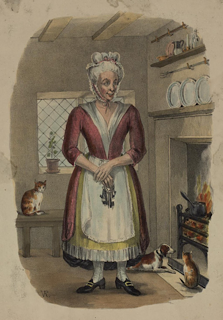
(Pictured: A portrait of Mary Carryl from the Welsh Portrait Collection at the National Library of Wales)

Leave a comment

The Limerick Soviet

The Limerick Soviet exists for a two-week period from April 15 to April 27, 1919, and is one of a number of self-declared Irish soviets that are formed around Ireland between 1919 and 1923. At the beginning of the Irish War of Independence, a general strike is organised by the Limerick Trades and Labour Council, as a protest against the British Army‘s declaration of a “Special Military Area” under the Defence of the Realm Act 1914, which covers most of Limerick city and a part of the county. The soviet runs the city for the period, prints its own money and organises the supply of food.

From January 1919 the Irish War of Independence develops as a guerrilla conflict between the Irish Republican Army (IRA) (backed by Sinn Féin‘s Dáil Éireann), and the British government. On April 6, 1919, the IRA tries to liberate Robert Byrne, who is under arrest by the Royal Irish Constabulary (RIC) in a hospital, being treated for the effects of a hunger strike. In the rescue attempt Constable Martin O’Brien is fatally wounded, and another policeman is seriously injured. Byrne is also wounded and dies later the same day.

In response, on April 9 British Army Brigadier Griffin declares the city to be a Special Military Area, with RIC permits required for all wanting to enter and leave the city as of Monday, April 14. British Army troops and armoured vehicles are deployed in the city.

On Friday, April 11 a meeting of the United Trades and Labour Council, to which Byrne had been a delegate, takes place. At that meeting Irish Transport and General Workers’ Union (ITGWU) representative Sean Dowling proposes that the trade unions take over Town Hall and have meetings there, but the proposal is not voted on. On Saturday, April 12 the ITGWU workers in the Cleeve’s factory in Lansdowne vote to go on strike. On Sunday, April 13, after a twelve-hour discussion and lobbying of the delegates by workers, a general strike is called by the city’s United Trades and Labour Council. Responsibility for the direction of the strike is devolved to a committee that describes itself as a soviet as of April 14. The committee has the example of the Dublin general strike of 1913 and “soviet” (meaning a self-governing committee) has become a popular term after 1917 from the soviets that had led to the Russian Soviet Federative Socialist Republic.

A transatlantic air race is being organised from Bawnmore in County Limerick at the same time but is cancelled. The assembled journalists from England and the United States take up the story of an Irish soviet and interview the organisers. The Trades Council chairman John Cronin is described as the “father of the baby Soviet.” Ruth Russell of the Chicago Tribune remarks on the religiosity of the strike committee, observes “the bells of the nearby St. Munchin’s Church tolled the Angelus and all the red-badged guards rose and blessed themselves.” The Sinn Féin Mayor of Limerick, Phons O’Mara, tells Russell there is no prospect of socialism, as “There can’t be, the people here are Catholics.”

The general strike is extended to a boycott of the troops. A special strike committee organises food and fuel supplies, prints its own money based on the British shilling, and publishes its own newspaper called The Worker’s Bulletin. The businesses of the city accept the strike currency. Cinemas open with the sign “Working under authority of the strike committee” posted. Local newspapers are allowed to publish once a week as long as they have the caption “Published by Permission of the Strike Committee.” Outside Limerick there is some sympathy in Dublin, but not in the main Irish industrial area around Belfast. The National Union of Railwaymen does not help.

On April 21 The Worker’s Bulletin remarks that “A new and perfect system of organisation has been worked out by a clever and gifted mind, and ere long we shall show the world what Irish workers are capable of doing when left to their own resources.” On Easter Monday 1919, the newspaper states “The strike is a worker’s strike and is no more Sinn Féin than any other strike.”

Liam Cahill argues, “The soviet attitude to private property was essentially pragmatic. So long as shopkeepers were willing to act under the soviet’s dictates, there was no practical reason to commandeer their premises.” While the strike is described by some as a revolution, Cahill adds, “In the end the soviet was basically an emotional and spontaneous protest on essentially nationalist and humanitarian grounds, rather than anything based on socialist or even trade union aims.”

After two weeks the Sinn Féin Lord Mayor of Limerick, Phons O’Mara, and the Catholic bishop Denis Hallinan call for the strike to end, and the Strike Committee issues a proclamation on April 27, 1919, stating that the strike is over.

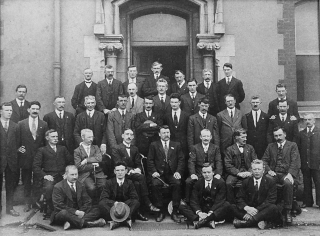
(Pictured: Photograph of Members of the 1919 Limerick Soviet, April 1919, Limerick City)


Leave a comment

Birth of Charlotte Milligan Fox, Composer & Music Collector

charlotte-milligan-fox

Charlotte Milligan Fox, Irish composer and music collector, is born on March 17, 1864 in Omagh, County Tyrone in what is now Northern Ireland.

Milligan is the eldest of eleven children born to Methodist parents Seaton Milligan (1837–1916) and Charlotte Burns (1842–1916), with nine surviving including Alice Milligan and Edith Wheeler. All nine children enroll at Methodist College Belfast which provides a privileged and exceptional education. She studies classical piano and composition at the Royal College of Music in London and the Conservatoires of Frankfurt and Milan. Following her marriage to Charles Eliot Fox in 1892, she settles in London.

In 1904 Fox co-founds with Alfred Perceval Graves the Irish Folk Song Society, an offshoot of the Folk-Song Society formed in 1898. Its aim is to collect and publish Irish airs and ballads, in addition to holding lectures and concerts on the subject. She acts as the society’s honorary secretary. The rules of the Society are collected in volume 4 of the Journal of the Irish Folk Song Society. The subscription is 5 shillings payable every January and committee meetings are held at the Rooms of the Irish Literary Society in London.

Fox is a musician in her own right and tours Ireland collecting folk songs and airs. She undertakes a series of tours of County Antrim between 1909 and 1910 with her sisters Edith Wheeler and Alice Milligan. The sisters record and transcribe songs by Irish singers, then publish articles and musical scores in The Journal of Irish Folk Song.

In 1910 Fox visits the east coast of the United States where the New York branch of the Irish Folk Song Society is formed. “The Bardic Recital” is produced on March 16 at the National Theatre in Washington, D.C. She collects and arranges the music for the play.

Fox rediscovers Edward Bunting‘s papers, and under the provision of her will they come to Queen’s University Belfast in 1916. From these papers she writes The Annals of the Irish Harpers. The publication of The Annals of the Irish Harpers stimulates a revival of interest in both the Irish harp and Edward Bunting. Alice Milligan nurses her sister prior to Fox’s death in London on March 25, 1916. An obituary of Charlotte Milligan Fox is in The Irish Booklover (1916). The Journal of the Irish Folk Song Society (1917) has a poem in remembrance of Charlotte Milligan Fox. The same issue has a memoir of Fox by Alice Milligan and an appreciation of Fox by Alfred Perceval Graves.

During 2010 and 2011, the Ulster History Circle mounts plaques for famous Ulster figures. Charlotte Milligan Fox and Alice Milligan have a plaque mounted on Omagh Library, 1 Spillar’s Place, Omagh, County Tyrone.