seamus dubhghaill

Promoting Irish Culture and History from Little Rock, Arkansas, USA


Leave a comment

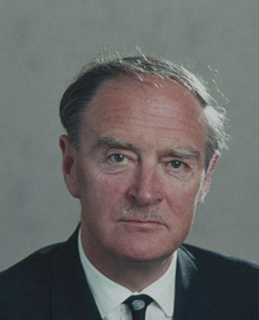
Birth of Joe Clarke, Irish Republican Politician

Joseph Christopher Clarke (Irish: Seosamh Ó Clérigh), Irish republican politician, is born on December 22, 1882, in Rush, Dublin.

Clarke is the son of William Clarke, merchant seaman, and Margaret Clarke (née Austin). Educated locally, he leaves school at the age of eleven and begins work as a kitchen porter, later becoming a boot-shop assistant, a harness maker and a van driver. Influenced by a series of lectures at the Oliver Bond Club, Parnell Square, and by the writings of Arthur Griffith, he commits himself to the republican cause, joining the Irish Republican Brotherhood (IRB) in 1913 and subsequently the Irish Volunteers.

Clarke works for the Sinn Féin Bank and is active in the 1916 Easter Rising. On Easter Monday morning, on April 24, 1916, he is one of thirteen volunteers who hold the Mount Street Bridge for nine hours against the overwhelming forces of the Sherwood Foresters regiment of the British Army. When captured, he is shot in the head, but survives, and is instead imprisoned in Liverpool Prison, Wakefield Prison and then Frongoch internment camp.

On his return to Ireland, Clarke acts as the courier for the First Dáil and serves as an usher at the first meeting of the First Dáil. He is interned from January 1921. Released in 1923, he acts as caretaker of the Sinn Féin headquarters on Harcourt Street and founds the Irish Book Bureau. Although the Anti-Treaty Sinn Féin rejects participation in the Dáil, they continue to contest local elections, and Clarke sits on Dublin City Council.

Although jailed many times between 1922 and 1940, Clarke remains an active republican campaigner, supporting the Irish Republican Army (IRA) initiatives of the 1940s and 1950s, taking a prominent role at republican meetings, and publicising the conditions of republican prisoners.

Clarke is a founder member of Comhairle na Poblachta in 1929. In 1937, he works with Brian O’Higgins to establish the Wolfe Tone Weekly as a light-hearted party newspaper. In August 1939, he is interned at Arbour Hill Prison, then later at Cork County Jail.

Although Clarke had served under Éamon de Valera during the Easter Rising, the two become implacable opponents. He is ejected from an official commemoration of the fiftieth anniversary of the First Dáil for interrupting de Valera’s speech in order to raise the complaints of the Dublin Housing Action Committee (DHAC). He vows to outlive de Valera and succeeds in this endeavour by outliving him a year.

Clarke is elected as a Vice-President of Sinn Féin in 1966. In the split of 1970, he supports the provisional wing, remaining Vice-President. In 1973 he is deported from Britain upon his arrival at Heathrow Airport.

Despite crippling arthritis, Clarke continues his work, refusing an IRA pension as he considers himself still on active service. He dies on April 22, 1976, at St. James’s Hospital, Dublin, and is buried in Glasnevin Cemetery close to the republican plot.

Clarke marries Anne, daughter of Thomas Hughes, sawyer, on July 25, 1909. They have two sons and one daughter. After her death, he marries Elizabeth Delaney on May 30, 1949.

The Dublin South West Inner City cumann of Sinn Féin is named for Clarke.

(Pictured: Joe Clarke selling Easter Lilies on Dublin’s O’Connell Street in 1966)


Leave a comment

Birth of J. B. Malone, Hillwalking Enthusiast

John James Bernard (J. B.) Malone, an Irish hillwalking enthusiast who popularises the pastime through his television programmes and books, is born on December 13, 1913, in Leeds, West Yorkshire, England. He is responsible for the establishment of the Wicklow Way as a recognised walking trail, having first proposed it in 1966.

Malone is born to James Bernard Malone and his wife, Agnes (née Kenny), both from Dublin. He is raised mainly in England and completes his secondary education at the Marist Brothers College, Grove Ferry, Kent.

Malone moves to Ireland in 1931 where he finds employment in a builders’ providers firm and an insurance company before joining the Irish Army in 1940. There he becomes a cartographer in the intelligence section. In 1947, having left the army, he goes to work at the Department of Posts and Telegraphs as a draughtsman. He remains employed in the Irish civil service until his retirement in 1979. Also in 1947, he marries Margaret Garry, and they have three children.

Malone starts hillwalking in 1931 when he climbs Montpelier Hill to visit the ruins of the Hell Fire Club. Later, while on leave during his military career, he develops a detailed knowledge of walking routes throughout the hills of County Wicklow. He sits on the Board of An Taisce in Ireland from 1970 to 1974.

Following his retirement from the civil service, Malone is appointed as a field officer with the Long-Distance Walking Routes Committee of Cospóir, the Irish Sports Council. There, he negotiates rights of way with landowners to enable his vision of the Wicklow Way to become a reality. He first proposes a guided walking route through the Wicklow hills in 1966, although he had first raised the idea as early as 1942.

From 1938 to 1975 Malone contributes a regular column to the Evening Herald entitled Over the Hills. Between 1967 and 1968 he writes the column Know your Dublin, illustrated by Liam C. Martin. The column features information on a Dublin landmark and is later compiled into a book published in 1969.

During the 1960s, Malone presents a television documentary series on RTÉ entitled Mountain and Meadow, in which, accompanied by a cameraman, he introduces viewers to a variety of hill walks in Wicklow and surrounding counties. In 1980, he presents a one-hour TV programme on the newly opened Wicklow Way.

From 1950 to 1988, Malone writes several books on hillwalking in the Dublin Mountains and the Wicklow Mountains.

In 1980, Malone is made an honorary life member of An Óige, the Irish Youth Hostel Association (IYHA), in recognition of his contribution to promoting the Irish countryside.

Malone dies at the age of 75 on October 17, 1989, at St. James’s Hospital in Dublin. He is buried in Bohernabreena Cemetery, Tallaght, County Dublin.

Following his death in 1989, Malone’s contribution to hillwalking in Ireland is marked by the erection of the J.B. Malone Memorial Stone plaque in his honour on a section of the Wicklow Way overlooking Lough Tay.

In October 2014, on the 25th anniversary of Malone’s death, the South Dublin Libraries hold an exhibition on his life and work.

(Pictured: The John James Bernard Malone memorial, on the Wicklow Way overlooking Lough Tay and Luggala)


Leave a comment

Death of Valerie Place, Nurse & Overseas Aid Worker

Valerie Place, Irish nurse and overseas aid worker, is killed on February 22, 1993, while serving in Somalia. She is the second western aid worker to be killed there during the conflict and famine in the early 1990s.

Place is born at 20 St. Brendan’s Crescent, Walkinstown, Dublin, on March 24, 1969. She is the third child of Patrick Place, coachbuilder, and his wife Margaret (née Byrne). She has three brothers and two sisters. She attends St. Paul’s secondary school, Greenhills, Dublin, and is trained as a nurse at St. James’s Hospital, Dublin, from 1987 to 1990. She works for a period with Caring and Sharing Association (CASA).

Place goes to Somalia in September 1992 as a volunteer worker on a two-year contract with Concern Worldwide, Ireland’s largest aid and humanitarian agency. Concern has been part of the international emergency response in Somalia since May 1992. She is one of seventy Irish aid workers based in seventeen locations across Somalia. She is the supervisor of a feeding station for 2,500 children and an adjoining school in Mogadishu. The aid workers work with local guards, and later the Unified Task Force (UNITAF) of 30,000 troops to secure the areas for the distribution of humanitarian relief. The task force struggles to protect the aid convoys from attacks from armed groups.

Place is traveling in a party, which includes Rev. Aengus Finucane, on February 22, 1993, to attend the opening of a school in Wanlewein for 1,200 when the party is ambushed. She is fatally wounded when her car, the last in the convoy, is ambushed at Afgooye. She is airlifted to a military hospital in Mogadishu by a United States Air Force helicopter but dies within minutes of her arrival there. Her funeral at the Church of the Holy Spirit, Greenhills, Dublin, is attended by 2,000 people, including Irish President Mary Robinson, who had met Place during her visit to Somalia in October 1992.

At the time of her death, Place is the second western aid worker killed in Somalia, after the death of Sean Devereux in January 1993. Her death causes demands that the task force do more to protect aid workers and to disarm the Somali factions, as well as prompting fresh criticism of the United Nations mandate in its failure to support military intervention with political initiatives. As the situation worsens, American troops withdraw in March 1994, and the United Nations disengages in March 1995.

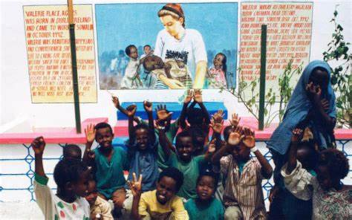
The Irish Department of Foreign Affairs founds the Valerie Place commemorative scholarship in March 1993, which brings Somali teachers and nurses to train in Ireland. In June 1997, St. James’s Hospital school of nursing unveils a portrait and a classroom dedicated to her memory. There is also a mural to Place in Mogadishu (pictured above).


Leave a comment

Birth of Archie Doyle, Anti-Treaty Irish Republican Army Member

Archie Doyle, one of three anti-Treaty members of the Irish Republican Army (IRA) who assassinated the Irish Minister for Justice Kevin O’Higgins, is born on September 29, 1903. He has a long subsequent career in the organisation’s ranks.

Doyle fights in the Irish War of Independence (1919-21) and takes the anti-Treaty side in the Irish Civil War (1922-23) and is subsequently interned among numerous others. Together with two fellow-detainees, Timothy Coughlin and Bill Gannon, he takes part in forming a secret “vengeance grouping.” The three vow that once free of imprisonment they will take revenge on their opponents, whom they consider traitors to the Irish cause.

Most such private revenge pacts are broken up by the IRA leadership when it reorganises following 1924, but Doyle and his two fellow conspirators persist and carry through their deadly aim. On July 10, 1927, the three surprised O’Higgins on his way to Mass at the Booterstown Avenue side of Cross Avenue in Blackrock, Dublin, and shoot him down.

O’Higgins is especially hated by IRA members for having ordered the executions of seventy-seven of their fellows during the Civil War, an act for which he outspokenly takes responsibility and refuses to express any remorse. Moreover, he is a dominant member of the Irish Free State government, and the conspirators have good reasons to believe that his death would weaken it.

The three make their escape and are not apprehended. However, Timothy Coughlin is shot to death by police informer Sean Harling on the night of January 28, 1928, on Dublin’s Dartry Road, under circumstances which remain controversial up to the present. A second IRA man is known to have been with Coughlin that night, in surveillance of Harling’s home, and escapes unharmed. It is believed that Doyle is that second man, though this point, as many other details of this still rather mysterious affair, remains not quite certain.

Doyle is among the beneficiaries of the amnesty issued by Éamon de Valera when he comes to power in 1932, under which numerous IRA men are released from prison and the charges against others dropped. In later times Doyle openly admits his part in the killing of O’Higgins, and indeed takes pride in it, without fear of prosecution.

With the end of the IRA’s alliance with de Valera and the increasing confrontation between them, Doyle, now a veteran highly respected in the IRA circles, becomes deeply involved in the organisation’s 1940s campaigns. Harry, the memoirs of IRA man Harry White, make repeated admiring references to “Archie Doyle of Dublin, the Tan War veteran who had fought through it all.”

During the IRA’s Northern campaign, Doyle is said to have participated in the abortive raid on the British barracks at Crossmaglen, County Armagh, on September 2, 1942, in retaliation for the execution of Tom Williams earlier that morning. The IRA unit, some twenty men in a commandeered lorry and accompanying car, is discovered by a passing Royal Ulster Constabulary (RUC) patrol near the village of Cullaville. Doyle is mentioned in White’s memoirs as having “jumped out of the car, Thompson in hand, and started shooting at the RUC.” Since the element of surprise is lost, the attack on the barracks has to be cancelled.

A week later, on September 9, White mentions Doyle as having commanded the assassination of Sergeant Denis O’Brien, Irish Special Branch detective and himself a former IRA man, near Dublin. It is a highly controversial affair, opposed by the IRA GHQ in Belfast as damaging to the Northern campaign, and precipitates a massive manhunt by the Irish police. It is IRA Chief of Staff Charlie Kerins who is caught two years later, charged with the O’Brien assassination and eventually executed for it. White, however, claims that it is Doyle who actually commands that action, on Kerins’s orders. Doyle, who openly spoke of his part in killing O’Higgins, seems far more reticent about this part of his career.

In 1943 Doyle is assigned as the IRA’s Quartermaster General in Belfast.

On July 1, 1943, Doyle is mentioned as having participated, together with Kerins and with Jackie Griffith, in an operation of “fund-raising” for the hard-pressed IRA (i.e., robbery). The three men arrive on bikes at the gates of Player Wills factory on the South Circular Road, Dublin, and with scarves around their faces stop at gunpoint a van loaded with some £5,000 for wages and drive away with the van and the money.

Griffith is shot down by the police in Dublin less than a week later, in what is charged to be an extrajudicial assassination, and Kerins is caught in 1944 and executed, becoming a major IRA martyr. Doyle, however, continually survives decades of a very dangerous way of life and manages to die of old age. He dies in St. James’s Hospital in Dublin in 1980.


Leave a comment

Birth of Leo Varadkar, Fine Gael Politician & Taoiseach

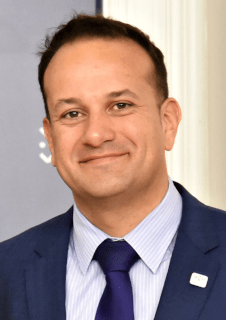
Leo Eric Varadkar, Irish Fine Gael politician who is serving since June 2020 as Tánaiste and Minister for Enterprise, Trade and Employment, is born on January 18, 1979, in the Rotunda Hospital, Dublin.

Varadkar is the third child and only son of Ashok and Miriam (née Howell) Varadkar. His father was born in Bombay (now Mumbai), India, and moved to the United Kingdom in the 1960s to work as a doctor. His mother, born in Dungarvan, County Waterford, meets her future husband while working as a nurse in Slough, Berkshire, England. He is educated at the St. Francis Xavier national school in Blanchardstown, Dublin, and then The King’s Hospital, a Church of Ireland secondary school in Palmerstown. During his secondary schooling, he joins Young Fine Gael. He is admitted to Trinity College Dublin (TCD), where he briefly reads law before switching to its School of Medicine. At TCD, he is active in the university’s Young Fine Gael branch and serves as Vice-President of the Youth of the European People’s Party, the youth wing of the European People’s Party, of which Fine Gael is a member. He is selected for the Washington Ireland Program for Service and Leadership (WIP), a half-year personal and professional development program in Washington, D.C., for students from Ireland.

Varadkar graduates in 2003, after completing his internship at King Edward Memorial Hospital in Mumbai. He then spends several years working as a non-consultant hospital doctor in St. James’s Hospital, Dublin, and Connolly Hospital, Blanchardstown, before specialising as a general practitioner in 2010.

In 2004, Varadkar joins Fine Gael and becomes a member of Fingal County Council and later serves as Deputy Mayor of Fingal. He is elected to Dáil Éireann for the first time in 2007. During the campaign for the 2015 same-sex marriage referendum, he comes out as gay, becoming the first serving Irish minister to do so.

Varadkar is elected a Teachta Dála (TD) for the Dublin West constituency in 2007. He serves under Taoiseach Enda Kenny as Minister for Transport, Tourism and Sport from 2011 to 2014, Minister for Health from 2014 to 2016, and Minister for Social Protection from 2016 to 2017.

In May 2017, Kenny announces that he is planning to resign as Taoiseach and Fine Gael leader. Varadkar stands in the leadership election to replace him. Although more party members vote for his opponent, Simon Coveney, he wins by a significant margin among Fine Gael members of the Oireachtas and is elected leader on June 2. Twelve days later, he is appointed Taoiseach, and at 38 years of age becomes the youngest person to hold the office. He is Ireland’s first, and the world’s fourth, openly gay head of government and the first Taoiseach of Indian heritage.

In 2020, Varadkar calls a general election to be held in February. While polls in 2019 have suggested a favourable result for Fine Gael, they ultimately come in third in terms of seats and votes, behind Fianna Fáil and Sinn Féin, with 35 seats, a loss of 15 seats for the party from the previous general election, when it had finished in first position. He resigns and is succeeded by Micheál Martin as Taoiseach. He is subsequently appointed Tánaiste and Minister for Enterprise, Trade and Employment as part of a three-party coalition composed of Fianna Fáil, Fine Gael and the Green Party.


Leave a comment

Birth of Peter Sutherland, Barrister & Politician

File source: http://commons.wikimedia.org/wiki/File:Peter-Sutherland-2011.jpg

Peter Denis Sutherland, businessman, barrister and politician, is born in Foxrock, Dublin on April 25, 1946. He is a barrister by profession and a Senior Counsel of the Bar Council of Ireland. He is known for serving in a variety of international organisations, political and business roles.

Sutherland is educated at Gonzaga College, Ranelagh, Dublin. He is of partial Scottish ancestry. He graduates in Civil Law at University College Dublin and practices at the Irish Bar between 1969 and 1980. He marries Maruja Sutherland, a Spaniard, in 1974.

Sutherland makes his entry into politics when he is appointed Attorney General of Ireland in June 1981. He resigns in March 1982 only to take the post again between December 1982 and December 1984.

Sutherland is appointed to the European Commission in 1985. He is Chairman of the Committee that produces The Sutherland Report on the completion of the Internal Market of the European Economic Community (EEC), commissioned by the European Commission and presented to the European Council at its Edinburgh meeting in 1992.

Sutherland serves as United Nations Special Representative of the Secretary-General for International Migration from January 2006 until March 2017. He is responsible for the creation of the Global Forum on Migration and Development (GFMD). He also serves as President of the International Catholic Migration Commission, as well as member of the Migration Advisory Board of the International Organisation for Migration.

In 1993, Sutherland becomes Director-General of the General Agreement on Tariffs and Trade, now the World Trade Organization. He serves as Chairman of Allied Irish Banks (AIB) from 1989 to 1993 and as Chairman of Goldman Sachs from 1995 to 2015.

In September 2016, Sutherland suffers a heart attack while on his way to Mass at a Catholic Church in London. Six months later, he resigns from his post as United Nations Special Representative of the Secretary-General for International Migration because of poor health. After a long illness, he dies at St. James’s Hospital in Dublin on January 7, 2018, of complications from an infection, at the age of 71. He is buried in Kilternan Cemetery Park in Dublin.

Peter Sutherland received numerous awards including European Person of the Year Award (1988).

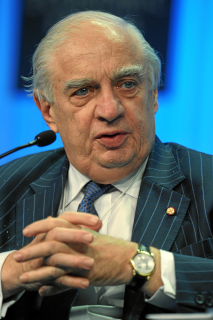
(Pictured: Peter D. Sutherland, Chairman, Goldman Sachs International, United Kingdom; Member of the Foundation Board of the World Economic Forum, speaks during the session ‘China’s Impact on Global Trade and Growth’ at the Annual Meeting 2011 of the World Economic Forum in Davos, Switzerland, January 27, 2011. Copyright by World Economic Forum swiss-image.ch/Photo by Michael Wuertenberg)


Leave a comment

Liam Cosgrave Elected Taoiseach of Ireland

liam-cosgrave

Liam Cosgrave is elected the sixth Taoiseach of Ireland on March 14, 1973. He serves in the position from March 1973 to July 1977.

Cosgrave is born on April 13, 1920, in Castleknock, County Dublin. His father, William Thomas Cosgrave, was the first President of the Executive Council and head of the government of the Irish Free State during the first 10 years of its existence (1922–32). The eldest son, he is educated at Synge Street CBS, Castleknock College, Dublin, studies law at King’s Inns and is called to the Irish bar in 1943. In that same year he enters Dáil Éireann (the lower house of the Oireachtas, the Irish parliament), and he retains his seat until his retirement from politics in 1981.

In 1948, when the first inter-party government replaces Éamon de Valera’s Fianna Fáil regime, which had been in power for the previous 16 years, Cosgrave becomes parliamentary secretary to the Taoiseach and to the Minister for Industry and Commerce. It is a short-lived administration, going out of power in 1951 after three years of rule. But in a second inter-party government (1954–57), he becomes Minister for External Affairs and leads the first Irish delegation to the United Nations General Assembly in 1956.

Cosgrave succeeds James Dillon as leader of the Fine Gael party in 1965. Eight years later, as leader of a coalition government in which Fine Gael combines forces with the Labour Party, he becomes Taoiseach. He and British Prime Minister Edward Heath are the main participants in the intergovernmental conference at Sunningdale in December 1973 that gives birth to Northern Ireland’s first, though short-lived, power-sharing executive (1973–74).

A devout Roman Catholic, Cosgrave is intensely conservative on social issues and shocks his cabinet colleagues by voting against his own government’s bill on liberalizing the sale of contraceptives in 1974. The National Coalition is defeated in the general election of June 1977, largely on the economic issues of inflation and unemployment.

In 1981, Cosgrave retires as Dáil Deputy for Dún Laoghaire to be replaced by his son, Liam T. Cosgrave. He reduces his involvement in public life, but he makes occasional appearances and speeches. In October 2010 he attends the launch of The Reluctant Taoiseach, a book about former Taoiseach John A. Costello written by David McCullagh. He also appears in public for the Centenary of the Easter Rising in 2016, watching from a car as the military parade marches through Dublin. On May 8, 2016, in a joint appearance with the grandsons of Éamonn Ceannt and Cathal Brugha, he unveils a plaque commemorating the 1916 Rising at St. James’s Hospital, the former site of the South Dublin Union.

Liam Cosgrave dies on October 4, 2017, at the age of 97 of natural causes. He had been at Tallaght Hospital for several months prior to his death there. His funeral is held on October 7, 2017, after which he is interred alongside his father at Inchicore‘s Goldenbridge Cemetery.

Taoiseach Leo Varadkar says “Liam Cosgrave was someone who devoted his life to public service; a grateful country thanks and honours him for that and for always putting the nation first. Throughout his life he worked to protect and defend the democratic institutions of our State and showed great courage and determination in doing so. He always believed in peaceful co-operation as the only way of achieving a genuine union between the people on this island, and in the 1970s he celebrated that this country had embarked, in his own words, ‘on a new career of progress and development in the context of Europe’. I had the honour on a few occasions to meet and be in the presence of Liam Cosgrave, and I was always struck by his commanding presence and great humility, which in him were complementary characteristics.”


Leave a comment

Death of Sportswriter Con Houlihan

Con Houlihan, Irish sportswriter, dies in Dublin on August 4, 2012. Despite only progressing to national journalism at the age of 46, he becomes “the greatest and the best-loved Irish sports journalist of all.”

Houlihan is born on December 6, 1925, in Castleisland, County Kerry. Over a lengthy career, Houlihan covers many Irish and international sporting events, from Gaelic football and hurling finals, to soccer and rugby World Cups, the Olympic Games and numberless race meetings inside and outside Ireland.

Houlihan is a journalist with the Irish Press group writing for The Irish Press, Evening Press and sometimes The Sunday Press, until the group’s demise in 1995. He writes the “Tributaries” column and Evening Press back sports page “Con Houlihan” column.

Houlihan dies on the morning of August 4, 2012 in St. James’s Hospital in Dublin. Often considered one of Ireland’s finest writers, he leaves behind a legacy of immense sports journalism that spans over 60 years. A minute’s silence is observed in his memory ahead of Kerry GAA‘s All-Ireland Senior Football Championship quarter-final defeat to Donegal GAA at Croke Park the following day. His last column, in which he wishes Irish Olympic boxer Katie Taylor well, is published the day after his death. His funeral takes place on August 8, 2012.

Ireland’s president, Michael D. Higgins, leads the tributes to Houlihan, describing him as a “most original writer, with a unique style based on his extensive knowledge of literature, politics, life and sport.” He adds, “He had that special quality and ability to identify with the passion, pain and celebration of Irish community life.”

A bronze bust of Houlihan is unveiled in his hometown of Castleisland in 2004. In 2011, another sculpture is erected outside The Palace bar in Dublin.