seamus dubhghaill

Promoting Irish Culture and History from Little Rock, Arkansas, USA


Leave a comment

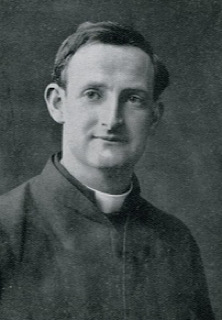
Birth of Father Willie Doyle

William Joseph Gabriel DoyleSJMC, an Irish Catholic priest, is born in Dalkey, County Dublin, on March 3, 1873. He is killed in action while serving as a military chaplain to the Royal Dublin Fusiliers during the World War I. He is a candidate for sainthood in the Catholic Church.

Doyle is the youngest of seven children of Hugh and Christine Doyle (née Byrne). He is educated at Ratcliffe College, a Catholic boarding school in Leicester, England.

After reading St. Alphonsus‘ book Instructions and Consideration on the Religious State, he is inspired to enter the priesthood. In March 1891, he enters the Society of Jesus (Jesuits) in Ireland. He then enters St. Stanislaus College in Tullabeg, Rahan, County Offaly. Having completed his novitiate, for his regency he is assigned to teach. He teaches at Belvedere College, Dublin, and at Clongowes Wood College, County Kildare, between 1894 and 1898. He then studies philosophy at Collège Saint-Augustin in Enghien, Belgium, and Stonyhurst College, England. From 1904 to 1907, he studies theology at Milltown College and University College Dublin (UCD).

He was ordainedCatholic priest on July 28, 1907. He then undertakes his tertianship at Drongen AbbeyDrongen, Belgium. He takes his final vows on February 2, 1909. From 1909 until 1915 he serves on the Jesuit mission team, traveling around Ireland and Britain preaching parish missions and conducting retreats. In 1914 he is involved in the foundation of a Colettine Poor Clares monastery in Cork, County Cork. He is an early member of the Pioneer Total Abstinence Association and is considered a future leader of the organisation by its founder, Fr. James Cullen.

Doyle volunteers to serve in the Royal Army Chaplains’ Department of the British Army during World War I. He is appointed as a chaplain with the 16th (Irish) Division. He is assigned to the 8th Battalion, Royal Irish Fusiliers, and is posted with them to the Western Front. During the Battle of Loos he is caught in a German gas attack and for his conduct is mentioned in dispatches. A recommendation for a Military Cross is rejected as “he had not been long enough at the front.” He is presented with the “parchment of merit” of the 49th (Irish) Brigade instead. On August 16, 1917, he is killed in action at the Battle of Langemarck “while administering the last rites to his stricken countrymen.”

Doyle is awarded the Military Cross for his bravery during the assault on the village of Ginchy during the Battle of the Somme in 1916. He is also posthumously recommended for both the Victoria Cross and the Distinguished Service Order, but is awarded neither. It is possible that  anti-Catholicism played a role in the British Army’s decision not to grant him both awards.

General William Hickie, the commander-in-chief of the 16th (Irish) Division, describes Father Doyle as “one of the bravest men who fought or served out here.”

Doyle’s body is never recovered but he is commemorated at Tyne Cot Commonwealth War Graves Cemetery and Memorial to the Missing in the Ypres Salient on the Western Front.

Doyle is proposed for canonisation in 1938, but this is not followed through. His papers can be found in the Jesuit archives, Leeson Street, Dublin.

A stained glass window dedicated to Doyle’s memory is present in St. Finnian’s Church, Dromin, County Louth.

Despite his troubled relationship with the Catholic Church in Ireland, Irish author and playwright Brendan Behan is known to have always felt a great admiration for Doyle. He praises Doyle in his 1958 memoir Borstal BoyAlfred O’Rahilly‘s biography of the fallen chaplain is known to have been one of Behan’s favorite books.

Irish folk singer Willie ‘Liam’ Clancy is named after Doyle due to his mother’s fondness for him, although they never meet.

In August 2022, the Father Willie Doyle Association is established to petition the Catholic Church to introduce a cause for canonisation for Doyle. In January 2022, the Supplex Libellus, the formal petition, is presented to Bishop Thomas Deenihan. Having consulted with the Irish Bishops’ Conference and the Dicastery for the Causes of Saints, Deenihan issues an edict on October 27, 2022, announcing the opening of a cause. The Opening Session takes place on November 20, 2022, at the Cathedral of Christ the King, Mullingar.


Leave a comment

Death of Francis Browne, Irish Jesuit & Photographer

Francis Patrick Mary Browne, distinguished Irish Jesuit and a prolific photographer, dies in Dublin on July 7, 1960. His best-known photographs are those of the RMS Titanic and its passengers and crew taken shortly before its sinking in 1912. He is decorated as a military chaplain during World War I.

Browne is born to a wealthy family in 1880 at Buxton House, Cork, County Cork, the youngest of the eight children of James and Brigid (née Hegarty) Browne. His mother is the niece of William Hegarty, Lord Mayor of Cork, and a cousin of Sir Daniel Hegarty, the first Lord Mayor of Cork. She dies of puerperal fever eight days after his birth. After the death of his father in a swimming accident at Crosshaven on September 2, 1889, he is raised and supported by his uncle, Robert Browne, Bishop of Cloyne, who buys him his first camera shortly before the younger man embarks on a tour of Europe in 1897.

Browne spends his formative years at Bower Convent, Athlone (1888–91), Belvedere College (1891–92), Christian Brothers College, Cork (1892–1893), St. Vincent’s Castleknock College (1893–97), graduating in 1897. He goes on the aforementioned tour of Europe, where he begins taking photographs.

Upon his return to Ireland, Browne joins the Jesuits and spends two years in the novitiate at St. Stanislaus College, Tullabeg, County Offaly. He attends the Royal University of Ireland, Dublin, where he is a classmate of James Joyce, who features him as Mr. Browne the Jesuit in Finnegans Wake. In 1909, he visits Rome with his uncle and brother, a bishop and priest respectively, during which they have a private audience with Pope Pius X with the Pope allowing Browne to take his photograph. He studies theology at the Milltown Institute of Theology and Philosophy in Dublin from 1911 to 1916.

In April 1912 Browne receives a present from his uncle: a ticket for the maiden voyage of RMS Titanic from Southampton, England, to Queenstown, Ireland, via Cherbourg, France. He travels to Southampton via Liverpool and London, boarding the RMS Titanic on the afternoon of April 10, 1912. He is booked in cabin A-37 on the Promenade Deck. He takes dozens of photographs of life aboard RMS Titanic on that day and the next morning. He captures the last known images of many crew and passengers, including captain Edward J. Smith, gymnasium manager T. W. McCawley, engineer William Parr, Major Archibald Butt, writer Jacques Futrelle and numerous third-class passengers whose names are unknown.

During his voyage on the RMS Titanic, Browne is befriended by an American millionaire couple who are seated at his table in the liner’s first-class dining saloon. They offer to pay his way to New York and back in return for him spending the voyage to New York in their company. He telegraphs his superior, requesting permission, but the reply is an unambiguous “GET OFF THAT SHIP – PROVINCIAL.”

Browne leaves the RMS Titanic when she docks in Queenstown and returns to Dublin to continue his theological studies. When the news of the ship’s sinking reaches him, he realises that his photos would be of great interest, and he negotiates their sale to various newspapers and news cartels. They appear in publications around the world. The Eastman Kodak Company subsequently gives him free film for life, and he often contributes to The Kodak Magazine. It is unknown what type of camera he used to shoot the famous photos aboard RMS Titanic.

After his ordination on July 31, 1915, Browne completes his theological studies. In 1916, he is sent to Europe to join the Irish Guards as a chaplain. He serves with the Guards until the spring of 1920, including service at the Battle of the Somme and at Locre, Wytschaete, Messines Ridge, Paschendaele, Ypres, Amiens and Arras in Flanders.

Browne is wounded five times during the war, once severely in a gas attack. He is awarded the Military Cross (MC) on June 4, 1917 “for distinguished service in the field”. He is awarded a bar to his MC on February 18, 1918. He is also awarded the Croix de Guerre by France.

Browne takes many photographs during his time in Europe. One, which he calls “Watch on the Rhine,” is considered a classic image of World War I. He assembles a collection of his war photographs in an album named after his most famous photograph and distributes copies to his colleagues in the Guards.

After the war, Browne returns to Dublin, where, in 1922, he is appointed superior of Gardiner Street Church in Dublin. Ill health dogs him, however, and in 1924 it is thought that he would recover more quickly in warmer climes. He is sent on an extended visit to Australia. He takes his camera along, photographing life aboard ship and in Cape Town, South Africa, where he breaks his voyage.

On his way back to Ireland, Browne visits Ceylon, Aden, Suez, Saloniki, Naples, Toulon, Gibraltar, Algeciras, and Lisbon, taking photographs of local life and events at every stop. It is estimated that he takes more than 42,000 photographs during his life.

Browne resumes office as the Superior of Saint Francis Xavier Church, Dublin, upon his return. In 1929 he is appointed to the Retreats and Mission staff of the Irish Jesuits. His work entails preaching at missions and religious retreats all over Ireland. As most of this work is necessarily performed on evenings and Sundays, he has considerable time to indulge in his hobby during the daytime. He takes photographs of many parishes and towns in Ireland, and also photographs in London and East Anglia during his ecclesiastical travels to England.

Browne dies in Dublin on July 7, 1960, and is buried in the Jesuit plot in Glasnevin Cemetery in Dublin. His negatives lay forgotten for 25 years after his death. They are found by chance in 1985 when Father Edward E. O’Donnell discovers them in a large metal trunk, once belonging to Browne, in the Irish Jesuit archives. “When the trunk was opened in 1985, people compared him to the greats like Henri Cartier-Bresson and Robert Doisneau, but his work predated theirs by decades,” archivist David Davison later recalls.

O’Donnell brings the negatives to the attention of several publishers. The RMS Titanic photographs are published in 1997 as Father Browne’s Titanic Album with text by E. E. O’Donnell (Fr. Eddie O’Donnell). In all, at least 25 volumes of Browne’s photographs have now been published. The features editor of The Sunday Times of London calls this “the photographic equivalent to the discovery of the Dead Sea Scrolls.” Many of these books have become best-sellers, the latest being the Centenary Edition of Father Browne’s Titanic Album in 2012 by Messenger Publications, Dublin.

The Irish province of the Jesuits, the owner of the negatives pursuant to Browne’s will, engage photographic restoration specialists David and Edwin Davison to preserve and catalogue the fragile and unstable negatives. The Davisons make copies of every negative and are in the process of transferring every usable image to a digital format for future generations. The Davisons later acquire the rights to the photographs and still own the rights as Davison & Associates.