seamus dubhghaill

Promoting Irish Culture and History from Little Rock, Arkansas, USA


Leave a comment

Death of George William Russell, Writer, Critic & Poet

George William Russell, Irish writer, editor, critic, poet, painter and Irish nationalist, dies of cancer in Bournemouth, England, on July 17, 1935.

Russell is born on April 10, 1867, in Lurgan, County Armagh, in what is now Northern Ireland. He writes with the pseudonym Æ (often written AE or A.E.). He is also a writer on mysticism, and a central figure in the group of devotees of theosophy which meets in Dublin for many years. He takes his pseudonym from a proofreader’s query about his earlier pseudonym, “AEon.”

Russell is the second son of Thomas Russell and Mary Armstrong. His father, the son of a small farmer, becomes an employee of Thomas Bell and Co., a prosperous firm of linen drapers. The family relocates to Dublin, where his father has a new offer of employment, when he is eleven years old.

Russell is educated at Rathmines School and the Metropolitan School of Art, where he begins a lifelong, if sometimes contentious, friendship with W. B. Yeats. In the 1880s, he lives at the Theosophical Society lodge at 3 Upper Ely Place, sharing rooms with Hamilton Malcolm Magee, the brother of William Kirkpatrick Magee.

Following his time at the Metropolitan School of Art, Russell becomes an accounts clerk in a drapery store but leaves in 1897 to organize agricultural cooperatives. Eventually he becomes editor of the periodicals Irish Homestead (1905–23) and The Irish Statesman (1923–30). In 1894 he publishes the first of many books of verse, Homeward: Songs by the Way, which establishes him in what is known as the Irish Literary Revival. His first volume of Collected Poems appears in 1913 and a second in 1926. He maintains a lifelong interest in theosophy, the origins of religion, and mystical experience. Candle of Vision: Autobiography of a Mystic (1918) is the best guide to his religious beliefs.

At the turn of the 20th century, Russell is considered by many to be the equal of Yeats, but he does not continue to grow and develop as Yeats does. He is prolific and versatile, but many critics find his poetry facile, vague, and monotonous, with “rather too much of the Celtic Twilight” in it.

Russell designs the famous Starry Plough flag for the Irish Citizen Army, which is unveiled on April 5, 1914, and flown during the Easter Rising in April 1916.

Russell, who had become increasingly unhappy in the Irish Free State which, according to Yeats, he called “a country given over to the Devil,” moves to England soon after his wife’s death in 1932. Despite his failing health he goes on a final lecture tour in the United States but returns home utterly exhausted. He dies of cancer in Bournemouth, England, on July 17, 1935. His body is brought back to Ireland, and he is interred in Mount Jerome Cemetery, Dublin.

Leave a comment

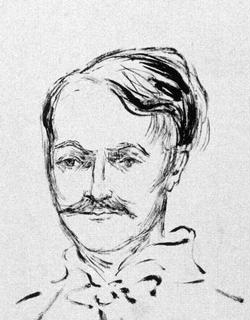
Birth of George William Russell, Writer, Poet & Nationalist

George William Russell, Irish writer, editor, critic, poet, painter and Irish nationalist, is born on April 10, 1867, in Lurgan, County Armagh, in what is now Northern Ireland. He writes with the pseudonym Æ (often written AE or A.E.). He is also a writer on mysticism, and a central figure in the group of devotees of theosophy which meets in Dublin for many years. He takes his pseudonym from a proofreader’s query about his earlier pseudonym, “AEon.”

Russell is the second son of Thomas Russell and Mary Armstrong. His father, the son of a small farmer, becomes an employee of Thomas Bell and Co., a prosperous firm of linen drapers. The family relocates to Dublin, where his father has a new offer of employment, when he is eleven years old.

Russell is educated at Rathmines School and the Metropolitan School of Art, where he begins a lifelong, if sometimes contentious, friendship with W. B. Yeats. In the 1880s, he lives at the Theosophical Society lodge at 3 Upper Ely Place, sharing rooms with Hamilton Malcolm Magee, the brother of William Kirkpatrick Magee.

Following his time at the Metropolitan School of Art, Russell becomes an accounts clerk in a drapery store but leaves in 1897 to organize agricultural cooperatives. Eventually he becomes editor of the periodicals Irish Homestead (1905–23) and The Irish Statesman (1923–30). In 1894 he publishes the first of many books of verse, Homeward: Songs by the Way, which establishes him in what is known as the Irish Literary Revival. His first volume of Collected Poems appears in 1913 and a second in 1926. He maintains a lifelong interest in theosophy, the origins of religion, and mystical experience. Candle of Vision: Autobiography of a Mystic (1918) is the best guide to his religious beliefs.

At the turn of the 20th century, Russell is considered by many to be the equal of Yeats, but he does not continue to grow and develop as Yeats does. He is prolific and versatile, but many critics find his poetry facile, vague, and monotonous, with “rather too much of the Celtic Twilight” in it.

Russell designs the famous Starry Plough flag for the Irish Citizen Army, which is unveiled on April 5, 1914, and flown during the Easter Rising in April 1916.

Russell, who had become increasingly unhappy in the Irish Free State which, according to Yeats, he called “a country given over to the Devil,” moves to England soon after his wife’s death in 1932. Despite his failing health he goes on a final lecture tour in the United States but returns home utterly exhausted. He dies of cancer in Bournemouth, England, on July 17, 1935. His body is brought back to Ireland, and he is interred in Mount Jerome Cemetery, Dublin.


Leave a comment

Birth of James Henry Cousins, Playwright & Actor

james-h-cousins

James Henry Cousins, Irish writer, playwright, actor, critic, editor, teacher and poet, is born in Belfast on July 22, 1873, a descendant of Huguenot refugees. He uses several pseudonyms including Mac Oisín and the Hindu name Jayaram.

Largely self-educated at night schools, Cousins works some time as a clerk and becomes private secretary and speechwriter to Sir Daniel Dixon, 1st Baronet, the Lord Mayor of Belfast. In 1897 he moves to Dublin where he becomes part of a literary circle which includes William Butler Yeats, George William Russell and James Joyce. It is believed that he serves as a model for the Little Chandler character in Joyce’s short story collection Dubliners.

Cousins is significantly influenced by Russell’s ability to reconcile mysticism with a pragmatic approach to social reforms and by the teachings of Helena Blavatsky. He has a lifelong interest in the paranormal and acts as reporter in several experiments carried out by William Fletcher Barrett, Professor of physics at the University of Dublin and one of the founders of the Society for Psychical Research.

Cousins produces several books of poetry while in Ireland as well as acting in the first production of Cathleen ní Houlihan, under the stage name of H. Sproule, with the famous Irish revolutionary and beauty Maud Gonne in the title role. His plays are produced in the first years of the twentieth century in the Abbey Theatre, the most famous being “the Racing Lug”. After a dispute with W.B. Yeats, who objects to “too much Cousins,” the Irish National Theatre movement splits with two-thirds of the actors and writers siding with Cousins against Yeats.

Cousins also writes widely on the subject of Theosophy and in 1915 travels to India with the voyage fees paid for by Annie Besant, the President of the Theosophical Society. He spends most of the rest of his life in the sub-continent, apart from a year as Professor of English Literature at Keio University in Tokyo and another lecturing in New York. Toward the end of his life, he converts to Hinduism. At the core of Cousins’s engagement with Indian culture is a firm belief in the “shared sensibilities between Celtic and Oriental peoples.”

While in India he becomes friendly with many key Indian personalities including poet Rabindranath Tagore, Indian classical dancer Rukmini Devi Arundale, painter Abdur Rahman Chughtai and Mahatma Gandhi. He is the person who brings change into the life of poetry of the great renowned Kannada poet and writer Kuvempu. He writes a joint autobiography with his wife Margaret Elizabeth Cousins, a suffragette and one of the co-founders of the Irish Women’s Franchise League and All India Women’s Conference (AIWC).

In his The Future Poetry Sri Aurobindo acclaims Cousins’ New Ways in English Literature as “literary criticism, which is of the first order, at once discerning and suggestive, criticism which forces us both to see and think.” He also acknowledges that he learned to intuit deeper being alerted by Cousins’ criticisms of his poems. In 1920 Cousins comes to Pondicherry to meet the Mother and Sri Aurobindo.

James Cousins dies on February 20, 1956, in Madanapalle, Andhra Pradesh, India at the age of 82.


Leave a comment

Birth of Margaret “Gretta” Cousins, Educationist & Suffragist

Margaret Elizabeth Cousins (née Gillespie), also known as Gretta Cousins, Irish Indian educationist, suffragist and Theosophist, is born into an Irish Protestant family in Boyle, County Roscommon, on October 7, 1878.

Gillespie is educated locally and in Derry. She studies music at the Royal University of Ireland in Dublin, graduating in 1902, and becomes a teacher. As a student she meets the poet and literary critic James Cousins. They are married in 1903. The pair explore socialism, vegetarianism, and parapsychology together. In 1906, after attending a National Conference of Women (NCW) meeting in Manchester, Cousins joins the Irish branch of the NCW. In 1907 she and her husband attend the London convention of the Theosophical Society, and she makes contact with suffragettes, vegetarians, anti-vivisectionists, and occultists in London.

Cousins co-founds the Irish Women’s Franchise League with Hanna Sheehy-Skeffington in 1908, serving as its first treasurer. In 1910 she is one of six Dublin women attending the Parliament of Women, which attempt to march to the House of Commons to hand a resolution to the Prime Minister. After 119 women marching to the House of Commons have been arrested, fifty requiring medical treatment, the women decide to break the windows of the houses of Cabinet Ministers. Cousins is arrested and sentenced to a month in Holloway Prison.

Vacationing with William Butler Yeats in 1912, Cousins and her husband hear Yeats read translations of poems by Rabindranath Tagore. In 1913, breaking the windows of Dublin Castle on the reading of the Second Home Rule Bill, Cousins and other suffragists are arrested and sentenced to one month in Tullamore Jail. The women demand to be treated as political prisoners and go on hunger strike to achieve release.

In 1913, she and her husband move to Liverpool, where James Cousins works in a vegetarian food factory. In 1915 they move to India. James Cousins initially works for New India, the newspaper founded by Annie Besant. After Besant is forced to dismiss him for an article praising the 1916 Easter Rising, she appoints him Vice-Principal of the new Besant Theosophical College, where Margaret teaches English.

In 1916, Cousins becomes the first non-Indian member of the SNDT Women’s University at Poona. In 1917, Cousins co-founds the Women’s Indian Association (WIA) with Annie Besant and Dorothy Jinarajadasa. She edits the WIA’s journal, Stri Dharma. In 1919 Cousins becomes the first Head of the National Girls’ School at Mangalore. She is credited with composing the tune for the Indian national anthem Jana Gana Mana in February 1919, during Rabindranath Tagore’s visit to Besant Theosophical College. In 1922, she becomes the first woman magistrate in India. In 1927, she co-founds the All India Women’s Conference, serving as its President in 1936.

In 1932, she is arrested and jailed for speaking against the Emergency Measures. By the late 1930s she feels conscious of the need to give way to indigenous Indian feminists:

“I longed to be in the struggle, but I had the feeling that direct participation by me was no longer required, or even desired by the leaders of India womanhood who were now coming to the front.”

A stroke leaves Cousins paralysed from 1944 onwards. She receives financial support from the Madras government, and later Jawaharlal Nehru, in recognition of her services to India. She dies on March 11, 1954. Her manuscripts are dispersed in various collections across the world.