seamus dubhghaill

Promoting Irish Culture and History from Little Rock, Arkansas, USA


Leave a comment

Sinking of the British Steamship Centurion

The U-20, a German U-boat under the command of  Kapitänleutnant Walther Schwieger, sinks the British steamship Centurion off the southeast coast of Ireland on May 6, 1915. This tragic event has far-reaching consequences and shapes the course of World War I.

The Centurion is traveling through the waters southeast of Ireland when a torpedo fired from the U-20 hits the vessel, causing it to rapidly sink. This act of aggression results in the loss of many innocent lives and sends shockwaves throughout the world.

At the time of the incident, World War I is in full swing. Germany, engaged in submarine warfare, seeks to disrupt British supply lines and cut off its access to vital resources. The sinking of merchant ships, regardless of their civilian nature, is part of Germany’s strategy to weaken the enemy. The attack on the Centurion is just one of many instances in which German submarines target and sink British vessels.

A difference in this particular incident as opposed to other similar incidents is the widespread outrage it triggers. The Centurion is an unarmed cargo ship carrying civilian goods, and its destruction is seen as a ruthless and unjustifiable act. The loss of civilian lives and the callousness with which the submarine attack is executed causes public opinion to turn against Germany.

The sinking highlights the growing concern over unrestricted submarine warfare and its impact on civilian populations. It pushes the United States, which at the time is neutral, closer to entering the war on the side of the Allies. The incident also plays a significant role in shaping public opinion in other neutral countries, putting pressure on Germany to reconsider its aggressive tactics.

In response to international outrage, Germany initially defends its actions, arguing that the Centurion was carrying contraband cargo. However, under mounting pressure, the German government eventually backs down and pledges to modify its submarine warfare policies to reduce the risk to civilian lives. This move is meant to appease neutral countries and prevent the United States from entering the war.

The sinking of the Centurion has a lasting impact on maritime warfare. The incident leads to the introduction of new rules of engagement, such as the requirement for submarines to surface and warn civilian vessels before attacking. These rules aim to minimize civilian casualties and reduce the risk of similar tragedies occurring in the future.

Moreover, the sinking serves as a catalyst for technological advancements in submarine warfare. Navies worldwide realize the need for more sophisticated anti-submarine measures and began developing detection systems and tactics to counter the stealth of submarines. This incident marks a turning point in the evolution of naval warfare, as nations seek to adapt and respond to the new challenges posed by underwater vessels.

The following day, May 7, 1915, the U-20 sinks the British ocean liner RMS Lusitania off the southern coast of Ireland. The liner sinks in eighteen minutes with 1,197 casualties. The wreck lies in 300 feet of water.

On November 4, 1916, U-20 becomes grounded on the Danish coast south of Vrist, after suffering damage to its engines. Her crew attempts to destroy her with explosives the following day, succeeding only in damaging the boat’s bow but making it effectively inoperative as a warship.

The U-20 remains on the beach until 1925 when the Danish government blows it up in a “spectacular explosion.” The Danish navy removes the deck gun and makes it unserviceable by cutting holes in vital parts. The gun is kept in the naval stores at Holmen, Copenhagen for almost 80 years. The conning tower is removed and placed on the front lawn of the local museum Strandingsmuseum St. George Thorsminde, where it remains today.

(Pictured: The U-20, second from left, at Kiel, Schleswig-Holstein, on February 17, 1914)


Leave a comment

Commissioning of the USS Juneau

USS Juneau (CL-52), a United States Navy Atlanta-class light cruiser, is commissioned on February 14, 1942, with Captain Lyman Knute Swenson in command. The ship becomes horribly famous as the vessel which carries the five Irish American Sullivan brothers to their death on November 13, 1942, after it is hit by a Japanese torpedo at the Battle of Guadalcanal.

The USS Juneau is laid down by Federal Shipbuilding and Drydock Company, Kearny, New Jersey, on May 27, 1940, and launched on October 25, 1941, sponsored by Mrs. Harry I. Lucas, wife of the mayor of the city of Juneau, Alaska.

After a hurried shakedown cruise along the Atlantic Coast in the spring of 1942, USS Juneau assumes blockade patrol in early May off Martinique and the Guadeloupe archipelago to prevent the escape of Vichy French naval units. She returns to New York to complete alterations and operates in the North Atlantic and Caribbean from June 1 to August 12 on patrol and escort duties. The cruiser departs for the Pacific Theater on August 22.

On 8 November, USS Juneau departs Nouméa, New Caledonia, as a unit of Task Force 67 under the command of Rear Admiral Richmond K. Turner to escort reinforcements to Guadalcanal. The force arrives there on the morning of November 12, and USS Juneau takes up her station in the protective screen around the transports and cargo vessels. Unloading proceeds unmolested until 14:05, when 30 Japanese planes attack the alerted United States group. The anti-aircraft fire is effective, and the USS Juneau alone accounts for six enemy torpedo bombers shot down. The few remaining Japanese planes are, in turn, attacked by American fighters with only one bomber escaping. Later in the day, an American attack group of cruisers and destroyers clears Guadalcanal on reports that a large enemy surface force is headed for the island. At 01:48 on November 13, Rear Admiral Daniel J. Callaghan‘s relatively small landing support group engages the enemy. The Japanese force consists of two battleships, one light cruiser, and nine destroyers.

Because of bad weather and confused communications, the battle occurs in near-pitch darkness and at almost point-blank range, as the ships of the two sides become intermingled. During the melee, the USS Juneau is struck on the port side by a torpedo launched by Japanese destroyer Amatsukaze, causing a severe list, and necessitating withdrawal. Before noon on November 13, USS Juneau, along with two other cruisers damaged in the battle, USS Helena (CL-50) and USS San Francisco (CA-38), head toward Espiritu Santo for repairs. USS Juneau is steaming on one screw, keeping station 800 yards off the starboard quarter of the likewise severely damaged USS San Francisco. She is down 12 feet by the bow, but able to maintain 13 knots.

A few minutes after 11:00, two torpedoes are launched from Japanese submarine I-26. These are intended for USS San Francisco, but both pass ahead of her. One strikes USS Juneau in the same place that had been hit during the battle. There is a great explosion, and USS Juneau breaks in two and disappears in just 20 seconds. Fearing more attacks from I-26, and wrongly assuming from the massive explosion that there are no survivors, USS Helena and USS San Francisco depart without attempting to rescue any survivors. In fact, more than 100 sailors survive the sinking of USS Juneau. They are left to fend for themselves in the open ocean for eight days before rescue aircraft belatedly arrive. While awaiting rescue, all but ten die from the elements and shark attacks. Among those lost are the five Sullivan brothers. Two of the brothers apparently survive the sinking, only to die in the water. Two presumably go down with the ship. Some reports indicate the fifth brother also survives the sinking but disappears during the first night when he leaves a raft and gets into the water. On November 20, 1942, USS Ballard (DD-267) recovers two of the ten survivors. Five more in a raft are rescued by a PBY Seaplane five miles away. Three others, including a badly wounded officer, make it to San Cristobal (now Makira) Island, about 55 miles away from the sinking. One of the survivors recovered by USS Ballard says he had been with one of the Sullivan brothers for several days after the sinking.

As a direct result of the Sullivans’ deaths (and the deaths of four of the Borgstrom brothers within a few months of each other two years later), the United States Department of War adopts the Sole Survivor Policy, a set of regulations, partially stipulated by law, that are designed to protect members of a family from the draft during peacetime, or from hazardous duty or other circumstances, if they have already lost family members to military service.

To honor the five Sullivan brothers, who all died in the sinking, and the USS Juneau, the United States Navy later commissions two ships named USS The Sullivans, and two ships named USS Juneau. On March 17, 2018, the wreck of USS Juneau is located by Paul Allen‘s research crew on board RV Petrel at a depth of about 13,800 feet off the coast of the Solomon Islands in several large pieces.


Leave a comment

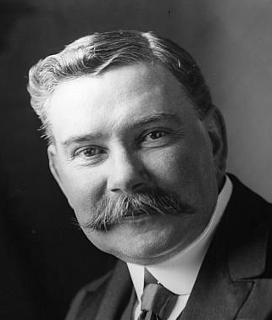
Death of Sir Charles Algernon Parsons, Anglo-Irish Engineer & Scientist

Sir Charles Algernon Parsons, Anglo-Irish engineer and scientist best known for his invention of the compound steam turbine, dies on February 11, 1931, on board the steamship Duchess of Richmond while on a cruise with his wife.

Parsons is born in London on June 13, 1854, the youngest among eleven children of the famous astronomer William Parsons, 3rd Earl of Rosse, of Parsonstown (now Birr), King’s County (now County Offaly) and Mary Parsons (née Field), a Yorkshire heiress. Only four sons survive to adulthood. He is strongly influenced by his father, who encourages him to use the workshops at the Birr Castle observatory, and he is tutored at home by some of the assistant astronomers before entering Trinity College Dublin in 1871. He transfers to St. John’s College, Cambridge, and upon graduation in 1877 as eleventh wrangler in a class of thirty-six studying mathematics, he takes the unusual step for the son of an earl, of becoming a premium apprentice at the Elswick Engine and Ordnance Works of Sir William George Armstrong at Newcastle upon Tyne. In the period following this he develops a unique high-speed steam engine, and a torpedo which is powered by a gas turbine. He joins Clarke Chapman at Gateshead as a partner in 1884. In a matter of months he files patents for the world’s first effective steam turbine. These embody many novelties, but the key feature is an electricity generator rated at 6 kW and designed to run, directly coupled, at the astonishing speed of 18,000 rpm.

Parsons is not satisfied that his partners’ efforts to promote turbine development are sufficiently aggressive, and in 1889 he leaves to establish his own company, C. A. Parsons & Company, at Heaton near Newcastle upon Tyne. The price of this impetuous action is the loss of access to his original patents. He quickly establishes alternative designs and by 1892 he has built a turbo-alternator with an output of 100 kW for the Cambridge Electricity Company. Exhausting to a condenser, it has a steam consumption comparable with the best steam engines. Even his 1884 patents envisage applying turbines to marine propulsion, but it is 1893 before he can embark on the design of a suitable demonstration boat of 40 tons. By using careful tests on models, he perfects the hull shape and predicts the power requirements. At this time he recovers his 1884 patents and even wins the very rare prize of an extension for five years, which is a measure of the perceived national importance of his invention.

A syndicate is formed to raise the capital necessary to build Parsons’s turbine-powered vessel Turbinia. At the Spithead Fleet Review in 1897 she speeds among the ships of the world’s navies at 34.5 knots. In 1905 the Royal Navy decides to adopt turbines for its future warships. This example is followed by navies worldwide, from the United States to Japan. Builders of mercantile vessels follow quickly and the turbines of the Cunard liner RMS Mauretania (1906), each developing 26,000 kW, are the largest in existence at the time. The Mauretania holds the Blue Riband for the speediest Atlantic crossing until 1929, a fact that keeps Parsons’s name before the public.

The firm of C. A. Parsons (1889), which builds turbines for use on land, is privately owned, but the Parsons Marine Steam Turbine Company (1897) is a public company. Parsons also earns income from over 300 patents through the Parsons Foreign Patents Co. (1899). He readily licenses others to use his patents but he avoides costly litigation, the ruin of many inventors.

Parsons inherits an interest in optical instruments from his father. In 1890 he develops a cost-effective method for manufacturing searchlight mirrors, using sheets of plate glass and an iron mold heated in a gas furnace. During World War I he supplies most of the national requirements. In 1921 he acquires the optical instrument manufacturers Ross Ltd. and the Derby Crown Glass Company, makers of optical quality glass. In 1925 the firm of Howard Grubb, which makes large optical telescopes, is rescued from insolvency by Parsons. He believes that it is of national importance to maintain the industrial capacity to make optical equipment. Not all of his projects are commercially profitable, as for example his acoustic amplifier, dubbed the “Auxetophone,” or his attempts at synthesising diamonds, which absorbs much time and effort. In the development of his many inventions, he displays great tenacity in the face of reverses and always employs a meticulously scientific approach.

The supply of power on a large scale is revolutionised by the steam turbine. During the twenty years following the building of his first turbogenerator, Parsons remains at the forefront of promoting, building, and selling ever larger and more efficient turbines. He is not only a scientific engineer and inventor, but also a successful manufacturer and businessman. Modest and retiring in manner, his chief weakness lay in a lack of skill in managing interpersonal relationships, though this is compensated to a large extent by his integrity and loyalty. He seeks out the ablest men to run his businesses, among them several Fellows of the Royal Society (FRS). He is elected FRS himself in 1898 and is knighted in 1911. In 1927 he becomes the first engineer to be awarded the Order of Merit for his outstanding contributions to society. He is honoured by many universities and institutions in Europe and the United States.

Parsons marries Katharine Bethell, a Yorkshire woman, in 1883. They have one daughter and a son who dies on active service in 1918. He keeps a residence in London and in Northumbria.

Parsons dies on February 11, 1931, on board the steamship Duchess of Richmond while on a cruise with his wife. The cause of death is given as neuritis. A memorial service is held at Westminster Abbey on March 3, 1931. He is buried in the parish church of St. Bartholomew’s in Kirkwhelpington in Northumberland. His estate is valued at £1,214,355 gross.

A portrait of Parsons, painted by Maurice Codner, hangs in the Institution of Mechanical Engineers, London. There is also a portrait by Sir William Orpen in the Laing Art Gallery, Newcastle upon Tyne, and a portrait by Walter Stoneman in the National Portrait Gallery, London.

(From: “Parsons, Sir Charles Algernon” by W. Garrett Scaife, Dictionary of Irish Biography, http://www.dib.ie, October 2009)


Leave a comment

Sinking of the RMS Leinster

RMS Leinster, a ship operated by the City of Dublin Steam Packet Company and serving as the KingstownHolyhead mailboat, is torpedoed and sunk by the Imperial German Navy submarine SM UB-123, which is under the command of Oberleutnant zur See Robert Ramm, just outside Dublin Bay on October 10, 1918, while bound for Holyhead. The exact number of dead is unknown but researchers from the National Maritime Museum of Ireland believe it to be at least 564, making it the largest single loss of life in the Irish Sea.

In 1895, the City of Dublin Steam Packet Company orders four steamers for Royal Mail service, named for four provinces of Ireland: RMS Leinster, RMS Connaught, RMS Munster, and RMS Ulster. The RMS Leinster is a 3,069-ton packet steamship with a service speed of 23 knots. The vessel, which is built at Cammell Laird‘s in Birkenhead, England, is driven by two independent four-cylinder triple-expansion steam engines. During World War I, the twin-propellered ship is armed with one 12-pounder and two signal guns.

The ship’s log states that she carries 77 crew and 694 passengers on her final voyage under the command of Captain William Birch. The ship had previously been attacked in the Irish Sea but the torpedoes missed their target. Those on board include more than 100 British civilians, 22 postal sorters and almost 500 military personnel from the Royal Navy, British Army and Royal Air Force. Also aboard are nurses from the UK, Ireland, Australia, New Zealand, Canada and the United States.

Just before 10:00 AM as it is sailing east of the Kish Bank in a heavy swell, passengers see a torpedo approach from the port side and pass in front of the bow. A second torpedo follows shortly afterwards, and strikes the ship forward on the port side in the vicinity of the mail room. Captain Birch orders the ship to make a U-turn in an attempt to return to Kingstown as it begins to settle slowly by the bow. It sinks rapidly, however, after a third torpedo strikes her, causing a huge explosion.

Despite the heavy seas, the crew manages to launch several lifeboats and some passengers cling to life-rafts. The survivors are rescued by HMS Lively, HMS Mallard and HMS Seal. Among the civilian passengers lost in the sinking are socially prominent people such as Lady Alexandra Phyllis Hamilton, daughter of James Hamilton, 2nd Duke of Abercorn, Robert Jocelyn Alexander, son of Irish composer Cecil Frances Alexander, Thomas Foley and his wife Charlotte Foley (née Barrett) who was the brother-in-law of the world-famous Irish tenor John McCormack. The first member of the Women’s Royal Naval Service to die on active duty, Josephine Carr, is among the dead, as are two prominent officials of the Irish Transport and General Workers’ Union, James McCarron and Patrick Lynch.

Captain Birch who is wounded in the initial attack, drowns when his lifeboat is swamped in heavy seas and capsizes while attempting to transfer survivors to HMS Lively. Several of the military personnel who die are buried in Grangegorman Military Cemetery.

Survivors are brought to Kingstown harbour. Among them are Michael Joyce, an Irish Parliamentary Party MP for Limerick City, and Captain Hutchinson Ingham Cone of the United States Navy, the former commander of the USS Dale (DD-4).

One of the rescue ships is the armed yacht and former fishery protection vessel HMY Helga. Stationed in Kingstown harbour at the time of the sinking, she had shelled Dublin during the 1916 Easter Rising in Dublin two years earlier. She was later bought and renamed the Muirchú by the Irish Free State government as one of its first fishery protection vessels.

At October 18, 1918 at 9:10 AM SM UB-125, outbound from Germany, picks up a radio message requesting advice on the best way to get through the North Sea minefield. The sender is Oberleutnant zur See Robert Ramm aboard SM UB-123. Extra mines have been added to the minefield since SM UB-123 had made her outward voyage from Germany. As SM UB-125 had just come through the minefield, Vater radios back with a suggested route. SM UB-123 acknowledges the message and is never heard from again.

The following day, ten days after the sinking of the RMS Leinster, SM UB-123 accidentally detonates a mine while trying to cross the North Sea and return to base in Imperial Germany. It is October 19, 1918. Oberleutnant zur See Robert Ramm, who has a wife and children, never returns to them. Thirty-five other German families are similarly bereaved. No bodies are ever found.

In 1991, the anchor of the RMS Leinster is raised by local divers. It is placed near Carlisle Pier and officially dedicated on January, 28, 1996.


Leave a comment

Birth of Louis Brennan, Irish Australian Inventor

louis-brennan

Louis Brennan, Irish Australian mechanical engineer and inventor, is born in Castlebar, County Mayo on January 28, 1852.

Brennan moves to Melbourne, Australia in 1861 with his parents. He starts his career as a watchmaker and a few years later is articled to Alexander Kennedy Smith, a renowned civil and mechanical engineer of the period. He serves as a sergeant in the Victorian Engineers under the command of Captain John James Clark. He invents the idea of a steerable torpedo in 1874, from observing that if a thread is pulled on a reel at an angle with suitable leverage, the reel will move away from the thread side. He spends some years working out his invention and receives a grant of £700 from the Victorian government towards his expenses. He patents the Brennan torpedo in 1877. The idea is trialed at Camden Fort near Crosshaven, County Cork.

Brennan goes to England in 1880 and brings his invention before the War Office. Sir Andrew Clarke alerts the authorities to the possibilities of the torpedo if used in the defence of harbours and channels, and the patent is eventually bought for a sum believed to be more than £100,000 (£ 9,331,100 in 2019). In 1887 he is appointed superintendent of the Brennan torpedo factory and is consulting engineer from 1896 to 1907.

Brennan does much work on a gyro monorail locomotive which is kept upright by a gyrostat. In 1903 he patents a gyroscopically balanced monorail system that he designs for military use. He successfully demonstrates the system on November 10, 1909, at Gillingham, England, but fears that the gyroscopes might fail prevents adoption of the system for widespread use.

From 1916 to 1919 Brennan serves in the munition invention department. From 1919 to 1926 he is engaged by the air ministry in aircraft research work at the Royal Aircraft Establishment, Farnborough, and gives much time to the invention of a helicopter. The government spends a large sum of money on it, but in 1926 the air ministry gives up working on it, much to Brennan’s disappointment.

Brennan marries Anna Quinn on 10 September 10, 1892. The marriage results in a son and a daughter. He is created a Companion of the Order of the Bath in 1892 and is foundation member of the National Academy of Ireland in 1922.

In January 1932 Brennan is knocked down by a car at Montreux, Switzerland, and dies on January 17, 1932. He is buried at St. Mary’s Catholic Cemetery, Kensal Green, London, in an unmarked plot numbered 2454 that is opposite the Chapel record office. On March 11, 2014, Taoiseach Enda Kenny unveils a new gravestone for Brennan at St. Mary’s in a ceremony honouring the inventor’s life and career.

Gillingham Library retains the archive of his papers.


Leave a comment

Sinking of the SS Tuscania

ss-tuscania

The SS Tuscania, a luxury liner of the Cunard Line subsidiary Anchor Line converted for troop use, is torpedoed and sunk on February 5, 1918 off Rathlin Island, north of Ireland by the German U-boat UB-77. The ship is transporting over 2,000 American troops to the war in Europe. Over 200 people lose their lives.

SS Tuscania carries passengers between New York City and Glasgow while in service with the Anchor Line, on a route that had previously been assigned to her sister ship SS Transylvania. She continues to run this route even as World War I breaks out in Europe in August 1914 and Germany initiates a submarine campaign against merchant shipping in waters near the United Kingdom.

SS Tuscania makes international headlines for rescuing passengers and crew from the burning Greek steamer SS Athinai on September 20, 1915. In 1916, SS Tuscania is refitted and pressed into service as a troopship. She makes the news again in March 1917 by evading a submarine and a suspected Imperial German Navy armed merchant cruiser.

On January 24, 1918, SS Tuscania departs Hoboken, New Jersey, with 384 crew members and 2,013 United States Army personnel aboard. On the morning of February 5, 1918, she turns south for the North Channel en route to Liverpool. The German submarine UB-77 sights SS Tuscania′s convoy during the day and stalks it until early evening. Under the cover of darkness at about 6:40 PM, the submarine′s commanding officer, Korvettenkapitän Wilhelm Meyer, orders two torpedoes fired at SS Tuscania. The second of these strikes home, sending her to the bottom of the Irish Sea within about four hours. SS Tuscania sinks nearly three years to the day after her maiden voyage as a passenger liner. Approximately 210 of the troops and crew are lost, while many others are rescued by the Royal Navy destroyers HMS Mosquito and HMS Pigeon.

Three notable passengers who survive the sinking are British critic Sydney Brooks, Leonard Read, founder of the Foundation for Economic Education, and Harry Randall Truman who later dies in the 1980 eruption of Mount St. Helens.

The wreck of SS Tuscania lies between Scotland‘s Islay and Northern Ireland′s Rathlin Island, about 7 nautical miles north of Rathlin lighthouse, at roughly 55.41°N 06.185°W in 328 feet of water.


Leave a comment

Sullivan Brothers Perish in the Sinking of the USS Juneau

sullivan-brothers

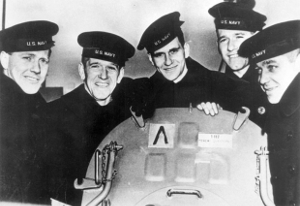
Five Sullivan brothers from Waterloo, Iowa, die when their ship, the light cruiser USS Juneau, is torpedoed and sunk by a Japanese submarine on November 13, 1942. Raised in an Irish Catholic family, the brothers’ great grandfather had emigrated from Ireland.

The five brothers, the sons of Thomas and Alleta Sullivan, are George Thomas Sullivan (27), Francis “Frank” Henry Sullivan (26), Joseph “Joe” Eugene Sullivan (24), Madison “Matt” Abel Sullivan (23), and Albert “Al” Leo Sullivan (20).

The Sullivans enlist in the U.S. Navy on January 3, 1942, with the stipulation that they serve together. The Navy has a policy of separating siblings, but it is not strictly enforced. George and Frank have served in the Navy before, but their brothers have not. All five are assigned to the light cruiser USS Juneau.

The Juneau participates in a number of naval engagements during the months-long Guadalcanal Campaign beginning in August 1942. Early on the morning of November 13, 1942, during the Naval Battle of Guadalcanal, the Juneau is struck by a Japanese torpedo and forced to withdraw. Later that day, as it is leaving the Solomon Islands area for the Allied rear-area base at Espiritu Santo with other surviving U.S. warships from battle, the Juneau is struck again, this time by a torpedo from Japanese submarine I-26. The torpedo apparently hits the thinly armored light cruiser at or near the ammunition magazines and the ship explodes and quickly sinks.

Captain Gilbert C. Hoover, commanding officer of the USS Helena and senior officer present in the battle-damaged U.S. task force, is skeptical that anyone has survived the sinking of the Juneau and believes it would be reckless to look for survivors, thereby exposing his wounded ships to a still-lurking Japanese submarine. Therefore, he orders his ships to continue on towards Espiritu Santo. Helena signals a nearby U.S. B-17 bomber on patrol to notify Allied headquarters to send aircraft or ships to search for survivors.

However, approximately 100 of Juneau‘s crew survive the torpedo attack and the sinking of their ship and are left in the water. The B-17 bomber crew, under orders not to break radio silence, does not pass the message about searching for survivors to their headquarters until they land several hours later. The crew’s report of the location of possible survivors is mixed in with other pending paperwork actions and goes unnoticed for several days. It was not until days later that headquarters staff realize that a search has never been mounted and belatedly orders aircraft to begin searching the area. In the meantime, Juneau‘s survivors, many of whom are seriously wounded, are exposed to the elements, hunger, thirst, and repeated shark attacks.

Eight days after the sinking, ten survivors are found by a PBY Catalina search aircraft and retrieved from the water. The survivors report that Frank, Joe, and Matt died instantly, Al drowned the next day, and George survived for four or five days before, suffering from delirium as a result of hypernatremia, he goes over the side of the raft he occupies and is never seen or heard from again.

Security requires that the Navy not reveal the loss of Juneau or the other ships so as not to provide information to the enemy. Letters from the Sullivan sons stop arriving at the home and the parents grow worried, which prompts Alleta Sullivan to write to the Bureau of Naval Personnel in January 1943, citing rumors that survivors of the task force claim that all five brothers were killed in action.

The letter is answered by President Franklin D. Roosevelt on January 13th, who acknowledges that the Sullivans are missing in action. By then, however, the parents have already been informed of their fate, having learned of their deaths on January 12, 1943. That morning, the boys’ father, Thomas, is preparing for work when three men in uniform approach his door. “I have some news for you about your boys,” one naval officer says. “Which one?” asks Thomas. “I’m sorry,” the officer replies. “All five.”

As a direct result of the Sullivans’ deaths, and the deaths of four of the Borgstrom brothers within a few months of each other two years later, the United States War Department adopts the Sole Survivor Policy.