seamus dubhghaill

Promoting Irish Culture and History from Little Rock, Arkansas, USA


Leave a comment

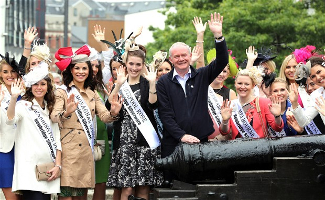
The Rose of Tralee Festival

rose-of-tralee

The first Rose of Tralee festival is held in Tralee, County Kerry, on August 25, 1959.

The Rose of Tralee festival is held every August in Tralee to choose a young woman to be crowned the Rose. The winner is the woman deemed to best match the attributes “lovely and fair” relayed in the song. She is selected based on her personality and should be a good role model for the festival and ambassador for Ireland during her travels around the world. It is not a beauty pageant, and the participants are not judged on their appearance but on their personality and suitability to serve as ambassadors for the festival. The festival bills itself as a celebration of the “aspirations, ambitions, intellect, social responsibility, and Irish heritage” of modern young women.

The festival has its origins in the local Carnival Queen, once an annual town event, fallen by the wayside due to post-war emigration. In 1957, the Race Week Carnival is resurrected in Tralee and it features a Carnival Queen. The idea for the Rose of Tralee International Festival comes when a group of local business people meet in Harty’s bar in Tralee to come up with ideas to bring more tourists to the town during the horse racing meeting and to encourage expats back to their native Tralee. Led by Dan Nolan, then Managing Director of The Kerryman newspaper, they hit on the idea of the Rose of Tralee Festival. The event starts in 1959 on a budget of just £750.

The founders of the organisation are Billy Clifford, an accountant with the Rank Organisation, who is one of the first recipients of the Golden Rose award, Dan Nolan, involved with the Tralee Races, Jo Hussey, a shopkeeper in Tralee, and Ted Keane, Sr., a local restaurateur.

Originally, only women from Tralee are eligible to take part. In the early 1960s it is extended to include any women from Kerry and, in 1967, it is further extended to include any women of Irish birth or ancestry. In 2004 Regional Finals are introduced to offer more people an opportunity to participate in the Rose of Tralee International Festival. It is held every year until 2015 in Portlaoise, County Laois, on the June Bank Holiday weekend. In 2014 it is announced that the 2015 Regional Finals will be the last, in favour of a revamped selection process held in Tralee.

Leave a comment

Death of Antarctic Explorer Tom Crean

Tom Crean

Thomas “Tom” Crean, Irish seaman and Antarctic explorer, dies on July 27, 1938 from complications of appendicitis.

Crean was born 1877 in the farming area of Gurtuchrane near the village of Annascaul on the Dingle Peninsula in County Kerry. He leaves the family farm to enlist in the Royal Navy at the age of fifteen. In 1901, while serving on Ringarooma in New Zealand, he volunteers to join Captain Robert Falcon Scott‘s 1901–04 Discovery Expedition to Antarctica, thus beginning his exploring career.

He is a member of three major expeditions to Antarctica during the Heroic Age of Antarctic Exploration, including Captain Scott’s 1911–13 Terra Nova Expedition. This sees the race to reach the South Pole lost to Roald Amundsen and ends in the deaths of Scott and his polar party. During this expedition, Crean’s 35 statute miles solo walk across the Ross Ice Shelf to save the life of Edward Evans leads to him receiving the Albert Medal for Lifesaving.

After his Terra Nova experience, Crean’s third and final Antarctic venture is as second officer on Ernest Shackleton‘s Imperial Trans-Antarctic Expedition, on Endurance. After Endurance becomes beset in the pack ice and sinks, Crean and the ship’s company spend months drifting on the ice before a journey in boats to Elephant Island. He is a member of the crew which makes an open boat journey of 800 nautical miles from Elephant Island to South Georgia, to seek aid for the stranded party.

Crean’s contributions to these expeditions seals his reputation as a polar explorer and earns him a total of three Polar medals. After the Endurance expedition, he returns to the navy. When his naval career ends in 1920 he moves back to County Kerry. In his home town of Annascaul, Crean and his wife Ellen live quietly and unobtrusively and open a pub called The South Pole Inn.

In 1938 Crean becomes ill with a ruptured appendix. He is taken to the nearest hospital in Tralee, but as no surgeon is available to operate, he is transferred to the Bon Secours Hospital in Cork where his appendix is removed. Because of the delay of the operation an infection develops and after a week in the hospital he dies on July 27, 1938, shortly after his sixty-first birthday. He is buried in his family’s tomb at the cemetery in Ballynacourty.

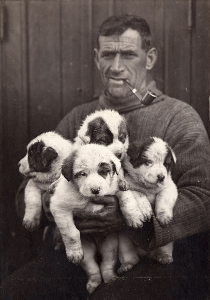
Crean’s name is commemorated in at least two places – 8,630 foot Mount Crean in Victoria Land and the Crean Glacier on South Georgia. A one-man play, Tom Crean – Antarctic Explorer, has been widely performed since 2001 by its author Aidan Dooley, including a special showing at the South Pole Inn, Annascaul, in October 2001. In July 2003, a bronze statue of Crean is unveiled across from his pub in Annascaul. It depicts him leaning against a crate whilst holding a pair of hiking poles in one hand and two of his beloved sled dog pups in the other.


Leave a comment

Death of Brendan the Navigator

brendan-the-navigator

Saint Brendan of Clonfert, called “the Navigator” and one of the early Irish monastic saints, dies on May 16, 577, in Annaghdown, County Galway.

In 484, Brendan is born in Tralee, County Kerry, in the province of Munster. He is born among the Altraige, a tribe originally centred around Tralee Bay, to parents called Finnlug and Cara. He is baptised at Tubrid, near Ardfert by Saint Erc, and is originally to be called “Mobhí” but signs and portents attending his birth and baptism lead to him being christened “Broen-finn” or “fair-drop.” For five years he is educated under Saint Ita, “the Brigid of Munster.” When he is six, he is sent to Saint Jarlath‘s monastery school at Tuam to further his education. Brendan is one of the “Twelve Apostles of Ireland,” one of those said to have been tutored by the great teacher, Finnian of Clonard.

At the age of twenty-six, Brendan is ordained a priest by Saint Erc. Afterwards, he founds a number of monasteries. Brendan’s first voyage takes him to the Aran Islands, where he founds a monastery. He also visits Hinba, an island off Scotland where he is said to meet Columcille. On the same voyage he travels to Wales, and finally to Brittany, on the northern coast of France. Between the years 512 and 530 Brendan builds monastic cells at Ardfert and, at the foot of Mount Brandon, Shanakeel— Seana Cill, usually translated as “the old church.” From here he supposedly sets out on his famous seven-year voyage for Paradise.

St. Brendan is chiefly renowned for his legendary journey to the Isle of the Blessed as described in the ninth century Voyage of St. Brendan the Navigator. Many versions exist that tell of how he sets out onto the Atlantic Ocean with sixteen pilgrims searching for the Garden of Eden. One of these companions is said to be Saint Malo, the namesake of Saint-Malo. This occurs sometime between 512 and 530 AD, before his travel to the island of Great Britain. On the trip, Brendan supposedly sees Saint Brendan’s Island, a blessed island covered with vegetation. He also encounters a sea monster, an adventure he shares with his contemporary, Saint Columba. The most commonly illustrated adventure is his landing on an island which turns out to be a giant sea monster called Jasconius or Jascon. This too, has its parallels in other stories, not only in Irish mythology but in other traditions, from Sinbad the Sailor to Pinocchio.

Brendan travels to Wales and the holy island of Iona, off the west coast of Scotland. Returning to Ireland, he founds a monastery at Annaghdown, where he spends the rest of his days. He also founds a convent at Annaghdown for his sister Briga. Having established the bishopric of Ardfert, St. Brendan proceeds to Thomond and founds a monastery at Inis-da-druim, in the present parish of Killadysert, County Clare, about the year 550. He then journeys to Wales and studies under Saint Gildas at Llancarfan, and then to Iona, for it is said that he leaves traces of his apostolic zeal at Kil-brandon and Kil-brennan Sound. After a three years’ mission in Britain, he returns to Ireland, and does more proselytising in various parts of Leinster, especially at Dysart, Killiney, and Brandon Hill. He establishes churches at Inchiquin, County Clare and at Inishglora, County Mayo, and founds Clonfert in County Galway around 557 AD.

Brendan dies on May 16, 577 at Annaghdown, while visiting his sister Briga. Fearing that after his death his devotees might take his remains as relics, Brendan arranges before his death to have his body secretly carried back to the monastery he founded at Clonfert concealed in a luggage cart. He is buried in Clonfert Cathedral.


Leave a comment

The SS Aud Begins Gun-Running Voyage to Ireland

the-ss-aud

The German merchant steam ship SS Libau, also known as SS Castro and masquerading under the cover name of SS Aud, sets sail from the Baltic port of Lübeck on April 9, 1916, loaded with guns and ammunition for the Irish Republican Brotherhood (IRB) as part of the preparation for the Easter Rising.

Masquerading as SS Aud, an existing Norwegian vessel of similar appearance, SS Libau sets sail from the port of Lübeck, under the command of Karl Spindler, bound for the southwest coast of Ireland. Under Spindler is a crew of 22 men, all of whom are volunteers. SS Libau, laden with an estimated twenty thousand rifles, one million rounds of ammunition, ten machine guns, and explosives under a camouflage of a timber cargo, evade patrols of both the British 10th Cruiser Squadron and local Auxiliary patrols.

After surviving violent storms off Rockall, SS Libau arrives in Tralee Bay on April 20. There they are due to meet Roger Casement and others, with Casement having been landed nearby by the German submarine U-19. The SS Libau has no communications equipment aboard, giving them no means of contacting the Irish while en route. As a result, they are unaware that the date for its arrival off Fenit has been altered from Thursday, April 20 to Sunday, April 23.

One of the two cars carrying Volunteers who are supposed to meet SS Libau crash into the River Laune, many miles away, at Ballykissane pier, Killorglin, resulting in the death of three of the four occupants of the car. This leads to no hope of an organised transfer of arms and the gun-running plan nears an end.

SS Libau, attempting to escape the area, is trapped by a blockade of British ships. Captain Spindler allows himself to be escorted towards Cork Harbour, in the company of the Acacia-class sloop HMS Bluebell. The German crew then scuttles the ship. Spindler and his crew are interned for the duration of the war. Roger Casement and his companions are captured in an old ringfort or rath between Ardfert and Tralee.

A number of rifles are recovered from SS Libau before the vessel is scuttled. Several examples exist in various museums in Britain and Ireland. Among these are the Cork Public Museum in Fitzgerald’s Park in Cork, a museum in Lurgan County Armagh, the National Museum of Ireland in Dublin, and the Imperial War Museum in London.


Leave a comment

Birth of Thomas Patrick Ashe

thomas-patrick-ashe

Thomas Patrick Ashe, a member of the Gaelic League, the Irish Republican Brotherhood (IRB), and a founding member of the Irish Volunteers, is born in Lispole, County Kerry, on January 12, 1885. Ashe enters De La Salle Training College, Waterford, in 1905 and begins a teaching career as principal of Corduff National School, Lusk, County Dublin, in 1908.

Ashe plays a major part in the 1916 Easter Rising outside the capital city commanding the Fingal battalion of the Irish Volunteers. Ashe is commandant of the 5th battalion of the Dublin brigade, a force of 60–70 men engaging British forces around north County Dublin during the rising. They are armed only with a few rounds, about a dozen service rifles, a dozen Mausers, and a dozen Martini-Henry carbines. Some of Ashe’s men are armed only with a shotgun against the well-equipped army regulars.

Ashe’s battalion wins a major victory in Ashbourne, County Meath, where they engage a much larger force. They capture a significant quantity of arms and up to twenty Royal Irish Constabulary (RIC) vehicles. Eleven RIC members, including County Inspector Alexander Gray, and two volunteers are killed during the 5-1/2-hour battle. Twenty-four hours after the rising collapses, Ashe’s battalion surrenders on the orders of Patrick Pearse. On May 8, 1916, Ashe and Éamon de Valera are court-martialled and sentenced to death. The sentences are commuted to penal servitude for life. Ashe is imprisoned in Lewes Prison in Lewes, East Sussex, England.

De Valera, Ashe, and Thomas Hunter lead a prisoner hunger strike on May 28, 1917. With accounts of prison mistreatment appearing in the Irish press and mounting protests in Ireland, Ashe and the remaining prisoners are freed on June 18, 1917, by David Lloyd George as part of a general amnesty.

Upon his release, Ashe returns to Ireland and begins a series of speaking engagements. In August 1917, he is arrested and charged with sedition for a speech that he makes in Ballinalee, County Longford, where Michael Collins is also speaking. He is detained at the Curragh but is then transferred to Mountjoy Prison in Dublin. He is convicted and sentenced to two years hard labour. Ashe and other prisoners, including Austin Stack, demand prisoner of war status. On September 20, 1917, Ashe again goes on hunger strike. He dies at the Mater Hospital on September 25, 1917, after being force fed by prison authorities. At the inquest into his death, the jury condemns the staff at the prison for the “inhuman and dangerous operation performed on the prisoner, and other acts of unfeeling and barbaric conduct.” His body lies in state at Dublin City Hall and is buried in Glasnevin Cemetery in Dublin.

Ashe is a relative of Catherine Ashe, the paternal grandmother of American actor Gregory Peck, who emigrates to the United States in the 19th century. The Ashe Memorial Hall built in 1928, housing the Kerry County Museum, in Tralee, County Kerry, is named after him while Nelson Street, also in Tralee, is renamed Ashe Street.