seamus dubhghaill

Promoting Irish Culture and History from Little Rock, Arkansas, USA


Leave a comment

Beginning of the Battle of Kilmallock

The Battle of Kilmallock begins on July 25, 1922, in County Limerick, ending on August 5. It is one of the largest engagements of the Irish Civil War.

The battle consists of ten days of fighting in the countryside around Kilmallock in County Limerick, in which the National Army of the Irish Free State, advancing south from Limerick city, find their path blocked by anti-Treaty IRA troops, dug into a number of villages at BruffBruree and Patrickswell. The fighting end with the retreat of the anti-Treaty fighters and the occupation of Kilmallock by Free State forces.

The prelude to the battle is the fall of Limerick city to Free State forces. The Republican forces in the city under Liam Deasy withdraw from their positions after a week of fighting and concentrate in Kilmallock and the nearby towns of Bruff and Bruree. The Free State forces, advancing south from the city, find their path blocked by the Republicans dug in at the three hilltop towns.

The National Army’s attempt to break through this position produces the only “line battle” of the war with the two sides facing each other along clear front-lines. The Kilmallock-Bruff-Bruree triangle sees some of the war’s most intense fighting.

Whereas in the fighting in Dublin, Limerick and Waterford, Free State troops equipped with artillery overcome Anti-Treaty resistance relatively easily, at Kilmallock they have a much harder time. The main reason for this is that the Free State troops, most of whom are new recruits, are facing some of the best of the IRA forces without an advantage in numbers or firepower. General Eoin O’Duffy complains of shortage of arms and ammunition. He estimates that while his forces have about 1,300 rifles, the Republicans could muster over 2,000. He is also critical of the quality of the troops at his disposal, whom he describes as, “a disgruntled, undisciplined and cowardly crowd.”

The Republicans know this and are confident of success. Nevertheless, the Republican commanders have their own issues with logistical support and lack of co-operation between forces from different counties. Deasy’s command includes Volunteers from counties Limerick itself, Cork and Kerry, all of whom have their own commanders. They have three improvised armoured cars, some mortars and heavy machine guns but no artillery.

O’Duffy draws up plans for the advance on Kilmallock with the assistance of his second-in-command Major General W. R. E. Murphy who had been a lieutenant colonel in World War I. His experience in the trenches has a major effect on his approach – pre-disposing him to cautious advances and use of trenches for cover.

The Republican forces have the better of the first clashes. On Sunday, July 23, Free State forces take Bruff and begin their advance on Kilmallock, but are twice beaten back by determined Republican resistance. The following day, the Republicans manage to retake Bruff in a counter-attack, taking 76 prisoners. As a result of this setback, O’Duffy calls off the advance for the time being and waits for reinforcements.

National Army forces quickly retake Bruff after reinforcements arrive. However, things get worse for the National Army as the week goes on. They make slow progress in taking the Republican strongpoints, and their casualties also mount. On Tuesday, July 25, a unit of the Dublin Guard under Tom Flood is ambushed on a narrow road. They fight their way clear, but only after losing four men. Three more Free State soldiers are killed two days later. On July 30, Major General Murphy launches an attack to take Bruree. The Dublin Guards attack the town from the southeast, supported by armoured cars and an 18-pound field gun. The Republicans hold out for five hours until Free State artillery is brought into action. At least 13 Free State soldiers and nine Anti-Treaty fighters are killed in the action and more are wounded before the Free State troops secure Bruree.

The Republican commander, Deasy, knows how important Bruree is to the defence of Kilmallock and draws up plans to recapture the town using three armoured cars, trench mortars and machine guns. On August 2, Republicans capture Patrickswell south of Limerick. The armoured cars then attack Bruree, taking Free State forces by surprise. One car attacks Commandant Flood’s headquarters at the Railway Hotel. The Commandant and his men manage to escape out the back of the building under the cover of Lewis gun fire. The second armoured car rams the front door of another post in the school house, which persuades the twenty-five troops inside to surrender.

However, when Free State reinforcements, along with armoured cars arrive, the Republican counter-attack stalls. The Free State reinforcements are led by Commandant General Seamus Hogan, who personally leads his forces, riding in the armoured car nicknamed “The Customs House.” Having failed to secure the surrender of the town, Republican forces retreat.

Having held Bruree against a Republican counterattack, Free State forces prepare to capture Kilmallock itself, but anticipate there will be heavy fighting. Republican Adjutant General Con Moloney comments on August 2, “Up to yesterday we have had the best of the operations there [the Kilmallock area]. There will, I fear, be a big change there now as the enemy have been reinforced very considerably.” In the 3rd Western Division area they have all but disbanded, unwilling to fight Free Staters, destroy roads, and now discouraged by the Catholic church.

On Thursday, August 3, a force of 2,000 Free State troops, backed up by armoured cars and artillery, advance on Kilmallock from Bruree, Dromin and Bulgaden. Seven hundred troops arrive the next day with an armoured car and a field gun. By Saturday, the town is surrounded by Free State forces. The Dublin Guard are also on hand to prevent Republican forces from escaping. Three miles away, Free State artillery is deployed and shells Republican forces on Kilmallock Hill and Quarry Hill. The two hills are soon controlled by Free State forces.

The National Army has, therefore, assembled sufficient force to smother resistance at Kilmallock. They are still, however, expecting hard fighting before they take the town. To their surprise, when the Free State troops enter the town, they encounter only light resistance from a Republican rearguard (volunteers from Cork). Most of the Republican troops have already abandoned their positions and retreated to Charleville.

They departed not because the Free State troops are stronger, but because they have been outflanked by Free State seaborne landings on the coasts of County Kerry and County Cork on August 2 and 8 respectively. The landings in Cork and Kerry force Commandant General Deasy to release units from this area to return home to their own areas. Although the landings in Cork occur after the retreat from Kilmallock, the subsequent loss of brigades from Cork adds to Commandant General Deasy’s problems. The final phase of the fighting in County Limerick comes when the Free State advance south is held up at Newcastle West. Another day of heavy fighting ensues in which the National Army troops have to bring up armoured cars and artillery to dislodge the Republicans, who reportedly lose up to 12 men before they retreat in the direction of Cork.

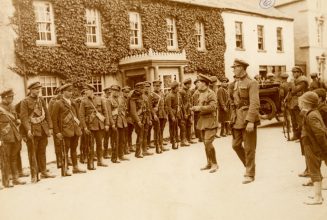
(Pictured: National Army troops lined up for a roll call during the Irish Civil War with local children casting an eye over the proceedings)

Leave a comment

Death of W. R. E. Murphy, Soldier & Policeman

William Richard English-Murphy, DSO MC, Irish soldier and policeman known as W. R. E. Murphy, dies on March 5, 1975, in Ardee, County Louth. He serves as an officer with the British Army in World War I and later in the National Army. In the Irish Civil War, he is second in overall command of the National Army from January to May 1923. He is first Irish Commissioner of the Dublin Metropolitan Police (DMP) and the last Commissioner of the force before its merger with the Garda Síochána in 1925. Thereafter he is the Deputy Commissioner of the Gardaí until his retirement in 1955.

Murphy is born in Danecastle, Bannow, County Wexford, on January 26, 1890. His parents die when he is four years old. His grandparents also die during his childhood. He and his sister Mae (Mary Sarah) are separately raised by relatives in Belfast and Waterford. He is completing his master’s degree at Queens University Belfast (QUB) when he follows the call of John Redmond to join the war effort and ensure Irish independence. Ulster regiments reject him because he is Catholic. Seeking a regiment that treats Irish volunteers with respect, he joins the British Army in Belfast in 1915 as an officer cadet in the South Staffordshire Regiment.

Murphy serves in the Battle of Loos in 1915 and is wounded but returns to action for the start of the Battle of the Somme in July 1916. He becomes commanding officer of the 1st Battalion, the South Staffordshire Regiment in August 1918, reaching the rank of temporary lieutenant colonel. In 1918, his regiment is posted to the Italian Front, at the Piave River, where they are when the armistice is declared on November 4, 1918. He is granted the rank of substantive lieutenant colonel on the retired list on May 16, 1922.

After he returns to Ireland, Murphy resumes his career as a teacher. At some point, he joins the Irish Republican Army (IRA), an organisation fighting to end British rule in Ireland.

In December 1921, the Anglo-Irish Treaty is signed between British and Irish leaders, resulting in the setting up of the Irish Free State. Conflict over the Treaty among Irish nationalists ultimately leads to the outbreak of the Irish Civil War in June 1922. Murphy enlists as a general in the new National Army of the Irish Free State. After the start of the Irish Civil War, he is put in command of troops charged with taking posts held by the anti-Treaty IRA in Limerick.

At the Battle of Kilmallock in July–August 1922, Murphy is second in command to Eoin O’Duffy. His troops successfully dislodge the anti-Treaty IRA from positions around Kilmallock in County Limerick, but he is criticised for his tendency to “dig in” and resort to trench warfare rather than rapid offensive action.

Afterward, Murphy is put in overall command of Free State forces in County Kerry until January 1923. He lobbies Richard Mulcahy, commander in chief, for 250 extra troops, to bring his command up to 1,500 and help to put down the guerrilla resistance there. In the early stages of the guerrilla war, he organises large-scale “sweeps” to break up the republican concentrations in west Cork and east Kerry. These meet with little success, however. He exercises overall command in the county, but day-to-day operations are largely run by Brigadier Paddy Daly, of the Dublin Guard.

In October, in response to continuing guerrilla attacks on his troops, Murphy orders a nightly curfew to be put into place in Tralee.

In December, Murphy writes to Mulcahy that the “Irregular [Anti-Treaty] organisation here is well-nigh broken up,” and suggests the end of the war in the county is in sight. His optimistic prediction, however, proves premature.

On December 20, Murphy sentences four captured republican fighters to death under the fictitious “Public Safety Act” for possession of arms and ammunition. However, the sentences are to be called off if local guerrilla activity ceases. Humphrey Murphy, the local IRA Brigade commander, threatens to shoot eight named government supporters in reprisal if the men are executed. Eventually, their sentence is commuted to penal servitude.

In January 1923, Murphy is promoted from his command in Kerry to “responsibility for operations and organisation at the national level” in the army. Paddy Daly takes over as commanding officer in Kerry. Murphy later voices the opinion that Daly had been a bad choice, given his implication in the Ballyseedy massacre and other events of March 1923, in which up to 30 anti-Treaty prisoners were killed in the county.

Murphy leaves the National Army after the end of the Irish Civil War in May 1923 and becomes the first Irish commissioner of the Dublin Metropolitan Police. He later becomes deputy commissioner of the Garda Síochána, when DMP is merged with the new national police force in 1925. He holds this post until his retirement in 1955.

Murphy is at the forefront of efforts to close down Dublin’s red-light district, the Monto, in the early 1920s. Between 1923 and 1925, religious missions led by Frank Duff of the Legion of Mary, a Roman Catholic organisation, and Fr. R.S. Devane work to close down the brothels. They receive the cooperation of Murphy in his role as Dublin Police Commissioner, and the campaign ends with 120 arrests and the closure of the brothels following a police raid on March 12, 1925.

Murphy also holds the post for a time of president of the Irish Athletic Boxing Association.

Murphy lives with his daughter, Joan McMahon, in Ardee, County Louth, after his wife, Mary Agnes Fortune, dies on July 31, 1958. He dies on March 5, 1975, and is buried in St. Peter’s Churchyard, Bray, County Wicklow.

(Pictured: Major-General W. R. E. Murphy, as depicted on a Wills’ Irish Sportsmen cigarette card, from their boxing series)


Leave a comment

The Irish Army Mutiny

The Army Mutiny is an Irish Army crisis that begins on March 7, 1924, provoked by a proposed reduction in army numbers in the immediate post-Civil War period. A second grievance concerns the handling of the Northern Boundary problem. As the prelude to a coup d’état, the decisions made by influential politicians and soldiers at the time have continuing significance for the Government of Ireland.

In the early weeks of the Irish Civil War, the National Army is comprised of 7,000 men. These come mainly from pro-Treaty Irish Republican Army (IRA) brigades, especially the Dublin Guard, whose members have personal ties to Michael Collins. They face around 15,000 anti-Treaty IRA men and Collins recruits experienced soldiers from wherever he can. The army’s size mushrooms to 55,000 men, many of whom are Irishmen with combat experience in World War I – 20,000 National Volunteers had joined the British Army on the urgings of Nationalist leader John Redmond.

Likewise, Irishmen who had served in the British forces account for over half of the 3,500 officers. W. R. E. Murphy, second-in-command (January–May 1923), had been a lieutenant colonel in the British Army, as had Emmet Dalton. Two more of the senior generals, John T. Prout and J. J. “Ginger” O’Connell, had served in the United States Army. Collins promotes fellow members of the Irish Republican Brotherhood (IRB) but is slow to put Squad members in high positions.

In December 1922, following Collins’s death, Liam Tobin forms the Irish Republican Army Organisation (IRAO), taking in Dublin Guard and other Irish Army officers who share his view that “higher command…was not sufficiently patriotic.” President of the Executive Council of the Irish Free State W. T. Cosgrave, head of the government, attempts to appease the IRAO. He meets with them several times before the 1923 Irish general election and persuades the opposing IRB faction of generals under Richard Mulcahy to keep quiet.

With the election over, Mulcahy now ignores the IRAO as he starts the process of demobilising 37,000 men. In November, sixty IRA officers mutiny and are dismissed without pay. The IRAO now pressures the Government into establishing a committee to supervise future demobilisation. The committee, consisting of Eoin MacNeill, Ernest Blythe, and IRAO sympathiser Joseph McGrath, effectively undermines the authority of the Army Council.

On March 7, 1924, a representative of the IRAO hands a demand to end demobilisation to W. T. Cosgrave. The ultimatum is signed by senior Army officers, Major-General Liam Tobin and Colonel Charles Dalton. Tobin knows his own position is to be scrapped in the demobilisation. Frank Thornton and Tom Cullen are also involved. That morning 35 men of the 36th Infantry Battalion refuse to parade, and the preceding week officers had absconded with arms from the McCan Barracks in Templemore, Gormanston Camp in County Meath, Baldonnel Aerodrome in Baldonnel, Dublin, and Roscommon. The immediate response is an order for the arrest of the two men on a charge of mutiny. This causes alarm throughout Dublin when announced.

On March 8, General Mulcahy makes an announcement to the Army:

“Two Army officers have attempted to involve the Army in a challenge to the authority of the Government. This is an outrageous departure from the spirit of the Army. It will not be tolerated…officers and men…will stand over their posts and do their duty today in this new threat of danger in the same wonderful, determined spirit that has always been the spirit of the Army.”

Leader of the Opposition, Thomas Johnson, issues a statement of support for the Government. In contrast, Minister for Industry and Commerce, Joseph McGrath, whose home Mulcahy orders to be searched, resigns because of dissatisfaction with the government’s attitude to the IRAO officers and support for their perception that the Irish Army treats former British officers better than former IRA officers. Fearing an incendiary speech by McGrath, Cosgrave first offers the IRAO an inquiry and an amnesty before then taking sick leave thus making Minister for Justice, Kevin O’Higgins, de facto head of the Government.

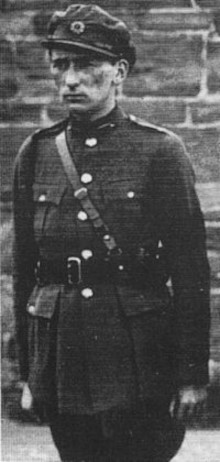
(Pictured: Major General Liam Tobin, a leading figure in the Army Mutiny)


Leave a comment

Death of Frank Duff, Founder of the Legion of Mary in Dublin

Francis Michael Duff, Irish lay Catholic and author known for bringing attention to the role of the Catholic Laity during the Second Vatican Council of the Roman Catholic Church, dies in Dublin on November 7, 1980. He is also the founder of the Legion of Mary in Dublin.

Duff is born in Dublin on June 7, 1889, at 97 Phibsboro Road, the eldest of seven children of John Duff and his wife, Susan Letitia (née Freehill). The wealthy family lives in the city at St. Patrick’s Road, Drumcondra. He attends Blackrock College.

In 1908, Duff enters the Civil Service and is assigned to the Irish Land Commission. In 1913, he joins the Society of Saint Vincent de Paul and is exposed to the real poverty of Dublin. Many who live in tenement squalor are forced to attend soup kitchens for sustenance, and abject poverty, alcoholism, and prostitution are rife in parts of Dublin. He joins and soon rises through the ranks to President of the St. Patrick’s Conference at St. Nicholas of Myra Parish. Having concern for people he sees as materially and spiritually deprived, he gets the idea to picket Protestant soup kitchens as he considers they are giving aid in the form of food and free accommodation at hostels in return for not attending Catholic services. He sets up rival Catholic soup kitchens and, with his friend, Sergeant Major Joe Gabbett, discourages Catholics from patronizing Protestant soup kitchens. They succeeded in closing down two of them over the years.

Duff publishes his first pamphlet, Can we be Saints?, in 1916. In it, he expresses the conviction that all, without exception, are called to be saints, and that through Christian faith, all have the means necessary.

In 1918, a friend gifts Duff a copy of True Devotion to Mary by the seventeenth-century French cleric Louis de Montfort, which influences his views on Mary. He is additionally influenced by the writings of John Henry Newman.

Duff briefly acts as private secretary to Michael Collins, the chairman of the Provisional Government and the commander-in-chief of the National Army. In 1924, he is transferred to the Department of Finance.

On September 7, 1921, Duff is a part of a meeting alongside Fr. Michael Toher and fifteen women which becomes the nucleus of what would become the Legion of Mary. The Legion of Mary is created to organise lay Catholics to perform voluntary work. He models the organisation on Roman legions. Some of the first causes the Legion pursues is to become involved with homelessness and prostitution in Dublin. In 1922, he defies the wishes of the Archbishop of Dublin and the widespread Crypto-Calvinism, or Jansenism, within the Catholic Church in Ireland, which had created an intense hostility towards both prostitutes and other allegedly “fallen women.” Similarly, to St. Vitalis of Gaza before him, he begins an outreach to the prostitutes living in often brutal and inhuman conditions in the “kip houses” of “the Monto,” as Dublin’s red-light district, one of the largest in Europe at the time, is then called. Although middle-class Dubliners dismissively view these women as “whores,” the impoverished but devoutly Catholic residents of the Monto tenements refer to local prostitutes as “unfortunate girls,” and understand that they often turn to prostitution as a last resort. As part of his work, Duff establishes the Sancta Maria hostel, a safe house for former prostitutes who had run away from their “kip keepers.” Following the Irish War of Independence and Irish Civil War, he also persuades the first Catholic Commissioner of the Dublin Metropolitan Police, former Irish Army General W. R. E. Murphy, to launch a crackdown and, even though prostitution in the Republic of Ireland, rooted in human trafficking, still exists, the closure of the Monto’s last “Kip-Houses” is announced on March 12, 1925.

In 1927, Duff establishes the Morning Star hostel for homeless men, followed shortly by the Regina Coeli hostel for homeless women in 1930. Unlike the Magdalen Asylums, the Regina Coeli hostel reflects his view that unwed mothers should be taught how to be able to provide for and raise their children. This defies the norm of the era which holds that the children of unwed mothers should be saved from the stigma of their illegitimacy by being put up for adoption as quickly as possible.

While Duff enjoys the support of W. T. Cosgrave, Ireland’s head of government, and in May 1931 is granted an audience with Pope Pius XI, his efforts are opposed internally in the Dublin diocese. The Archbishop of Dublin Edward Joseph Byrne and his successor John Charles McQuaid seek to censor him because of his involvement with prostitutes. McQuaid also does not approve of his ecumenical efforts. In the 1930s and 1940s Duff creates the Mercier Society, a study group designed to bring together Catholics and Protestants, as well as the Pillar of Fire, a group designed to promote dialogue with Ireland’s Jewish community. In communication with Irish social dissidents Seán Ó Faoláin and Peadar O’Donnell, he suggests he is far more censored than even they are.

Duff does have some supporters amongst the Catholic hierarchy though. With the backing of Cardinal Joseph MacRory and Francis Bourne of Westminster, the Legion is able to expand rapidly and internationally. In 1928 the Legion establishes its first presidium in Scotland. In 1932 he is able to use the occasion of the Eucharistic Congress of Dublin to introduce the concept of the Legion of Mary to several visiting bishops, leading to further international growth.

Duff retires from the Civil Service in 1934 to devote all of his time to the Legion of Mary.

In July 1940, an overseas club for Afro-Asian students in Dublin is created. At that time Ireland is a popular destination for students from Asia and Africa because of its recent anti-imperial, anti-colonial history. Duff personally funds the purchase of a building for the club using funds from an inheritance. The club lasts until 1976 and facilitate many notable students, including Jaja Wachuku.

For the rest of his life, and with the help of many others, Duff guides the Legion’s worldwide extension. Today, the Legion of Mary has an estimated four million active members and 10 million auxiliary members in close to 200 countries in almost every diocese in the Catholic Church.

In 1965, Pope Paul VI invites Duff to attend the Second Vatican Council as a lay observer. When he is introduced to the assembly by the Archbishop of Liverpool, John Heenan, he receives a standing ovation.

Duff makes the promotion of devotion to the Most Sacred Heart of Jesus part of the Legion’s apostolate.

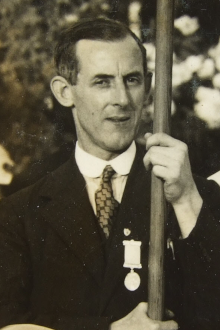
Duff dies in Dublin at the age of 91 on November 7, 1980, and is interred at Glasnevin Cemetery. In July 1996, the cause of his beatification is introduced by Cardinal Desmond Connell.