seamus dubhghaill

Promoting Irish Culture and History from Little Rock, Arkansas, USA


Leave a comment

Death of Anne Devlin, Renowned Irish Republican

Anne Devlin, an Irish republican renowned for her unwavering loyalty to Robert Emmet during the 1803 rebellion, enduring torture and imprisonment for her refusal to betray her comrades, dies in Dublin on September 18, 1851.

Devlin is born in 1780 in Cronebeg, near Aughrim, County Wicklow, the second of four daughters and three sons of Bryan and Winifred (née Byrne) Devlin, who are Catholics engaged in farming. Her father and several relatives are members of the Society of United Irishmen, advocating for Irish independence. Though she and her immediate family do not initially participate in the Irish Rebellion of 1798, they provide shelter and assistance to rebels, and their home is destroyed by Crown forces, while her father is imprisoned until 1801.

After the family moves to Rathfarnham, Dublin, Devln becomes the housekeeper for Robert Emmet in April 1803, providing cover for his Dublin operations planning a nationalist uprising. She actively aids the United Irishmen by arranging meetings, transporting arms, and acting as a messenger to insurgent forces, notably her cousin Michael Dwyer in the Wicklow Mountains. The rebellion carefully orchestrated for July 23, 1803, collapses due to inadequate popular support and confusion among the rebels.

Following the failed uprising, Devlin and her family are arrested. She endures brutal interrogation by Major Henry Charles Sirr and is subjected to half-hanging, solitary confinement, and threats against her family, yet she refuses to reveal any critical information about Emmet or other conspirators. She spends over two years in Kilmainham Gaol and, despite her endurance, her health is permanently affected. She is released in 1806 after sustained lobbying and public outrage over her mistreatment.

After her release, Devlin works as a maid and laundress, initially assisted by the Emmet family and their acquaintances. She marries William Campbell in 1811, though she experiences increasing poverty after his death in 1845. She continues to be remembered for her courage, and her experiences are recorded by historians and contemporaries such as Dr. Richard Robert Madden and Brother Luke Cullen, preserving her memoirs and accounts of her revolutionary involvement.

Devlin dies on September 18, 1851, in Dublin and is interred at Glasnevin Cemetery, later commemorated with a monument and Celtic cross.

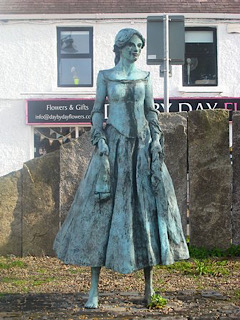
Devlin is widely celebrated as Ireland’s first female political prisoner and a symbol of loyalty and courage. A statue in Rathfarnham, annual memorial services in Dublin’s St. Catherine’s Church, and the naming of community centers in her honor (e.g., Anne Devlin Community Centre, 2026) reflect her enduring impact. Her life has inspired literature and film, including Pat Murphy‘s 1984 movie Anne Devlin, which portrays her perspective during the Emmet rebellion. She is credited in James Joyce’s short story “A Mother” as a model for the character Mrs. Kearney.

Anne Devlin’s life embodies courage, steadfast nationalism, and sacrifice. She actively supports Robert Emmet and the United Irishmen, suffers imprisonment without betrayal, and faces lifelong hardship, yet remains commemorated as a heroine of Irish independence.

(Pictured: Anne Devlin statue in Rathfarnham, Dublin)


Leave a comment

Death of May Tennant, Civil Servant & Trade Unionist

Margaret Edith (May) Tennant (née Abraham), CH, civil servant, trade unionist, factory inspector, and campaigner, dies at Great Maytham, near Rolvenden, Kent, England, on July 11, 1946.

Abraham is born on April 5, 1869, in Rathgar, County Dublin. She works to improve conditions for industrial workers and is also involved in women’s health and education. She is one of the first people to be appointed to the Order of the Companions of Honour in 1917.

Abraham is educated at home. Following her father’s death in 1887, she decides to move to London in search of employment. In London she becomes secretary to Emilia, Lady Dilke, who is a leader of the Women’s Trade Union League, an organisation of which she becomes treasurer. She supports the London Dock Strike of 1889 and helps organise laundresses.

In 1891, Abraham is appointed to the Royal Commission on Labour, set up to investigate the poor conditions faced by industrial workers, as one of four women assistant commissioners.

H. H. Asquith decides to appoint women factory inspectors in 1893, and Abraham is one of his first choices, soon superintending a team of five women inspectors. In this position, she is known for her good humour which helps relations with factory managers. In 1895, she joins the Departmental Committee on Dangerous Trades. She writes a book on factory legislation in 1896, The Laws Relating to Factories and Workshops, Including Laundries and Docks.

In 1896, Abraham marries Harold Tennant, brother-in-law of and parliamentary secretary to Asquith, and chairman of the Departmental Committee on Dangerous Trades. She resigns in 1897 shortly before the birth of her first son, to devote herself to her family. She goes on to have five children. Her eldest son, Henry, is killed in battle in 1917 during World War I.

Despite her new family life, Tennant does not give up her work entirely, remaining on the Committee on Dangerous Trades. In 1899, she becomes chairman of the Industrial Law Indemnity Fund, which provides compensation to victimised workers. She is on the Royal Commission on Divorce in 1909 and is a founder and treasurer of the Central Committee for Women’s Employment.

During World War I, Tennant takes on more work. She works initially for the War Office as welfare advisor, then briefly in the Women’s Department of the National Service Department, before moving to the Ministry of Munitions. After the war, she reduces her workload, but still serves on committees on maternal mortality and maternal health. She is also a governor of Bedford College in London, an institution founded for the education of women that is part of the University of London. From 1941 she is closely involved in campaigning for the Royal Air Force Benevolent Fund.

Tennant and her husband purchase and rebuild a country house, Great Maytham, at Rolvenden, Kent, a property whose old walled garden had earlier been the inspiration for The Secret Garden by Frances Hodgson Burnett. She develops expertise as a gardener, becoming prominent in the Royal Horticultural Society. After her husband’s death in 1935, she moves to a smaller house named Cornhill at Great Maytham, where she dies July 11, 1946. Some of her correspondence is in the British Library, London.