seamus dubhghaill

Promoting Irish Culture and History from Little Rock, Arkansas, USA


Leave a comment

Death of Anne Devlin, Renowned Irish Republican

Anne Devlin, an Irish republican renowned for her unwavering loyalty to Robert Emmet during the 1803 rebellion, enduring torture and imprisonment for her refusal to betray her comrades, dies in Dublin on September 18, 1851.

Devlin is born in 1780 in Cronebeg, near Aughrim, County Wicklow, the second of four daughters and three sons of Bryan and Winifred (née Byrne) Devlin, who are Catholics engaged in farming. Her father and several relatives are members of the Society of United Irishmen, advocating for Irish independence. Though she and her immediate family do not initially participate in the Irish Rebellion of 1798, they provide shelter and assistance to rebels, and their home is destroyed by Crown forces, while her father is imprisoned until 1801.

After the family moves to Rathfarnham, Dublin, Devln becomes the housekeeper for Robert Emmet in April 1803, providing cover for his Dublin operations planning a nationalist uprising. She actively aids the United Irishmen by arranging meetings, transporting arms, and acting as a messenger to insurgent forces, notably her cousin Michael Dwyer in the Wicklow Mountains. The rebellion carefully orchestrated for July 23, 1803, collapses due to inadequate popular support and confusion among the rebels.

Following the failed uprising, Devlin and her family are arrested. She endures brutal interrogation by Major Henry Charles Sirr and is subjected to half-hanging, solitary confinement, and threats against her family, yet she refuses to reveal any critical information about Emmet or other conspirators. She spends over two years in Kilmainham Gaol and, despite her endurance, her health is permanently affected. She is released in 1806 after sustained lobbying and public outrage over her mistreatment.

After her release, Devlin works as a maid and laundress, initially assisted by the Emmet family and their acquaintances. She marries William Campbell in 1811, though she experiences increasing poverty after his death in 1845. She continues to be remembered for her courage, and her experiences are recorded by historians and contemporaries such as Dr. Richard Robert Madden and Brother Luke Cullen, preserving her memoirs and accounts of her revolutionary involvement.

Devlin dies on September 18, 1851, in Dublin and is interred at Glasnevin Cemetery, later commemorated with a monument and Celtic cross.

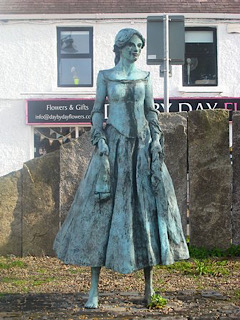
Devlin is widely celebrated as Ireland’s first female political prisoner and a symbol of loyalty and courage. A statue in Rathfarnham, annual memorial services in Dublin’s St. Catherine’s Church, and the naming of community centers in her honor (e.g., Anne Devlin Community Centre, 2026) reflect her enduring impact. Her life has inspired literature and film, including Pat Murphy‘s 1984 movie Anne Devlin, which portrays her perspective during the Emmet rebellion. She is credited in James Joyce’s short story “A Mother” as a model for the character Mrs. Kearney.

Anne Devlin’s life embodies courage, steadfast nationalism, and sacrifice. She actively supports Robert Emmet and the United Irishmen, suffers imprisonment without betrayal, and faces lifelong hardship, yet remains commemorated as a heroine of Irish independence.

(Pictured: Anne Devlin statue in Rathfarnham, Dublin)


Leave a comment

The Battle of Oulart Hill

battle-of-oulart-hill

The Battle of Oulart Hill takes place on May 27, 1798 when a rebel gathering of between 4,000 and 5,000 massacre a detachment of 110 militia sent from Wexford town to stamp out the spreading rebellion in County Wexford.

When news of the long expected rising on May 23 of the Society of United Irishmen in the midlands reaches County Wexford, it is already in an unsettled condition due to fears brought by the recently instituted anti-insurgent disarmament campaign in the county. The measures used included pitchcapping, half-hanging, and house burnings to uncover rebel conspirators. The recent arrival in Wexford of the North Cork Militia, who are notorious for their brutality in the “pacification” of Ulster, terror raids by local yeomen and finally news of the massacres at Dunlavin Green, Carlow and Carnew, have the effect of drawing people together in large groups for security, especially at night.

One such group of one hundred or so gather on the evening of May 26 at The Harrow, near the parish of Boolavogue under the tutelage of Fr. John Murphy, when they encounter a patrol of about 20 yeomen on their way to the house of a suspected rebel. They burn the suspect’s dwelling but, returning empty-handed, they encounter Fr. Murphy’s band again. The patrol are pushing their way through when a skirmish begins in which they lose two of their number, the rest fleeing with news of the killings.

The reaction on both sides is rapid. Vengeful yeomanry patrols roam, burning and killing indiscriminately, while the rebels rouse the countryside and make several raids on manors and other houses holding arms, killing more loyalists and yeomen. News of the skirmish and raids has by now reached Wexford town and, on the morning of May 27, the bulk of its garrison, 110 of the North Cork militia under Colonel Foote, are ordered north to crush the nascent rebellion. They are joined en route by some 16 yeomen cavalry under Colonel Le Hunt. However, these yeomanry are of doubtful loyalty, many (including their sergeant) having joined the rebels that morning.

The militia reaches the village of Oulart at 2:00 PM on May 27. Finding a mass of “from four to five thousand combatants” occupying the high ground of Oulart hill, they rashly advance and pursue the rebels to the summit. The rebel leaders mistakenly believe a large body of yeoman cavalry is waiting to intercept their flight, so their forces desperately turn to face their enemy and kill the whole detachment in an instant, leaving only the commanding officer, Colonel Foote, and four other survivors to escape to their base at Wexford.

Foote reports that, contrary to his orders, the militia had advanced incautiously and were surrounded and overpowered by the overwhelming rebel numbers, mostly armed with pikes, and that “great numbers” of the rebels were killed.

Following the rebel victory, almost all of North Wexford joins the rebellion. Crown forces and loyalist civilians cede control of the countryside, withdrawing to towns such as Enniscorthy, Gorey and Wexford.

(Pictured: The Battle of Oulart Hill by Fr. Edward Foran OSA (1861-1938) who also designed the 1898 Monument in Oulart Village)