seamus dubhghaill

Promoting Irish Culture and History from Little Rock, Arkansas, USA


Leave a comment

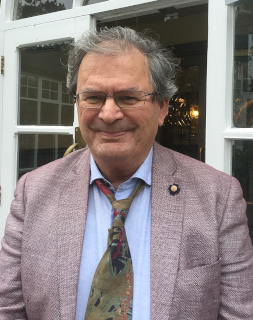
Birth of Irish Writer Gabriel Rosenstock

Gabriel Rosenstock, Irish writer who works chiefly in the Irish language, is born in Kilfinane, County Limerick, on September 29, 1949. A member of Aosdána, he is poet, playwright, haikuist, tankaist, essayist, and author/translator of over 180 books, mostly in Irish.

Rosenstock’s father, George, is a doctor and writer from Schleswig-Holstein, Germany, who serves as a medical officer with the Wehrmacht in World War II. His mother is a nurse from County Galway. He is the third of six children and the first born in Ireland. He is educated locally in Kilfinane, then in Mount Sackville, County Dublin.

Rosenstock exhibits an early interest in anarchism and is expelled from Gormanston College in County Meath and exiled to Rockwell College near Cashel, County Tipperary. Later, he attends University College Cork (UCC).

Rosenstock works for some time on the television series Anois is Arís on RTÉ, then on the weekly newspaper Anois. Until his retirement he works with An Gúm, the publications branch of Foras na Gaeilge, the North-South body which promotes the Irish language.

Although he has worked in prose, drama and translation, Rosenstock is primarily known as a poet. He has written or translated over 180 books.

Rosenstock has edited and contributed to books of haiku in Irish, English, Scots and Japanese. He is a prolific translator into Irish of international poetry (among others Ko Un, Seamus Heaney, K. Satchidanandan, Rabindranath Tagore, Muhammad Iqbal, Hilde Domin, Peter Huchel), plays (Samuel Beckett, Max Frisch, W. B. Yeats) and songs (Bob Dylan, Kate Bush, The Pogues, Leonard Cohen, Bob Marley, Van Morrison, Joni Mitchell). He also has singable Irish translations of Lieder and other art songs. His being named as Lineage Holder of Celtic Buddhism inspires the latest title in a rich output of haiku collections: Antlered Stag of Dawn (Onslaught Press, Oxford, 2015), haiku in Irish and English with translations into Japanese and Scots Lallans.

Rosenstock also writes for children, in prose and verse. Haiku Más É Do Thoil É! (An Gúm) wins the Children’s Books Judges’ Special Prize in 2015.

Rosenstock appears in the anthology Best European Fiction 2012, edited by Aleksandar Hemon, with a preface by Nicole Krauss (Dalkey Archive Press). He gives the keynote address to Haiku Canada in 2015.

Rosenstock has worked with American photographer Ron Rosenstock, Indian Photographer Debiprasad Mukherjee, Greek photographer Kon Markogiannis, Dublin photographer Jason Symes, French photographer Jean-Pierre Favreau and many more to create the new guise of a photo-haiku (or a haiga) – the interplay of visual aesthetic and literature.

Rosenstock currently resides in Dublin. His son, Tristan, is a member of the Irish traditional music quintet Téada, and impressionist/actor Mario Rosenstock is his nephew.

4 Comments

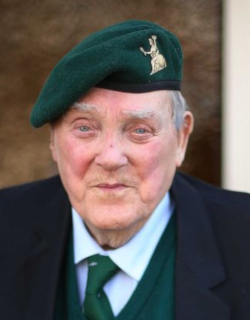
Death of Pat Gillen, Irish D-Day Survivor

pat-gillenFormer Commando Pat Gillen, one of the last surviving Irish D-Day veterans, dies at the age of 89 at his home in Cork, County Cork on December 27, 2014. He is among the first wave of troops to land on Sword Beach in Normandy on June 6, 1944.

A rifleman in the 6 Commando unit charged with securing the strategically important Pegasus Bridge near Caen, Gillen is never injured despite making a six-mile trek through marshland from the beach to Caen and spending weeks in the trenches at Saulnier. More than half his brigade falls in the face of vicious fire from German forces.

On his return to Ireland, Gillen applies for a job as a male stenographer with Ford Motor Company in Cork, where the company’s first plant outside the United States employs thousands of workers in the 1930s. Having studied Pitman shorthand, typing and bookkeeping at school, he is called for an interview that includes a shorthand test in which the only word “I could just not get right was carburetor.”

Not alone does Gillen land the job with the U.S. car and tractor firm, he also meets Rita, the daughter of his B&B landlady, whom he marries two years later. Blessed with a lively sense of humour, he has a natural flair for getting on with people and is assigned to Ford’s public relations division.

Gillen’s ease when dealing with journalists is an attribute that serves him well during an 11-year spell as Ford’s press officer, especially in the turbulent times leading up to its decision to close the Cork manufacturing plant in 1984, when he also retires after 38 years with the company.

A witty, unassuming man, Gillen’s abiding interests are gardening, his twelve grandchildren, the FCA, and letter-writing to wartime comrades, a practice he keeps up until weeks before his death.

On December 8, 2014, just over two weeks before his death and surrounded by his family in an emotional ceremony at the Mercy University Hospital in Cork, Gillen is presented with the Chevalier de la Légion d’honneur by the French ambassador to Ireland, Jean-Pierre Thébault, in recognition of his courage and gallantry in the liberation of France. It is the highest French honour.

With characteristic generosity, Gillen dedicates the medal to fellow countrymen, including two cousins who fought in but did not survive World War II. “This award is as much theirs as mine,” he said. “By the grace of God, I survived to be here today while many of my friends sleep in the fields of France.”

At the time of his passing Gillen is surrounded by his family. Predeceased by Rita, he is survived by their four children, Robin, Mary, Patricia, and Gerard, his sister, Mary, and brothers Michael (“Chick”), Liam and Bobby. His sister Angela Scully also predeceases him.

(From: D-Day veteran who became Ford’s PR man in Cork, The Irish Times, January 17, 2015)