seamus dubhghaill

Promoting Irish Culture and History from Little Rock, Arkansas, USA


Leave a comment

Birth of Northern Ireland Politician Gerry Fitt

Gerard FittNorthern Ireland politician, is born in Belfast on April 9, 1926. He is a founder and the first leader of the Social Democratic and Labour Party (SDLP), a social democratic and Irish nationalist party.

Fitt is educated at a local Christian Brothers school in Belfast. He joins the Merchant Navy in 1941 and serves on convoy duty during World War II. His elder brother Geordie, an Irish Guardsman, is killed at the Battle of Normandy.

Living in the nationalist Beechmount neighbourhood of the Falls, he stands for the Falls as a candidate for the Dock Labour Party in a city council by-election in 1956, but loses to Paddy Devlin of the Irish Labour Party, who later becomes his close ally. In 1958, he is elected to Belfast City Council as a member of the Irish Labour Party.

In 1962, he wins a seat in the Parliament of Northern Ireland from the Ulster Unionist Party, becoming the only Irish Labour member. Two years later, he left Irish Labour and joined with Harry Diamond, the sole Socialist Republican Party Stormont MP, to form the Republican Labour Party. At the 1966 general election, Fitt won the Belfast West seat in the Westminster parliament.

Many sympathetic British Members of Parliament (MPs) are present at a civil rights march in Derry on October 5, 1968, when Fitt and others are beaten by the Royal Ulster Constabulary. Fitt also supports the 1969 candidacy of Bernadette Devlin in the Mid Ulster by-election who runs as an anti-abstentionist ‘Unity‘ candidate. Devlin’s success greatly increases the authority of Fitt in the eyes of many British commentators, particularly as it produces a second voice on the floor of the British House of Commons who challenge the Unionist viewpoint at a time when Harold Wilson and other British ministers are beginning to take notice.

In August 1970, Fitt becomes the first leader of a coalition of civil rights and nationalist leaders who create the Social Democratic and Labour Party (SDLP). By this time Northern Ireland is charging headlong towards near-civil war and the majority of unionists remain hostile.

After the collapse of Stormont in 1972 and the establishment of the Northern Ireland Assembly in 1973 Fitt becomes deputy chief executive of the short-lived Power-Sharing Executive created by the Sunningdale Agreement.

Fitt becomes increasingly detached from both his own party and also becomes more outspoken in his condemnation of the Provisional Irish Republican Army. He becomes a target for republican sympathisers in 1976 when they attack his home. He becomes disillusioned with the handling of Northern Ireland by the British government. In 1979, he abstains from a crucial vote in the House of Commons which brings down the Labour government, citing the way that the government had failed to help the nationalist population and tried to form a deal with the Ulster Unionist Party.

In 1979, Fitt is replaced by John Hume as leader of the SDLP and he leaves the party altogether after he agrees to constitutional talks with British Secretary of State Humphrey Atkins without any provision for an ‘Irish dimension’ and then sees his decision overturned by the SDLP party conference. Like Paddy Devlin before him, he claims the SDLP has ceased to be a socialist force.

In 1981, he opposes the hunger strikes in the Maze prison in Belfast. His seat in Westminster is targeted by Sinn Féin as well as by the SDLP. In June 1983, he loses his seat in Belfast West to Gerry Adams, in part due to competition from an SDLP candidate. The following month, on October 14, 1983, he is created a UK life peer as Baron Fitt, of Bell’s Hill in County Down. His Belfast home is firebombed a month later and he moves to London.

Gerry Fitt dies in London on August 26, 2005, at the age of 79, after a long history of heart disease.

Leave a comment

Birth of Labour Party Leader Frank Cluskey

Frank Cluskey, Irish politician and leader of the Irish Labour Party from 1977 to 1981, is born in Dublin on April 8, 1930.

Cluskey is educated at St. Vincent’s C.B.S. in Glasnevin. He works as a butcher and then joins the Labour Party. He quickly becomes a branch secretary in the Workers’ Union of Ireland. At the 1965 general election he is elected as a Labour Party Teachta Dála (TD) for the Dublin South-Central constituency. In 1968 he is elected Lord Mayor of Dublin. In 1973 he is appointed Parliamentary Secretary to the Minister for Social Welfare, Brendan Corish. He introduces sweeping reforms to the area while he holds that position. He plays a leading role in initiating the EU Poverty Programmes.

The Fine Gael–Labour Party coalition is defeated at the 1977 general election resulting in the resignation of Brendan Corish as Labour Party leader. Cluskey is elected the new leader of the Labour Party. In 1981, the Labour Party enters into a coalition government with Fine Gael. However, Cluskey has lost his seat in Dáil Éireann at the 1981 general election and with it the party leadership. He is appointed on July 1, 1981, as a Member of the European Parliament (MEP) for Dublin, replacing Michael O’Leary, who had resigned the seat after succeeding Cluskey as Labour leader.

The coalition government falls in January 1982 over a budget dispute, and Cluskey is re-elected to the Dáil at the February 1982 general election. When the coalition returns to office after the November 1982 election, Cluskey is appointed as Minister for Trade, Commerce and Tourism. He then resigns from the European Parliament, to be replaced by Brendan Halligan.

On December 8, 1983, Cluskey resigns as Minister due to a fundamental disagreement over government policy about the Dublin Gas Company. He retains his Dáil seat in the 1987 general election.

Following his re-election Cluskey’s health begins to deteriorate. He dies in Dublin on May 7, 1989, following a long battle with cancer.


Leave a comment

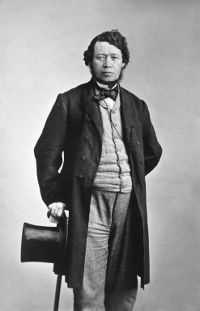
The Assassination of Thomas D’Arcy McGee

Thomas D’Arcy Etienne Hughes McGee, Irish-Canadian politician, Catholic spokesman, journalist, poet, and a Father of Canadian Confederation, is assassinated by Fenian elements on April 7, 1868, in OttawaOntarioCanada. He is to date the only Canadian victim of political assassination at the federal level.

McGee, born on April 13, 1825 in Carlingford, County Louth, grows up a Catholic Irishman who hates the British rule of Ireland and works for a peasant revolution to overthrow British rule and secure Irish independence. He escapes arrest and flees to the United States in 1848, where he reverses his political beliefs. He becomes disgusted with American republicanism and democracy, and becomes intensely conservative in his politics and in his religious support for the Pope.

McGee moves to Canada in 1857 and works hard to convince the Irish Catholics to cooperate with the Protestant British in forming a Confederation that will make for a strong Canada in close alliance with Britain. His fervor for Confederation garners him the title “Canada’s first nationalist.” He fights the Fenians in Canada, who are Irish Catholics who hate the British and resemble his younger self politically. McGee succeeds in helping create the Canadian Confederation in 1867.

On 7 April 1868, McGee, having participated in a parliamentary debate that goes on past midnight, walks back to the boarding house where he is staying. McGee is opening the door to Trotter’s Boarding House in Ottawa when he is shot by someone waiting for him on the inside. Several people run to the scene, however there is no sign of the assassin. It is later determined that McGee is assassinated with a shot from a handgun by Patrick J. Whelan.

McGee is given a state funeral in Ottawa and interred in a crypt at the Cimetière Notre Dame des Neiges in Montreal. His funeral procession in Montreal draws an estimated crowd of 80,000 out of a total city population of 105,000.

Patrick J. Whelan, a Fenian sympathiser and a Catholic, is accused, tried, convicted, and hanged for the crime on February 11, 1869, in Ottawa. The jury is decisively swayed by the forensic evidence that Whelan’s gun had been fired shortly before the killing, together with the circumstantial evidence that he had threatened and stalked McGee. Historian David Wilson points out that forensic tests conducted in 1972 show that the fatal bullet is compatible with both the gun and the bullets that Whelan owned. Wilson concludes, “The balance of probabilities suggests that Whelan either shot McGee, or was part of a hit-squad, but there is still room for reasonable doubt as to whether he was the man who actually pulled the trigger.”

The government of Canada’s Thomas D’Arcy McGee Building stands near the site of the assassination. The case is dramatised in the Canadian play Blood on the Moon by Ottawa actor/playwright Pierre Brault. The assassination of McGee is also a major component of Away, a novel about Irish immigration to Canada by Canadian novelist Jane Urquhart.


Leave a comment

The Flags and Emblems (Display) Act (Northern Ireland) 1954

The Flags and Emblems (Display) Act (Northern Ireland) 1954, an Act of the Parliament of Northern Ireland, receives royal assent on April 6, 1954. It is repealed under the direct rule of the Government of the United Kingdom, by the Public Order (Northern Ireland) Order 1987.

The Act is bitterly resented by nationalists who see it as being deliberately designed to suppress their identity. Although it does not refer explicitly to the Irish tricolour, it does the Union Flag. The Act gives the Royal Ulster Constabulary a positive duty to remove any flag or emblem from public or private property which is considered to be likely to cause a breach of the peace, but legally exempts the Union Flag from ever being considered a breach of the peace. As a result, of all the flags likely to be displayed in Northern Ireland, almost exclusively the Irish tricolour would be deemed a breach of the peace. However, the Act is not a wholesale ban on the Irish flag, and it is often allowed to remain flying, especially at Gaelic Athletic Association (GAA) grounds.

The Act is introduced at a time of some turmoil within unionism in Northern Ireland, dissent that is viewed with alarm by the Ulster Unionist government, and the legislation is initiated amid the pressure emanating from that dissent. Hard line unionists accuse the government of appeasing nationalists. A more lenient approach by government to some nationalist parades leads to an increase in the flying of the Irish Tricolour. Likewise, the Coronation celebrations lead to the erection of Union Flags, not only in unionist enclaves, but in nationalist areas where disputes erupt and where some Union Flags are taken down and replaced with the Tricolour. Nationalists also organise boycotts of shops which openly celebrate the coronation with the display of the Union Flag, increasing tension and unionist fears. The Act takes over some of the powers of the Civil Authorities (Special Powers) Act (Northern Ireland) 1922.

Violations of the Act are punishable by a fine of up to £500 or up to five years in prison. The enforcement of the Act on occasion leads to rioting, most notoriously during the UK General Election of 1964 on the lower Falls Road in Belfast.

(Pictured: Coat of Arms of the Parliament of Northern Ireland)


Leave a comment

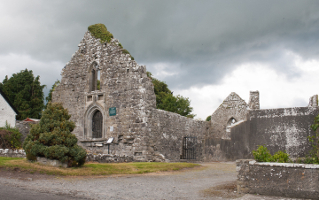
Death of St. Ruadhán of Lorrha

St. Ruadhán mac Fergusa Birn, also known as Rowan and Rodan, Irish Christian abbot who founds the monastery of Lorrha near Terryglass in County Tipperary, dies at the monastery on April 5, 584. Known for his prophesies, he is venerated as a saint and as one of the “Twelve Apostles of Ireland” after his death.

Ruadhán is educated in Clonard, County Meath, by St. Finnian and is known as one of the Twelve Apostles of Ireland. He is said to replace St. Brendan the Navigator at Lorrha after Brendan precedes to cross the River Shannon and set up his monastery at ClonfertCounty Galway.

Ruadhán founds a monastic settlement at Lorrha that consists of a monastery and various other buildings including cells for the many monks that live there. Also a ditch or large mound is built around the settlement to keep animals in and intruders out, the outlines of which remain visible today. Life for the monks is tough but simple, rising early from their beds which consist of rushes or straw placed on the bare ground. They then pray and fast between their domestic chores. The settlement is self-sufficient providing everything from food, clothing, to shelter. Villages and towns, such as the village of Lorrha, often pop up around monastic settlements as trade and refuge attracts the local people.

His embassy in 556 to King Diarmait mac Cerbaill at Tara, is worked into a legend known as the “Curse of Tara”, but the high-king continues to reside at Tara until his death in 564. Diarmuid Mac Cerbhaill violates the sanctity of the church by taking a hostage from its protection. The downfall of Tara from a once thriving royal residence is credited to Ruadhán.

Ruadhán gives the prophecy that Diarmait will be killed by the roof-beam of his hall at Tara. Diarmait has the beam cast into the sea. Diarmait then asks his druids to find the manner of his death, and they foretell that he will die of slaughter, drowning, and burning, and that the signs of his death will be a shirt grown from a single seed of flax and a mantle of wool from a single sheep, ale brewed from one seed of corn, and bacon from a sow which has never farrowed.

On a circuit of Ireland, Diarmait comes to the hall of Banbán at Ráith Bec, and there the fate of which he is warned comes to pass. The roof beam of Tara has been recovered from the sea by Banbán and set in his hall, the shirt, mantle, ale, and bacon are duly produced for Diarmait. Diarmait goes to leave Banbán’s hall, but Áed Dub mac Suibni, waiting at the door, strikes him down and sets fire to the hall. Diarmait crawls into an ale vat to escape the flames and is duly killed by the falling roof beam. Thus, all the prophecies are fulfilled.

The bell of St. Ruadhán is found in a well named after the Saint and is preserved in the British Museum. This well is situated across the road from the present day Church of Ireland.

(Pictured: Lorrha Priory of St. Ruadhán)


Leave a comment

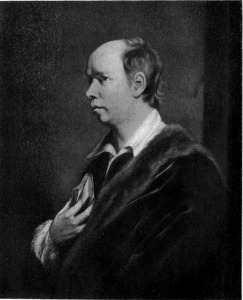
Death of Oliver Goldsmith, Novelist, Playwright & Poet

Oliver Goldsmith, Irish novelist, playwright, and poet best known for his novel The Vicar of Wakefield (1766), his pastoral poem The Deserted Village (1770), and his plays The Good-Natur’d Man (1768) and She Stoops to Conquer (1771, first performed in 1773), dies in London on April 4, 1774. He is thought to have written the classic children’s tale The History of Little Goody Two-Shoes (1765).

Goldsmith’s birth date and location are not known with certainty, although he reportedly tells a biographer that he was born on November 10, 1728. The location of his birthplace is either in the townland of Pallas, near BallymahonCounty Longford, where his father is the Anglican curate of the parish of Forgney, or at the residence of his maternal grandparents, at the Smith Hill House near Elphin, County Roscommon, where his grandfather Oliver Jones is a clergyman and master of the Elphin diocesan school, which is where Goldsmith studies. When Goldsmith is two years old, his father is appointed the rector of the parish of “Kilkenny West” in County Westmeath. The family moves to the parsonage at Lissoy, between Athlone and Ballymahon, and continues to live there until his father’s death in 1747.

In 1744 Goldsmith enters Trinity College, Dublin. His tutor is Theaker Wilder. Neglecting his studies in theology and law, he falls to the bottom of his class. In 1747, along with four other undergraduates, he is expelled for a riot in which they attempt to storm the Marshalsea Prison. He is graduated in 1749 as a Bachelor of Arts, but without the discipline or distinction that might have gained him entry to a profession in the church or the law. His education seems to have given him mainly a taste for fine clothes, playing cards, singing Irish airs, and playing the flute. He lives for a short time with his mother, tries various professions without success, studies medicine desultorily at the University of Edinburgh from 1752 to 1755, and sets out on a walking tour of FlandersFranceSwitzerland, and Northern Italy.

Goldsmith settles in London in 1756, where he briefly holds various jobs, including an apothecary‘s assistant and an usher of a school. Perennially in debt and addicted to gambling, Goldsmith produces a massive output as a hack writer for the publishers of London, but his few painstaking works earn him the company of Samuel Johnson, with whom he is a founding member of “The Club.” There, through fellow Club member Edmund Burke, he makes the acquaintance of Sir George Savile, who later arranges a job for him at Thornhill Grammar School. The combination of his literary work and his dissolute lifestyle leads Horace Walpole to give him the epithet “inspired idiot.” During this period, he uses the pseudonym “James Willington,” the name of a fellow student at Trinity, to publish his 1758 translation of the autobiography of the Huguenot Jean Marteilhe.

Goldsmith is described by contemporaries as prone to envy, a congenial but impetuous and disorganised personality who once planned to emigrate to America but failed because he missed his ship. At some point around this time he works at Thornhill Grammar School, later basing Squire Thornhill on his benefactor Sir George Savile and certainly spending time with eminent scientist Rev. John Mitchell, whom he probably knows from London. Mitchell sorely misses good company, which Goldsmith naturally provides in spades. Thomas De Quincey writes of him “All the motion of Goldsmith’s nature moved in the direction of the true, the natural, the sweet, the gentle.”

His premature death in 1774 is believed to have been partly due to his own misdiagnosis of a kidney infection. Goldsmith is buried in Temple Church in London. There is a monument to him in the centre of Ballymahon and also in Westminster Abbey with an epitaph written by Samuel Johnson.


Leave a comment

Death of Street Rhymer Michael J. Moran

Michael J. Moran, an Irish street rhymer popularly known as Zozimus, dies in Dublin on April 3, 1846. He is a resident of Dublin and also known as the “Blind Bard of the Liberties” and the “Last of the Gleemen.”

Moran is born around 1794 in Faddle Alley off the Blackpitts in Dublin’s Liberties and lives in Dublin all his life. At two weeks old he is blinded by illness. He develops an astounding memory for verse and makes his living reciting poems, many of which he has composed himself, in his own lively style. He is described by songwriter Patrick Joseph McCall as the last gleeman of the Pale.

Many of his rhymes have religious themes while others are political or recount current events. He is said to have worn “a long, coarse, dark, frieze coat with a cape, the lower parts of the skirts being scalloped, an old soft, greasy, brown beaver hat, corduroy trousers and Francis Street brogues, and he carried a long blackthorn stick secured to his wrist with a strap.”

Moran performs all over Dublin including at Essex BridgeWood Quay, Church Street, Dame Street, Capel Street, Sackville StreetGrafton StreetHenry Street, and Conciliation Hall.

In his last few years, Moran’s voice grows weak, costing him his means of livelihood. He ends up feeble and bedridden and he dies on April 3, 1846 at his lodgings in 15 Patrick Street. He is buried two days later on Palm Sunday in Glasnevin’s Prospect Cemetery, which is guarded day and night, as he had feared grave robbers, who are busy in Dublin at the time.

His grave remains unmarked until the late 1960s, when the band Dublin City Ramblers erect a tombstone in his memory. His grave is in the “Poor Ground” of the cemetery, not far from Daniel O’Connell‘s monument.

Moran’s nickname is derived from a poem written by Anthony Coyle, Bishop of Raphoe about Saint Mary of Egypt. According to legend, she had followed pilgrims to Jerusalem with the intent of seducing them, then, turning penitent on finding herself prevented from entering the Church of the Holy Sepulchre by a supernatural force, she flees to the desert and spends the remainder of her life in solitary penance. When she is at the point of death, God sends Zosimas of Palestine to hear her confession and give her Holy Communion, and a lion to dig her grave. The poem has the intolerable cadence of the eighteenth century, but is so popular, and so often called for, that Moran is soon nicknamed “Zozimus,” and by that name is remembered.


Leave a comment

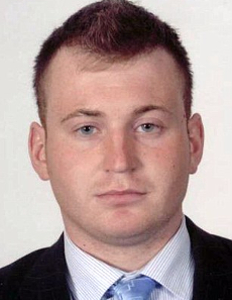
Murder of PSNI Officer Ronan Kerr

Police Constable Ronan Kerr, a Police Service of Northern Ireland (PSNI) officer, is killed by a booby trap car bomb planted outside his home in Killyclogher near Omagh on April 2, 2011. Responsibility for the attack is later claimed by a dissident republican group claiming to be made of former members of the Provisional Irish Republican Army.

Kerr is Roman Catholic, a group which at the time constitutes approximately 30% of PSNI officers, and is 25 years old at the time of his death. He is a member of a Gaelic Athletic Association club, the Beragh Red Knights. The guard of honour at Kerr’s funeral is formed of club members and PSNI officers, a funeral also attended by the leaders of Ireland’s four main churches.

Kerr’s murder is condemned by almost all sections of Northern Irish politics and society as well as bringing international condemnation. On April 6, a Peace Rally is organised in Belfast by the Irish Congress of Trade Unions, which is reported to be attended by up to 7,000 persons. Similar events are held in Omagh, Enniskillen, and London.

BBC Ireland correspondent Mark Simpson comments, in relation to the unified response of the community, “A murder designed to divide people has actually brought them closer together.” Graffiti praising the murder is daubed on walls in predominantly republican areas of Derry.

On July 26, 2011 five men are arrested in connection with the investigation. They are later released. On November 26, 2012, investigating detectives announce the arrest of a 22-year-old man in Milton Keynes. On November 27, a 39-year-old man in County Tyrone is arrested and questioned. However, as of 2017 no persons have been charged with Constable Kerr’s murder.


2 Comments

Formation of The Irish Guards

The Irish Guards regiment is formed on April 1, 1900 by order of Queen Victoria to commemorate the Irishmen who fought in the Second Boer War for the British Empire. The Irish Guards, part of the Guards Division, is a Foot Guards regiment based in Cavalry Barracks, Hounslow.

The regiment takes its motto, “Quis Separabit” or “Who shall separate us?” from the Order of St. Patrick, an order of chivalry founded by George III.

As a Foot Guards Regiment the Irish Guards Regiment is involved in state ceremonial and public duties at Buckingham PalaceWindsor CastleSt. James’s Palace, and the Tower of London. HRH Prince William is Colonel of the Regiment and wore the uniform of the Irish Guards for his marriage to Kate Middleton.

Saint Patrick’s Day is the traditional celebration of the Irish Guards and fresh shamrock is presented to members of the regiment.

The 1st Battalion Irish Guards is broken down into five separate Companies – three rifle companies, Numbers One, Two, and Four Companies, the Support Company (3 Company) and Headquarter Company. The rifle companies use the Warrior tracked armoured vehicle. In common with her sister Guards regiments, the regimental organization also includes the Band of the Irish Guards and the Corps of Drums, a fife and drum band.

The Battalion has deployed on recent conflicts including Iraq and Afghanistan. The Battalion has also recently carried out a tour of Cyprus under the United Nations. As well as deploying on operations the Battalion has also deployed on various oversea exercises to BosniaLatviaOmanKenya, and numerous other countries.

(Photo used with approval of copyright holder James Brunker, https://james-brunker.pixels.com/featured/irish-guards-on-the-march-james-brunker.html)