In 1761, O’Brien enters the Irish House of Commons as the member for Ennis, sitting until 1768. Subsequently he successfully runs for Clare, a seat previously held by his father, holding it until 1776. He is then again elected for Ennis, but following the unseating of Hugh Dillon Massy as Member of Parliament for Clare, he returns to represent that constituency in 1778. In the election of 1783, he becomes the representative for Tuam. He is sworn of the Privy Council of Ireland in 1786. He serves for the latter constituency until 1790, when he is re-elected for Ennis. He holds this seat finally until his death on January 15, 1795.
O’Brien marries Anne French, the daughter of Robert French, in 1768 and has by her seven children, three sons and four daughters. He is succeeded in the baronetcy as well as in the constituency of Ennis by his oldest son Edward.
Born Margaret Power, she is a daughter of Edmund Power and Ellen Sheehy, small landowners. She is “haphazardly educated by her own reading and by her mother’s friend Ann Dwyer.” Her childhood is blighted by her father’s character and poverty, and her early womanhood made wretched by a compulsory marriage at the age of fifteen to Captain Maurice St. Leger Farmer, an English officer whose drunken habits finally bring him as a debtor to the King’s Bench Prison, where he dies by falling out of a window in October 1817. She had left him after three months of marriage.
Marguerite later moves to Hampshire, England to live for five years with the family of Thomas Jenkins, a sympathetic and literary sea captain. Jenkins introduces her to the Irishman Charles John Gardiner, 1st Earl of Blessington, a widower with four children and seven years her senior. They marry at St. Mary’s, Bryanston Square, Marylebone, on February 16, 1818, only four months after the death of her first husband.
Of rare beauty, charm and wit, Lady Blessington is no less distinguished for her generosity and for the extravagant tastes she shares with her second husband, which results in encumbering his estates with debt. On August 25, 1822, they set out for a continental tour with Marguerite’s youngest sister, the 21-year-old Mary Anne, and servants. On the way they meet Count Alfred D’Orsay, who had first become an intimate of Lady Blessington in London in 1821, in Avignon on November 20, 1822, before settling at Genoa for four months from March 31, 1823. There they meet Lord Byron on several occasions, giving Lady Blessington material for her Conversations with Lord Byron.
It is in Italy, on December 1, 1827, that Count D’Orsay marries Harriet Gardiner, Lord Blessington’s only daughter by his former wife. The Blessingtons and the newlywed couple move to Paris towards the end of 1828, taking up residence in the Hôtel Maréchal Ney, where the Earl suddenly dies at the age of 46 of an apoplectic stroke in 1829. D’Orsay and Harriet then accompanied Lady Blessington to England, but the couple separates soon afterwards amidst much acrimony. D’Orsay continues to live with Lady Blessington until her death. Their home, first at Seymour Place, and afterwards Gore House, Kensington, now the site of the Royal Albert Hall, become a centre of attraction for all that is distinguished in literature, learning, art, science and fashion. Benjamin Disraeli writes Venetia whilst staying there, and it is at her home that Hans Christian Andersen first meets Charles Dickens.
After her husband’s death Lady Blessington supplements her diminished income by contributing to various periodicals as well as by writing novels. She is for some years editor of The Book of Beauty and The Keepsake, popular annuals of the day. In 1834 she publishes her Conversations with Lord Byron. Her Idler in Italy (1839–1840), and Idler in France (1841) are popular for their personal gossip and anecdotes, descriptions of nature and sentiment.
Early in 1849, Count D’Orsay leaves Gore House to escape his creditors. Subsequently the furniture and decorations are sold in a public sale successfully discharging Lady Blessington’s debts. She joins the Count in Paris, where she dies on June 4, 1849, of a burst heart. On examination it is discovered that her heart is three times normal size.
(Pictured: Marguerite, Countess of Blessington, painted by Sir Thomas Lawrence in 1822)
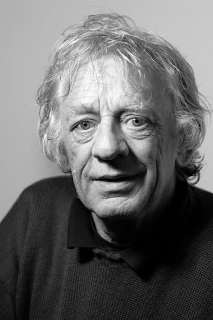
Michael “Mick” Lally, Irish stage, film and television actor, dies in Dublin on August 31, 2010. He departs from a teaching career for acting during the 1970s. Though best known in Ireland for his role as Miley Byrne in the television soap Glenroe, his stage career spans several decades, and he is involved in feature films such as Alexander and the Academy Award-nominated The Secret of Kells. Many reports cite him as one of Ireland’s finest and most recognisable actors.
In 1982, Lally stars in the TV series The Ballroom of Romance alongside Brenda Fricker. From 1983 he plays the role of Miley Byrne in the RTÉ soap Glenroe, reprising the character that he played earlier in Bracken in 1978. In 1979, he wins a Jacob’s Award for his performance as Miley in Bracken. He also has some musical success when “The By-road to Glenroe” goes to the top of the Irish charts in 1990. He is also involved in voice-over work, including a noted advertisement for Kilmeaden Cheese during the 1990s. Other TV appearances include roles in Tales of Kinvarna, The Year of the French and Ballykissangel.
In 1994, Lally plays the character Hugh in The Secret of Roan Inish, and in 1995 portrays Dan Hogan in the film adaptation of Maeve Binchy‘s Circle of Friends. Other film roles included Poitín, Our Boys, The Outcasts, A Man of No Importance and others. In later years, he provides the voice of Brother Aidan in the Academy Award-nominated The Secret of Kells, an animated film directed by Tomm Moore.
Lally appears in several TV advertisements encouraging elderly people to “release the equity tied up in their homes” during the Celtic Tiger.
Mick Lally dies on the morning of August 31, 2010, after a short stay in the hospital. The cause of death is reported as heart failure, arising from an underlying emphysema condition. His funeral takes place in Dublin on September 2, 2010. The Irish Examiner comments that the “nation has lost one of its favourite uncles.” Personalities from TV, film, theatre and politics attend, while President of IrelandMary McAleese sends a letter and Lally receives a standing ovation at the end.
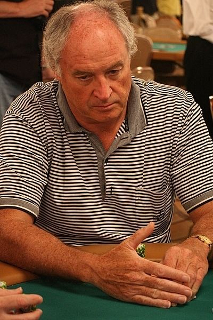
O’Dea comes close to winning a World Series of Poker (WSOP) bracelet in 1983 in the $1,000 Limit Hold ’em event, finishing runner-up to Tom McEvoy. He makes the final table of the WSOP Main Event in 1983 where he finishes in sixth place behind McEvoy, the eventual winner. He finishes ninth in 1991 in the event won by Brad Daugherty. He also cashes in the Main Event in 1990 (32nd), 1994 (27th), 1996 (25th), and 2007 (171st).
In 1998, O’Dea wins a WSOP bracelet in Pot Limit Omaha Hold ’em with rebuys event, defeating two-time world champion, Johnny Chan in heads-up play.
O’Dea first appears on the Late Night Poker television programme in series 4, finishing fifth in a heat won by Robin Keston. He returns to the show in series 6, winning his heat and going on to finish fourth in the Grand Final.
In 2004, O’Dea wins the Poker Million tournament, overcoming Dave “The Devilfish” Ulliott in the eventual heads-up confrontation. The following year, he makes the final table again and finishes in fifth place.
O’Dea is the first member of the European Poker Players Hall of Fame. As of 2009, his total live tournament winnings exceed $1,000,000. His 23 cashes as the WSOP account for $471,687 of those winnings.
His son, Eoghan O’Dea, is also a poker player who competes primarily online under the moniker “intruder123.” In December 2008 he follows up a $300,000 online win with a 2nd-place finish in the Poker Million for $260,000. In 2011, he makes a deep run at the Main Event of 2011 World Series of Poker earning his place in the November Nine.
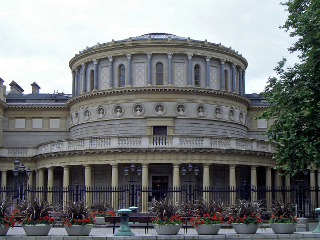
The Museum of Science and Art, Dublin on Kildare Street opens on August 29, 1890. The museum is founded on August 14, 1877, by act of Parliament. The decision to establish a state-run museum arises from requests by the Royal Dublin Society for continued government funding for its expanding museum activities.
A number of developments lead to the Science and Art Museums Act of 1877, which has the effect of transferring the buildings and collections of the Royal Dublin Society to state ownership. The collections are further enhanced by the transfer of other notable collections from institutions such as the Royal Irish Academy and Trinity College Dublin.
The Museum is the responsibility of the Department of Science and Art, which is also responsible for the South Kensington museums in London. State support for the institution is manifested in the construction of the new building on Kildare Street. It is built in the VictorianPalladian style and has been compared with the Altes Museum in Berlin, designed by Karl Friedrich Schinkel in the 1820s. Neoclassical influences can be seen in the colonnaded entrance and the domed rotunda, which rises to a height of 20 metres, and is modeled on the Pantheon in Rome.
The new museum houses coins, medals and significant Irish antiquities from the Royal Irish Academy including the Tara Brooch and Ardagh Chalice, ethnographical collections with material from Captain James Cooke‘s voyages from Trinity College Dublin, and the collections of the Geological Survey of Ireland.
These are joined by material from the decorative arts and ethnographical collections of the Royal Dublin Society along with their Irish collections of antiquities, minerals and plants. The old Royal Dublin Society museum on the Merrion Street side of Leinster House, erected with government assistance and opened in 1856, is devoted to natural history. It is dominated by zoology throughout much of its subsequent history and has an annex devoted to geology.
The building on Kildare Street is designed by Thomas Newenham Deane and is used to show contemporary Irish, British and Continental craftsmanship in its construction. State involvement in the running of the Museum allows for steady funding and a connection with other state museums in London and Edinburgh which is of considerable benefit. The collections grow with material acquired through purchase, public donation and shares of significant collections acquired by the state and dispersed by the London museums.
Catalogues are prepared by leading experts in various disciplines and printed in the Museum’s own press. In 1900 control passes to the Department of Agriculture and Technical Instruction and in 1908 its name is changed from “The Dublin Museum of Science and Art” to the “National Museum of Science and Art.” The name of the institution is changed again in 1921 to the “National Museum of Ireland.”
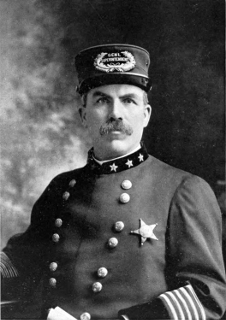
Francis O’Neill, Irish-born American police officer and collector of Irish traditional music, is born in Tralibane, near Bantry, County Cork on August 28, 1848. His biographer Nicholas Carolan refers to him as “the greatest individual influence on the evolution of Irish traditional dance music in the twentieth century.”
At an early age O’Neill hears the music of local musicians, among them Peter Hagarty, Cormac Murphy and Timothy Dowling. At the age of 16, he becomes a cabin boy on an English merchant vessel. On a voyage to New York, he meets Anna Rogers, a young emigrant whom he later marries in Bloomington, Illinois. The O’Neills move to Chicago, and in 1873 he becomes a policeman with the Chicago Police Department. He rises through the ranks quickly, eventually serving as the Chief of Police from 1901 to 1905. He has the rare distinction, in a time when political “pull” counts for more than competence, of being re-appointed twice to the position by two different mayors.
O’Neill is a flautist, fiddler and piper and is part of the vibrant Irish community in Chicago at the time. During his time as chief, he recruits many traditional Irish musicians into the police force, including Patrick O’Mahony, James O’Neill, Bernard Delaney, John McFadden and James Early. He also collects tunes from some of the major performers of the time including Patsy Touhey, who regularly sends him wax cylinders and visits him in Chicago. He also collects tunes from a wide variety of printed sources.
O’Neill retires from the police force in 1905. After that, he devotes much of his energy to publishing the music he has collected. He dies in Chicago, at the age of 87, on January 28, 1936.
In 2000, a life-size monument of Francis O’Neill playing a flute is unveiled next to the O’Neill family homestead in Tralibane, County Cork. The monument, and a commemorative wall are erected through the efforts of the Captain Francis O’Neill Memorial Company.
In 2008, Northwestern University Press issues Captain O’Neill’s Sketchy Recollections of an Eventful Life in Chicago, a non-musical memoir edited by Ellen Skerrett and Mary Lesch, O’Neill’s great-granddaughter, with a foreword by Nicholas Carolan of the Irish Traditional Music Archive. Carolan himself writes a musical biography of O’Neill, A Harvest Saved: Francis O’Neill and Irish Music in Chicago, which is published in Ireland by Ossian in 1997.
In August 2013, the inaugural Chief O’Neill Traditional Music Festival takes place in Bantry, County Cork, just a few miles from Tralibane. The 2013 event marks the centenary of the publication of O’Neill’s Irish Minstrels and Musicians. The event has taken place annually since.
Foley is born May 24, 1818, at 6 Montgomery Street, Dublin, in what is then the city’s artists’ quarter. The street has since been renamed Foley Street in his honour. His father is a glassblower and his step-grandfather Benjamin Schrowder is a sculptor. At the age of thirteen he begins to study drawing and modelling at the Royal Dublin Society, where he takes several first-class prizes. In 1835 he is admitted as a student in the schools of the Royal Academy of Arts in London. He exhibits there for the first time in 1839, and comes to fame in 1844 with his Youth at a Stream. Thereafter commissions provide a steady career for the rest of his life. In 1849 he is made an associate, and in 1858 a full member of the Royal Academy of Arts.
In 1851, inspired by the recently closed Great Exhibition, the Corporation of London votes a sum of £10,000 to be spent on sculpture to decorate the Egyptian Hall in the Mansion House. Foley is commissioned to make sculptures of Caractacus and Egeria.
In 1864 Foley is chosen to sculpt one of the four large stone groups, each representing a continent, at the corners of George Gilbert Scott‘s Albert Memorial in Kensington Gardens. His design for Asia is approved in December of that year. In 1868, he is also asked to make the bronze statue of Prince Albert himself, to be placed at the centre of the memorial, following the death of Carlo Marochetti, who had originally received the commission but had struggled to produce an acceptable version.
Foley exhibits at the Royal Academy of Arts between 1839 and 1861. Further works are shown posthumously in 1875. His address is given in the catalogues as 57, George St., Euston Square, London until 1845, and 19, Osnaburgh Street from 1847.
John Henry Foley dies at Hampstead, north London on August 27, 1874, and is buried in St. Paul’s Cathedral on September 4. He leaves his models to the Royal Dublin Society, where he had his early artistic education, and a large part of his property to the Artists’ Benevolent Fund. He does not see the Albert Memorial completed before his death. A statue of Foley himself, on the front of the Victoria and Albert Museum, depicts him as a rather gaunt figure with a moustache, wearing a floppy cap.
Foley’s pupil Thomas Brock brings several of Foley’s works to completion after his death, including his statue of Prince Albert for the Albert Memorial. Foley’s articled pupil and later studio assistant Francis John Williamson becomes a successful sculptor in his own right, reputed to have been Queen Victoria‘s favourite. Other pupils and assistants are Charles Bell Birch, Samuel Ferris Lynn, Charles Lawes, and Richard Belt.
By the middle of August, the Provisional Government of the Irish Free State under Collins has control of Dublin. Collins himself has established a Criminal Investigation Department based at Oriel House, Westland Row. These former IRA Volunteers, turned Free Staters, acquire a ruthless reputation and become known to republicans as the Oriel House Gang. They are plain-clothed and heavily armed and Oriel House is notorious for ill-treatment of republican prisoners held there. Accounts of the killings of August 26 indicate that the Oriel House Gang is responsible.
The day after Collins is assassinated, Richard Mulcahy, Chief of Staff of the Free State Army, sends a message to his soldiers. He urges them to “stand calmly by your posts” and says, “Let no cruel act of reprisal blemish your bright honour.” Yet in Dublin, within days of that message, and as the body of Collins lay in state in City Hall, Free State forces carry out atrocities which have been almost totally forgotten.
Following the assassination at Béal na mBláth on August 22, Collins’s body is brought to Dublin and lay in state in City Hall. On August 26, a short distance away from City Hall where crowds are still filing past the coffin, Bernard Daly is working as a bartender in Hogan’s licensed premises in Suffolk Street. At about 3:30 PM three armed men enter the pub and arrest Daly at gunpoint. He is dragged to the cellar and then taken away in a Ford car.
Plain-clothed, armed men travelling in a large Ford car, possibly some or all of the same individuals, are responsible for the second summary execution of August 26. Seán Cole of Lower Buckingham Street and Alf Colley of Parnell Street are officers of Fianna Éireann, the republican youth organisation. They are arrested at Annesley Bridge and taken to Yellow Lane, Whitehall. They suffer the same fate as Bernard Daly, only this time there are witnesses.
The Irish News reports that soon after 6:00 PM, a group of children and young people playing on the road are surprised when a large Ford car comes to a sharp halt. There are five or six men inside – Cole and Colley and their abductors. The two Fianna members are forced out of the car while the crowd is held back at gunpoint. One of the Free Staters tries to open a gate to a field, which is presumably to be the site of the executions, but the gate is locked.
Cole and Colley are placed with their backs to the gate, held in position and killed with revolver shots to the body and head. Their killers then drive away from the scene.
The sites of the executions of Bernard Daly, Seán Cole and Alf Colley are marked by small memorials.
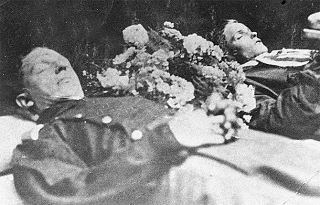
(Pictured: Seán Cole and Alf Colley – summarily executed in revenge for death of Michael Collins)
Hope is born to a Presbyterian family originally of Covenanter stock. He is apprenticed as a linen weaver but attends night school in his spare time. Influenced by the American Revolution, he joins the Irish Volunteers, but upon the demise of that organisation and further influenced by the French Revolution, he joins the Society of the United Irishmen in 1795.
Hope quickly establishes himself as a prominent organiser and is elected to the central committee in Belfast, becoming close to leaders such as Samuel Neilson, Thomas Russell, and Henry Joy McCracken. He is almost alone among the United Irish leaders in targeting manufacturers as well as landowners as the enemies of all radicals. In 1796, he is sent to Dublin to assist the United Irish organisation there to mobilise support among the working classes, and he is successful in establishing several branches throughout the city and especially in The Liberties area. He also travels to counties in Ulster and Connacht, disseminating literature and organizing localities.
Upon the outbreak of the 1798 rebellion in Leinster, Hope is sent on a failed mission to Belfast by Henry Joy McCracken to brief the leader of the County Down United Irishmen, Rev. William Steel Dickson, with news of the planned rising in County Antrim, unaware that Dickson had been arrested only a couple of days before. He manages to escape from Belfast in time to take part in the Battle of Antrim where he plays a skillful and courageous role with his “Spartan Band,” in covering the retreat of the fleeing rebels after their defeat.
Hope manages to rejoin McCracken and his remaining forces after the battle at their camp upon Slemish mountain, but the camp gradually disperses, and the dwindling band of insurgents are then forced to go on the run. He successfully eludes capture, but his friend McCracken is captured and executed on July 17. Upon the collapse of the general rising, he refuses to avail of the terms of an amnesty offered by Charles Cornwallis, 1st Marquess Cornwallis on the grounds that to do so would be “not only a recantation of one’s principles, but a tacit acquiescence in the justice of the punishment which had been inflicted on thousands of my unfortunate associates.”
Hope lives the years following 1798 on the move between counties Dublin, Meath and Westmeath but is finally forced to flee Dublin following the failure of Robert Emmet‘s rebellion in 1803. He returns to the north and evades the authorities attentions in the ensuing repression by securing employment with a sympathetic friend from England. He is today regarded as the most egalitarian and socialist of all the United Irish leadership.
James Hope dies in 1846 and is buried in the Mallusk cemetery, Newtownabbey. His gravestone features the outline of a large dog, which supposedly brought provisions to him and his compatriots when they were hiding following the Battle of Antrim.
Maureen Toal, stage and television actress whose professional career lasts for more than sixty years, dies on August 24, 2012.
Toal is born in Fairview, Dublin on September 7, 1930. She begins performing at the Abbey Theatre in Dublin in 1946, when she is just sixteen years old. She becomes a fixture at the theater, portraying some of the strongest roles on the stage including Bessie Burgess in The Plough and the Stars and the Widow Quinn in The Playboy of the Western World. She also appears in several one woman shows, including Baglady, which is written by Irish playwrightFrank McGuinness.
In 1952, Toal marries fellow Irish actor Milo O’Shea. They divorce in 1974.
Playwright John B. Keane writes the role of Mame Fadden in his play The Change in Mame Fadden specifically for Toal. Hugh Leonard also pens characters in his plays A Life and Great Big Blonde with the intention of casting Toal in the roles. Toal is best known to Irish television audiences for her role as Teasy McDaid on RTÉ One‘s Glenroe during the 1990s.
In 2010, Toal is awarded an honorary doctorate in literature at University College Dublin for which McGuinness delivers the citation, describing her as “our greatest actress.” He also praises her performances including Maggie in Arthur Miller‘s After the Fall and particularly her lead roles in his own plays, The Factory Girls and Baglady, where, he says, she tells the toughest of stories with devastating honesty. “Hers is the look out of which were fashioned the masks of comedy and tragedy.”
Maureen Toal dies in her sleep at her home in Sandycove, Dublin, on August 24, 2012, two weeks before her 82nd birthday. She is survived by her son, Colm O’Shea, two sisters, one brother, and three grandchildren.




 seamus dubhghaill