
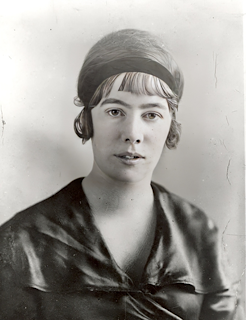
Nellie Gifford, Irish republican activist and nationalist, dies in Rathmines, Dublin, on June 23, 1971.
Born Helen Ruth Gifford on November 9, 1880, in Phibsborough, Dublin, to Frederick Gifford, a solicitor, and Isabella Julia Gifford (née Burton), Gifford is the fifth child and second eldest daughter of the family of six daughters and six sons. Her father is a Catholic while her mother, a niece of the painter Frederic Burton, is rigorously Protestant. All the children are brought up in the Church of Ireland. The men, emigrate and remain unionist while the women are active nationalists. Most famous are the two youngest, the artist Grace Gifford, and the journalist and broadcaster Sidney Czira.
Gifford grows up in Rathmines and goes to school at Alexandra College. She trains as a domestic economy teacher and works for seven years at a series of positions in County Meath.
Gifford experiences the living conditions of the landless rural poor while lodging in labourers’ cottages during this time. As a result, she becomes a supporter of the campaigns of the land agitator and nationalist MP Laurence Ginnell.
Gifford is also influenced by her sisters’ nationalism and feminism. With them, she becomes involved with the Irish Women’s Franchise League, and gets to know Constance Markievicz. She gets parts in stage plays, including Eleanor’s Enterprise by George Birmingham in the Gaiety Theatre, a play produced by the countess’s husband, Count Casimir Markievicz.
During the 1913 Dublin lock-out Gifford assists James Larkin enter the Imperial Hotel, on August 31 to address the crowd. He enters in disguise, that of an elderly and infirm clergyman. She poses as his niece. She speaks to the hotel staff to prevent Larkin’s strong Liverpool accent giving away his identify. This is the speech which precipitates the “Bloody Sunday” police baton charge. Gifford goes on to be a founding member of the Irish Citizen Army (ICA). This group is attractive to many women due to the feminist beliefs of James Connolly.
Gifford gives lessons on camp cookery in Liberty Hall and finds jobs for recruits coming in from abroad. As a result of this work she, very fatefully, introduces Michael Collins to her future brother-in-law Joseph Plunkett who go on to serve together in the 1916 Easter Rising. Collins is Plunkett’s aide-de-camp.
Gifford is the only one of her sisters to actively participate in the rising itself. She is with the ICA’s St. Stephen’s Green contingent alongside Countess Markievicz. Throughout the week she supervises the garrison’s provisions in the Royal College of Surgeons building, commandeering food from shops and bread vans, and by courier from other garrisons. She also ensures the delivery of provisions to troops both in the college with her and in outlying posts. She is one of the women arrested at the surrender and jailed in Kilmainham Gaol. At the same time, in the same prison her sister Grace marries Joseph Plunkett hours before his execution. Only twelve women are detained after the main release of women prisoners on May 8, 1916. Gifford is one of those transferred to Mountjoy Prison until her release on June 4, 1916. Afterward she continues to be as involved in the campaigns.
After her time in prison, Gifford travels through England to the United States where she and other women veterans of Easter week lecture throughout America. While there she marries Joseph Donnelly, of Omagh, County Tyrone in 1918. In 1921 she and their year-old daughter Maeve leave him to return to Ireland.
Frederick Gifford dies in September 1917 and leaves Gifford £800. However, she is was not well off. She becomes a broadcaster and journalist for the national radio and the Irish press. Holding to her upbringing, she remains a staunch Protestant, unlike four of her sisters, who had married Catholics.
Gifford becomes devoted to preserving the historical record of the independence movement. Noticing the huge number of visitors for the 1932 Eucharistic Congress, she organises a small exhibition there of 1916 memorabilia for the National Museum of Ireland. She is irritated by the display of Catholic religious artifacts there. She campaigns for a permanent exhibition of recent Irish nationalist history. She coordinates a substantial body of material pertinent to nationalist organisations, the Easter Rising, and the Irish War of Independence, which now forms the core of the present collection.
Over the years Gifford is secretary of the Old IRA Association, a member of the Old Dublin Society, and a founder of the Kilmainham Gaol Restoration Society. She also looks after stray and neglected dogs and cats. She dies at the age of 90 on June 23, 1971, at the Gascoigne nursing home in Rathmines, Dublin.
(Pictured: Irish nationalist Nellie Gifford taken in Boston in 1917)


