seamus dubhghaill

Promoting Irish Culture and History from Little Rock, Arkansas, USA


Leave a comment

Death of Josephine McNeill, First Irish Female Diplomat

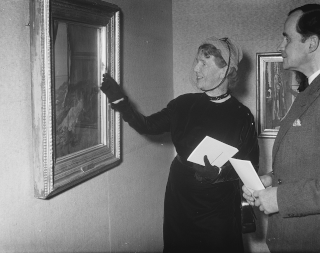
Josephine McNeill, Irish diplomat, dies in Dublin on November 19, 1969. She is the first Irish female diplomat appointed to represent Ireland abroad in a ministerial capacity.

McNeill is born Josephine Ahearne on March 31, 1895, in FermoyCounty Cork, the daughter of shopkeeper and hotelier, James Ahearne, and his wife Ellen Ahearne (née O’Brien). She attends the Loretto Convent, Fermoy, and goes on to graduate from University College Dublin (UCD) with a BA,  H.Dip.Ed. in French and German. With this she begins a teaching career, at St. Louis’ Convent, Kiltimagh, at the Ursuline Convent, Thurles, and at Scoil Íde. Scoil Íde, the female counterpart to St. Enda’s School, had been established by her friend, Louise Gavan Duffy. She is fluent in the Irish language and takes an active part in the cultural elements of the Irish independence movement, such as literature and music. She is a member of Cumann na mBan, serving as a member of the executive committee in 1921.

McNeill becomes engaged to Pierce McCan, but he dies of influenza in Gloucester Gaol in March 1919. She marries James McNeill in 1923, while he is serving as Irish High Commissioner in London. Despite her reservations, she becomes a noted hostess, both in London and later in Dublin when her husband becomes the Governor-General of the Irish Free State from 1928 to 1932.

After the death of her husband in 1938, McNeill becomes the honorary secretary of the council of the Friends of the National Collections, as well as serving as chair of the executive committee of the Irish Countrywomen’s Association until 1950. As a member of the Department of External Affairs advisory committee on cultural relations, she writes on economic, social and cultural issues. She represents Ireland at the UNESCO general assembly in Paris in 1949.

McNeill is an active member of Clann na Poblachta from its foundation in 1946. She is appointed the minister to the Netherlands in 1950 by Seán MacBride, making her the first Irish female diplomat to represent the Republic of Ireland abroad in a ministerial capacity. This appointment is not well received by diplomats in the Department of External Affairs. Her reports from The Hague focus on the issues the Netherlands faces with decolonisation. In 1955, she becomes the minister to Sweden, going on to hold the joint appointment to Austria and Switzerland from 1956 to 1960, after which she retires. While serving in Switzerland she puts aside the resentment she feels towards Éamon de Valera based on how he had treated her husband, to sit with him during a convalescence while de Valera recovers from an eye operation.

McNeill is an amateur pianist and collects paintings and porcelains. In 1933, she publishes the Irish language book, Finnsgéalta ó India.

McNeill dies in St. Vincent’s Hospital, Dublin, on November 19, 1969. She is buried in Kilbarrack Cemetery. Her papers are held in the UCD Archives.

Leave a comment

Mary McAleese Meets Bill Clinton in the Oval Office

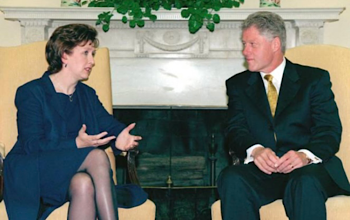
On June 23, 1998, Irish president Mary McAleese pays a courtesy call on President Bill Clinton at the White House before he leaves for China. This is one of the highlights of her six-day visit to Washington, D.C. and New York.

As this is not a state visit, there is no formal welcome for President McAleese or official functions at the White House as there was for President Mary Robinson‘s state visit two years earlier. McAleese arrives the previous day by government jet, accompanied by her husband, Dr. Martin McAleese, and the Minister for Foreign Affairs, David Andrews, and his wife. The McAleese’s son, thirteen-year-old Justin McAleese, travels to the United States separately and joined his parents in Washington, D.C..

Within hours of her arrival, McAleese attends a reception in the Four Seasons Hotel mainly for the Irish American community and hosted by the Irish ambassador, Sean O Huiginn, and his wife. In her remarks to the several hundred guests, President McAleese praises the role of President Clinton in the Northern Ireland peace process and of former Senator George Mitchell. She says Clinton’s contribution has been “remarkable.” She says, “He was prepared to take risks for peace: without his courage and leadership we could not have made the progress we have.”

McAleese says many of those present “have descended from some of the first settlers of the early colonies – some of whom, like myself, come from the northern part of the island of Ireland. I am deeply honoured that all of you have retained such a close bond and pride in your Irish heritage and that you demonstrated your affection by the strength of the many vibrant organisations in this area.”

McAleese says when our forebears crossed the Atlantic Ocean they retained a yearning that someday the Ireland they left would be a better place. “Regrettably, they did not live to see a new Ireland but it is now a reality in the economic, cultural and social progress of the last number of years.” Arranging the meeting at the White House is a problem for U.S. and Irish officials because of Clinton’s extremely busy schedule, as he prepares for his China visit. But the fact that he makes time for it is an indication of the importance he attaches to U.S.-Irish relations.

Later in the day, McAleese has lunch at the U.S. Supreme Court with Chief Justice William Rehnquist. This is followed by a speech at Georgetown University, mainly dealing with Northern Ireland.

In the evening, McAleese attends a dinner in her honour at the Irish Embassy residence, to which leading political and administration figures are invited. On June 24, following a press conference at the National Press Club and a lunch on Capitol Hill with members of Congress, she flies to New York. There she pays a courtesy visit on the UN Secretary-General, Kofi Annan, and later attends a trade show organised by the Irish Business Organisation. In the evening she attends the “Dreamer of Dreams” awards ceremony organised by the Irish Voice newspaper.

On Thursday, June 25, McAleese has more engagements and prior to her return to Ireland on Friday, June 26.

(From: “McAleese for courtesy call on Clinton today” by Joe Carroll, The IrishTimes, http://www.irishtimes.com, July 23, 1998)


Leave a comment

Death of Seán Lester, Last Secretary-General of the League of Nations

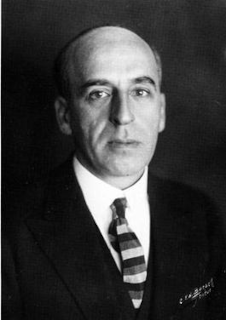
Seán Lester, Irish diplomat who is the last secretary-general of the League of Nations from August 31, 1940, to April 18, 1946, dies at Recess, County Galway, on June 13, 1959.

Lester is born on September 28, 1888, in Carrickfergus, County Antrim, as John Ernest Lester, the son of a Protestant grocer Robert Lester and his wife, the former Henrietta Ritchie. Although the town of Carrickfergus is strongly Unionist, he joins the Gaelic League as a youth and is won over to the cause of Irish nationalism. As a young man, he joins the Irish Republican Brotherhood (IRB). He works as a journalist for the North Down Herald and a number of other northern papers before he moves to Dublin, where he finds a job at the Freeman’s Journal. By 1919, he has risen to its news editor.

After the Irish War of Independence, a number of Lester’s friends join the new government of the Irish Free State. He is offered and accepts the position as director of publicity.

Lester marries Elizabeth Ruth Tyrrell in 1920 by whom he has three daughters.

In 1923, Lester joins Ireland’s Department of External Affairs. He is sent to Geneva in 1929 to replace Michael MacWhite as Ireland’s Permanent Delegate to the League of Nations. In 1930, he succeeds in organising Ireland’s election to the Council (or executive body) of the League of Nations for three years. He often represents Ireland at Council meetings and stands in for the Minister for External Affairs. He becomes increasingly involved in the work of the League, particularly in its attempts to bring a resolution to two wars in South America. His work brings him to the attention of the League Secretariat and begins his transformation from national to international civil servant.

When Peru and Colombia have a dispute over a town in the headwaters of the Amazon River, Lester presides over the committee that finds an equitable solution. He also presides over the less-successful committee when Bolivia and Paraguay go to war over the Gran Chaco.

In 1933, Lester is seconded to the League’s Secretariat and sent to Danzig (now Gdańsk, Poland), as the League of Nations’ High Commissioner from 1934 to 1937. The Free City of Danzig is the scene of an emerging international crisis between Nazi Germany and the international community over the issue of the Polish Corridor and the Free City’s relationship with the Third Reich. He repeatedly protests to the German government over its persecution and discrimination of Jews and warns the League of the looming disaster for Europe. He is boycotted by the representatives of the German Reich and the representatives of the Nazi Party in Danzig.

Lester returns to Geneva in 1937 to become Deputy Secretary General of the League of Nations. In 1940, he becomes Secretary General of the body, becoming the League’s leader a year after the beginning of World War II which shows that the League has failed its primary purpose. The League has only 100 employees, including guards and janitors, out of the original 700.

Lester remains in Geneva throughout the war and keeps the League’s technical and humanitarian programs in limited operation for the duration of the war. In 1946, he oversees the League’s closure and turns over the League’s assets and functions to the newly established United Nations.

Lester is given the Woodrow Wilson Award in 1945 and a doctorate of the National University of Ireland (NUI) in 1948.

Despite rumours that he would be prepared to stand for election as President of Ireland, Lester seeks no permanent office and retires to Recess, County Galway, in the west of Ireland, where he dies on June 13, 1959. In its obituary, The Times describes him as an “international conciliator and courageous friend of refugees.”

In August 2010, a room in the Gdańsk City Hall, the building that had been Lester’s residence during his stay, is renamed by Mayor Paweł Adamowicz as the Seán Lester Room.

Lester’s granddaughter, Susan Denham, is Chief Justice of Ireland for the Supreme Court of Ireland from 2011 to 2017.