Moore is born in 1701, the second son of Charles Moore, Lord Moore, son of Henry Hamilton-Moore, 3rd Earl of Drogheda, and Jane Loftus, daughter of Lord Loftus. He serves in the Irish House of Commons as the Member of Parliament for Dunleer between 1725 and 1727 when he succeeds to his elder brother’s titles and takes his seat in the Irish House of Lords. In 1748 he is invested as a member of the Privy Council of Ireland and made a Governor of Meath.
Moore marries, firstly, Lady Sarah Ponsonby, daughter of Brabazon Ponsonby, 1st Earl of Bessborough, and Sarah Margetson, in 1727, with whom he has six sons and two daughters. Following her death on January 19, 1736, he married, secondly, Bridget Southwell, daughter of William Southwell and Lucy Bowen, on October 13, 1737.
Moore and his son Edward are lost in a storm at sea while travelling between Holyhead and Dublin on October 28, 1758. He is succeeded by his eldest son, Charles, who is created Marquess of Drogheda in 1791.
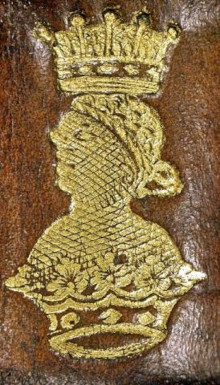
(Pictured: Stamp of Edward Moore, 5th Earl of Drogheda)
Butlers’s attempts to conclude a peace are blocked by a Catholic faction that advocates complete independence for Ireland. The situation deteriorates further, and, in July 1647, he departs from Ireland, leaving the Protestant cause in the hands of the parliamentarians, who had defeated King Charles I in the first English Civil War (1642–1646).
Returning to Ireland in September 1648, Butler concludes a peace with the confederacy in January 1649. He then rallies Protestant royalists and Catholic confederates in support of Charles II, son and successor of Charles I. For several months most of Ireland is under his control. But the parliamentarian general Oliver Cromwell lands at Dublin in August 1649 and swiftly conquers the country for Parliament. Butler flees to France and becomes one of Charles II’s closest advisers at his court-in-exile in Paris.
When Charles II returns to England in the Restoration of 1660, Butler, who had urged constitutional rather than military rule, is made commissioner for the treasury and the navy. Appointed Lord Lieutenant of Ireland in 1662, he makes vigorous attempts to encourage Irish commerce and industry. Nevertheless, his enemies at court persuade Charles to dismiss him in 1669. He is restored to royal favour in 1677 and is again appointed Lord Lieutenant of Ireland. Although he is created a duke in the English peerage in 1682, he is recalled from Ireland in 1684 as a result of new intrigues at Charles’s court and because of the determination of James, Duke of York, to strengthen his supporters in Ireland.
Wesley is the son of Richard Wesley, 1st Baron Mornington, and Elizabeth Sale. He is educated at Trinity College Dublin and is elected its first Professor of Music in 1764. From early childhood he shows extraordinary talent on the violin and soon begins composing his own works. As a composer he is remembered chiefly for glees such as “Here in cool grot” and for a double Anglican chant. His son, Arthur Wellesley, 1st Duke of Wellington, is the only one of his children to inherit something of his musical talent.
Wesley represents Trim in the Irish House of Commons from 1757 until 1758, when he succeeds his father as 2nd Baron Mornington.
Wesley marries Anne Hill-Trevor, eldest daughter of banker Arthur Hill-Trevor, 1st Viscount Dungannon, and his wife Anne Stafford, on February 6, 1759. His godmother, the famous diarist Mary Delany, says the marriage is happy, despite his lack of financial sense and her “want of judgment.” They have nine children, most of whom are historically significant.
In 1759 Wesley is appointed Custos Rotulorum of Meath and in 1760, in recognition of his musical and philanthropic achievements, he is created Viscount Wellesley, of Dangan Castle in the County of Meath, and Earl of Mornington. He is elected Grandmaster of the Grand Lodge of Ireland in 1776, a post he holds until the following year.
Wesley dies at the age of 45 on May 22, 1781. Like his father, he is careless with money, and his early death leaves the family exposed to financial embarrassment, leading ultimately to the decision to sell all their Irish estates.
Four streets in Camden Town, which form part of the estate of Wesley’s son-in-law Henry FitzRoy, are named Mornington Crescent, Place, Street and Terrace after him. Of these, the first has since become famous as the name of a London Underground station.
Hely-Hutchinson enters the Army as a cornet in the 18th Royal Hussars in 1774, rising to a lieutenant the following year. In 1776 he is promoted to become a captain in the 67th (South Hampshire) Regiment of Foot, and a major there in 1781. He moves regiments again in 1783, becoming a lieutenant-colonel in, and colonel-commandant of, the 77th Regiment of Foot, which is, however, disbanded shortly afterwards following an earlier mutiny. He spends the next 11 years on half-pay, studying military tactics in France before serving as a volunteer in the Flanders campaigns of 1793 as aide-de-camp to Sir Ralph Abercromby.
Hely-Hutchinson is second-in-command of the 1801 expedition to Egypt, under Abercromby. Following Abercromby’s death in March after being wounded at the Battle of Alexandria, he takes command of the force. From then he is able to besiege the French firstly at Cairo which capitulates in June and then besieges and takes Alexandria, culminating in the capitulation of over 22,000 French soldiers. In reward for his successes there, the Ottoman SultanSelim III makes him a Knight, 1st Class, of the Order of the Crescent.
On December 18, 1801, Hely-Hutchinson is created Baron Hutchinson in the Peerage of the United Kingdom, gaining a seat in the House of Lords. In recognition of his “eminent services” during the “late glorious and successful campaign in Egypt,” at the request of the King, the Parliament of the United Kingdom settles on Lord Hutchinson and the next two succeeding male heirs of his body an annuity of £2000 per annum, paid out of the Consolidated Fund.
Hely-Hutchinson is promoted lieutenant-general in September 1803 and made a full general in June 1813. In 1806, he becomes colonel of the 57th (West Middlesex) Regiment of Foot, transferring in 1811 to be colonel of the 18th Regiment of Foot, a position he holds until his death. He also holds the position of Governor of Stirling Castle from 1806 until his death.
Hely-Hutchinson sits as Member of Parliament (MP) for Lanesborough from 1776 to 1783 and for Taghmon from 1789 to 1790. Subsequently, he represents Cork City in the Irish House of Commons until the Act of Union 1800 and is then member for Cork City in the after-Union Parliament of the United Kingdom until 1802.
Hely-Hutchinson dies on June 29, 1832, never having married.
Richard Boyle, 1st Earl of Cork, English-born politician who serves as Lord Treasurer of the Kingdom of Ireland and is also known as the Great Earl of Cork, dies on September 15, 1643 in Youghal, County Cork. He is an important figure in the continuing English colonisation of Ireland in the 16th and 17th centuries, as he acquires large tracts of land in plantations in Munster in southern Ireland.
Boyle goes to Ireland in 1588. He becomes deputy Escheator under Ireland’s Escheator General John Crofton and uses his office to enrich himself, only to lose his property in the Munster rebellion in 1598. Returning to England, he is imprisoned on charges of embezzlement arising from his activities in Ireland. He is acquitted by a royal court, however, and in 1600 Elizabeth I of England appoints him clerk of the council of Munster.
Two years later, Boyle purchases Sir Walter Raleigh’s estates in the Irish counties of Cork, Waterford, and Tipperary. By employing settlers imported from England, he develops his lands and founds ironworks and other industries. The enormous wealth he accumulates brings him honours and political influence. Created Earl of Cork in 1620, he is appointed a Lord Justice of Appeal in 1629 and Lord High Treasurer in 1631. Nevertheless, soon after Sir Thomas Wentworth (afterward Earl of Strafford) goes to Ireland as lord deputy in 1633, Boyle is fined heavily for possessing defective titles to some of his estates. Thereafter his political influence declines.
Boyle dies at Youghal on September 15, 1643, having been chased off his lands in the Irish Rebellion of 1641. His sons, however, recover the family estates after the suppression of the rebellion.
Boyle’s first wife, Joan Apsley, the daughter and co-heiress of William Apsley of Limerick, whom he marries on November 6, 1595, dies at Mallow, County Cork on December 14, 1599 during childbirth. By his second wife, Catherine Fenton, daughter of Sir Geoffrey Fenton, he has eight daughters and seven sons, including the renowned chemist Robert Boyle and the statesman-dramatist Roger Boyle, 1st Earl of Orrery.
The Hunt/de Vere family estate of 300 years (1657–1957), including the period of the de Vere Baronetcy of Curragh, is the present day Curraghchase Forest Park, in County Limerick. De Vere spends most of his life on the estate and is closely involved in its management. He suffers much trouble from his ownership of the island of Lundy, which his father, who was not much of a businessman, had unwisely purchased in 1802, and which becomes a heavy drain on the family’s finances. Sir Vere is never able to find a purchaser for Lundy, and it takes his son until 1834 to dispose of it.
De Vere stands for election in the 1820 General Election and comes in third with 2,921 votes.
De Vere is a poet. William Wordsworth calls his sonnets the most perfect of the age. These and his drama, Mary Tudor: An Historical Drama, are published by his son, the poet Aubrey Thomas de Vere, in 1875 and 1884.
De Vere produces numerous works over his lifetime. The most notable are Ode to the Duchess of Angouleme (1815), Julian the Apostate: A Dramatic Poem (1822), The Duke of Mercia: An Historical Drama [with] The Lamentation of Ireland, and Other Poems (1823), A Song of Faith: Devout Exercises and Sonnets and his most famous work, Mary Tudor: An Historical Drama.
Agar is the second son of Henry Agar, a former MP for Gowran, and Anne Ellis, and is probably born at Gowran Castle in County Kilkenny. On March 20, 1760, he marries Lucia Martin, widow of Henry Boyle-Walsingham. Together they have three children: Henry-Welbore Agar-Ellis (b. January 22, 1761), John Ellis (b. December 31, 1763), and Charles-Bagnell (b. August 13, 1765).
In addition to being a Member of Parliament (MP) for Gowran, for which he sits three times, from 1753 to 1761, again from 1768 to 1769 and finally from 1776 to 1777, Agar controls three other borough seats through the strength of his family holdings. He represents Kilkenny County between 1761 and 1776 and Thomastown between 1768 and 1769. He holds the post of joint Postmaster General of Ireland with William Ponsonby, 1st Baron Ponsonby between 1784 and 1789.
James Agar dies on January 1, 1789. His eldest son, Henry-Welbore Agar-Ellis, becomes 2nd Viscount Clifden and Baron Mendip.
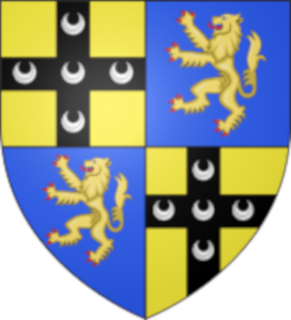
(Pictured: Arms of Agar-Ellis: 1st and 4th quarter: a cross sable charged with five crescents argent for Ellis; 2nd and 3rd quarter: azure with a lion rampant for Agar)
Hobart marries firstly Margaretta, daughter of Edmund Bourke, in 1792. They have one son, who dies in infancy, and a daughter, Lady Sarah, who marries Prime Minister Lord Goderich and is the mother of George Robinson, 1st Marquess of Ripon. After Margaretta’s death in 1796 he marries secondly the Hon. Eleanor Agnes, daughter of William Eden, 1st Baron Auckland, in 1799. There are no children from this marriage.
Robert Hobart dies at Hamilton Place, London, on February 4, 1816 at the age of 55, after falling from his horse. He is succeeded in the earldom by his nephew, George. Lady Buckinghamshire dies in October 1851, at the age of 74.
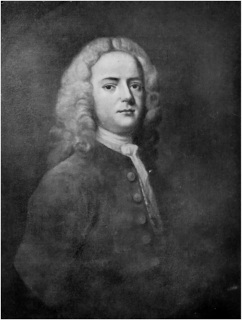
Sackville serves twice as Lord Lieutenant of Ireland, from 1731 to 1737 and again from 1751 to 1755. In 1739, at the foundation of the Foundling Hospital, he is one of that charity’s original governors. His first term as Lord Lieutenant is uneventful. His second takes place at a time of acute political tension between the two main factions in the Irish Government, one led by Henry Boyle, the Speaker of the Irish House of Commons, the other by George Stone, the Anglican Archbishop of Armagh. Sackville, now heavily influenced by his son George Sackville, makes the mistake of openly backing the archbishop. He is unable to oust Boyle from power and is accused of being the archbishop’s tool. He becomes extremely unpopular, leading to his eventual recall.
Sackville’s last years are uneventful, apart from a riot in 1757 caused by the passage of the Militia Act to raise an army for the Seven Years’ War, in which he narrowly escapes injury. He dies at Knole, a country house in west Kent, on October 9, 1765, and is buried at Withyham in East Sussex.
(Pictured: Oil on canvas Portrait of Lionel Sackville, 1st Duke of Dorset (1688-1765) by Godfrey Kneller (1646-1723), 1719, currently displayed at Commonwealth Secretariat, Marlborough House, London)
In the final years of his reign, Henry is increasingly infirm and focused on securing peace within the kingdom and his own religious devotions. Edward becomes the Steward of England and begins to play a more prominent role in government. Henry’s finances are in a precarious state as a result of the war, and when Edward decides to join the crusades in 1268 it becomes clear that fresh taxes are necessary.
Henry is concerned that Edward’s absence might encourage further revolts, but is swayed by his son to negotiate with multiple parliaments over the next two years to raise the money. Although Henry had initially reversed Simon de Montfort‘s anti-Jewish policies, including attempting to restore the debts owed to Jews where these could be proven, he faces pressure from parliament to introduce restrictions on Jewish bonds, particularly their sale to Christians, in the final years of his reign in return for financing. Henry continues to invest in Westminster Abbey, which becomes a replacement for the Angevin mausoleum at Fontevraud Abbey, and in 1269 he oversees a grand ceremony to rebury Edward the Confessor in a lavish new shrine, personally helping to carry the body to its new resting place.
Edward leaves for the Eighth Crusade, led by Louis IX of France, in 1270, but Henry becomes increasingly ill. Concerns about a fresh rebellion grow and the following year the King writes to his son asking him to return to England, but Edward does not turn back. Henry recovers slightly and announces his renewed intention to join the crusades himself, but he never regains his full health. On the evening of November 16, 1272, Henry dies in Westminster, probably with his wife, Eleanor of Provence, in attendance. He is succeeded by Edward, who slowly makes his way back to England via Gascony, finally arriving in August 1274.
At his request, Henry is buried in Westminster Abbey in front of the church’s high altar, in the former resting place of Edward the Confessor. A few years later, work begins on a grander tomb for the King and in 1290 Edward moves his father’s body to its current location in Westminster Abbey. His gilt-brass funeral effigy is designed and forged within the abbey grounds by William Torell. Unlike other effigies of the period, it is particularly naturalistic in style, but it is probably not a close likeness of Henry himself.
Eleanor likely hopes that Henry will be recognised as a saint, as his contemporary Louis IX of France had been. Indeed, Henry’s final tomb resembles the shrine of a saint, complete with niches possibly intended to hold relics. When the King’s body is exhumed in 1290, contemporaries note that the body is in perfect condition and that Henry’s long beard remains well preserved, which at the time is considered to be an indication of saintly purity. Miracles begin to be reported at the tomb, but Edward is sceptical about these stories. The reports cease, and Henry is never canonised. In 1292, Henry’s heart is removed from his tomb and reburied at Fontevraud Abbey with the bodies of his Angevin family.
(Pictured: Effigy of Henry in Westminster Abbey, c. 1272)