In 1972, Linehan wins a Jacob’s Award for her RTÉ Radio comedy series Get an Earful of This. She is the recipient of the Lifetime Achievement Award at the Irish Theatre Awards in 2008.
Linehan and her husband live in Dublin and have four children and eight grandchildren. Her father Daniel McMenamin was a Teachta Dála for Donegal from 1927 to 1961.
Delia Murphy Kiernan, singer and collector of Irish ballads, is born on February 16, 1902, in Ardroe, Roundfort, County Mayo. She records several 78 rpm records in the 1930s, 1940s and 1950s. In 1962 she records her only LP, The Queen of Connemara, for Irish Prestige Records, New York, on the cover of which her name appears alongside the LP title.
Delia’s father, John Murphy, from nearby Hollymount, makes his fortune in the Klondike Gold Rush. While in America, he marries Ann Fanning from Roscrea, County Tipperary. They return to Ireland in 1901 and purchase the large Mount Jennings Estate in Hollymount. John encouraged Delia’s interest in singing ballads from a young age. He also allows Irish travelers to camp on the estate. According to her own account, she learns her first ballads at their campfires.
Delia is educated at Presentation Convent in Tuam, Dominican College in Dublin and University College Galway (UCG), where she graduates with a Bachelor of Commerce degree. In UCG she meets Dr. Thomas J. Kiernan, and they marry in 1924, on her 22nd birthday. Kiernan then joins the Irish diplomatic service, where his first posting is to London. While there Delia sings at many venues including many gatherings of Irish emigrants and becomes quite well-known. In 1939 she records The Blackbird, The Spinning Wheel and Three Lovely Lassies for HMV.
In 1941 Kiernan is appointed Irish Minister Plenipotentiary to the Holy See in Rome. The Irish legation is the only English-speaking legation to remain open after the United States enters World War II. Delia becomes one of those who assist Hugh O’Flaherty in hiding Jews and escapes allied soldiers from the Nazis. In 1943, when Italy changes sides, many escaped POWs are helped by the legation to leave Italy. In 1946 she is awarded to Dame Commander of the Equestrian Order of the Holy Sepulchre.
Kiernan later serves as Irish High Commissioner and later first Ambassador in Australia, and later to West Germany, Canada, and the United States. In 1961, while she is living in Ottawa, Delia makes the recording of The Queen of Connemara produced by Ken Goldstein. The Kiernans purchase a farmhouse in Jasper, Ontario, near the Rideau Canal where she spends most of her time, even after Kiernan is posted to Washington, D.C. Tom Kiernan dies in December 1967.
By 1969 Delia’s health is in decline. In November of that year, she sells her farmhouse in Canada and returns to Ireland. She lives in a cottage in Strawberry Beds, Chapelizod, County Dublin. She dies of a massive heart attack on February 11, 1971, five days before her 69th birthday. She records upwards of 100 songs during her lifetime.
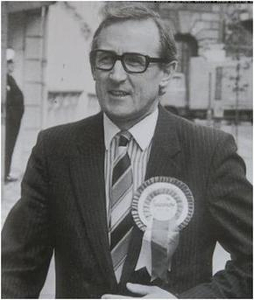
The youngest son of Jim and Lily McCusker, McCusker is born and raised in the heart of Lurgan, County Armagh, Northern Ireland. He is educated at Lurgan Model Primary School, Lurgan College and Stranmillis University College, before qualifying as a teacher. Before entering politics he works in industry, latterly with Goodyear, in their Craigavon Plant.
McCusker is an Orangeman and staunch Unionist. Prior to his death in Portadown, County Armagh, Northern Ireland on February 12, 1990, five days after his 50th birthday, McCusker is expected to rise further in the Ulster Unionist Party and British political scenes, due to his ability and popularity among his peers and the wider public. He is a member of the Methodist Church in Ireland (Lurgan circuit).
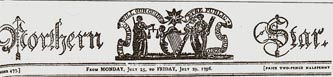
The first issue of the Northern Star, the newspaper of the Society of United Irishmen, is published in Belfast on January 4, 1792. It is published from 1792 until its suppression by the British army in May 1797.
The publication of an Irish newspaper that reflects and disseminates liberal views is an early goal of Irish republicans in the late 18th century. By the founding of the Society of United Irishmen in October 1791, the project is well underway, and the first edition of the Northern Star appears in Belfast in January 1792. Like the United Irishmen, the first financial backers of the Northern Star are Presbyterian and one of the United Irish leadership, Samuel Neilson, is made editor.
Political content dominates the Northern Star but its publication of local news, as opposed to the focus on British and international affairs of other Irish newspapers of the time, brings it wide popularity. Leading members of the United Irishmen are regular contributors and mixed direct political analyses with cutting political satire. William Orr is among those who contributed to its content and his letters lead to his eventual arrest and execution under the Insurrection Act of 1797. The newspaper also enjoys an excellent voluntary distribution network as its penetration follows rapidly wherever the United Irishmen set up new branches. It was estimated that for each copy of the Northern Star sold there are at least five readers, as the reading aloud of articles from the paper is a regular feature of United Irish meetings.
The newspaper is initially protected from the authorities due to the support of well-connected liberals but following the outbreak of war between Great Britain and Revolutionary France in 1793 and the subsequent banning of the United Irishmen as a seditious body it begins to draw increasing attention. The massive popularity of the newspaper protects it from serious harassment until January 1797 when the establishment goes into a state of panic following the French invasion scare at Bantry Bay. The paper is alleged to be behind the Dublin-based Union Star, a militant, low-circulation newssheet, often posted in public places, which specializes in naming informers, “notorious Orangemen,” and other enemies of the United Irishmen, being regarded by Dublin Castle as a republican hitlist.
The extensive distribution network and potency of the Northern Star in spreading United Irish opinion alarms the authorities and possession of a copy comes to be regarded as an admission of seditious intent. The end finally comes with the uncovering of supposed United Irish infiltration of the Monaghanmilitia in Belfast, which results in the execution of four soldiers. General Gerard Lake, 1st Viscount Lake, already engaged in a brutal counter-insurgency campaign, is quick to put much of the blame on the Northern Star and requests permission to suppress the paper.
As it turns out, official suppression is not necessary as on May 19, 1797, three days after the execution of their ex-comrades, a mob of Monaghan militiamen anxious to prove their loyalty attack the offices of the Northern Star and destroy not only the printing presses but the building itself. The attack results in the demise of the Northern Star to the undoubted satisfaction of the authorities as no action is taken against those involved in the destruction. The Chartist movement later pays tribute to the Northern Star by using the same name for their newspaper that is founded in 1837 by Feargus O’Connor.
Nearly 150,000 people take to the streets on December 9, 2005, as the Irish Ferries protest mushrooms into the largest public demonstration the country has seen for two decades.
An Garda Síochána estimate that 40,000 people take part in the march in Dublin, although organisers claim the figure is far higher. Gerry Adams of Sinn Féin, Pat Rabbitte of the Labour Party and John Gormley of the Green Party participate in the march in the capital. Staff on board the MS Isle of Inismore in Pembroke and the four engineers holed up in the ships control room say they are overwhelmed by the level of support shown by marchers in the rallies.
Bus and rail services are disrupted during the protest but return to normal for evening rush hour.
The Irish Small & Medium Enterprises Association (ISME) strongly criticises the National Day of Protest. In a statement, ISME Chief Executive Mark Fielding says the protest is undermining the industrial relations process in this country and has very little to do with the Irish Ferries dispute and is in fact an attempt by the unions to influence negotiations in advance of any new national pay agreement.
Director General of the Irish Business and Employers Confederation (IBEC) Turlough O’Sullivan says there is nothing to be gained from disrupting business and the general public. He adds that whatever one’s views on the Irish Ferries dispute, nothing can justify calling a national work stoppage when discussions are already underway in a bid to resolve the row.
Cary is born into an old Anglo-Irish family, and at age 16 he studies painting in Edinburgh and then in Paris. From 1909 to 1912 he is at Trinity College, Oxford, where he reads law. Having joined the colonial service in 1914, he serves in the Nigeria Regiment during World War I. He is wounded while fighting in Cameroon and returns to civil duty in Nigeria in 1917 as a district officer. West Africa becomes the locale of his early novels.
Resolved to become a writer, Cary settles in Oxford in 1920. Although that year he publishes ten short stories in The Saturday Evening Post, he decides he knows too little about philosophy, ethics, and history to continue writing in good conscience. Study occupies the next several years, and it is only in 1932 that his first novel, Aissa Saved, appears. The story of an African girl converted to Christianity but still retaining pagan elements in her faith, it is followed by three more African novels — An American Visitor (1933), The African Witch (1936), and Mister Johnson (1939) — and a novel about the decline of the British Empire, Castle Corner (1938). Childhood is the theme of his next two novels, his own in A House of Children (1941) and that of a cockney wartime evacuee in the country in Charley Is My Darling (1940).
Cary’s trilogy on art begins with the first-person narration of a woman, Sara Monday, in Herself Surprised (1941) and follows with that of two men in her life, the lawyer Tom Wilcher in To Be a Pilgrim (1942) and the artist Gulley Jimson in The Horse’s Mouth(1944), his best-known novel. Monday is portrayed as a warm-hearted, generous woman who is victimized both by the conservative upper-class Wilcher and by the talented but disreputable painter Jimson. The latter character is a social rebel and visionary artist whose humorous philosophy and picaresque adventures in The Horse’s Mouth helped make him one of the best-known characters in 20th-century fiction.
Similarly, Cary’s other trilogy is seen from the vantage of a politician’s wife in A Prisoner of Grace (1952), the politician himself in Except the Lord (1953), and the wife’s second husband in Not Honour More (1955).
In 1952, Cary has some muscle problems which are originally diagnosed as bursitis, but as more symptoms are noted over the next two years, the diagnosis is changed to that of motor neuron disease (known as Lou Gehrig’s disease (ALS) in North America), a wasting and gradual paralysis that is terminal. As his physical powers fail, Cary has to have a pen tied to his hand and his arm supported by a rope to write. Finally, he resorts to dictation until unable to speak, and then ceases writing for the first time since 1912. His last work, The Captive and the Free (1959), first volume of a projected trilogy on religion, is unfinished at his death on March 29, 1957. His short stories are collected in Spring Song (1960).
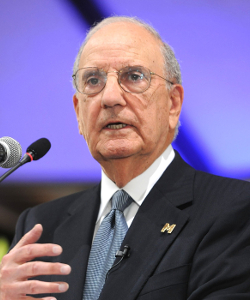
Since 1995, Mitchell has been active in the Northern Ireland peace process, having served as the United States Special Envoy for Northern Ireland under President Bill Clinton. He first leads a commission that establishes the principles on non-violence to which all parties in Northern Ireland have to adhere and subsequently chairs the all-party peace negotiations, which lead to the Belfast Peace Agreement signed on Good Friday 1998, known since as the “Good Friday Agreement.” Mitchell’s personal intervention with the parties is crucial to the success of the talks. He is succeeded as special envoy by Richard Haass.
For his involvement in the Northern Ireland peace negotiations, Mitchell is awarded the Presidential Medal of Freedom on March 17, 1999, and the Philadelphia Liberty Medal on July 4, 1998. In accepting the Liberty Medal, he states, “I believe there’s no such thing as a conflict that can’t be ended. They’re created and sustained by human beings. They can be ended by human beings. No matter how ancient the conflict, no matter how hateful, no matter how hurtful, peace can prevail.”
While in Dublin Sheridan attends the English Grammar School in Grafton Street. The family moves permanently to England in 1758 where he is a pupil at Harrow School from 1762 to 1768. After his period in Harrow School, his father employs a private tutor to directs his studies.
In 1775, Sheridan’s first play, The Rivals, is produced at London’s Covent Garden Theatre. It is a failure on its first night. He casts a more capable actor in the lead for its second performance, and it is a smash which immediately establishes the young playwright’s reputation and the favour of fashionable London. It has gone on to become a standard of English literature.
Shortly after the success of The Rivals, Sheridan and his father-in-law, Thomas Linley the Elder, a successful composer, produce the opera, The Duenna. This piece is accorded such a warm reception that it plays for seventy-five performances.
The following year, Sheridan, his father-in-law, and one other partner purchase a half-interest in the Drury Lane theatre and, two years later, buy out the other half. Sheridan is the manager of the theatre for many years and later becomes sole owner with no managerial role.
His most famous play, The School for Scandal (Drury Lane, May 8, 1777), is considered one of the greatest comedies of manners in English. It is followed by The Critic (1779), an updating of the satirical Restoration comedyThe Rehearsal. He has a rivalry with his fellow playwright Richard Cumberland and includes a parody of Cumberland in The Critic. In 1778, Sheridan writes The Camp, which comments on the ongoing threat of a French invasion of Britain.
In 1780, Sheridan enters Parliament as the ally of Charles James Fox on the side of the American Colonials in the political debate of that year. He remains in Parliament for 32 years.
On February 24, 1809, despite the much-vaunted fire safety precautions of 1794, the theatre burns down. On being encountered drinking a glass of wine in the street while watching the fire, Sheridan is famously reported to have said, “A man may surely be allowed to take a glass of wine by his own fireside.”
When he fails to be re-elected to Parliament in 1812, his creditors close in on him and his last years are harassed by debt and disappointment. On hearing of his debts, the United States Congress offers Sheridan £20,000 in recognition of his efforts to prevent the American Revolutionary War. The offer is refused.
In December 1815 Sheridan becomes ill and is largely confined to bed. He dies in poverty on July 7, 1816, and is buried in the Poets’ Corner of Westminster Abbey. His funeral is attended by dukes, earls, lords, viscounts, the Lord Mayor of London, and other notables.
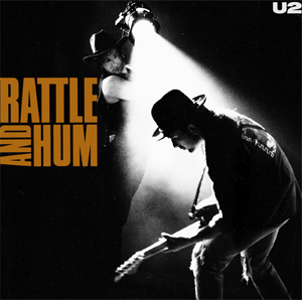
Although Rattle and Hum is intended to represent the band paying tribute to rock legends, some critics accuse U2 of trying to place themselves amongst the ranks of these artists. Critical reception to both the album and the film is mixed. One Rolling Stone editor speaks of the album’s “excitement”, another describes it as “misguided and bombastic.” The film grosses just $8.6 million, but the album is a commercial success, reaching number one in several countries and selling 14 million copies. Lead single “Desire” becomes the band’s first U.K. number-one song while reaching number three in the United States.
At the end of 1988, Rattle and Hum is voted the 21st-best album of the year in the Pazz & Jop, an annual poll of American critics published by The Village Voice. In other critics’ lists of the year’s top albums, it is ranked number one by HUMO, second by the Los Angeles Times and Hot Press, 17th by OOR, 23rd by New Musical Express (NME), and 47th by Sounds.
Lifetime sales for the album have surpassed 14 million copies.
Mayo is the eldest son of Robert Bourke, 5th Earl of Mayo, and his wife, Anne Charlotte, daughter of the Hon. John Jocelyn. His younger brother, the Hon. Robert Bourke, is also a successful politician. He is educated at Trinity College, Dublin.
After travelling in Russia, Mayo enters parliament for Kildare in 1847, a seat he holds until 1852, and then represents Coleraine from 1852 to 1857 and Cockermouth from 1857 to 1868. He is thrice appointed Chief Secretary for Ireland – in 1852, 1858, and 1866. In 1869 he becomes the fourth Viceroy of India where he is locally often referred to as “Lord Mayo.” He consolidates the frontiers of India and reorganises the country’s finances. He also does much to promote irrigation, railways, forests, and other useful public works. He establishes local boards to solve local problems. During his tenure, the first census takes place in 1872. The European-oriented Mayo College at Ajmer is founded by him for the education of young Indian chiefs, with £70,000 being subscribed by the chiefs themselves.
While visiting the convict settlement at Port Blair in the Andaman Islands in 1872 for the purpose of inspection, he is assassinated by Sher Ali Afridi, an AfridiPathan convict who uses a knife. His murderer appears to be motivated only by a sense of injustice at his own imprisonment and has resolved to kill a high-ranking colonial official. Mayo’s body is brought home to Ireland and buried at the medieval ruined church in Johnstown, County Kildare, near his home at Palmerstown House. Afridi is hanged.
In 1873, the newly discovered swallowtail butterflyPapilio mayo from the Andaman Islands is named in his honour. The traditional Irish marchLord Mayo (Tiagharna Mhaighe-eo) is named after him. According to tradition, it is composed by his harper David Murphy to appease Mayo after Murphy angered him.
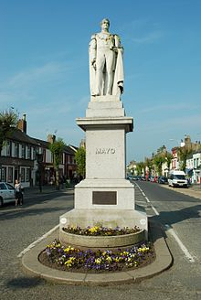
On August 19, 1875, a statue of Lord Mayo is unveiled in the town of Cockermouth in the centre of the main street. The 800-guinea cost of the statue is raised by public subscription. The statue, carved in Sicilian marble, depicts Lord Mayo in his viceregal garb, and still stands today.
In 2007, a statue of Lord Mayo is unearthed in Jaipur, India, after being buried for six decades. The statue had previously been installed in the premises of Mayo Hospital, currently known as the Mahilya Chikatsalya, Jaipur. The 9-foot-tall cast-iron statue, weighing around 3 tons, was ordered sculpted by the Maharaja Ram Singh ji of Jaipur, as a tribute to Lord Mayo after his assassination. To prevent it from vandalism, the statue is buried in the premises of the Albert Hall Museum of Jaipur at the time of the independence of India. After six decades, the statue is unearthed by the Jaipur Mayo Alumni Chapter on May 29, 2007, and sent to Mayo College, in Ajmer, India, where it is installed. Mayo College in Ajmer already has a full life-size statue of Lord Mayo sculpted in white marble installed in front of its famous Main Building since inception and a marble sculpted bust of him in its School Museum.




 Former

 seamus dubhghaill