seamus dubhghaill

Promoting Irish Culture and History from Little Rock, Arkansas, USA


Leave a comment

The Castle Hill Rebellion

castle-hill-rebellion

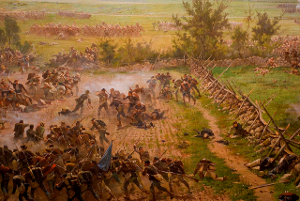
The Castle Hill Rebellion, a rebellion by convicts against the colonial forces of Australia in the Castle Hill area of the British colony of New South Wales, takes place on March 4, 1804. The rebellion culminates at Rouse Hill, dubbed the Second Battle of Vinegar Hill after the first Battle of Vinegar Hill which had taken place in 1798 in Ireland. It is the first and only major convict uprising in Australian history suppressed under martial law.

On March 4, according to the official accounts, 233 convicts led by Philip Cunningham, a veteran of the Irish Rebellion of 1798 as well as the mutiny on the convict transport ship Anne, escapes from a prison farm intent on “capturing ships to sail to Ireland,” In response, martial law is quickly declared in the Colony of New South Wales. The mostly Irish rebels, having gathered reinforcements, are hunted by the colonial forces until they are sequestered on March 5 on a hillock nicknamed Vinegar Hill. Under a flag of truce, Cunningham is arrested, and troops charge and the rebellion is crushed by a raid.

According to the official records of the day, around 230 are eventually brought in over next few days. Of the convicts directly engaged in the battle, 15 are killed and nine, including the ringleaders Cunningham and William Johnston, are executed, with two subjected to gibbeting. Two men, John Burke and Bryan McCormack, are reprieved and detained at the Governor’s pleasure, seven are whipped with 200 or 500 lashes then allotted to the Coal River chain gang, while 23 others are sent to the Newcastle coal mines. Another 34 prisoners are placed in irons until they can be “disposed of.” It is not known whether some, or all of them, are sent to the Coal River. Of the remaining rebels, some are put on good behaviour orders against a trip to Norfolk Island, while the majority are pardoned and allowed to return to their places of employment as having been coerced into the uprising.

Cunningham, badly wounded but still alive, is court martialed under the martial law and hanged at the Commissariat Store at Windsor, which he had bragged he would burn down. Initially, military officers are intent on hanging a token number of those captured having convened a military court at the Whipping Green but this is quickly stopped by Governor Gidley King fearful of the repercussions.

Martial law is eventually lifted on March 10, 1804, but this does not end the insurgency. Irish plots continue to develop, keeping the Government and its informers vigilant, with military call out rehearsals continuing over the next three years. Governor King remains convinced that the real inspirers of revolt had kept out of sight. He had some suspects sent to Norfolk Island as a preventive measure.


4 Comments

Birth of Major General Thomas Conway

thomas-conway

Thomas Conway, a major general in the American Continental Army during the American Revolutionary War, is born in Cloghane, County Kerry, on February 27, 1735. He becomes involved with the alleged Conway Cabal with Horatio Gates and later serves with Émigré forces during the French Revolutionary War.

Conway is born to James Conway and his wife Julieanne Conway. As a child, he immigrates to France with his parents. At 14, he enrolls in the Irish Brigade of the French Army and rises rapidly to the rank of colonel by 1772.

Following the outbreak of the American Revolutionary War he volunteers to the Continental Congress for service with the American rebels in 1777. Based on an introduction from Silas Deane, the Congress appoints him a brigadier general on May 13, and sends him on to George Washington.

Conway commands the leading brigade on the American right flank at the Battle of Germantown and is justly praised for his actions. However, Washington opposes his promotion to major general, believing that many American-born officers with longer and valuable service deserve the rank. This, and Conway’s condescending attitude, lead to continued friction between the men. Congress appoints Conway a major general anyway in December 1777 and makes him inspector general of the army.

When his name is used politically, it is used to describe the infighting known as the Conway Cabal. During the affair, he has written a letter to General Horatio Gates in which he refers to Washington as a “weak general.” The letter is intercepted by Washington and his backers after its delivery is botched by Brigadier General James Wilkinson and is brought before the Congress for inquiry. When the contents of the letter are made public, Conway loses his command as a result. He tries a ploy that had worked before his promotion and submits his resignation to Congress in March 1778. This time, however, it is accepted, so he is forced to leave the Continental Army. John Cadwalader shoots him in a duel on July 4, 1778. When he recovers, he writes an apology to Washington and returns to France.

Conway later returns to the French Army. In 1787 he receives promotion to Maréchal-de-camp (Major General) and an appointment as Governor of French colonies in India.

In 1793 he fights with royalist forces in opposition to French Revolution in southern France. Their loss forces him to become an exile from his adopted country.

During the French Revolution he is condemned to death. He is saved only by an appeal to Great Britain, against which he had fought in the American Revolution, but is compelled to flee from France for his life. He supposedly returns to Ireland and remains there until his death.

After that Conway disappears from history. He is believed to have died about 1800 in poverty and exile.


Leave a comment

William Smith O’Brien Pardoned from Deportation

william-smith-obrien

William Smith O’Brien, leader of the Young Ireland Rebellion of 1848, is pardoned from his deportation to Van Diemen’s Land on February 26, 1854, on the condition of exile from Ireland.

From April 1828 to 1831 O’Brien serves as Conservative MP for Ennis. He becomes MP for Limerick County in 1835, holding his seat in the House of Commons until 1849.

Although a Protestant country-gentleman, O’Brien supports Catholic Emancipation while remaining a supporter of British-Irish union. In 1843, in protest against the imprisonment of Daniel O’Connell, he joins O’Connell’s anti-union Repeal Association.

Three years later, O’Brien withdraws the Young Irelanders from the association. In January 1847, along with Thomas Francis Meagher, he founds the Irish Confederation, although he continues to preach reconciliation until O’Connell’s death in May 1847. He is active in seeking relief from the hardships of the famine. In March 1848, he speaks out in favour of a National Guard and tries to incite a national rebellion. He is tried for sedition on May 15, 1848, but is not convicted.

On July 29, 1848, O’Brien and other Young Irelanders lead landlords and tenants in a rising in three counties, with an almost bloodless battle against police at Ballingarry, County Tipperary. In O’Brien’s subsequent trial, the jury finds him guilty of high treason. He is sentenced to be hanged, drawn, and quartered. Petitions for clemency are signed by 70,000 people in Ireland and 10,000 people in England.

In Dublin on June 5, 1849, the sentences of O’Brien and other members of the Irish Confederation are commuted to transportation for life to Van Diemen’s Land, which is Tasmania in present-day Australia.

O’Brien attempts to escape from Maria Island off Tasmania but is betrayed by Captain Ellis of the schooner hired for the escape. He is sent to Port Arthur where he meets up with John Mitchel, who had been transported prior to the rebellion. The cottages which O’Brien lives in on Maria Island and Port Arthur have been preserved in their 19th century state as memorials.

Having emigrated to the United States, Ellis is tried by another Young Irelanders leader, Terence MacManus, at a lynch court in San Francisco for the betrayal of O’Brien. He is freed for lack of evidence.

In 1854, after five years in Tasmania, O’Brien is released on the condition he never return to Ireland. He settles in Brussels. In May 1856, he is granted an unconditional pardon and returns to Ireland that July. He contributes to The Nation newspaper but plays no further part in politics.

In 1864 he visits England and Wales, with the view of rallying his failing health, but no improvement takes place, and he dies at Bangor, Wales on June 16, 1864.


Leave a comment

Irish Free State Suspends Executions

irish-free-state-executionsOn February 8, 1923, the Irish Free State suspends executions until February 18, offering an amnesty to anyone who surrenders before that date.

In the aftermath of the sudden death of Arthur Griffith and the killing of Michael Collins, in August 1922, William T. Cosgrave becomes chairman of the provisional government. Cosgrave and his colleagues remain wedded to a ruthless military and political strategy that ensures, by May 1923, a decisive win over the Republicans and the end of the Irish Civil War. Cosgrave’s analysis is that “the executions have had a remarkable effect. It is a sad thing to say, but it is nevertheless the case.” He could also be chilling in his resolve: “I am not going to hesitate and if the country is to live and if we have to exterminate 10,000 republicans, the 3 millions of our people are bigger than the ten thousand.”

The Free State suspends executions and offers an amnesty in the hope that anti-treaty fighters will surrender. However, the war drags for another two months and witnesses at least twenty more official executions.

Several Republican leaders narrowly avoid execution. Ernie O’Malley, captured on November 4, 1922, is not executed because he is too badly wounded when taken prisoner to face a court-martial and possibly because the Free State is hesitant about executing an undisputed hero of the recent struggle against the British. Liam Deasy, captured in January 1923, avoids execution by signing a surrender document calling on the anti-treaty forces to lay down their arms.

The Anti-Treaty side calls a ceasefire on April 30, 1923 and orders their men to “dump arms,” ending the war on May 24. Nevertheless, executions of Republican prisoners continue after this time. Four Irish Republican Army (IRA) men are executed in May after the ceasefire order and the final two executions take place on November 20, months after the end of hostilities. It is not until November 1924 that a general amnesty is offered for any acts committed in the civil war.

In highlighting the severity of the Free State’s execution policy, however, it is important not to exaggerate its extent. The Free State takes over 12,000 Republicans prisoner during the war, of whom roughly 80, less than 1%, are executed. How those who are executed are chosen from the others captured in arms is unclear, however many more men are sentenced to the death penalty than are actually shot. This is intended to act as a deterrent to anti-Treaty fighters in the field, who know that their imprisoned comrades are likely to be executed if they kept up their armed campaign.

Perhaps this realism is also beginning to affect the republican self-declared “men of faith.” Dan Breen, who leads an IRA column in Tipperary during the Civil war, tells his fellow republicans, “In order to win this war you’ll need to kill 3 out of every 5 people in the country and it isn’t worth it.”


Leave a comment

Birth of Thomas Arthur, comte de Lally, baron de Tollendal

thomas-arthur-lally

Thomas Arthur, comte de Lally, baron de Tollendal, French General of Irish Jacobite ancestry, is born on January 13, 1702. Lally commands French forces in India during the Seven Years’ War, including two battalions of his own red-coated Regiment of Lally of the Irish Brigade.

Lally is born at Romans-sur-Isère, Dauphiné, the son of Sir Gerald Lally, one of the original “Wild Geese” of 1691 and an Irish Jacobite from Tuam, County Galway, who married a French lady of noble family. His title is derived from the Lally’s ancestral home, Castel Tullendally in County Galway where the Lally’s, originally called O’Mullallys, are prominent members of the Gaelic Aristocracy who can trace their ancestry back to the second century High King of Ireland, Conn of the Hundred Battles.

Entering the French army in 1721 he serves in the war of 1734 against Austria. He is present at the Battle of Dettingen in 1743 and commands the regiment de Lally in the famous Irish brigade in the Battle of Fontenoy in May 1745. He is made a brigadier on the field by Louis XV of France.

Lally is a staunch Jacobite and in 1745 accompanies Charles Edward Stuart to Scotland, serving as aide-de-camp at the Battle of Falkirk Muir in January 1746. Escaping to France, he serves with Marshal Maurice de Saxe in the Low Countries. At the Siege of Maastricht in 1748 he is made a maréchal de camp.

When war breaks out with Britain in 1756 Lally is appointed governor-general of French India and commands a French expedition to India, made up of four battalions, two of whom are from his own Regiment of Lally of the Irish Brigade. He reaches Pondicherry in April 1758, and within six weeks has pushed the British back from the coast to Madras, the headquarters of the British East India Company.

He is a man of courage and a capable general, but his pride and ferocity make him unpopular with his officers and men. He is unsuccessful in an attack on Tanjore, and as he lacks French naval support he has to retire from the Siege of Madras in 1758, owing to the timely arrival of the British fleet. He is defeated by Sir Eyre Coote at the Battle of Wandiwash in 1760, and besieged in Pondicherry, where he is forced to capitulate in 1761.

Lally is sent to England as a prisoner of war. Public opinion in France is very hostile, blaming him for the defeat by the British, and there are widespread calls for Lally to be put on trial. While in London, he hears that he is accused of treason in France, and insists, against advice, on returning on parole to stand trial. He is kept prisoner for nearly two years before the trial begins in 1764. When the Advocate General of the Paris Parlement Joseph Omer Joly de Fleury begins the prosecution, Lally has not received any documentation of the charges and is not allowed a defence lawyer. Throughout the trial, which lasts for two years, Lally fights against Joly de Fleury’s charges but on May 6, 1766, he is convicted and sentenced to death.

Lally makes an unsuccessful attempt at suicide in prison after his sentencing. On May 9, 1766, three days after his conviction, he is gagged to prevent him from protesting his innocence further and is transported in a garbage cart to the Place de Grève to be beheaded. The executioner’s first blow only slices open his skull, and it takes a second blow to kill him.


Leave a comment

Death of James Hogun, American Revolutionary War Officer

James Hogun, Irish American military officer who is as one of five generals from North Carolina to serve with the Continental Army during the American Revolutionary War, dies on January 4, 1781.

Born in Ireland around 1721, Hogun migrates to North Carolina, then a British colony, in 1751. Settling in Halifax County, he raises a family and establishes himself as a prominent local figure.

A member of the county’s Committee of Safety, he represents it at the North Carolina Provincial Congress and helps to draft the first Constitution of North Carolina. When North Carolina decides to raise three more regiments for George Washington’s Continental Army, James Hogun is appointed colonel of one of them, the 7th North Carolina. He participates in the battles of Brandywine and Germantown in 1777, where Hogun is cited for “distinguished intrepidity.” The Continental Congress promotes Hogun to brigadier general in 1779, although several congressmen and the North Carolina General Assembly wish to see Thomas Clark of North Carolina promoted instead.

In November 1779, Hogun is sent south in command of the North Carolina Brigade to the aid of General Benjamin Lincoln, who is facing an anticipated British assault at Charleston, South Carolina. The march south, through one of the worst winters ever, is a severe one and Hogun’s numbers are reduced by the time he reached Charleston on March 3, 1780. Before the end of the month, British General Henry Clinton’s men are besieging the city. The Americans, though outnumbered more than two to one, have a few successes but soon they are running low on food and ammunition.

At a council of war May 11, the decision is made to surrender. The surrender the following day is one of the worst American defeats of the war — more than 2,500 men become British prisoners. The British hastily build a prison on Haddrel’s Point, a peninsula in Charleston’s harbor, to hold the prisoners, but the site is incomplete, and conditions are harsh.

Generals McIntosh, Lincoln, and Scott, and other high-ranking officers accept parole from the British and depart. Generals William Moultrie and Hogun refuse, preferring to stay with their men. The British are trying to recruit colonial soldiers to serve them in the West Indies. In spite of his flagging health, Hogun fears some of his men might weaken if he departs.

As winter sets in, Hogun’s condition worsens. On January 4, 1781, he passes away and was buried near the prison. Like so many other Irish-born soldiers before and after him, James Hogun had given his last full measure of devotion to his adopted country.


Leave a comment

Birth of Commodore Thomas Macdonough

thomas-macdonough

Commodore Thomas Macdonough, American naval officer noted for his roles in the first Barbary War and the War of 1812, whose family is from Dublin, is born on December 31, 1783, in the New Castle County, Delaware town then known as “The Trap,” but now renamed McDonough in his honor.

Before joining the U.S. Navy, Macdonough, for unknown reasons, changes the spelling of his last name from “McDonough” to “Macdonough.” He joins the Navy in 1800 as a midshipman and spends the first years of his naval career fighting pirates, including the famous Barbary pirates operating out of Tripoli. When the War of 1812 breaks out, Macdonough, then a lieutenant, is made the commander of all the Navy’s forces on Lake Champlain, an extremely important post due to the threat of British invasion from Canada. The opposing sides build their fleets on the Lake through most of 1813.

In August of that year, British General Sir George Prévost begins his invasion from Canada. Moving along the western edge of Lake Champlain, he hopes to use the guns of his fleet to help cover his advance. The British army outnumbers the Americans better than two to one, but Prévost needs to use the Lake to supply his army, thus the fleet of Thomas Macdonough becomes a prime target of the British fleet on Lake Champlain.

The two fleets are fairly evenly matched, but the guns of the British ships have an advantage in range. Macdonough comes up with a brilliant plan to negate this advantage. He anchors inside Plattsburgh Bay in such a manner that the British cannot fire at them from long range and have to come around Cumberland Head and approach them head on, presenting their bows to the American guns. From there it becomes a close-range slugging match, more to the liking of the Americans.

On board his flagship, the USS Saratoga, Macdonough fires the first shot, hitting the HMS Confiance, the flagship of Captain George Downie, commander of the British fleet. Macdonough continues to work the gun through the fierce 2 ½-hour battle. Twice his men are sure he has been killed as he is knocked out and lay on the deck. But twice he rises and returns to action. Finally, with Captain Downie dead, and their ships devastated, the largest ships of the British fleet strike their colors, and their gunboats run for home.

On land, General Prévost has engaged the American land forces as the British fleet attacks. When it becomes apparent the American fleet is victorious, Prévost knows that further movement south is futile. He breaks off the attack and retreats toward Canada. Thomas Macdonough’s fleet has ended the British invasion. It is one of the greatest victories in the history of the U.S. Navy.

For his enormous contribution to the momentous victory, the United States Congress has a medal struck in Macdonough’s honor, and New York and Vermont present him with huge tracks of land. He continues his Navy career after the war.

On November 10, 1825, Macdonough dies of consumption aboard ship while commanding the USS Constitution as it is passing Gibraltar. His body is returned to the United States and is buried in Middletown, Connecticut. He is laid to rest alongside his wife Ann Shaler, a lady of a prominent family in Middletown, she having died just a few months earlier.


Leave a comment

Birth of John B. Bannon, Irish Catholic Jesuit Priest

john-bannon

John B. Bannon, Irish Catholic Jesuit priest who serves as a Confederate chaplain during the American Civil War, is born in Roosky, County Roscommon, on December 29, 1829. He is also renowned as an orator.

Bannon is born to James Bannon, a Dublin grain dealer, and Fanny Bannon (née O’Farrell). He goes to the vincentian Castleknock College in Dublin. In 1846 he goes to study for the priesthood at St. Patrick’s Pontifical University, Maynooth, in the minor seminary until 1850 and completing his theology course in 1853. He is ordained on June 16, 1853, by Archbishop Paul Cullen for the Dublin Diocese. He soon applies to move to America.

Shortly after ordination he moves to the Archdiocese of St. Louis, Missouri. He becomes pastor to St. John the Apostle and Evangelist Church which he builds in 1858. He serves in the First Missouri Confederate Brigade, during the American Civil War. He ministers at the battles of Corinth, Fort Gibson, and at Big Black River Bridge, Vicksburg.

He is detained on July 4, 1863, when Vicksburg surrenders. After being released by Union forces, he goes to Richmond, Virginia in August 1863, where Jefferson Davis and Secretary of State Judah Benjamin ask him to go to Ireland to discourage recruitment for the Federal forces and try to get international help for the Confederacy.

In November 1863, Bannon returns to Ireland, writing and pamphleting to discourage people from emigrating and joining the Union side of the civil war. He makes two trips to Rome to try, unsuccessfully, to get the Vatican to side with the Confederacy. Following the American Civil War, he is banned from preaching in St. Louis, and stays in Ireland, becoming a Jesuit in 1865, spending some time in Milltown Park, Tullabeg College, and in Gardiner Street.

Bannon dies on July 14, 1913, in Upper Gardiner Street, and is buried in the Jesuit plot at Glasnevin Cemetery, Dublin.


Leave a comment

Death of Dan Breen, Irish Patriot & Politician

Irish republican Dan Breen (1967)

Daniel “Dan” Breen, volunteer in the Irish Republican Army during the Irish War of Independence and the Irish Civil War, dies in Dublin on December 27, 1969. In later years, he was a Fianna Fáil politician.

Breen is born in Grange, Donohill parish, County Tipperary, on August 11, 1894. His father dies when he is six, leaving the family very poor. He is educated locally before becoming a plasterer and later a linesman on the Great Southern Railways.

Breen is sworn into the Irish Republican Brotherhood in 1912 and the Irish Volunteers in 1914. On January 21, 1919, the day the First Dáil meets in Dublin, Breen takes part in the Soloheadbeg Ambush. The ambush party of eight men, led by Seán Treacy, attacks two Royal Irish Constabulary (RIC) men who are escorting explosives to a quarry. The two policemen, James McDonnell and Patrick O’Connell, are fatally shot during the incident. The ambush is considered to be the first incident of the Irish War of Independence.

During the conflict, the British put a £1,000 price on Breen’s head, which is later increased to £10,000. He quickly establishes himself as a leader within the Irish Republican Army (IRA). He is known for his courage. On May 13, 1919 he helps rescue his comrade Seán Hogan at gunpoint from a heavily guarded train at Knocklong station in County Limerick. Breen, who is wounded, remembers how the battalion is “vehemently denounced as a cold-blooded assassins” and roundly condemned by the Catholic Church. After the fight, Treacy, Séamus Robinson, and Breen meet Michael Collins in Dublin, where they are told to make themselves scarce although they do not necessarily agree.

Breen and Sean Treacy shoot their way out through a British military cordon in the northern suburb of Drumcondra (Fernside). They escape, only for Treacy to be killed the next day. Breen is shot at least four times, twice in the lung.

The British reaction is to make Tipperary a “Special Military Area,” with curfews and travel permits. Volunteer GHQ authorises entrerprising attacks on barracks. The British policy forces Breen and Treacy to retreat to Dublin. They join Michael Collins’ Squad of assassins, later known as the Dublin Guard, and Dublin becomes the centre of the war.

Breen is present in December 1919 at the ambush in Ashtown beside Phoenix Park in Dublin where Martin Savage is killed while trying to assassinate the Lord Lieutenant of Ireland, Viscount John French. The IRA hides behind hedges and a dungheap as the convoy of vehicles drives past. They have been instructed to ignore the first car but this contains their target, Lord French. Their roadblock fails as a policeman removes the horse and cart intended to stop the car.

Breen utterly rejects the Anglo-Irish Treaty, which makes him, like many others, angry and embittered. In the June 1922 elections Breen is nominated as a candidate by both the pro- and anti-Treaty sides, but is not elected.

Breen is elected to Dáil Éireann at the 1923 general election as a Republican anti-Treaty Teachta Dála (TD) for the Tipperary constituency. Following the Anglo-Irish Treaty, Breen joins the Anti-Treaty IRA in the civil war, fighting against those of his former comrades in arms who support the Treaty. He is arrested by the National Army of the Irish Free State and interned at Limerick Prison. He spends two months there before going on hunger strike for six days followed by a thirst strike of six days, prompting his release.

Breen writes a best-selling account of his guerrilla days, My Fight for Irish Freedom, in 1924. He represents Tipperary from the Fourth Dáil in 1923 as a Republican with Éamon de Valera and Frank Aiken. He is defeated in the June 1927 general election and travels to the United States where he opens a prohibition speakeasy. In 1932 he returns to Ireland and regains his seat as a member of Fianna Fáil in the Dáil at that year’s general election. During World War II he is said to hold largely pro-Axis views. He represents his Tipperary constituency without a break until his retirement at the 1965 election.

Breen dies in Dublin on December 27, 1969 and is buried in Donohill, near his birthplace. His funeral is the largest seen in west Tipperary since that of his close friend and comrade-in-arms Seán Treacy at Kilfeacle in October 1920. An estimated attendance of 10,000 mourners assemble in the tiny hamlet, giving ample testimony to the esteem in which he was held.

Breen is the subject of a 2007 biography Dan Breen and the IRA by Joe Ambrose.


1 Comment

Death of Grace Evelyn Gifford Plunkett

grace-gifford-plunkett

Grace Evelyn Gifford Plunkett, Irish artist and cartoonist who is active in the Republican movement, dies suddenly in her apartment in South Richmond Street, Portobello, Dublin, on December 13, 1955.

Gifford is the second youngest of twelve children born to Frederick Gifford, a solicitor and Roman Catholic, and Isabella Julia Burton Gifford, a Protestant. She grows up in the fashionable suburb of Rathmines in Dublin. The boys are baptised as Catholics and the girls as Protestant, but effectively the children are all raised as Protestants. The girls attend Alexandra College in Earlsfort Terrace, and the boys attend the The High School in Harcourt St.

At the age of 16, Gifford enters the Dublin Metropolitan School of Art, where she studies under the Irish artist William Orpen. Orpen regards Gifford as one of his most talented pupils. He often sketches her and eventually paints her as one of his subjects for a series on “Young Ireland.” Around this time, Gifford’s talent for caricature is discovered and developed. In 1907 she attends a course in Fine Art at the Slade School of Fine Art, London.

Gifford returns to Dublin in 1908 and, with great difficulty, attempts to earn a living as a caricaturist, publishing her cartoons in The Shanachie, Irish Life, Meadowstreet, and The Irish Review, which is edited from 1913 by Joseph Plunkett. She considers emigrating but gives up the idea. Later that year, she meets Plunkett for the first time at the opening of St. Edna’s School, a new bilingual school in Ranelagh, Dublin. Plunkett is a friend of her brother-in-law, another of the future leaders of the 1916 Easter Rising, Thomas MacDonagh, who is married to Gifford’s sister Muriel.

Her growing interest in the Roman Catholic religion leads to the deepening of Gifford and Plunkett’s relationship. Plunkett proposes to her in 1915. She accepts and takes formal instruction in Catholic doctrine. She is received into the Catholic Church in April 1916. The couple plan to marry on Easter Sunday that year, in a double wedding with his sister and her fiancé.

After the Rising, her brother-in-law Thomas MacDonagh is executed by firing squad along with Patrick Pearse and Thomas Clarke on May 3. That same day, Gifford learns that Plunkett is to be shot at dawn. She purchases a ring in a jeweler’s shop in Dublin city centre and, with the help of a priest, persuades the military authorities to allow them to marry. She and Plunkett are married on the night of May 3, 1916, in the chapel of Kilmainham Gaol, a few short hours before he is executed.

Grace Plunkett decides to devote herself through her art to the promotion of Sinn Féin policies and resumes her commercial work to earn a living. She is elected to the Sinn Féin executive in 1917.

During the Irish Civil War, Plunkett is arrested with many others in February 1923 and interned at Kilmainham Gaol for three months. She is released in May 1923.

When the Civil War ends, Plunkett has no home of her own and little money. Like many Anti-Treaty Republicans, she is the target of social ostracism and has difficulty finding work. She moves from one rented apartment to another and eats in the city-centre restaurants. She befriends many people and has many admirers but has no wish to remarry. Her material circumstances improve in 1932 when she receives a Civil List pension from Éamon de Valera‘s Fianna Fáil government. She lives for many years in a flat in Nassau St. with a balcony overlooking the sports ground of Trinity College.

Plunkett’s in-laws refuse to honour her husband’s will, which leaves everything to his widow. Legally, the will is invalid because there is only one of the required two witnesses and also the marriage takes place after the will is made, automatically revoking it. She begins legal proceedings against her in-laws in 1934. The Count and Countess Plunkett settle out of court and Plunkett is paid £700, plus costs.

From the late 1940s onwards, Plunkett’s health declines. In 1950 she is brought to St. Vincent’s Hospital, then in the city centre. She convalesces in a nursing home, which she does not like because it restricts her freedom.

After her sudden death on December 13, 1955, Grace Gifford Plunkett’s body is removed to St. Kevin’s Church, Harrington Street, and among the attendees at her funeral is President Seán T. O’Kelly. She is buried with full military honours near the republican plot in Glasnevin Cemetery.

Grace Gifford Plunkett is the subject of “Grace,” a song written in 1985 by Frank and Seán O’Meara, which becomes popular in Ireland and elsewhere and has been recorded by many musicians.