
Major Thomas Buchanan McGuire, Jr., the second highest scoring United States ace of World War II and winner of the Medal of Honor, is shot down and killed over the Pacific on January 7, 1945.

McGuire is an Irish American born in Ridgewood, New Jersey on August 1, 1920. He spends most of his childhood in Sebring, Florida, where he and his mother move after his parents are divorced.
McGuire enlists in the army as a aviation cadet in July 1941 and earns his pilot’s wings in February 1942. Sent to Alaska, McGuire bristles at the lack of combat and requests a transfer to a combat squadron. In December he is sent to California to learn to fly the twin-engine P-38 Lightning in which he earns his fame. In March 1943 he ships out to the Pacific, joining the 49th Fighter Group. One of the veteran combat pilots in the 49th is Richard Bong, who becomes the highest scoring ace of World War II.
In just his second mission, on August 18, McGuire is credited with shooting down three Japanese planes. On his next mission, on the 21st, he shoots down two more, making him an ace after just three missions. In October he is shot down but manages to bail out over the ocean and is rescued by a PT boat. When he takes off from his base in the Philippines on Christmas day 1944, he has thirty-one kills. In the next two days he shoots down seven enemy planes to bring his total to thirty-eight, putting him only two behind Bong, who has been sent home for a fund-raising tour. McGuire is anxious to pass him.

Early on the morning of January 7, McGuire leads a flight of four P-38s over Japanese airbases on Negros Island. The group is confronted by a lone Ki-43 “Oscar.” As the Japanese fighter approaches from behind, McGuire makes an extremely sharp turn to the left. This extremely dangerous maneuver, performed at an altitude of only 300 feet, causes McGuire’s P-38 to stall. It snap rolls inverted and noses down into the ground. Despite the low altitude, McGuire nearly pulls out successfully. Had he jettisoned his drop tanks at the start of the dogfight, he might have managed it, however McGuire is killed on impact.
A memorial, placed by aviation archaeologist and former fighter pilot David Mason in 2007, stands at McGuire’s fatal crash site on Negros Island as a tribute. McGuire is posthumously awarded the Medal of Honor for his seven kills in two days in December. He is memorialized by the renaming of Fort Dix Army Air Force Base in Burlington County, New Jersey, to McGuire Air Force Base in 1948.
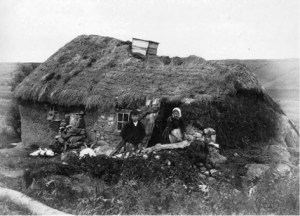 The Night of the Big Wind (Irish: Oíche na Gaoithe Móire), a powerful European windstorm sweeps without warning across Ireland beginning in the afternoon of January 6, 1839, causing severe damage to property and several hundred deaths. As many as one quarter of the houses in north Dublin are damaged or destroyed and 42 ships are wrecked. The storm tracks eastward to the north of Ireland bringing winds gusts of over 100 knots to the south before moving across the north of England and onto the European continent where it eventually dies out. At the time, it is the most damaging Irish storm in 300 years.

 Daniel “Dan” Keating is born in Castlemaine, County Kerry, on January 2, 1902. Keating is a life-long Irish republican and patron of Republican Sinn Féin.
 seamus dubhghaill