A chartered accountant by profession, Ardagh obtains his qualification in Canada in the 1970s and returns to Ireland to practice. He is first elected to Dáil Éireann at the 1997 Irish general election and retains his seat at the 2002 and 2007 general elections. He replaces Ben Briscoe as the TD and main candidate for Fianna Fáil in Dublin South-Central in 2002. He serves as chairman of a number of Dáil committees during his time as a TD.
Ardagh is first elected to Dublin County Council in 1985 and remains a member until 1999. He is elected to Dublin City Council in 1999 and remains a councillor until 2003.
On December 9, 2010, Ardagh announces he will not be standing at the 2011 Irish general election. He resigns as a TD on January 28, 2011, in advance of the 2011 general election.
Ardagh’s daughter is Fianna Fáil TD Catherine Ardagh. He dies on May 17, 2016, after a long illness.
Before entering politics, Cannon is a planning official for Galway City Council and Dublin City Council, as well as CEO and secretary of the Irish Pilgrimage Trust. In 2002, he is honoured as one of the Galway People of the Year.
Cannon is elected as Leader of the Progressive Democrats in April 2008. He is the first leader of the party to sit as a Senator while serving as leader. At his first press conference as party leader, he states that he believes “there was passion, commitment, talent and knowledge within the PDs’ ranks to stage a big comeback.”
However, after speculation increases that Noel Grealish, one of the two Progressive Democrat TDs, intends to leave the party, Cannon announces in September 2008 that a party conference will be held on November 8, 2008, at which he will recommend that the party disband. The delegates present at the conference vote 201–161 to agree with this recommendation.
On March 24, 2009, Cannon announces his decision to resign the leadership of the Progressive Democrats and joins Fine Gael the same day. At the 2011 Irish general election, he is one of two Fine Gael TDs elected in Galway East.
In 2019, in recognition of his work in education, Cannon is appointed as a UNICEF global champion for education. He is one of seven Generation Unlimited Champions who advocates worldwide for the development of UNICEF’s Gen U programme.
At the 2020 Irish general election, Cannon is elected to the second seat in Galway East. He continues to serve as a minister of state until the formation of a new government on June 27, 2020.
On March 19, 2024, Cannon announces that he will not contest the next general election, blaming a “toxicity in politics.”
Cannon is a musician and songwriter, and recently collaborated with Irish folk singer Seán Keane and others on songwriting projects. One of his co-compositions, “Nature’s Little Symphony,” is performed in Dublin by the RTÉ Concert Orchestra as part of the national Cruinniú celebrations on Easter Monday 2017. Both “Nature’s Little Symphony” and another of his compositions, “Gratitude,” are featured on the album Gratitude recorded by Keane and the RTÉ Concert Orchestra in 2018. On the August 10, 2018, Cannon plays piano with Keane and the RTÉ Concert Orchestra as part of a sold-out performance at the National Concert Hall. In 2019, he composes “An Túr,” a short piano instrumental to celebrate the birthday of W. B. Yeats.
In 2021 Cannon is commissioned to compose the soundtrack to a poem by Emily Cullen as part of the national commemoration of the signing of the Anglo-Irish Treaty in 1921.
In March 2024, Cannon begins presenting The Grey Lake Cafe, a radio show on Loughrea Community Radio featuring his own musical choices, and interviews with public figures who have a passion for music.
Cannon is also an avid cyclist and cycling safety advocate. He specialises in endurance cycling challenges and on June 19, 2021, he cycles Ireland end to end, a distance of 575 km, in 23 hours and 23 minutes, to raise money for charity.
On July 2, 2021, Cannon is involved in a road traffic collision and suffers serious injuries. On July 2, 2022 he marks the first anniversary of the incident by cycling 500 km around the border of County Galway. Marking the same date in 2023, he cycles 935 km (581 mi) in 56 hours, covering all 32 counties of the island of Ireland while fundraising for Hand In Hand, a charity that supports families challenged by childhood cancer.
In 2004, Bacik’s book Kicking and Screaming: Dragging Ireland into the 21st Century, is published by The O’Brien Press.
In 2007, she contested the Seanad Éireann elections for the third time in the Dublin University constituency, and is elected to the third seat, behind sitting Independent senators Shane Ross and David Norris. She initially sits as an Independent senator.
In February 2009, Bacik is included in an ‘All Star Women’s Cabinet’ in the Irish Independent. In March 2009, she confirmed claims made on a TV programme that she had taken two voluntary pay cuts of 10% in addition to a pension levy. In June 2009, she is the Labour Party candidate for the Dublin Central by-election. She comes in third with 17% of the first preference votes. She joins the Labour Party group in the Seanad in September 2009, and becomes Labour Party Seanad spokesperson for both Justice and Arts, Sports and Tourism. In November 2009, a feature by Mary Kenny of the Irish Independent includes Bacik in a list of women who “well deserved their iconic status.”
In May 2010, Bacik seeks Labour’s nomination to contest the next election in the Dublin South-East constituency but is not selected. In December 2010, she is added to the ticket as the second candidate beside Labour Party leader, Eamon Gilmore, in the Dún Laoghaire constituency for the 2011 Irish general election. Gilmore tops the poll, with Bacik receiving 10.1% of first preference votes but she is not elected. She is re-elected to Seanad Éireann at the subsequent election, after which she becomes Deputy Leader of the Seanad. She holds her seat in the Seanad in 2016 and in 2020.
On April 27, 2021, after the resignation of Eoghan Murphy from his Dáil seat in Dublin Bay South, Bacik announces her intention to stand in the upcoming by-election. She campaigns with an emphasis on providing affordable housing, as well as improving healthcare and childcare, tackling climate change, and achieving “a true republic in which church and state are separated.” During the campaign, she describes herself as having “more bills passed into law than any other Senator, on issues such as workers’ conditions, women’s health rights, and LGBT equality”. She also campaigns on increasing the number of sports amenities for children in the area, calling for unused Defence Forces football fields at the Cathal Brugha Barracks to be freed up for local sports, with the suggestion rejected by Fine GaelMinister for DefenceSimon Coveney. Fine Gael complains to RTÉ after she features prominently on National Treasures, a prime-time TV show broadcast by RTÉ during the campaign. RTÉ has strict rules about fair coverage of candidates during campaigns. The national broadcaster blames an “inadvertent error” for the programme being shown three days before the election. A steering group within the broadcaster tells Fine Gael that “the broadcast should not have happened.” Consequentially, RTÉ has to show a special report on the by-election on Prime Time to “ensure fair coverage is given to all candidates.”
Bacik wins this election, receiving 8,131 (30.2%) first-preference votes. It is her fourth attempt as a Labour candidate, and she expresses her delight at the success at the count centre in the RDS. Following the election, she is described by The Irish Times as “a formidable activist and public intellectual” and that Fine Gael’s perceived antipathy towards their former TD, Kate O’Connell, may have contributed to the surge in support to Bacik from women voters. The newspaper claims that her election is “a long overdue morale boost” for Labour.
In March 2022, Bacik confirms she will run to succeed Alan Kelly as Labour Party leader. Kelly states that he believes that Bacik will succeed him. On March 24, 2022, she is confirmed as Labour Party leader unopposed at a party conference in Dublin. In a speech, she says she will focus on the rising cost of living and the serious and global problems facing the country. She pledges that Labour will fight the next election as a “standalone party” rather than joining any left-wing alliance.
McDonald is born into a middle-class family in south Dublin. Her father Patrick McDonald, a builder and surveyor, and her mother Joan, separate when she is nine years old, and she stays with her mother in Rathgar. She has three siblings, one older and two younger. Her great-uncle, James O’Connor, was a member of the Anti-Treaty IRA and was executed at the Curragh Camp during the Irish Civil War.
She works as a researcher for the Institute of European Affairs, a consultant for the Irish Productivity Centre, a human resources consultancy that is jointly operated by Ibec and Irish Congress of Trade Unions (ICTU), and a trainer in the Partnership Unit of the Educational and Training Services Trust.
McDonald starts her political career by first joining Fianna Fáil in 1998 but leaves the party after a year due to core policy differences, particularly in relation to Northern Ireland and social justice. She quickly realises that Sinn Féin is a more appropriate party for her Republican views after meeting Sinn Féin members through the Irish National Congress.
She first runs for office at the 2002 Irish general election when she unsuccessfully contests the Dublin West constituency for Sinn Féin, polling 8.02% of first preference votes.
In 2004, McDonald becomes Sinn Féin’s first Member of the European Parliament (MEP) in Ireland, when she is elected at the 2004 European Parliament election in Ireland for the Dublin constituency, receiving over 60,000 first preference votes. She serves until 2009 and is a prominent member of the Employment and Social Affairs committee and Civil Liberties committee.
McDonald contests the Dublin Central constituency again at the 2011 Irish general election, this time picking up 13.1% of first preference votes. She is successful in taking the last seat in the constituency. Following the election, she becomes Sinn Féin’s Spokesperson for Public Expenditure and Reform and is a member of the Public Accounts Committee from then until 2017.
After her re-election to the Dáil at the 2016 Irish general election, in which she tops the poll in Dublin Central, she becomes Sinn Féin’s All-Ireland Spokesperson for Mental Health and Suicide Prevention, which she holds until being elected president of Sinn Féin in 2018.
At a Sinn Féin party conference on November 18, 2017, Gerry Adams is re-elected party leader but announces that he will ask party leadership to call for a special Ard Fheis to be held within three months to choose a new president, and that he will not stand for re-election as TD for the Louth constituency in the next election.
At the close of nominations to succeed Adams on January 20, 2018, McDonald is announced as the president-elect of Sinn Féin, as she is the sole nominee to enter the race. She is confirmed as president at a special Ard Fheis on February 10, 2018, in Dublin.
McDonald is nominated as Taoiseach on February 20, 2020, but is defeated 45 to 84. On June 26, 2020, Fianna Fáil, Fine Gael, and the Green Party form a coalition government, leaving Sinn Féin as the largest opposition party, and McDonald as Leader of the Opposition. She dismisses the coalition agreement as a “marriage of convenience,” and accuses Fianna Fáil and Fine Gael of conspiring to exclude Sinn Féin from government.
At the 2024 Irish general election, McDonald is re-elected to the Dáil topping the poll in Dublin Central with Sinn Féin increasing their seat share by two seats, remaining the second largest party by representation in the Dáil and attaining 19% of the first preference votes, a fall of 5.5% from 2020 and fall behind Fianna Fáil by 2.9% and Fine Gael by 1.8%.
McDonald is again nominated as Taoiseach on December 18, 2024, but is defeated 44 to 110.
McDonald’s husband, Martin Lanigan, works as a gas control superintendent for the emergency dispatch division of Gas Networks Ireland, a state infrastructure provider. They have two children and live in Cabra, Dublin.
He is elected in 1985 as a Workers’ Party member of Dublin City Council for Crumlin–Kimmage area, and is re-elected at subsequent local elections until 2011, when he is forced to resign his seat due to dual mandate. He is finally elected at the 1989 Irish general election. He joins with Workers’ Party members who form Democratic Left in 1992. He unexpectedly loses his seat at the 1992 Irish general election. Labour’s Pat Upton is unexpectedly returned on the first count, with Byrne finally losing the last seat to Fianna Fáil‘s Ben Briscoe by five votes after a marathon 10-day count.
He loses his seat again at the 1997 Irish general election. Although the Labour Party and the Democratic Left merge in 1999, he is not selected to contest the Dublin South-Central by-election which follows Pat Upton‘s death later that year. Upton’s sister Mary is elected for the Labour Party.
Byrne contests the 2002 Irish general election on the Labour Party ticket as Mary Upton’s running-mate but is unsuccessful. Along with Upton, he contests the Dublin South-Central constituency at the 2007 Irish general election advocating a Labour Party/Fine Gael government but misses the final seat by 69 votes. He is nominated by the Labour Party to contest the Seanad election in the Labour panel but is not elected. In 2009, he is re-elected to Dublin City Council. At the 2011 Irish general election he is re-elected to the Dáil, after a fourteen-year absence.
In January 2015, Byrne becomes involved in an altercation with Sinn Féin TD, Jonathan O’Brien. During ministers’ questions, O’Brien criticises TánaisteJoan Burton over homelessness in Ireland, citing the experiences of his brother, a recovering heroin addict. Byrne asks of O’Brien, “Why doesn’t his good family give him a home?” This infuriates O’Brien. The Irish TimesjournalistMiriam Lord criticizes Byrne, remarking that “You sense the relief rising in the chamber. They don’t like it when the real world intrudes. These sort of things don’t really happen to TDs.”
O’Hanlon enters his first electoral contest when he is the Fianna Fáil candidate in the 1973 Monaghan by-election caused by the election of Erskine Childers to the Presidency. He is unsuccessful on this occasion but is eventually elected at the 1977 Irish general election for the Cavan–Monaghan constituency. He is one of a handful of new Fianna Fáil deputies who are elected in that landslide victory for the party and, as a new TD, he remains on the backbenches. Two years later he becomes a member of Monaghan County Council, serving on that authority until 1987.
When Fianna Fáil returns to power after a short-lived Fine Gael–Labour Party government in 1982, O’Hanlon is once again overlooked for ministerial promotion. An extensive cabinet reshuffle toward the end of the year sees him become Minister of State for Social Welfare Claims. His tenure is short-lived as the government falls a few weeks later and Fianna Fáil are out of power.
In early 1983, Charles Haughey announces a new front bench, and O’Hanlon is promoted to the position of spokesperson on Health and Social Welfare.
Following the 1987 Irish general election, Fianna Fáil are back in power, albeit with a minority government, and O’Hanlon becomes Minister for Health. Immediately after taking office, he is confronted with several controversial issues, including the resolution of a radiographers’ dispute and the formation of an HIV/AIDS awareness campaign. While Fianna Fáil campaigns on a platform of not introducing any public spending cuts, the party commits a complete U-turn once in government. The savage cuts about healthcare earn O’Hanlon the nickname “Dr. Death.” Despite earning this reputation, he also introduces a law to curb smoking in public places.
In 1991, O’Hanlon becomes Minister for the Environment following Albert Reynolds‘ failed leadership challenge against Charles Haughey.
When Reynolds eventually comes to power in 1992, O’Hanlon is one of several high-profile members of the cabinet who lose their ministerial positions.
In 1995, O’Hanlon becomes chair of the Fianna Fáil parliamentary party before being elected Leas-Cheann Comhairle (deputy chair) of Dáil Éireann in 1997. Following the 2002 Irish general election, he becomes Ceann Comhairle of Dáil Éireann. In this position, he is required to remain neutral and, as such, he is no longer classed as a representative of any political party. He is an active chair of the Dáil. However, on occasion, he is criticised, most notably by Labour’s Pat Rabbitte, for allegedly stifling debate and being overly protective of the government. Following the 2007 Irish general election, he is succeeded as Ceann Comhairle by John O’Donoghue. He is the vice-chair of the Joint Oireachtas Committee on Foreign Affairs.
Two of O’Hanlon’s children have served as local politicians in Cavan-Monaghan. A son Shane is a former member of Monaghan County Council and a daughter Fiona O’Hea serves one term on Cootehill Town Council. The Sinn Féin TD Caoimhghín Ó Caoláin is also a relation of O’Hanlon. He is also the father of actor and comedian Ardal O’Hanlon.
On December 5, 2011, Pringle delivers a televised address to the nation, representing the technical group of TDs in Dáil Éireann. He does so in response to TaoiseachEnda Kenny‘s address to the nation of the previous evening. Later that month, he calls on people for support in a campaign not to pay a new household charge brought in as part of the latest austerity budget and announces that he will not register for the tax or pay it.
In February 2012, Pringle publishes his expenses online. He is elected leader of the technical group in Dáil Éireann in March 2012.
In May 2012, Pringle brings an unsuccessful High Court challenge over the 2012 European Fiscal Compact referendum and the European Stability Mechanism (ESM) Treaty which is appealed to the Supreme Court in July 2012. In July 2012, the Irish Supreme Court decides to refer three questions to the Court of Justice of the European Union (CJEU) arising out of his challenge of the European Stability Mechanism Treaty and doubts about the ESM’s legality under the Treaties of the European Union. The CJEU holds an oral hearing on the referral on October 23, 2012. It is the first time that the full court sits to hear a reference from a member state of the Union. The 27 judges hear oral arguments from the counsel for Pringle, Ireland, nine other member states, the Commission, the Council, and the European Parliament. On November 27, 2012, the EU Court of Justice dismisses Pringle’s arguments and rules that the ESM is in accordance with the Treaties.
In the 2016 Irish general election, after a re-drawing of constituency boundaries, Pringle campaigns in the new five-seater Donegal constituency. He is re-elected to the final seat by a margin of just 184 votes over Sinn Féin’s Pádraig Mac Lochlainn. During negotiations to form a government, Pringle says he is glad not to have signed up to the Independent Alliance, after that group enters talks with Taoiseach Enda Kenny. He says that unless Kenny or Fianna Fáil leader Micheál Martin sign up to Right2Change, he will not support either as Taoiseach.
As of April 2016, Pringle had become a member of the Independents 4 Change technical group in the Dáil.
In May 2016, Pringle introduces legislation designed to retain water in public ownership and avoid further privatisation.
Pringle puts forward a bill calling on the government to end public spending from fossil fuels, which passes, making Ireland the first country to fully divest public money from fossil fuels. In June 2022, he puts forward a bill proposing a referendum on lowering the voting age to sixteen.
Dunphy grows up in Drumcondra, Dublin, in what he describes as “a one-room tenement flat [with] no electricity, no hot water.” He attends Saint Patrick’s National School, Drumcondra. In 1958, he gets a one-year government scholarship to Sandymount High School but has to work as a messenger at the tweed clothing shop Kevin and Howlin.
A promising footballer, Dunphy leaves Dublin while still a teenager to join Manchester United as an apprentice. He does not break into the first team at United, and subsequently leaves to play for York City, Millwall, Charlton Athletic, Reading and Shamrock Rovers. It is at Millwall that he makes the most impact. He is considered an intelligent and skillful player in the side’s midfield. He is a member of “The Class of ’71,” the Millwall side that fails by just one point to gain promotion to the Football League First Division.
Dunphy accompanies Johnny Giles back to Ireland to join Shamrock Rovers in 1977. Giles wants to make the club Ireland’s first full-time professional club and hopes to make Rovers into a force in European football by developing talented young players at home who would otherwise go to clubs in England. Dunphy is originally intended to be in charge of youth development. However, despite an FAI Cup winners medal in 1978, his only medal in senior football, and two appearances in the UEFA Cup Winners’ Cup, he becomes disillusioned with the Irish game and drops out of football altogether to concentrate on a career in journalism.
Since the 1980s, Dunphy has written a number of books. His first and most widely praised book is Only a Game? The Diary of a Professional Footballer, which is an autobiographical account of his days playing for Millwall. Written in diary form, it records events from the dressing room of his 1973–74 season, which begins well for him at Millwall but subsequently ends in disillusionment: after being substituted in an October 27, 1973, home loss to eventual league winners Middlesbrough, he does not play another game all season, the club finishing mid-table.
In 1985, rock band U2 and manager Paul McGuinness commission Dunphy to write the story of their origins, formation, early years and the time leading up to their highly successful album The Joshua Tree. His book Unforgettable Fire – Past, Present, and Future – The Definitive Biography of U2 is published in 1988. It receives some favourable reviews, but critics close to the band speak of many inaccuracies. A verbal war erupts in the press during which he calls lead singer Bono a “pompous git.”
Dunphy also writes a biography of long-serving Manchester United manager Matt Busby and in 2002 ghost writes the autobiography of Republic of Ireland and Manchester United player Roy Keane.
Since the mid-1980s, Dunphy has regularly appeared as an analyst during football coverage on Raidió Teilifís Éireann (RTÉ). Since RTÉ acquired the rights to show English football, he has been a regular contributor to Premier Soccer Saturday. He also contributes to analysis of UEFA Champions League games and, in international football, RTÉ’s coverage of FIFA World Cups, UEFA European Football Championships and qualifying matches involving the Republic of Ireland national football team.
In 2001, Dunphy becomes the first male host of the quiz show The Weakest Link, which airs on TV3, for just one series. In 2003, he is hired again by TV3 to host their new Friday night chat show, entitled The Dunphy Show. Pitted head-to-head with RTÉ’s long-running flagship programme, The Late Late Show, Dunphy’s show loses what is a highly publicised “ratings war,” and is cancelled before its original run concludes.
Dunphy is the first presenter of a made-for-mobile television show on the 3 mobile network in Ireland. His rants and “Spoofer of the Week” are watched by thousands of 3 Mobile customers. The shows are awarded “Best Entertainment Show” at Ireland’s Digital Media Awards. He admits he never uses a mobile himself but enjoys filming for a mobile audience from his living room in Ranelagh.
In July 2018, Dunphy announces that he is leaving RTÉ after 40 years with the broadcaster, and that he intends to focus on his podcastThe Stand with Eamon Dunphy.
Dunphy has also has a prominent radio career with several stations, including Today FM, Newstalk and RTÉ Radio 1. He is the original host in 1997 of the popular current affairs show The Last Word on Today FM. In September 2004, he takes over The Breakfast Show slot on the Dublin radio station Newstalk 106 from David McWilliams. The show tries to court controversy and listeners in equal measure. He fails to attract the large listenership predicted, with only a few additional thousand tuning in. He announces in June 2006 his intention to leave Newstalk 106, citing an inability to sustain the demands of an early morning schedule. After his departure from Newstalk 106, he confirms he is suffering from a viral illness from which he later recovers.
In July 2006, RTÉ announces that Dunphy will present a new weekly programme as part of the new RTÉ Radio 1 autumn schedule.
Dunphy rejoins Newstalk but leaves again in 2011 “due to interference from management and a push to put a more positive spin on the news.” On his last show he accuses his boss, Denis O’Brien, of “hating journalism.” He quits after Sam Smyth is sacked from Today FM (also owned by O’Brien) and says management at Newstalk is trying to remove “dissenting voices” like Constantin Gurdgiev from the airwaves.
Dunphy is a daily Mass-goer until he is preparing for marriage to his first wife, Sandra from Salford, when he is 21. He is Catholic and she is Protestant. The priest instructing them for marriage disapproves strongly of the mixed couple, saying that he should not marry her because she is “not a proper person.” Dunphy’s observance is already weakening but he quits his daily Mass-going at this point. He and Sandra have two children, a boy and a girl, and he is now a grandfather. His first marriage ends, and he moves to Castletownshend in County Cork for two years in the early 1990s. He lives with another partner, Inge, before meeting his second wife, RTÉ commissioning editor Jane Gogan, in the Horseshoe Bar in Dublin in 1992. They marry at the Unitarian Church on St. Stephen’s Green on September 24, 2009.
In an interview with An Phoblacht, Dunphy, who had previously written highly critical articles on the Provisional IRA and Sinn Féin, states that he is now a Sinn Féin supporter and declares he had voted for them in the 2011 Irish general election. He describes their representatives as “incredibly hard-working and incredibly intelligent.”
Dunphy publishes his autobiography entitled The Rocky Road in October 2013.
Today, Dunphy generally resides at his home near Ranelagh in Dublin. He also owns a holiday home in Deauville, France.
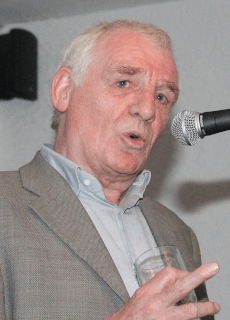
(Pictured: Éamon Dunphy at the Sinn Féin Summer School, 2013)
Adebari arrives in Dublin with his wife and two children in 2000. After he converts from Islam to Christianity, he flees Nigeria in 2000, and makes a claim for asylum on the grounds of religious persecution. His application is rejected because of a lack of evidence that he had personally suffered persecution. He does however gain automatic residency when his wife gives birth to a son in Ireland shortly after their arrival.
Adebari and his family settle in County Laois. He completes his master’s degree in intercultural studies at Dublin City University (DCU) and sets up a firm called Optimum Point Consultancy.
In 2004, Adebari is elected as a town councilor in local elections. On June 27, 2007, at the age of 43, he is elected mayor of the 9-member Portlaoise Town Council, by a vote of six to three and with support from Fine Gael, Sinn Féin and an Independent councilor. At a meeting attended by officials from the Nigerian, South African, and the United States embassies, the new mayor is quoted as saying his election is proof that “Ireland is not just a country of a thousand welcomes, but it is a country of equal opportunity.” In the 2009 local elections he is re-elected to the town council and also to Laois County Council for the Portlaoise electoral area.
In 2007, Adebari denies claims that he was a train operator in London who worked out of the Queen’s Park station on the Bakerloo line. Multiple London Underground employees, including Paddy Clarke, a retired tube driver from County Louth, state that Adebari worked as a train driver in London during the late 1990s before moving to Ireland. Clarke states, “at the very least fifty drivers and six or more managers will remember him. His photograph and signature are on file with London Underground’s personnel office which were used in the issue of his free travel-pass and identity card.” Adebari asserts he traveled to Ireland directly from Nigeria via Paris, and never worked or lived in London at any time.
Higgins returns to Ireland and attends University College Dublin (UCD), studying English and French. For several years he is a teacher in several Dublin inner city schools. While at university he joins the Labour Party and becomes active in the Militant Tendency, an entryistTrotskyist group that operates within the Labour Party. Throughout his time in the Labour Party, he is a strong opponent of coalition politics, along with TDs Emmet Stagg and Michael D. Higgins. He is elected to the Administrative Council of the Labour Party by the membership in the 1980s. In 1989, he is expelled alongside 13 other members of Militant Tendency by party leader Dick Spring. The group eventually leaves the party and forms Militant Labour, which becomes the Socialist Party in 1996.
Higgins speaks out against the Iraq War while a TD, and addresses the Dublin leg of the March 20, 2003 International Day of Action. He is also prominent in the successful 2005 campaign to bring Nigerian school student Olukunle Eluhanla back to Ireland after he had been deported. He remains an opponent of the deportation policy.
Higgins uses his platform in the Dáil to raise the issue of exploitation of migrant and guest workers in Ireland. He and others claim that many companies are paying migrants below the minimum wage and, in some cases, not paying overtime rates. He expresses opposition in the Dáil to the jailing of the Rossport Five in July 2005. He raises the outsourcing of jobs by Irish Ferries in the Dáil in November 2005, requesting new legislation to regulate what he describes as “these modern slavers.”
Higgins is elected again as TD for Dublin West at the 2011 Irish general election. He wins the third seat (of four) with 8,084 first preference votes. In his first speech in the 31st Dáil, he opposed the nomination of Fine Gael‘s Enda Kenny as Taoiseach. On May 4, 2011, Kenny is forced to apologise to Higgins in the Dáil after falsely accusing him of being a supporter of Osama bin Laden after Higgins offers criticism of his assassination by the CIA. He had asked the Taoiseach, “Is assassination only justified if the target is a reactionary, anti-democratic, anti-human rights obscurantist like bin Laden?”
In the Dáil, Higgins accuses TánaisteEamon Gilmore of doing nothing for the 14 Irish citizens being held “incommunicado” by Israel in November 2011. In December 2011, he describes as a disgraceful campaign of intimidation the fines imposed by the government on people who are unable to pay a new household charge brought in as part of the latest austerity budget and says to Enda Kenny that he will be “the new Captain Boycott of austerity in this country.” He asks that Minister for FinanceMichael Noonan provide EBS staff with the 13th month end-of-year payment they are being denied.
In September 2012, Higgins publicly disagrees with former Socialist Party colleague Clare Daly, saying it is “unfortunate” that she has resigned from the party, but that it is impossible for Daly under the banner of the Socialist Party to continue to offer political support to Mick Wallace, who is at that time embroiled in scandal.
Higgins announces in April 2014 that he will not contest the next Dáil election. At the time he states his belief that the “baton of elected representation” should be carried by another generation of Socialist Party politicians — like Ruth Coppinger and Paul Murphy.



 seamus dubhghaill