seamus dubhghaill

Promoting Irish Culture and History from Little Rock, Arkansas, USA


Leave a comment

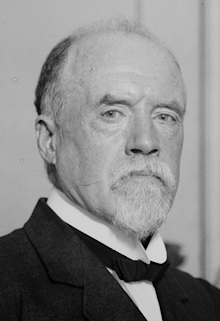
Death of Laurence Ginnell, Politician, Lawyer & Member of Parliament

Laurence GinnellIrish nationalist politicianlawyer and Member of Parliament (MP) of the House of Commons of the United Kingdom of Great Britain and Ireland, dies in the United States on April 17, 1923. He serves as member of the Irish Parliamentary Party (IPP) for North Westmeath at the 1906 United Kingdom general election. From 1910 he sits as an Independent Nationalist and at the 1918 United Kingdom general election in Ireland he is elected for Sinn Féin.

Ginnell is born in DelvinCounty Westmeath, in 1852, (baptised April 9, 1852) the son of Laurence Ginnell and Mary Monaghan and twin to Michael Ginnell. He is self-educated and is called to the Irish bar as well as the Bar of England and Wales. In his youth, he is involved with the Land War and acts as private secretary to John Dillon.

The last great social and agrarian campaign of the Irish home rule movement, the Ranch War (1906 and 1909), is largely led and organised by Ginnell from the central office of the United Irish League. He is elected an MP in 1906, takes his seat at Westminster and swears allegiance to Edward VII. On October 14, 1906, he launches the “war” at Downs, County Westmeath.

The purpose of the war is to bring relief to the large numbers of landless and smallholders, particularly in the West, who are relatively untouched by the Wyndham Land Act (1903) and by the larger policy of purchase. The strategy that Ginnell pursues is the Down’s Policy, or cattle driving, a proceeding designed to harass the prosperous grazier interests, whose “ranches” occupy large, under populated and under worked tracts. The Down’s Policy is also meant to draw public attention to the scandalous inequalities that survive in the Irish countryside. The conservatives within the home rule leadership are understandably suspicious about the revival of agrarian disturbances, but the mood of the party organisation is hardening in the aftermath of a disappointing devolution bill in May 1907, from the new Liberal government, so that it seems logical to turn to the traditional mechanism for reactivating the national question: agrarian agitation.

Ginnell’s cattle drives begin to tail off after the summer of 1908, and the agitation is finally dissolved with the passage of a 1909 Act by the Liberal Chief Secretary Augustine Birrell that allows the transfer to the Irish Land Commission of farmland by compulsory purchase, which is hailed by the national movement as an historic victory. In reality, the Ranch War involves an implosion within sectors of the Irish Parliamentary Party, as its leadership has not facilitated the working of the Wyndham Land Act in the first place because John Dillon and his like want conflict above victory.

In 1909, Ginnell is expelled from the Irish Parliamentary Party for the offence of asking to see the party accounts after which he sits as an Independent Nationalist. During this time, he is addressed frequently as “The MP for Ireland.” At Westminster, he is highly critical of the British government‘s war policy and its holding of executions of certain participants in the Easter Rising of 1916. On May 9, he accuses British Prime Minister H. H. Asquith, of “Murder” and is forcibly ejected from the Chamber. He visits many of the prisoners who are interned in various prisons in Wales and England.

In 1917, Ginnell campaigns to try to ensure the election of George Noble Plunkett in the North Roscommon by-election in which he defeats the IPP candidate on an abstentionist platform. Following the victory of Éamon de Valera in East Clare, while he is standing for Sinn Féin, on July 10, 1917, Ginnell joins Sinn Féin.

At the Sinn Féin ardfheis in 1917, at which the party is reconstituted as a republican party with de Valera as president, Ginnell and W. T. Cosgrave are elected Honorary Treasurers. He is imprisoned in March 1918 for encouraging land agitation and later deported to Reading Gaol. In the 1918 United Kingdom general election, he is elected as a Sinn Féin MP for the Westmeath constituency by comfortably defeating his IPP challenger. After his release from prison, he attends the proceedings of the First Dáil. Along with fellow TD James O’Mara, he is one of the only TDs to serve as a member in both the House of Commons and Dáil Éireann.

He is one of the few people to have served in the House of Commons and in the Oireachtas. He is appointed Director of Propaganda in the Second Ministry of the Irish Republic. After spending a year as a republican campaigner in Chicago, he is appointed the Representative of the Irish Republic in Argentina and South America by de Valera. He carries out his propaganda work here to distribute copies of the Irish Bulletin and to provide the Sinn Féin version of the conflict during the Irish War of Independence. On August 16, 1921, he returns home to attend the first meeting of the Second Dáil. He travels back to Argentina some months later to serve as the Representative of the Republic there.

Ginnell opposes the Anglo-Irish Treaty that is ratified by the Dáil in January 1922, and is elected as an anti-Treaty Sinn Féin TD at the 1922 Irish general election on the eve of the Irish Civil War.

On September 9, 1922, Ginnell is the only anti-Treaty TD to attend the inaugural meeting of the Provisional Parliament or Third Dáil. Before signing the roll, he says, “I want some explanation before I sign. I have been elected in pursuance of a decree by Dáil Éireann, which decree embodies the decree of May 20, 1922. I have heard nothing read in reference to that decree, nothing but an Act of a foreign Parliament. I have been elected as a member of Dáil Éireann. I have not been elected to attend any such Parliament. Will anyone tell me with authority whether it is…”.

Ginnell is at this point interrupted but resumes by saying that he will sign the roll and take his seat in the Assembly if the Assembly is Dáil Éireann. He is informed he is not allowed raise any such question until a Ceann Comhairle has been elected. He continues to ask questions regardless to which he gets no answer including his question: “Will any member of the Six Counties be allowed to sit in this Dáil?” W. T. Cosgrave moves at this point that he be excluded from the House. Ginnell protests, and he is dragged out by force.

De Valera later appoints Ginnell a member of his “Council of State,” a twelve-member body set up to advise him on the deteriorating situation in the civil war. He returns to the United States soon afterward to serve as the Republic‘s envoy in the country. He orders Robert Briscoe and some of his friends to take possession of the Consular Offices in Nassau Street, New York City, then in the hands of the Irish Free State Government, to obtain the list of the subscribers to the bond drive organized to aid the struggle in the War of Independence. At the time, a court case is ongoing to decide on who has the right to the funds: the newly installed Provisional Government or de Valera, as one of the three trustees among the anti-Treatyites.

Ginnell dies in Washington, D.C. on April 17, 1923, at the age of 71, still campaigning against the Anglo-Irish Treaty.
Leave a comment

Death of Séamus Dwyer, Irish Politician

Séamus Dwyer, Pro-Treaty politician, is shot dead at his shop in Rathmines, Dublin, by Anti-Treaty fighters on December 20, 1922.

Dwyer is born in Dublin on November 15, 1886.

Serving as an intelligence officer for the Dublin Brigade of the Irish Republican Army (IRA), and as a Dáil Court judge he is imprisoned by the British in 1921. He is elected unopposed at the 1921 Northern Ireland and Southern Ireland general election for the Dublin County constituency as a Sinn Féin Teachta Dála (TD) in the 2nd Dáil. He votes in favour of the Anglo-Irish Treaty. He stands as a pro-Treaty Sinn Féin candidate at the 1922 Irish general election but is not elected.

Dwyer runs a off-licence/grocery shop in Rathmines and is a member of the Rathmines Urban Council. He marries Marie Molloy in 1914, they have no children. He is a member of the Peace Committee of ten men which sit in May 1922 and bring about the agreement between Michael Collins and Éamon de Valera.

On December 20, 1922, Dwyer is shot dead in his shop at 5 Rathmines Road, Dublin, by anti-Treaty IRA Volunteer Robert Bonfield. At about 4:50 p.m., Dwyer is talking to a customer when a young man enters the shop. Addressing Dwyer, the young man asks “Are you Mr. O’Dwyer?” Dwyer replies yes and the young man says that he has a note for him. The young man reaches into the pocket of his overcoat a draws a revolver. He fires twice at Dwyer at point-blank range and he dies instantly. The customer and a shop assistant give chase but are unable to catch the assassin. Two republicans, Frank Lawlor and the actual assassin, Robert Bonfield, are later killed by Free State forces in revenge for the shooting of Dwyer.

Dwyer is buried in Plot UA 67 South Section, Glasnevin Cemetery, Glasnevin, County Dublin.


Leave a comment

The Copley Street Riot

The Copley Street riot occurs on August 13, 1934, at the Copley Street Repository, Cork, County Cork, after Blueshirts opposed to the collection of annuities from auctioned cattle ram a truck through the gate of an ongoing cattle auction. The Broy Harriers open fire and one man, 22 year old Michael Lynch, is killed and several others injured.

Following the Irish War of Independence (1919–21), Britain relinquishes its control over much of Ireland. However, aspects of the Anglo-Irish Treaty, which had marked the end of the war, lead to the Irish Civil War (1922–23). The aftermath leaves Ireland with damaged infrastructure and hinders its early development.

Éamon de Valera, who had voted against the Anglo-Irish treaty and headed the Anti-Treaty movement during the civil war, comes to power following the 1932 Irish general election and is re-elected in 1933. While the treaty stipulates that the Irish Free State should pay £3.1 million in land annuities to Great Britain, and despite advice that an economic war with Britain could have catastrophic consequences for Ireland (as 96% of exports are to Britain), de Valera’s new Irish government refuses to pay these annuities – though they continue to collect and retain them in the Irish exchequer.

This refusal leads to the Anglo-Irish trade war (also known as the “Economic War”), which persists until 1935, when a new treaty, the Anglo-Irish Trade Agreement, is negotiated in 1938. During this period, a 20% duty is imposed on animals and agricultural goods, resulting in significant losses for Ireland. Specifically, poultry trade declines by 80%, butter trade by 50% and cattle prices drop by 50%. Some farmers are forced to kill and bury animals because they cannot afford to maintain them.

In 1933, Fine Gael emerges as a political party—a merger of Cumann na nGaedheal and the National Centre Party. Fine Gael garners substantial support from rural farmers who are particularly affected by the Economic War. They strongly object to the collection of land annuities by the Fianna Fáil government. The Blueshirts, a paramilitary organisation founded as the Army Comrades Association in 1932 and led by former Garda Commissioner Eoin O’Duffy, transforms into an agrarian protest organisation, mobilising against seizures, cattle auctions, and those tasked with collecting annuities.

O’Duffy, a key figure in Irish politics, encourages farmers to withhold payment of land annuities to the government. Arising from this stance, Gardaí start to seize animals and farm equipment, auctioning them to recover the outstanding funds. While seized cattle are auctioned, local farmers rarely participate. Instead, Northern Ireland dealers, often associated with the name O’Neill, are the primary buyers. These auctions are protected by the Broy Harriers, an armed auxiliary group linked to the police.

By 1934, tensions escalate, and a series of anti-establishment incidents are attributed to the Blueshirts. These incidents range from minor acts of violence, such as breaking windows, to more serious offenses like assault and shootings.

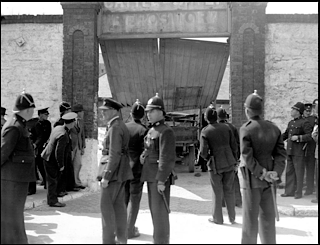
On August 13, 1934, an auction takes place at Marsh’s Yard on Copley Street in Cork, featuring cattle seized from farms in Bishopstown and Ballincollig. The police establish a cordon by 10:00 a.m., with 300 officers on duty. Lorries arrived at 11:00 a.m.

Around noon, three thousand protestors assemble. Within twenty-five minutes, an attempt is made to breach the yard gate by ramming it with a truck. According to Oireachtas records, there are approximately 20 men in the truck which they run against the gate. The Minister for Justice P. J. Ruttledge, says that the truck “with those people in it charged through those cordons of Guards; that several Guards jumped on to the lorry and tried to divert the driver by catching hold of the steering wheel and trying to twist it.” Some contemporary news sources suggest that the ramming truck knocked down the surrounding police cordon “like ninepins and crush[ed] a police inspector against a gate.” Later sources suggest that the senior officer (a superintendent) was injured in a fall, while attempting to avoid being struck, rather than being hit directly by the truck.

A man named Michael Lynch, wearing the distinctive blue shirt, and approximately 20 others reportedly manage to enter the yard. As soon as they enter the yard they are fired upon by armed “special branch” police detectives who are in the yard. Lynch later succumbs to his injuries at the South Infirmary. Thirty-six others are wounded. Despite the violence, the auction proceeds after a one-hour delay.

Following the shooting, a riot ensues, but when news of Lynch’s death reaches the participants, they cease rioting, kneel, and recited a Rosary.

The funeral of Michael Lynch occurs on August 15, 1934. The funeral procession is planned to depart from Saints Peter and Paul’s Church, Cork at 2:30 PM.

The occasion allows for a significant show of force for Eoin O’Duffy and the Blueshirts, and features Roman salutes and military drills. Farmers in Munster reportedly stop work for an hour, and Blueshirt members ask shopkeepers to close their businesses, as a show of respect for the “martyr.” Lynch is afforded a “full Blueshirt burial,” and the coffin is adorned with the flag of the Blueshirts (the Army Comrades Association).

According to the  Minister for Justice, at the funeral W. T. Cosgrave stands beside O’Duffy as the Blueshirt leader gives an oration saying, “We are going to carry on until our mission is accomplished […] those 20 brave men, whose deed will live for ever, not only in Cork but in every county in Ireland, broke through in the lorry […] all Blueshirts should try to emulate his bravery and nobleness. Every Blueshirt is prepared to go the way of Michael for his principles.”

The court grants the family £300 in 1935. This is appealed to the High Court, followed by the Supreme Court, which dismisses the case. In the Supreme Court, Henry Hanna describes the Broy Harriers as “an excrescence” upon the Garda Síochána.

When the matter is discussed in the Seanad in September 1934, and before a vote is taken to “[condemn] the action of the members of the special branch of the Gárda Síochána […] on Monday, the 13th August 1934,” the senators who support Éamon de Valera’s government walk out.

In August 1940, a memorial is unveiled on the tomb of Lynch in Dunbulloge Cemetery in Carrignavar, County Cork, consisting of a limestone Celtic cross and pedestal. The pedestal is engraved with a quote from the American orator, William Jennings Bryan: “The humblest citizen of all the land, when clad in the armour of a righteous cause is stronger than all the hosts of error.”

(Pictured: Aftermath of the ramming of Marsh’s Yard, Copley Street, that leads to the death of Michael Lynch and the Copley Street Riot on August 13, 1934)