seamus dubhghaill

Promoting Irish Culture and History from Little Rock, Arkansas, USA


Leave a comment

Birth of Pat Falvey, Mountaineer, Expedition Leader & Polar Explorer

Pat Falvey, Irish high-altitude mountaineer, expedition leader, polar explorer, entrepreneur, author, corporate/personal trainer/coach, and motivational speaker, is born in Cork, County Cork, on June 2, 1957. He is the first person to complete the Seven Summits twice, with the summiting of Mount Everest reached from both the Tibetan (1996) and Nepalese sides (2004). He is expedition leader of the team that sees Clare O’Leary become the first Irish woman to reach the summit of Mount Everest in 2004. Other extreme expeditions that he makes include walking to the South Pole, crossing South Georgia island, and traversing the Greenland ice sheet. He starts his first business at 15 years of age and has since had businesses in property development, finance, construction, insurance, tourism, and film production. He has been a motivational speaker since the 1990s.

Raised on the north side of Cork city, Falvey starts mountain climbing in his late twenties, having worked as a builder and property developer from his late teens onward. Following the economic recession of the mid-1980s in Ireland, he loses most of his wealth and discovers mountaineering in his late 20s.

Falvey begins his climbing career with hill walking and climbing on the MacGillycuddy’s Reeks in County Kerry. He then devotes himself to training to become a high-altitude mountaineer. He trains initially with the Cork Mountaineering Club, at Tiglin in County Wicklow and becomes a member of Kerry Mountain Rescue, climbing very frequently in Ireland, Scotland, France and the Himalayas.

In June 1994, Falvey climbs Denali, also known as Mount McKinley, in Alaska, reaching the first summit in his Seven Summits attempt. This is followed by Mount Kilimanjaro in Tanzania (January 1995), Mount Everest via the Northeast Ridge (June 1995), Aconcagua in Argentina (December 1995), Mount Elbrus in Russia (March 1996), Vinson Massif in Antarctica (January 1997) and Mount Kosciusko in Australia (February 1997). He is the first Irish man (and the 32nd person in the world) to complete the Seven Summits.

Falvey is the expedition leader of the first Irish team to reach the summit of Cho Oyu in China and Nepal without oxygen, on May 20, 1998. He reaches the summit of Ama Dablam in Nepal on November 3, 1999. In 2003, he is the expedition leader of the first Irish team to reach the summit of Mount Everest via the South-Southeast Ridge, with team members Ger McDonnell and Mick Murphy reaching the summit. On May 18, 2004, he reaches the summit of Everest via the South-Southeast Ridge, and leads the expedition that sees the first Irish woman, Dr. Clare O’Leary, reach the top of Everest.

Falvey and O’Leary complete the Seven Summits on December 16, 2005, when he becomes the first person to complete the Seven Summits twice by climbing Mount Everest from both the Tibetan and Nepalese sides.

In 2006, Falvey leads a group of 32 across the South Georgia Traverse on South Georgia island in honour of Polar explorers Sir Ernest Shackleton and Kerryman Tom Crean, in the Beyond Endurance Antarctic expedition. He leads the first Irish traverse of Greenland in 2006. In January 2008, he leads a four-person Irish expedition to the South Pole. In April 2009, he and O’Leary do a “symbolic” walk to the North Pole, completing the final four-day trek to the Pole.

Falvey joins the Kerry county football team as a “sports performance coach” in 2021. Manager Peter Keane says, “You take us in this country with five million people and we have had some unbelievable adventurers like Shackleton and Crean; you look at someone like Pat who has climbed Everest twice from two different sides, managed to climb the Seven Summits twice, and I am looking to see if he can bring something different in here.”

Falvey’s publications include Reach for the Sky (The Collins Press, 1997), A Journey to Adventure: Stories I never thought I’d tell (The Collins Press, 2007), The Summit: How Triumph Turned to Tragedy on K2’s Deadliest Days (Beyond Endurance Publishing with The O’Brien Press, 2013), You Have the Power: Explore the Mindset You Need to Realise Your Dreams (Beyond Endurance Publishing, 2016) and Accidental Rebel (Beyond Endurance Publishing, 2018).


Leave a comment

The First Irish Expedition Reaches the South Pole

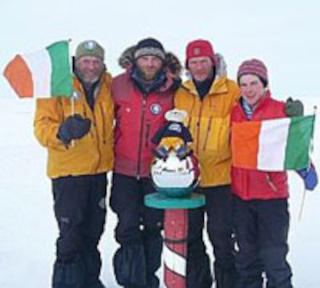
The first Irish expedition arrives at the South Pole on January 8, 2008. Team leader Pat Falvey (50), Dr. Clare O’Leary (35), Jonathan Bradshaw (36) and Shaun Menzies (42) arrive at their destination after covering the final 23 kilometres.

The expedition has been trekking since November through some of the harshest known conditions, battling icy winds, sub-zero temperatures and snowstorms. The squad, who make up the Beyond Endurance expedition, travel approximately 1,100 km (680 miles), with each member hauling a sledge weighing over 150 kg (330 lbs.).

“We’re so happy to be here, we can’t believe it,” says Falvey. “We’re ecstatic but totally exhausted, shattered, and worn away. It’s now -32.5 degrees Celsius (-26.5 F) and I’m chattering from the cold but so excited. All of the meridians and all of the longitudes passed through the point where my hand was. By walking around the South Pole, I could go back in time to yesterday or go a day ahead to tomorrow.”

A spokesman for the team confirms their arrival at their destination at around 7:30 p.m. Irish time.

Deputy team leader, Dr. O’Leary, is the first Irish woman to make it to the South Pole. She is also the first Irish woman to climb Mount Everest and the first to complete the Seven Summits Challenge. A specialist in gastroenterology and general internal medicine, she is based in Tipperary University Hospital, Clonmel, where she works as a consultant.

Menzies and Bradshaw are relatively inexperienced high-altitude trekkers who are invited to join the expedition.

“This a very historic occasion. It is very exciting. It shows that Ireland can play its part in polar exploration,” spokesman Niall Foley says from the team’s base in Killarney, County Kerry. The team is in good spirits and resting at the Amundsen-Scott South Pole Station, he adds. “They’re well and being taken care of by the researchers there. They’re having a cup of cocoa I think.”

The team flies from the South Pole back to Ireland, via Chile, arriving on January 16. The Beyond Endurance Expedition begins in 2006 with an ambitious adventure by a group of “ordinary” people aged from 21 to 61 traveling across South Georgia, landing on Elephant Island, a mountainous ice-covered island off the Antarctic coast.

The purpose of the expedition is to give budding explorers the chance to see Antarctica. From this group, Menzies, a Dublin IT consultant, is selected for rigorous training in Greenland for the South Pole expedition. There they meet up with Bradshaw, a budding adventurer who has explored remote parts of the Himalayas, Africa and New Zealand, who is on a separate trek.

The four adventurers retrace the steps of some of the best-known Irish Antarctic explorers, including Ernest Shackleton and Tom Crean. In 2004, County Kerry native Mike Barry becomes the first Irish man to trek to the South Pole as part of an international expedition. However, Falvey’s squad has now become the first Irish-led team to perform the feat.

President Mary McAleese says the achievement, which coincides with the one hundredth anniversary of Ernest Shackleton’s first attempt on the South Pole, is “particularly poignant.” “I congratulate Pat Falvey, Clare O’Leary, Jonathon Bradshaw and Shaun Menzies on their remarkable accomplishment, and send my very best wishes to their many supporters in this mammoth undertaking.”

Taoiseach Bertie Ahern says he has been following the team’s expedition since the team set out. “Total admiration is perhaps the best way to sum up my thoughts on what you have achieved,” Ahern says. “You are continuing a proud tradition of Irish adventurers, and you should be very proud of your wonderful achievement.”

(From: “Irish team reaches South Pole” by Paul Anderson, The Irish Times, http://www.irishtimes.com, January 9, 2008)


Leave a comment

Birth of Thomas Spring Rice, 1st Baron Monteagle of Brandon

Thomas Spring Rice, 1st Baron Monteagle of Brandon, PC, FRS, FGS, British Whig politician who serves as Chancellor of the Exchequer from 1835 to 1839, is born on February 8, 1790, into a notable Anglo-Irish family which owns large estates in Munster.

Spring Rice is one of the three children of Stephen Edward Rice, of Mount Trenchard House, and Catherine Spring, daughter and heiress of Thomas Spring of Ballycrispin and Castlemaine, County Kerry, a descendant of the Suffolk Spring family. He is a great grandson of Sir Stephen Rice, Chief Baron of the Irish Exchequer and a leading Jacobite Sir Maurice FitzGerald, 14th Knight of Kerry. His grandfather, Edward, converted the family from Roman Catholicism to the Anglican Church of Ireland, to save his estate from passing in gavelkind.

Spring Rice is educated at Trinity College, Cambridge, and later studies law at Lincoln’s Inn, but is not called to the Bar. His family is politically well-connected, both in Ireland and Great Britain, and he is encouraged to stand for Parliament by his father-in-law, Lord Limerick.

Spring Rice first stands for election in Limerick City in 1818 but is defeated by the Tory incumbent, John Vereker, by 300 votes. He wins the seat in 1820 and enters the House of Commons. He positions himself as a moderate unionist reformer who opposes the radical nationalist politics of Daniel O’Connell and becomes known for his expertise on Irish and economic affairs. In 1824 he leads the committee which establishes the Ordnance Survey in Ireland.

Spring Rice’s fluent debating style in the Commons brings him to the attention of leading Whigs and he comes under the patronage of the Marquess of Lansdowne. As a result, he is made Under-Secretary of State for the Home Department under George Canning and Lord Goderich in 1827, with responsibility for Irish affairs. This requires him to accept deferral of Catholic emancipation, a policy which he strongly supports. He then serves as joint Secretary to the Treasury from 1830 to 1834 under Lord Grey. Following the Reform Act 1832, he is elected to represent Cambridge from 1832 to 1839. In June 1834, Grey appoints him Secretary of State for War and the Colonies, with a seat in the cabinet, a post he retains when Lord Melbourne becomes Prime Minister in July. A strong and vocal unionist throughout his life, he leads the Parliamentary opposition to Daniel O’Connell’s 1834 attempt to repeal the Acts of Union 1800. In a six-hour speech in the House of Commons on April 23, 1834, he suggests that Ireland should be renamed “West Britain.” In the Commons, he also champions causes such as the worldwide abolition of slavery and the introduction of state-supported education.

The Whig government falls in November 1834, after which Spring Rice attempts to be elected Speaker of the House of Commons in early 1835. When the Whigs return to power under Melbourne in April 1835, he is made Chancellor of the Exchequer. As Chancellor, he has to deal with crop failures, a depression and rebellion in North America, all of which create large deficits and put considerable strain on the government. His Church Rate Bill of 1837 is quickly abandoned and his attempt to revise the charter of the Bank of Ireland ends in humiliation. Unhappy as Chancellor, he again tries to be elected as Speaker but fails. He is a dogmatic figure, described by Lord Melbourne as “too much given to details and possessed of no broad views.” Upon his departure from office in 1839, he has become a scapegoat for the government’s many problems. That same year he is raised to the peerage as Baron Monteagle of Brandon, in the County of Kerry, a title intended earlier for his ancestor Sir Stephen Rice. He is also Comptroller General of the Exchequer from 1835 to 1865, despite Lord Howick‘s initial opposition to the maintenance of the office. He differs from the government regarding the exchequer control over the treasury, and the abolition of the old exchequer is already determined upon when he dies.

From 1839 Spring Rice largely retires from public life, although he occasionally speaks in the House of Lords on matters generally relating to government finance and Ireland. He vehemently opposes John Russell, 1st Earl Russell‘s policy regarding the Irish famine, giving a speech in the Lords in which he says the government had “degraded our people, and you, English, now shrink from your responsibilities.”

In addition to his political career, Spring Rice is a commissioner of the state paper office, a trustee of the National Gallery and a member of the senate of the University of London and of the Queen’s University of Ireland. Between 1845 and 1847, he is President of the Royal Statistical Society. In addition, he is a Fellow of the Royal Society and a Fellow of the Geological Society of London. In May 1832 he becomes a member of James Mill‘s Political Economy Club.

Spring Rice is well regarded in Limerick, where he is seen as a compassionate landlord and a good politician. An advocate of traditional Whiggism, he strongly believes in ensuring society is protected from conflict between the upper and lower classes. Although a pious Anglican, his support for Catholic emancipation wins him the favour of many Irishmen, most of whom are Roman Catholic. He leads the campaign for better county government in Ireland at a time when many Irish nationalists are indifferent to the cause. During the Great Famine of the 1840s, he responds to the plight of his tenants with benevolence. The ameliorative measures he implements on his estates almost bankrupts the family and only the dowry from his second marriage saves his financial situation. A monument in honour of him still stands in the People’s Park in Limerick.

Even so, Spring Rice’s reputation in Ireland is not entirely favourable. In a book regarding assisted emigration from Ireland, a process in which a landlord pays for their tenants’ passage to the United States or Australia, Moran suggests that Spring Rice was engaged in the practice. In 1838, he is recorded as having “helped” a boat load of his tenants depart for North America, thereby allowing himself the use of their land. However, he is also recorded as being in support of state-assisted emigration across the British Isles, suggesting that his motivation is not necessarily selfish.

Spring Rice dies at the age of 76 on February 7, 1866. Mount Monteagle in Antarctica and Monteagle County in New South Wales are named in his honour.

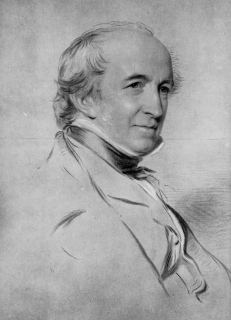
(Pictured: Thomas Spring Rice, 1st Baron Monteagle of Brandon (1790-1866), contemporary portrait by George Richmond (1809-1896))

Leave a comment

Birth of Antarctic Explorer Tom Crean

Tom Crean

Thomas “Tom” Crean, Irish seaman and Antarctic explorer, is born on February 25, 1877 in the farming area of Gurtuchrane near the village of Annascaul on the Dingle Peninsula in County Kerry.

Crean leaves the family farm to enlist in the Royal Navy at the age of fifteen. In 1901, while serving on Ringarooma in New Zealand, he volunteers to join Captain Robert Falcon Scott‘s 1901–04 Discovery Expedition to Antarctica, thus beginning his exploring career.

He is a member of three major expeditions to Antarctica during the Heroic Age of Antarctic Exploration, including Captain Scott’s 1911–13 Terra Nova Expedition. This sees the race to reach the South Pole lost to Roald Amundsen and ends in the deaths of Scott and his polar party. During this expedition, Crean’s 35 statute miles solo walk across the Ross Ice Shelf to save the life of Edward Evans leads to him receiving the Albert Medal for Lifesaving.

After his Terra Nova experience, Crean’s third and final Antarctic venture is as second officer on Ernest Shackleton‘s Imperial Trans-Antarctic Expedition, on Endurance. After Endurance becomes beset in the pack ice and sinks, Crean and the ship’s company spend months drifting on the ice before a journey in boats to Elephant Island. He is a member of the crew which makes an open boat journey of 800 nautical miles from Elephant Island to South Georgia, to seek aid for the stranded party.

Crean’s contributions to these expeditions seals his reputation as a polar explorer and earns him a total of three Polar medals. After the Endurance expedition, he returns to the navy. When his naval career ends in 1920 he moves back to County Kerry. In his home town of Annascaul, Crean and his wife Ellen live quietly and unobtrusively and open a pub called The South Pole Inn.

In 1938 Crean becomes ill with a ruptured appendix. He is taken to the nearest hospital in Tralee, but as no surgeon is available to operate, he is transferred to the Bon Secours Hospital in Cork where his appendix is removed. Because of the delay of the operation an infection develops and after a week in the hospital he dies on July 27, 1938, shortly after his sixty-first birthday. He is buried in his family’s tomb at the cemetery in Ballynacourty.

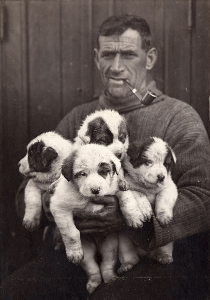
Crean’s name is commemorated in at least two places – 8,630 foot Mount Crean in Victoria Land and the Crean Glacier on South Georgia. A one-man play, Tom Crean – Antarctic Explorer, has been widely performed since 2001 by its author Aidan Dooley, including a special showing at the South Pole Inn, Annascaul, in October 2001. In July 2003, a bronze statue of Crean is unveiled across from his pub in Annascaul. It depicts him leaning against a crate whilst holding a pair of hiking poles in one hand and two of his beloved sled dog pups in the other.


Leave a comment

Birth of James David Bourchier

james-david-bourchier

James David Bourchier, Irish journalist and political activist, is born at Baggotstown House, Bruff, County Limerick, on December 18, 1850. He works for The Times as the newspaper’s Balkan correspondent. He lives in Sofia, Bulgaria from 1892 to 1915. He is an honourable member of the Sofia Journalists’ Society and a trusted advisor of Tzar Ferdinand I of Bulgaria. He acts as an intermediary between the Balkan states at the conclusion of the Balkan Wars of 1912-1913.

Bourchier studies at Trinity College, Dublin, where he is elected a scholar in classics in 1871. Deeply engaged in the processes that are taking place on the Balkan peninsula at that time, Bourchier supports the idea that the island of Crete be annexed by Greece.

In his writings he criticises certain clauses of the 1913 Treaty of Bucharest, which he deems unfair to Bulgaria. As a result of the treaty, Bulgaria loses the southern part of Dobrudja, which is annexed by Romania, and part of Macedonia.

Bourchier also expresses his strong support for Bulgaria during the Paris Peace Conference of 1919-1920. The conference produces five treaties, including the Treaty of Neuilly-sur-Seine, the peace agreement between the Allies and Bulgaria. Under the terms of the treaty, Bulgaria has to cede part of Western Thrace to Greece and several border areas to Yugoslavia. Southern Dobrudja is confirmed in Romanian possession, reparations are required, and the Bulgarian Army is limited to 20,000 men.

With his numerous publications in the British press, and in his private and social correspondence, Bourchier repeatedly voices his sympathy towards Bulgaria and its people. After his death in Sofia on December 30, 1920, James Bourchier is buried near the Rila Monastery in southwestern Bulgaria.

Bourchier Peak on Rila Mountain, James Bourchier Boulevard and James Bourchier Metro Station in Sofia, and Bourchier Cove on Smith Island in the South Shetland Islands, Antarctica are named after James David Bourchier.