seamus dubhghaill

Promoting Irish Culture and History from Little Rock, Arkansas, USA


Leave a comment

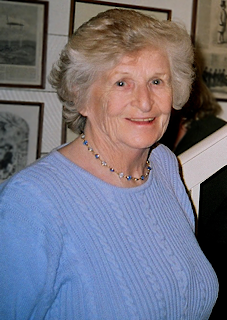
Death of Actress Ronnie Masterson

Ronnie Masterson, one of the best-known Irish stage actors of her generation from the 1940s to the 1970s, dies at the age of 87 in Rush, County Dublin, on February 10, 2014. Following her stage career she builds a solid film and television career with RTÉ, and independent directors including Peter Kosminsky, Alan Parker and Neil Jordan.

Masterson is born in Dublin on April 4, 1926. She trains at the Abbey Theatre and first appears on stage there in 1944. At the Abbey, she meets and then marries actor Ray McAnally in 1951, and they remain married until his death in 1989, although they reside in different homes; her husband with Irish actress Britta Smith. McAnally and Masterson have four children: Conor, Aonghus, Máire and Niamh.

In the late 1960s Masterson and McAnally leave the permanent and pensionable security of the national theatre to set up their own company, Old Quay Productions. The company brings contemporary American and British theatre to Irish audiences, including Alan Ayckbourn‘s Relatively Speaking, Edward Albee‘s Who’s Afraid of Virginia Woolf?, Bill Naughton‘s Alfie, and Robert Patrick‘s Kennedy’s Children.

Kennedy’s Children nearly bankrupts the company, having to be pulled early in a 14-week run, when playgoers in Dublin mistake its title as an adverse comment on the children of assassinated and revered U.S. president John F. Kennedy, whereas the play is actually a series of monologues exploratory of U.S. society in the Vietnam War era. They are rescued by two giants of Irish independent theatre, Phyllis Ryan of Gemini Productions – whose Eblana Theatre the couple had hired- and John B. Keane, who has just published Letters of a Matchmaker , a novel written as a series of letters between a rural matchmaker and his clients.

Film and television work follow, including many episodes of RTÉ soap opera Glenroe, in which Masterson plays Madge O’Regan, and in 1988 her first film, The Dawning, an adaptation of Jennifer Johnston‘s story The Old Jest, which wins first prize as best film at the Montreal World Film Festival and where she acts opposite Anthony Hopkins, Trevor Howard and a young Hugh Grant.

Masterson’s best film work is probably as a memorable Grandma Sheehan in Alan Parker’s screen version of Frank McCourt‘s Angela’s Ashes in 1999, where, in her own words in an interview with her grandson, Aonghus Óg McAnally, she says, “Without doubt I had the best script.”

Other notable film roles include Fools of FortuneThe Real Charlotte and Kosminsky’s dramatisation of the events which led to the Stalker inquiry in Northern IrelandShoot to Kill, where she plays Mrs. Tighe opposite her old Abbey colleague Peadar Lamb, as Mr. Tighe.

Speaking to The Irish Times , Lamb remarks how, as a young actor at the Abbey in 1949, Masterson had been a “striking” Kathleen Ní Houlihan in W. B. Yeats‘s play, her height, green eyes and vivid red hair perfect for the part.

Lamb, who serves for many years with Masterson on the committee of Irish Actors’ Equity Association, pays tribute also to her work for other actors: “She didn’t waste words, but spoke very strongly when she did speak.” RTÉ producer Laurence Foster also pays a tribute to this aspect of Masterson’s career on the SIPTU website.

Masterson also plays in the Edinburgh International Festival and in many Dublin Theatre Festival productions. She appears on many series broadcast on RTÉ, BBC and ITV and tours extensively in the United States in her own one woman shows.

In November 2005, Masterson is in the United States again, this time to take the lead role in The Sea Captain, a short film directed by her son, veteran television producer Conor McAnally.

Masterson dies on February 10, 2014, at Rush Nursing Home in Rush, County Dublin. She is buried at St. Fintan’s Cemetery, Sutton, Dublin.

Leave a comment

Death of Actor T. P. McKenna

thomas-patrick-mckenna

Character actor Thomas Patrick McKenna, known professionally as T. P. McKenna and for his stage, film, and television work, dies at Royal Free Hospital, Hampstead, London on February 13, 2011, following a long illness.

McKenna is born in Mullagh, County Cavan on September 7, 1929. A prolific theater actor throughout his career, he makes his stage debut in Summer and Smoke by Tennessee Williams at the Pike Theatre in Dublin in 1954.

McKenna makes his film debut in the IRANazi drama The Night Fighters (1960) and from this uncredited beginning he moves up to tenth billing in The Siege of Sidney Street (1960). His next major movie is Girl with Green Eyes (1964), by which time he has also started a successful television career, making his TV debut in Espionage (1963) and over the next few years appears in several more TV shows. His versatility enables him to play three characters in The Avengers (1961). He is also featured in such well-regarded shows as Adam Adamant Lives! (1966), Dixon of Dock Green (1955) and The Saint (1962).

Meanwhile, McKenna’s film career develops along literary lines, and he is featured in Brendan Behan‘s The Quare Fellow (1962), the Sean O’Casey biopic Young Cassidy (1965) and James Joyce‘s Ulysses (1967). He takes smaller parts in such epics as The Charge of the Light Brigade (1968) and Anne of the Thousand Days (1969).

British films such as Perfect Friday (1970) and Villain (1971) allowed McKenna to showcase his suave, urbane persona before trying something different in the controversial Straw Dogs (1971). He appears alongside a young Anthony Hopkins in All Creatures Great and Small (1975) before starring with John Gielgud for the second time, this time in A Portrait of the Artist as a Young Man (1977). Over the next few years his co-stars are as diverse as Leonard Rossiter (Britannia Hospital (1982)), Timothy Dalton (The Doctor and the Devils (1985)), Ben Kingsley (Pascali’s Island (1988)) and Dolph Lundgren (Red Scorpion (1988)). Not all of these films are successes, but he always gives good value for the money and develops themes of his, such as an interest in Irish issues, in The Outsider (1980). His last released film is Valmont (1989), which is unfortunately completely overshadowed by Dangerous Liaisons (1988), which is based on the same novel.

Over the years McKenna makes numerous guest appearances in TV series such as Minder (1979), Casualty (1986), Lovejoy (1986), Inspector Morse (1987), Heartbeat (1992) and Ballykissangel (1996). He is also prominent in TV movies and series, featuring in Charles DickensMasterpiece Theatre: Bleak House (1985), Stendhal‘s Scarlet and Black (1993) and an adaptation of Henry JamesThe American (1998).

McKenna dies on February 13, 2011, at the Royal Free Hospital in Hampstead, London, at the age of 81 following a long period of illness. He is buried alongside his wife at Teampall Cheallaigh Cemetery in his native County Cavan.

Following his death, tributes are paid by President of Ireland Mary McAleese, Prince Charles, and Ireland’s Minister for Tourism, Culture and Sport Mary Hanafin, who says that McKenna was “one of a great generation whose talents on the screen and stage both at home and abroad gave us all great pride in his accomplishments.” In County Cavan, he is commemorated by the T. P. McKenna Drama Scholarships (VEC) and the T. P. McKenna Perpetual Trophy presented as part of the Millrace Annual Drama Festival.


Leave a comment

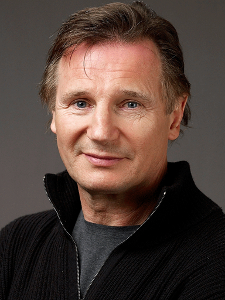
Birth of Actor Liam Neeson

Actor Liam John Neeson is born on June 7, 1952, in BallymenaCounty Antrim. Raised as a Roman Catholic, Neeson is named Liam after the local priest. He says growing up as a Catholic in a predominately Protestant town made him cautious. At age nine, he begins boxing lessons at the All-Saints Youth Club and later becomes Ulster’s amateur senior boxing champion.

Neeson first steps on stage at age eleven after his English teacher offers him the lead role in a school play, which he accepts because the girl he is attracted to is starring in it. He continues to act in school productions over the following years.

Neeson’s interest in acting and decision to become an actor is also influenced by minister Ian Paisley, into whose Free Presbyterian church Neeson would sneak. Neeson says of Paisley, “He had a magnificent presence, and it was incredible to watch him just Bible-thumping away… it was acting, but it was also great acting and stirring too.”

In 1971, Neeson is enrolled as a physics and computer science student at Queen’s University BelfastNorthern Ireland, before leaving to work for the Guinness Brewery. At Queen’s, he discovers a talent for football and is spotted by Seán Thomas at Bohemian F.C. There is a club trial in Dublin and Neeson plays one game as a substitute against Shamrock Rovers F.C. but is not offered a contract.

In 1976, Neeson joins the Lyric Players’ Theatre in Belfast for two years. He then acts in the Arthurian film, Excalibur (1981), alongside Helen Mirren. Between 1982 and 1987, he stars in five films, most notably alongside Mel Gibson and Anthony Hopkins in The Bounty (1984) and Robert De Niro and Jeremy Irons in The Mission (1986). He lands a leading role alongside Patrick Swayze in Next of Kin (1989).

Neeson rises to prominence when he stars in the title role in Steven Spielberg‘s 1993 Oscar winner Schindler’s List. He has since starred in other successful films, including the title role in the historical biopic Michael Collins (1996), the film adaptation of Victor Hugo‘s 1862 novel Les Misérables (1998), Star Wars: Episode I – The Phantom Menace as Qui-Gon Jinn (1999), the biographical drama Kinsey (2004), the superhero film Batman Begins as Ra’s al Ghul (2005), the action thriller series Taken (2008–2014), the fantasy adventure film Clash of the Titans (2010) as Zeus, the fantasy films in The Chronicles of Narnia series (2005–2010) as Aslan, and the thriller-survival film The Grey (2011). In 2016 he narrates the RTÉ One three-part documentary on the Easter Rising1916.

Neeson has been nominated for a number of awards, including an Academy Award for Best Actor, a BAFTA Award for Best Actor in a Leading Role and three Golden Globe Awards for Best Actor in a Motion Picture DramaEmpire magazine ranks Neeson among both the “100 Sexiest Stars in Film History” and “The Top 100 Movie Stars of All Time.”