seamus dubhghaill

Promoting Irish Culture and History from Little Rock, Arkansas, USA


2 Comments

Annie’s Bar Massacre

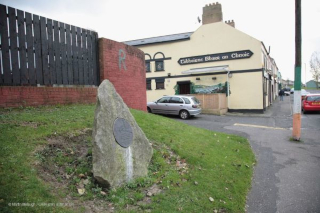
annies-bar-memorial

The Annie’s Bar massacre, a mass shooting incident in Derry‘s Top of the Hill, takes place on December 20, 1972, during the height of the Northern Ireland Troubles. The bar is located in a small Catholic enclave of the majority Protestant Waterside area of Derry. Five civilians are shot dead by Loyalist paramilitaries from a unit of the Ulster Freedom Fighters (UFF) which is a part of the Ulster Defence Association (UDA). The shooting is also known as the “Top of the Hill bar shooting.”

The UDA is formed in September 1971 during one of the most violent phases of The Troubles right after internment without trial is introduced when a number of Loyalist Defense groups combine together. They form a paramilitary wing, the UFF, in 1972 so the organisation can use the UFF name to carry out violent acts and kill people while keeping the UDA name legal by not involving the UDA name with attacks.

The UDA/UFF claim to be combating the Provisional Irish Republican Army (IRA) but approximately 85% of its victims are innocent Catholic civilians. The UDA carries out its first killing on April 20, 1972, when they shoot dead taxi driver Gerard Donnelly in Ardoyne, Belfast. In October, the group is responsible for the deaths of two small girls when they detonate a car bomb outside an Irish nationalist pub in Sailortown, Belfast. The girls killed are Clare Hughes, age 4, and Paula Strong, age 6.

On December 20, 1972, along the Strabane Old Road, Annie’s Bar is packed with customers watching a football match. At about 10:30 PM two men from the UDA burst into the bar, one of them carrying a Sterling submachine gun and the other holding a pistol. Both are wearing hoods to disguise their identities. The men instantly and indiscriminately spray the main room in the bar with bullets. The attack is reported to have lasted less than a minute, but it still manages to leave five people dead, and four others wounded. Those killed in the attack are all males and include, Charlie McCafferty (31), Frank McCarron (58), Charles Moore (31), Barney Kelly (26) and Michael McGinley (37). At the time this is the largest and most deadly attack carried out by the UDA. They do not carry out another attack of this size until February 1992, when they shoot dead five civilians and injure nine in the Sean Graham bookmakers’ shooting on the Ormeau Road in Belfast.

The year 1972 in Derry begins with the Bloody Sunday shooting which occurs in the Bogside area and ends with the Annie’s Bar shooting. Nobody is ever charged in connection with the Annie’s Bar murders, although in recent years relatives of those murdered have been calling for a fresh investigation to take place.

The attack is carried out by members from the UDA’s “North Antrim & Londonderry Brigade.” Although this is one of the UDA’s smaller brigades it also carries out the October 1993 Greysteel massacre which is the UDA’s worst ever attack, in which eight people are killed and 19 others are injured. The Greysteel shooting happens about 9-10 miles away from Annie’s Bar.

(Pictured: Annie’s Bar Memorial stone located at Strabane Old Road, Top of the Hill, Waterside, Derry, County Derry, Northern Ireland. Annie’s Bar is in the background. Photo taken by Martin Melaugh, November 20, 2008.)
Leave a comment

The Bayardo Bar Attack

bayardo-bar-attack

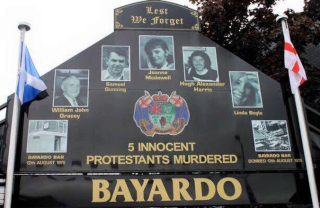
The Bayardo Bar attack takes place on August 13, 1975, in Belfast as a unit of the Provisional Irish Republican Army (IRA), led by Brendan McFarlane, launch a bombing and shooting attack on a pub on Aberdeen Street, in the loyalist Shankill Road area of the city.

By 1975, the conflict in Northern Ireland known as “the Troubles” is more than six years old. On February 10, 1975, the Provisional IRA and the British government enter into a truce and restart negotiations. There is a rise in sectarian killings during the truce, which ‘officially’ lasts until early 1976. The truce, however, is interrupted in the early hours of July 31, 1975, by the Miami Showband killings at Buskhill outside Newry, County Down.

Two weeks later, on August 13, 1975, the Bayardo Bar is crowded with people of all ages. Shortly before closing time a stolen green Audi automobile, containing a three-man unit of the IRA’s Belfast Brigade, pulls up outside. It is driven by the unit’s leader Brendan “Bik” McFarlane, a 24-year-old volunteer from Ardoyne. Volunteers Seamus Clarke and Peter “Skeet” Hamilton get out and approach the pub’s side entrance on Aberdeen Street. One of them immediately opens fire with an ArmaLite, instantly killing doorman William Gracey and his brother-in-law Samuel Gunning, with whom he had been chatting outside. The other volunteer then enters the pub, where patrons are drinking and singing, and drops a duffel bag containing a ten-pound bomb at the entrance. Both men make their getaway back to the waiting car. As panicked customers run to the toilets for safety, the bomb explodes and brings down a section of the old brick-and-plaster building upon them. The bodies of civilian Joanne McDowell and UVF member Hugh Harris are later found beneath the rubble of fallen masonry. Seventeen-year-old civilian Linda Boyle is pulled out alive but dies of her injuries at the hospital on August 21. Over 50 people are injured in the attack.

A Belfast Telegraph article later claims that, as the IRA unit drives away down Agnes Street, they fire into a crowd of women and children queuing at a taxi rank although there are no fatalities. Within 20 minutes of the blast, the IRA unit is arrested after their car is stopped at a roadblock. The ArmaLite that had been used to kill Gracey and Gunning is found inside the car along with spent bullet casings and fingerprints belonging to the three IRA men.

The IRA does not initially claim responsibility, however, IRA members later state that the Bayardo was attacked because it was a pub where Ulster Volunteer Force (UVF) members met and planned terrorist assaults against nationalists. The pub is in the UVF-dominated middle Shankill Road area, and the Ulster Banner is displayed from its upper windows. A former IRA prisoner claims that fellow inmate Lenny Murphy told him he had left the Bayardo ten minutes before the attack and that the Brigade Staff had just finished holding a meeting there.

Loyalists, especially the UVF, respond with another wave of sectarian attacks against Catholics. Two days after the pub attack, a loyalist car bomb explodes without warning on the Falls Road, injuring 35 people. On 22 August, the UVF launches a gun and bomb attack on McGleenan’s Bar in Armagh. The attack is strikingly similar to that at Bayardo. One gunman opens fire while another plants the bomb, the explosion causing the building to collapse. Three Catholic civilians are killed and several more are wounded. That same night, another bomb wrecks a Catholic-owned pub in nearby Blackwatertown, although there are no injuries.

In May 1976, Brendan McFarlane, Seamus Clarke, and Peter Hamilton are convicted in a non-jury Diplock court and sentenced to life imprisonment inside the HM Prison Maze for carrying out the Bayardo murders. In 1983 McFarlane leads the Maze Prison escape, a mass break-out of 38 republican prisoners, including Clarke and Hamilton.


Leave a comment

The Funeral of Rosemary Nelson, Human Rights Lawyer

rosemary-nelson

The funeral of murdered human rights lawyer, Rosemary Nelson, takes place at St. Peter’s Church in Lurgan, County Armagh, Northern Ireland on March 18, 1999.

Rosemary Nelson, née Magee, obtains her law degree at Queens University Belfast. She works with other solicitors for a number of years before opening her own practice. She represents clients in a number of high-profile cases, including Michael Caraher, one of the South Armagh Snipers, as well as a republican paramilitary accused of killing two Royal Ulster Constabulary (RUC) officers. She also represents the Garvaghy Road Residents’ Coalition in nearby Portadown in the long-running Drumcree conflict against the Orange Order and RUC.

Nelson claims she has received death threats from members of the RUC as a result of her legal work. Some RUC officers make abusive and threatening remarks about her to her clients, which become publicly known. In 1998, the United Nations Special Rapporteur on the Independence of Judges and Solicitors, Param Cumaraswamy, notes these threats in his annual report, and states in a television interview that he believes her life could be in danger. He makes recommendations to the British government concerning threats from police against Solicitors, which are not acted upon. Later that year, Nelson testifies before a committee of the United States Congress investigating human rights in Northern Ireland, confirming that death threats have been made against her and her three children.

Nelson is assassinated, at the age of 40, by a car bomb outside her home in Lurgan on March 15, 1999. A loyalist paramilitary group calling itself the Red Hand Defenders claim responsibility for the killing. She is survived by her husband and their three children.

In 2004, the Cory Collusion Inquiry recommends that the UK Government hold an inquiry into the circumstances of Nelson’s death. She is posthumously awarded the Train Foundation‘s Civil Courage Prize, which recognises “extraordinary heroes of conscience.”

The resulting inquiry into her assassination opens at the Craigavon Civic Centre, Craigavon, County Armagh, in April 2005. In September 2006 the British Security Service MI5 announces it would be represented at the inquiry. This move provokes criticism from Nelson’s family, who reportedly express concerns that MI5 would remove sensitive or classified information.

The results of the inquiry are published on May 23, 2011. The inquiry finds no evidence that state agencies (the RUC, British Army and MI5) had “directly facilitated” her murder, but “could not exclude the possibility” that individual members had helped the perpetrators. It finds that state agencies had failed to protect her and that some RUC intelligence about her had been leaked. Both of these, it says, increased the danger to her life. The report also states that RUC officers had publicly abused and assaulted her in 1997, and made threatening remarks about her to her clients, which became publicly known. It concludes that this helped “legitimise her as a target in the eyes of loyalist terrorists.”


Leave a comment

Harrods Bombing

harrods-bombing

A Provisional Irish Republican Army (PIRA) car bomb kills six and injures ninety outside London‘s Harrods department store, a large, upmarket department store in the affluent Knightsbridge district near Buckingham Palace on December 17, 1983. The IRA Army Council claims that it has not authorised the attack and expresses regret for the civilian casualties. After the bombing, the IRA changes its tactic to focus on military targets on the mainland.

Harrods had been the target of an earlier IRA bomb on December 21, 1974, which was placed in the northeast corner of the first floor. There was a very short warning, and the store was in the process of being cleared when it exploded. It was also the target of a much smaller IRA bomb almost ten years later, in January 1993, which injured four people.

From 1973 the Provisional IRA has carried out waves of bombing attacks on commercial targets in London and elsewhere in England as part of its “economic war.” The goal is to damage the economy and cause disruption, which would put pressure on the British government to withdraw from Northern Ireland. On December 10, 1983, the IRA carries out its first attack in London in some time when a bomb explodes at the Royal Artillery Barracks, injuring three British soldiers.

One week later, on the afternoon of December 17, IRA members park a car bomb near the side entrance of Harrods, on Hans Crescent. The bomb contains 25 to 30 lbs. of explosives and is set to be detonated by a timer. It is left in a 1972 blue Austin 1300 GT four-door sedan. At 12:44 PM a man using an IRA codeword phones the central London branch of the Samaritans charity. The caller says there is a car bomb outside Harrods and another bomb inside Harrods and gives the car’s registration plate. According to police, he does not give any other description of the car.

The bomb explodes at about 1:21 PM, as four police officers in a car, an officer on foot and a police dog-handler near the suspect vehicle. Three officers and three bystanders are killed, and 90 others are injured, including 14 police officers. The blast damages 24 cars and all five floors on the side of Harrods, sending a shower of glass down onto the street. The police car absorbs much of the blast and this likely prevents further casualties.

Five people die at the scene of the bombing and a sixth later dies in the hospital. The bystanders who die are Philip Geddes (24), a journalist who had heard about the alert and went to the scene, Jasmine Cochrane-Patrick (25) and Kenneth Salvesen (28), a United States citizen. The Metropolitan Police Service officers killed are Sergeant Noel Lane (28) and Constable Jane Arbuthnot (22). A third officer, Inspector Stephen Dodd (34), dies in the hospital from his injuries on December 24. Constable Jon Gordon survives but loses both legs and part of a hand in the blast.

At the time of the explosion, a second warning call is made by the IRA. The caller says that a bomb has been left in the C&A department store at the east end of Oxford Street. Police clear the area and cordon it off, but this claim is found to be false. In the aftermath of the attack, hundreds of extra police and mobile bomb squads are drafted into London. Aleck Craddock, chairman of Harrods, reports that £1 million in turnover has been lost as a result of the bombing. Despite the damage, Harrods re-opens three days later, proclaiming it will not be “defeated by acts of terrorism.” Denis Thatcher, the husband of British Prime Minister Margaret Thatcher, visits the store and tells reporters “no damned Irishman is going to stop me going there.”


Leave a comment

The 2002 Bali Bombings

bali-bombings-2002

The 2002 Bali bombings occur on October 12, 2002 in the tourist district of Kuta on the Indonesian island of Bali. The attack kills 202 people, including 88 Australians, 38 Indonesians, and people of more than 20 other nationalities. An additional 209 people are injured.

At 11:05 PM Central Indonesian Time, a suicide bomber inside the nightclub Paddy’s Pub, sometimes referred to as Paddy’s Irish Bar and owned Natalia Daly of Cork, County Cork, detonates a bomb in his backpack, causing many patrons, with or without injuries, to immediately flee into the street. Twenty seconds later, a second and much more powerful car bomb hidden inside a white Mitsubishi van is detonated by another suicide bomber outside the Sari Club, a renowned open-air thatched roof bar located opposite Paddy’s Pub.

The bombing occurs during one of the busiest tourist periods of the year in Kuta Beach, driven in part by many Australian sporting teams making their annual end-of-season holiday.

Damage to the densely populated residential and commercial district is immense, destroying neighbouring buildings and shattering windows several blocks away. The car bomb explosion leaves a one-metre-deep crater.

The local Sanglah Hospital is ill-equipped to deal with the scale of the disaster and is overwhelmed with the number of injured, particularly burn victims. There are so many people injured by the explosion that some of the injured have to be placed in hotel pools near the explosion site to ease the pain of their burns. Many of the injured are forced to be flown extreme distances to Darwin (1,100 mi) and Perth (1,600 mi) on the Australian continent for specialist burn treatment.

A comparatively small bomb detonates outside the U.S. consulate in Denpasar, which is believed to have exploded shortly before the two Kuta bombs, causes minor injuries to one person and minimal property damage. It is reportedly packed with human feces.

The final death toll is 202, mainly comprising Western tourists and holiday-makers in their 20s and 30s who are in or near Paddy’s Pub or the Sari Club, but also including many Balinese Indonesians working or living nearby, or simply passing by. Hundreds more people suffer horrific burns and other injuries. The largest group among those killed are holidayers from Australia with 88 fatalities. On October 14, the United Nations Security Council passes Resolution 1438 condemning the attack as a threat to international peace and security.

Various members of Jemaah Islamiyah, a violent Islamist group, are convicted in relation to the bombings, including three individuals who are sentenced to death. An audio-cassette purportedly carrying a recorded voice message from Osama bin Laden states that the Bali bombings are in direct retaliation for support of the United StatesWar on Terror and Australia‘s role in the liberation of East Timor. The recording does not claim responsibility for the Bali attack. However, former FBI agent Ali Soufan confirms that Al-Qaeda did in fact finance the attack.

On November 8, 2008, Imam Samudra, Ali Amrozi bin Haji Nurhasyim and Huda bin Abdul Haq are executed by firing squad on the island prison of Nusa Kambangan. On March 9, 2010, Dulmatin, nicknamed “the Genius” and believed to be responsible for setting off one of the Bali bombs with a mobile phone, is killed in a shoot-out with Indonesian police in Jakarta.


Leave a comment

The Omagh Car Bombing

The Omagh bombing, a car bombing in Omagh, County Tyrone, Northern Ireland, takes place on August 15, 1998. It is carried out by a group calling themselves the Real Irish Republican Army, a Provisional Irish Republican Army (IRA) splinter group who opposes the IRA’s ceasefire and the Good Friday Agreement.

On the day of the bombing, the bombers drive a car, loaded with 230 kilograms (510 lb) of fertiliser-based explosives, across the Irish border. At approximately 2:19 PM they park the vehicle outside S.D. Kells’ clothes shop in Omagh’s Lower Market Street, on the southern side of the town centre, near the crossroads with Dublin Road. They are unable to find a parking space near the intended target, the Omagh courthouse. The two male occupants arm the bomb and, upon exiting the car, walk east down Market Street towards Campsie Road.

Three telephone calls are made warning of a bomb in Omagh, using the same codeword that had been used in the Real IRA’s bomb attack in Banbridge two weeks earlier. At 2:32 PM, a warning is telephoned to Ulster Television saying, “There’s a bomb, courthouse, Omagh, Main Street, 500 lb., explosion 30 minutes.” One minute later, the office receives a second warning saying, “Martha Pope (which is the RIRA’s code word), bomb, Omagh town, 15 minutes.” The caller claims the warning on behalf of “Óglaigh na hÉireann.” One minute later, the Coleraine office of the Samaritans receives a call stating that a bomb will go off on “Main Street” about 200 yards (180 m) from the courthouse. The recipients pass the information on to the Royal Ulster Constabulary (RUC) but are claimed to be inaccurate and police inadvertently move people towards the bomb.

The car bomb detonates at 3:10 PM in the crowded shopping area. The bombing kills 29 people, including a woman pregnant with twins, and injures some 220 others. Twenty-one people who are in the vicinity of the vehicle die at the scene. Eight more people die on the way to or in the hospital. The death toll is higher than that of any single incident during what are considered “the Troubles.”

The bombing causes outrage both locally and internationally, spurs on the Northern Ireland peace process, and deals a severe blow to the Dissident republican campaign. The Real IRA apologises and declares a ceasefire shortly afterwards. The victims include people from many backgrounds: Protestants, Catholics, a Mormon teenager, five other teenagers, six children, a mother pregnant with twins, two Spanish tourists, and others on a day trip from the Republic of Ireland. Both unionists and Irish nationalists are killed and injured.

It is alleged that the British, Irish and U.S. intelligence agencies have information which could have prevented the bombing, most of which comes from double agents inside the Real IRA. This information is not given to the local police, the Royal Ulster Constabulary (RUC). In 2008 it is revealed that British intelligence agency, Government Communications Headquarters, was monitoring conversations between the bombers as the bomb was being driven into Omagh.

A 2001 report by the Police Ombudsman says that the RUC Special Branch failed to act on prior warnings and slammed the RUC’s investigation of the bombing. The RUC has obtained circumstantial and coincidental evidence against some suspects, but it has not come up with anything to convict anyone of the bombing. Colm Murphy is tried, convicted, and then released after it is revealed that Garda Síochána forged interview notes used in the case. Murphy’s nephew, Sean Hoey, is also tried and found not guilty.

In June 2009, the victims’ families win a GB£1.6 million civil action against four defendants. In April 2014, Seamus Daly is charged with the murders of those killed, however, the case against him is withdrawn in February 2016.


Leave a comment

Bloody Friday in Belfast

bloody-friday-1972

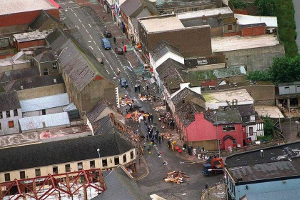
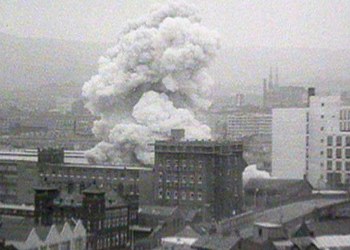
At least twenty Provisional Irish Republican Army (IRA) bombs explode in Belfast on July 21, 1972, during the Troubles in what has become known as “Bloody Friday.” Most of the bombs are car bombs and most target infrastructure, especially the transport network. Nine people are killed, including two British soldiers and five civilians, while 130 are injured.

In late June and early July 1972, a British government delegation led by William Whitelaw holds secret talks with the Provisional IRA leadership. As part of the talks, the IRA agrees to a temporary ceasefire beginning on June 26. The IRA leaders seek a peace settlement that includes a British withdrawal from Northern Ireland by 1975 and the release of republican prisoners. However, the British refuse and the talks break down. The ceasefire comes to an end on July 9.

Bloody Friday is the IRA’s response to the breakdown of the talks. According to the IRA’s Chief of Staff, Seán Mac Stíofáin, the main goal of the bombing operation is to wreak financial harm. It is a “message to the British government that the IRA could and would make a commercial desert of the city unless its demands were met.” Some also see it as a reprisal for Bloody Sunday in Derry six months earlier. The attack is carried out by the IRA’s Belfast Brigade and the main organiser is Brendan Hughes, the brigade’s Officer Commanding.

The bombings occur during an 80-minute period on the afternoon of Friday, July 21. At least 24 bombs are planted. At least 20 explode and the rest fail to detonate or are defused. At the height of the bombing, the middle of Belfast “resembled a city under artillery fire; clouds of suffocating smoke enveloped buildings as one explosion followed another, almost drowning out the hysterical screams of panicked shoppers.” According to The Guardian, “for much of the afternoon, Belfast was reduced to near total chaos and panic. Thousands streamed out of the stricken city…and huge traffic jams built up. All bus services were cancelled, and on some roads, hitchhikers frantically trying to get away lined the pavements.”

Nine people are killed and 130 are injured, some of them horrifically mutilated. Of those injured, 77 are women and children. All of the deaths are caused by two of the bombs – at Oxford Street bus depot and at Cavehill Road. The Oxford Street bomb kills two British soldiers and four Ulsterbus employees. One employee is a Royal Ulster Constabulary (RUC) reservist, one is an Ulster loyalist paramilitary, and the other two are civilians. The Cavehill Road bomb kills three civilians.

The IRA’s Belfast Brigade claims responsibility for the bombings and says that it had given warnings to the security forces before the bombs exploded. It says that the Public Protection Agency, the Samaritans and the press “were informed of bomb positions at least 30 minutes to one hour before each explosion.” Mac Stíofáin says, “It required only one man with a loud hailer to clear each target area in no time” and alleged that the warnings for the two bombs that claim lives are deliberately ignored by the British for “strategic policy reasons.”