seamus dubhghaill

Promoting Irish Culture and History from Little Rock, Arkansas, USA


Leave a comment

Death of William Conway, Cardinal of the Roman Catholic Church

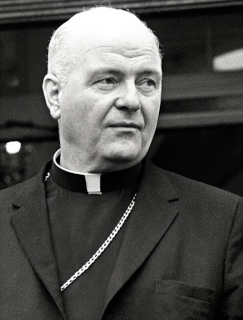
William John Cardinal Conway, Irish cardinal of the Roman Catholic Church who serves as Archbishop of Armagh and Primate of All Ireland from 1963 until his death, dies in Armagh, County Armagh, Northern Ireland, on April 17, 1977, after a short illness.

Conway is born on January 22, 1913, in Belfast, the eldest of four sons and five daughters of Patrick Joseph Conway and Annie Conway (née Donnelly). His father, a self-employed housepainter, also has a paint shop in Kent Street off Royal Avenue. His mother, who survives her son, is born in Carlingford, County Louth. He attends Boundary Street Primary School, St. Mary’s CBS (now St. Mary’s CBGS Belfast). His academic successes are crowned by a scholarship to Queen’s University Belfast. He decides to study for the diocesan priesthood. In 1933 he is conferred with an honours BA in English literature and goes on to read a distinguished course in theology at St. Patrick’s College, Maynooth.

Conway is ordained on June 20, 1937, and awarded a DD (1938). On November 12, 1938, he enters the Pontifical Irish College in Rome, and in 1941 he receives the DCL degree at the Pontifical Gregorian University. When Italy enters World War II in June 1940, he returns to Belfast to take up duty in the Diocese of Down and Connor. He is appointed to teach English and Latin in St. Malachy’s College in Belfast, but after one year he is named professor of moral theology and canon law in Maynooth. He contributes regular ‘Canon law replies’ to the Irish Ecclesiastical Record, which are later collected as Problems in canon law (1950), the only book published by him.

In 1957 Conway becomes vice-president of Maynooth, and in 1958, he is named Ireland’s youngest bishop, Titular Bishop of Neve, and auxiliary bishop to Cardinal John D’Alton, Archbishop of Armagh and Primate of All Ireland. He is consecrated in St. Patrick’s Cathedral, Armagh on July 27, 1958. He serves as administrator of St. Patrick’s Church, Dundalk, for the next five years, gaining valuable pastoral experience, and also uses these years to familiarise himself with his new diocese, especially its geography. On the death of D’Alton, he is chosen to succeed him in September 1963, and is enthroned on September 25 in St. Patrick’s Cathedral, Armagh by the apostolic nuncio, Archbishop Sensi. At the end of 1964, Pope Paul VI chooses him as Ireland’s seventh residential cardinal, and he receives the red hat in the public consistory of February 22, 1965.

The thirteen-odd years of Conway’s ministry as primate are dominated firstly by the Second Vatican Council and secondly by the Troubles in Northern Ireland. His primary concern is the church, to steer it through testing times. He is a very active bishop in a diocese of 160,000 Catholics, with fifty-seven parishes and some 167 priests. He carries the burden alone until 1974 when he is given an auxiliary in the person of his secretary, Fr. Francis Lenny (1928–78). Two new parishes are created, five new churches are built, and many others are renovated to meet the requirements of liturgical reform. Twenty new schools are also provided. He attends all four sessions of the Vatican council (1962–65), as auxiliary bishop and as primate. On October 9, 1963, he addresses the assembly, making a plea that the council might not be so concerned with weightier matters as to neglect to speak about priests. He also makes contributions on the topics of mixed marriages, Catholic schools, and the laity. On the topic of education, he is convinced that integrated schools will not solve Northern Ireland’s problems.

Conway represents the Irish Catholic Bishops’ Conference at each assembly of the Synod of Bishops in Rome, at first with Bishop Michael Browne of the Diocese of Galway and Kilmacduagh, his former professor in Maynooth, and later with the Archbishop of Dublin, Dermot Ryan. With Cardinals Jean-Marie Villot and Pericle Felici, he is chairman of the first synod in 1969, a signal honour conferred on him by Pope Paul VI. He addresses the assembly, opposing the ordination of married men as a move that would release a flood of applications from around the world for dispensations from priestly celibacy. His experience of violence in Northern Ireland is reflected in contributions he makes to later synod assemblies, especially in 1971 and 1974.

Apart from the synod, Conway travels a few times each year to Rome for meetings of the three Roman congregations on which he is called to serve (those of bishops, catholic education, and the evangelisation of peoples) and the commission for the revision of the code of canon law. He also travels further afield in a representative capacity to the International Eucharistic Congress at Bogotá, also attended by Pope Paul VI, and to Madras (1972), where he acts as papal legate for the centenary celebrations in honour of St. Thomas. In 1966 he is invited by the bishops of Poland to join in celebrations for the millennium of Catholicism in that country but is refused an entry visa by the Polish government. In January 1973 he feels obliged to forgo participation in the Melbourne eucharistic congress because of the troubled situation at home. Within Ireland he accepts invitations to become a freeman of Cork and Galway (1965) and of Wexford (1966). In 1976 the National University of Ireland (NUI) confers on him an honorary LL.D.

Conway is acknowledged as an able and diligent chairman of the Irish Catholic Bishops’ Conference. The core problem in the early years is how to lead the Irish church into the difficult new era that follows the council. He shows exceptional leadership qualities in the manner in which he promotes firm but gentle progress, avoiding sudden trauma and divisions. A major event in his term as Archbishop of Armagh, and one that gives him much satisfaction, is the canonization of Oliver Plunkett, his martyred predecessor, in the holy year 1975. He follows with great interest the final stages of the cause from 1968 and is greatly disappointed when grounded by his doctors six weeks before the event. He does however take part, concelebrating with Pope Paul VI at the ceremony on October 12, 1975. He also presides the following evening at the first mass of thanksgiving in the Lateran Basilica, receiving a tumultuous applause from the thousands of Irish present.

More than anything else, the Troubles in Northern Ireland occupy Conway during the second half of his term as archbishop and primate. He is the leading spokesman of the Catholic cause but never fails to condemn atrocities wherever the responsibility lay. He brands as ‘monsters’ the terrorist bombers on both sides. In 1971 he denounces internment without trial, and the following year he is mainly responsible for highlighting the ill-treatment and even torture of prisoners in Northern Ireland. He repudiates the idea that the conflict is religious in nature, emphasising its social and political dimensions, and is openly critical of the British government over conditions in Long Kesh Detention Centre, and of ‘the cloak of almost total silence’ surrounding violence against the Catholic community.

In January 1977 Conway undergoes surgery in a Dublin hospital, and almost immediately comes to know that he is terminally ill. It is the best-kept secret in Ireland until close to the end. On March 29, he writes to his fellow bishops informing them that the prognosis regarding his health is ‘not good, in fact . . . very bad,’ and that he is perfectly reconciled to God’s will. He is still able to work at his desk until Good Friday, April 8, 1977.

Conway dies in Armagh on Low Sunday night, April 17, 1977. Seven countries are represented at his funeral by six cardinals and many bishops. The apostolic nuncio, the bishops of Ireland, the president and Taoiseach, six Irish government ministers, and the Secretary of State for Northern Ireland are also among the mourners. The cardinal is laid to rest in St. Patrick’s Cathedral Cemetery, Armagh. The red hat received from Pope Paul VI is suspended from the ceiling of the Lady chapel, joining those of his four immediate predecessors.

(From: “Conway, John William,” Dictionary of Irish Biography, http://www.dib.ie, contributed by J. J. Hanley)

Leave a comment

The Battle of Moyry Pass

The Battle of Moyry Pass begins on September 20, 1600, ending on October 9, in counties Armagh and Louth, in the north of Ireland, during the Nine Years’ War. It is the first significant engagement of forces following the cessation of arms agreed in the previous year between the Irish leader Hugh O’Neill and the English Crown commander, Robert Devereux, 2nd Earl of Essex.

The battle is fought by the armies of O’Neill and Charles Blount, 8th Baron Mountjoy, a follower of the late Earl of Essex. Mountjoy is determined to pierce O’Neill’s heartland in central and western Ulster by the Moyry Pass. In the course of the two-week assault the English troops establish a garrison near Armagh, taking heavy casualties, and Mountjoy retires with difficulty to Dundalk.

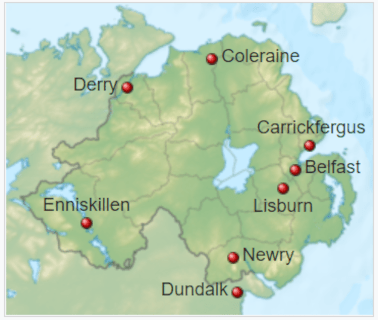
Mountjoy’s strategy for putting down O’Neill’s rebellion is gradually to constrict his territory in Ulster with a ring of fortified garrisons on the borders. To this end, he lands seaborne forces at Derry in the north of the province and at Carrickfergus in the east of Ulster. In September 1600, Mountjoy moves north from Dublin and concentrates at Dundalk in order to mount an expedition further into Ulster and re-establish a garrison at Armagh, which position had been evacuated by the English Crown forces after O’Neill’s victory at the Battle of the Yellow Ford in 1598.

On September 17, 1600, Mountjoy sets out from Dundalk, intending to march to Newry and then on to Armagh. The Moyry Pass (or “Gap of the North”) is the sole point of entry to Ulster as much of the terrain is wooded and mountainous, and it has been well fortified by O’Neill with trenches and barricades. There are three lines of trenches, barricaded with earth and stone, and on the flanks the Irish have made further earth and stone works and “plashed” (twisted) the branches of low-growing trees in order to provide cover for themselves and prevent the English occupying the heights on either side of the Pass.

The English reach the pass on September 20 and set up camp just outside, to the south on Faughart Hill. Taking advantage of a misty day on the 25th, an officer named Thomas Williams (who had commanded the Blackwater Fort during the Battle of the Yellow Ford) makes a sortie into the pass. After heavy fighting he identifies the Irish defence works and returns to the English camp with 12 dead and 30 wounded. For six days heavy rain holds up the fighting, until the weather clears on October 2. The weather is important because the matchlock muskets of the day do not work in wet conditions. On October 2, Sir Samuel Bagnall leads his regiment of infantry into the Pass at the head of four other regiments. The English breach the first barricade, and Thomas Bourke’s regiment leads the way to the second and third lines of defence. The English take the second line only to find themselves in a trap, with gunfire concentrated from three sides. They try to dislodge the Irish from their remaining positions for three more hours before retreating, with the Irish in close pursuit. The English admit 46 killed and 120 wounded, but it is thought that they understated their losses throughout the campaign.

On October 5, Mountjoy sends two regiments on a flanking march over the hill to the west, with one further regiment supported by horsemen advancing up the centre of the Pass. No significant gains are made, and the regiments turn back, reporting casualties of 50 dead and 200 wounded.

By October 9 the privy councilor Geoffrey Fenton complains, “we are now but where we were in the beginning.” Mountjoy retires to Dundalk on either October 8 or 9, but on October 14 word reaches the English camp that O’Neill has abandoned the Pass and retreated to a crannog stronghold at Lough Lurcan. The most likely explanation for O’Neill’s withdrawal from his position of strength is that he is short of ammunition and food and fears a flanking attack on his rear from Newry.

Mountjoy occupies the Moyry Pass on October 17 and dismantles O’Neill’s earthworks. He marches on to Carrickban, just outside Newry, and by Sunday, November 2, sets up camp at Mountnorris, halfway between Newry and Armagh. There he builds an earthwork fort and leaves a garrison of 400 men under the command of Captain Edward Blaney. He then marches back to Dundalk via Carlingford, but is attacked on November 13 by O’Neill, close to the Fathom Pass. Mountjoys men force their way through, and the Lord Deputy claims the army lost 15–20 killed and 60–80 wounded, but a later report suggests the losses are much heavier, with 80 killed.

The battle of Moyry Pass is a stalemate as Mountjoy cannot take the Pass and O’Neill cannot keep it. Mountjoy does establish a garrison at Mountnorris, but has to retire to Dundalk after taking substantial casualties. Mountjoy claims his force lost only 200 men killed and 400 wounded in the fighting from September 20 to November 13, though this may be a considerable underestimate. More, he says, died of disease. The Irish casualties are given by the English as an incredible 900–1,200 killed and wounded, but this is questionable given that the Irish were in a strong defensive position of their own choosing, behind the protection of fieldworks. These figures probably say more about what Mountjoy wanted Queen Elizabeth I to hear than about the actual casualty figures. The following year Mountjoy builds Moyry Castle to secure the pass.

(Pictured: View of the entrance to the Moyry Pass looking north from Faghart Hill)


Leave a comment

The Battle of Lisnagarvey

The Battle of Lisnagarvey is fought on December 6, 1649, near Lisnagarvey, County Antrim, during the Irish Confederate Wars, an associated conflict of the Wars of the Three Kingdoms (1638-51). Forces loyal to the Commonwealth of England defeat an army supporting Charles II of England, composed of Royalists and Scots Covenanters.

The Irish Confederate Wars, sparked by the Irish Rebellion of 1641, are initially fought between the predominantly Catholic Confederation, and a largely Protestant government army led by James Butler, 1st Duke of Ormond. Both claims to be loyal to Charles I, while there is a three-sided war in Ulster. The latter involves Royalists, Gaelic Catholic leader Eoghan Ó Néill, and Presbyterian militia known as the Laggan Army, supported by Scots Covenanters under Robert Monro.

In September 1643, Ormond agrees to a truce, or ‘Cessation’, with the Confederation, freeing his troops for use in England against Parliament in the First English Civil War. Some Irish Protestants object, and switch sides, including Sir Charles Coote, who becomes Parliamentarian commander in Connacht. Charles surrenders in 1646, while a Covenanter/Royalist uprising is quickly suppressed in the 1648 Second English Civil War. On January 17, 1649, the Confederation allies with Ormond’s Royalists. Following the execution of Charles on January 30, they are joined by the Laggan Army and remaining Scots troops in Ulster.

There are various reasons for this. The Covenanter government, who provides support for Scottish settlers in Ulster, considers Oliver Cromwell and other leaders of the new Commonwealth of England dangerous political and religious radicals. As Scots, they object to the execution of their king by the English; as Presbyterians, they view monarchy as divinely ordained, making it also sacrilegious, and transfer their allegiance to his son, Charles II of England.

However, this is offset by a split within the Confederation, between Catholic landowners who want to preserve the position prevailing in 1641, and those like Ó Néill, whose estates had been confiscated in 1607. As a result, he agrees a truce with Coote, and refuses to join the Alliance, depriving them of their most effective fighting force in the north. Despite this, by late July, Ormond’s combined Royalist/Confederate army controls most of Ireland.

In Ulster, Derry is the only major town still held by forces loyal to the Commonwealth. The garrison is commanded by Coote, who is besieged by the Laggan Army under George Munro, Robert’s nephew. In July, Munro is forced to lift the siege by Ó Néill, an example of the impact of the truce between two unlikely allies.

Ormond’s defeat at Rathmines on August 2 allows Cromwell and an army of 12,000 to land in Dublin unopposed. After capturing Drogheda on September 11, his main force heads south towards Wexford. Colonel Robert Venables is sent north with three regiments, or around 2,500 men, to take control of Ulster. Munro’s garrisons surrender with minimal resistance, and by the end of September, Venables has occupied Dundalk, Carlingford, Newry, and Belfast. These are accompanied by the mass expulsion of Scots settlers, as punishment for their defection. When Coote captures Coleraine on September 15, he massacres the largely Scottish garrison.

At the end of October, Coote joins Venables at Belfast. They spend November reducing remaining Royalist garrisons in the north, and in early December, assemble 3,000 men to attack Carrickfergus. After lifting the siege of Derry, Munro has retreated to Enniskillen with the remainder of the Laggan Army. Since the loss of Carrickfergus would effectively cut communications with Scotland, he is determined to prevent this if at all possible.

He combines forces with Royalist leader Lord Clandeboye, creating an army of around 5,000. However, it comprises remnants from many different regiments, its men are poorly equipped, and demoralised, while most have not been paid for over two years. As they march north, their numbers dwindle due to desertion.

Learning of their advance, Coote and Venables move to intercept Munro, and the two advance guards make contact outside Lisnagarvey, near Lisburn, on December 6. Despite superior numbers, the Royalists cannot hold their ground against their far more experienced opponents. When the main body of the Parliamentarian force appears, the retreat rapidly turns into a rout, the majority fleeing without firing a shot. In the pursuit that follows, they lose 1,500 men, killed or captured, along with their baggage train and supplies. Clandeboye and the remnants of his army surrender shortly afterwards, although Monro escapes to Enniskillen.

Lisnagarvey ends resistance by Scottish forces to the Parliamentarian army. Carrickfergus surrenders on December 13, and as with other towns, its Scottish settlers are expelled. Early in 1650, Monro agrees to evacuate Enniskillen for £500, and returns to Scotland, leaving Ó Néill’s army as the only remaining obstacle to Parliamentarian control of the north. However, his death in November 1649 proves a major blow to its morale and fighting ability. In June 1650, it is destroyed by Coote and Venables at Scarrifholis.

(Pictured: Map of key locations of the 1649 campaign in Ulster)


Leave a comment

The Battle of Scarrifholis

The Battle of Scarrifholis takes place on June 21, 1650, near Letterkenny, County Donegal, during the Irish Confederate Wars. A force loyal to the Commonwealth of England commanded by Charles Coote defeats the Catholic Ulster Army, commanded by Heber MacMahon, Roman Catholic Bishop of Clogher.

Although slightly smaller than their opponents, Coote’s troops consist largely of veterans from the New Model Army and have three times the number of cavalry. After an hour of fighting, the Ulster army collapses and flees, losing most of its men, officers, weapons, and supplies. The battle secures the north of Ireland for the Commonwealth and clears the way to complete the Cromwellian conquest of Ireland.

The Irish Confederate Wars, sparked by the Irish Rebellion of 1641, are initially fought between the predominantly Catholic Confederation, and a largely Protestant Irish Royal Army, led by James Butler, 1st Duke of Ormond. Both claim to be loyal to Charles I, while there is a three-sided war in Ulster. The latter involves Royalists, Gaelic Catholic leader Eoghan Ruadh Ó Néill, and Presbyterian militia, known as the Laggan Army, supported by Scots Covenanters under Robert Munro.

In September 1643, Ormond agrees a truce, or ‘Cessation’, with the Confederation, freeing his troops for use in England against Parliament in the First English Civil War. Some Irish Protestants object, and switch sides, including Sir Charles Coote, who becomes Parliamentarian commander in Connacht. Charles surrenders in 1646, while a Covenanter/Royalist uprising is quickly suppressed in the 1648 Second English Civil War. On January 17, 1649, the Confederation allies with Ormond’s Royalists. Following the execution of Charles on January 30, they are joined by the Laggan Army and remaining Scots troops in Ulster.

There are various reasons for this. The Covenanter government, who provide support for Scottish settlers in Ulster, consider Oliver Cromwell and other leaders of the new Commonwealth of England dangerous political and religious radicals. As Scots, they object to the execution of their king by the English. As Presbyterians, they view monarchy as divinely ordained, making regicide also sacrilegious, and they transfer their allegiance to his son, Charles II of England.

However, this is offset by a split within the Confederation, between Catholic landowners who want to preserve the position prevailing in 1641, and those like Ó Néill, whose estates had been confiscated in 1607. As a result, he agrees a truce with Coote, and refuses to join the Alliance, depriving them of their most effective fighting force in the north. Despite this, by late July, Ormond’s combined Royalist/Confederate army control most of Ireland.

Ormond’s defeat at the Battle of Rathmines on August 2 allows Cromwell and an army of 12,000 to land in Dublin unopposed. After capturing Drogheda on September 11, his main force heads south towards Wexford. Colonel Robert Venables is sent north with three regiments, or around 2,500 men, to take control of Ulster. Munro’s garrisons surrender with minimal resistance, and by the end of September, Venables has occupied Dundalk, Carlingford, Newry, and Belfast. These are accompanied by the mass expulsion of Scots settlers, as punishment for their defection. When Coote captures Coleraine on September 15, he massacres the largely Scottish garrison.

Ó Néill’s death in November 1649 and Coote’s defeat of a combined Royalist/Covenanter force at Lisnagarvey in December leaves the Catholic Ulster army as the only remaining opposition to the Commonwealth in the north. At a meeting at Belturbet on March 18, 1650, Heber MacMahon, Catholic Bishop of Clogher, is appointed in his place. Although a leading figure in the Confederation, MacMahon has no military experience and opposes the alliance with Ormond’s Royalists. His election is essentially a compromise between supporters of Henry, Ó Néill’s son, and his cousin, Felim Ó Néill.

By May 20, MacMahon and his deputy Richard O’Farrell have assembled an army near Loughgall, with 5,000 infantry and 1,000 cavalry. They lack both arms and artillery but after Ormond promises to send these from Connacht, they march north, intending to divide Coote’s troops at Derry from those commanded by Venables at Carrickfergus in the east. To do this, MacMahon establishes a line of garrisons with its northern end at Ballycastle, then moves south, intending to cross the River Foyle just below Lifford and maintain contact with Ormond through Ballyshannon.

At this point, Coote has only 1,400 men and seems vulnerable. The Irish cross the river on June 2, beating off an attack by the Commonwealth cavalry and occupy Lifford, where they spend the next two weeks and Coote withdraws to Derry. However, the supplies promised by Ormond fail to arrive, leaving MacMahon short of provisions, while on June 18 Coote is joined by an additional 1,000 infantry under Colonel Roger Fenwick sent from Belfast. At the same time, detaching men for the new garrisons leave MacMahon with around 4,000 infantry and 400 cavalry.

MacMahon now relocates to the Doonglebe/Tullygay Hill overlooking the pass at Scariffhollis, a strong defensive position two miles west of Letterkenny on the River Swilly. When Myles MacSweeney takes his regiment off to recapture his ancestral home at Doe Castle, it leaves the two armies roughly equal in number. However, Coote’s men are well equipped veterans, and he has three times the number of cavalry. When he appears at Scariffhollis on June 21, MacMahon’s subordinates advise him not to risk battle. They argue Coote will soon be forced to retreat due to lack of provisions, allowing the Irish to withdraw into Connaught in good order.

For reasons that are still debated, MacMahon ignores this advice and on the morning of June 21, 1650, orders his troops down from their mountain camp to give battle. Coote later reports that although the ground is still “excessive bad,” it allows him to use his cavalry, although the initial fighting is conducted by the opposing infantry.

The Irish army is drawn up in a large mass formation with 200–300 musketeers in front, which may have been due to their shortage of ammunition. The battle begins when Colonel Fenwick leads a detachment of 150 men against the advance guard. After an exchange of fire, during which Fenwick is mortally wounded, it turns into a hand-to-hand struggle. As Coote feeds in reinforcements, the Irish musketeers fall back on their main force, which has no room to manoeuvre and is now subjected to devastating volleys at close range. After an hour of bitter conflict, the Irish are out of ammunition and at this point the Parliamentarian cavalry charges their flank. Thrown into disarray, the Irish break and run.

In most battles, flight is the point at which the defeated suffer the heaviest casualties, exacerbated by the lack of Irish cavalry and the brutal nature of the war. Most of the infantry dies on the battlefield or in the pursuit that follows, including Henry Ó Néill and many officers, some of whom are killed after surrendering. Estimates of the Irish dead range from 2,000 – 3,000, while Coote loses around 100 killed or wounded.

MacMahon escapes with 200 horse but is captured a week later and executed. Phelim Ó Néill and O’Farrell make it to Charlemont, which is besieged by Coote and surrenders on August 14. With the exception of a few scattered garrisons, this ends fighting in the north. Limerick is taken by Hardress Waller in October 1651, and the war ends when Galway surrenders to Coote in May 1652.

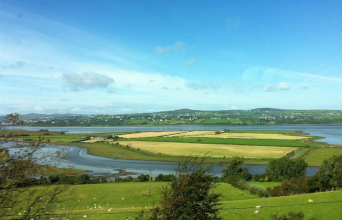
(Pictured: A view of the mouth of River Swilly at Lough Swilly, Letterkenny, County Donegal)


Leave a comment

Birth of William John Conway, Cardinal of the Roman Catholic Church

William John Cardinal Conway, Irish cardinal of the Roman Catholic Church who serves as Archbishop of Armagh and Primate of All Ireland from 1963 until his death, is born on January 22, 1913, in Belfast.

Conway is the eldest of four sons and five daughters of Patrick Joseph Conway and Annie Conway (née Donnelly). His father, a self-employed housepainter, also has a paint shop in Kent Street off Royal Avenue. His mother, who survives her son, is born in Carlingford, County Louth. He attends Boundary Street Primary School, St. Mary’s CBS (now St. Mary’s CBGS Belfast). His academic successes are crowned by a scholarship to Queen’s University Belfast. He decides to study for the diocesan priesthood. In 1933 he is conferred with an honours BA in English literature and goes on to read a distinguished course in theology at St. Patrick’s College, Maynooth.

Conway is ordained on June 20, 1937, and awarded a DD (1938). On November 12, 1938, he enters the Pontifical Irish College in Rome, and in 1941 he receives the DCL degree at the Pontifical Gregorian University. When Italy enters World War II in June 1940, he returns to Belfast to take up duty in the Diocese of Down and Connor. He is appointed to teach English and Latin in St. Malachy’s College in Belfast, but after one year he is named professor of moral theology and canon law in Maynooth. He contributes regular ‘Canon law replies’ to the Irish Ecclesiastical Record, which are later collected as Problems in canon law (1950), the only book published by him.

In 1957 Conway becomes vice-president of Maynooth, and in 1958, he is named Ireland’s youngest bishop, Titular Bishop of Neve, and auxiliary bishop to Cardinal John D’Alton, Archbishop of Armagh and Primate of All Ireland. He is consecrated in St. Patrick’s Cathedral, Armagh on July 27, 1958. He serves as administrator of St. Patrick’s Church, Dundalk, for the next five years, gaining valuable pastoral experience, and also uses these years to familiarise himself with his new diocese, especially its geography. On the death of D’Alton, he is chosen to succeed him in September 1963, and is enthroned on September 25 in St. Patrick’s Cathedral, Armagh by the apostolic nuncio, Archbishop Sensi. At the end of 1964, Pope Paul VI chooses him as Ireland’s seventh residential cardinal, and he receives the red hat in the public consistory of February 22, 1965.

The thirteen-odd years of Conway’s ministry as primate are dominated firstly by the Second Vatican Council and secondly by the Troubles in Northern Ireland. His primary concern is the church, to steer it through testing times. He is a very active bishop in a diocese of 160,000 Catholics, with fifty-seven parishes and some 167 priests. He carries the burden alone until 1974 when he is given an auxiliary in the person of his secretary, Fr. Francis Lenny (1928–78). Two new parishes are created, five new churches are built, and many others are renovated to meet the requirements of liturgical reform. Twenty new schools are also provided. He attends all four sessions of the Vatican council (1962–65), as auxiliary bishop and as primate. On October 9, 1963, he addresses the assembly, making a plea that the council might not be so concerned with weightier matters as to neglect to speak about priests. He also makes contributions on the topics of mixed marriages, Catholic schools, and the laity. On the topic of education, he is convinced that integrated schools will not solve Northern Ireland’s problems.

Conway represents the Irish Catholic Bishops’ Conference at each assembly of the Synod of Bishops in Rome, at first with Bishop Michael Browne of the Diocese of Galway and Kilmacduagh, his former professor in Maynooth, and later with the Archbishop of Dublin, Dermot Ryan. With Cardinals Jean-Marie Villot and Pericle Felici, he is chairman of the first synod in 1969, a signal honour conferred on him by Pope Paul VI. He addresses the assembly, opposing the ordination of married men as a move that would release a flood of applications from around the world for dispensations from priestly celibacy. His experience of violence in Northern Ireland is reflected in contributions he makes to later synod assemblies, especially in 1971 and 1974.

Apart from the synod, Conway travels a few times each year to Rome for meetings of the three Roman congregations on which he is called to serve (those of bishops, catholic education, and the evangelisation of peoples) and the commission for the revision of the code of canon law. He also travels further afield in a representative capacity to the International Eucharistic Congress at Bogotá, also attended by Pope Paul VI, and to Madras (1972), where he acts as papal legate for the centenary celebrations in honour of St. Thomas. In 1966 he is invited by the bishops of Poland to join in celebrations for the millennium of Catholicism in that country but is refused an entry visa by the Polish government. In January 1973 he feels obliged to forgo participation in the Melbourne eucharistic congress because of the troubled situation at home. Within Ireland he accepts invitations to become a freeman of Cork and Galway (1965) and of Wexford (1966). In 1976 the National University of Ireland (NUI) confers on him an honorary LL.D.

Conway is acknowledged as an able and diligent chairman of the Irish Catholic Bishops’ Conference. The core problem in the early years is how to lead the Irish church into the difficult new era that follows the council. He shows exceptional leadership qualities in the manner in which he promotes firm but gentle progress, avoiding sudden trauma and divisions. A major event in his term as Archbishop of Armagh, and one that gives him much satisfaction, is the canonization of Oliver Plunkett, his martyred predecessor, in the holy year 1975. He follows with great interest the final stages of the cause from 1968 and is greatly disappointed when grounded by his doctors six weeks before the event. He does however take part, concelebrating with Pope Paul VI at the ceremony on October 12, 1975. He also presides the following evening at the first mass of thanksgiving in the Lateran Basilica, receiving a tumultuous applause from the thousands of Irish present.

More than anything else, the Troubles in Northern Ireland occupy Conway during the second half of his term as archbishop and primate. He is the leading spokesman of the Catholic cause but never fails to condemn atrocities wherever the responsibility lay. He brands as ‘monsters’ the terrorist bombers on both sides. In 1971 he denounces internment without trial, and the following year he is mainly responsible for highlighting the ill-treatment and even torture of prisoners in Northern Ireland. He repudiates the idea that the conflict is religious in nature, emphasising its social and political dimensions, and is openly critical of the British government over conditions in Long Kesh Detention Centre, and of ‘the cloak of almost total silence’ surrounding violence against the Catholic community.

In January 1977 Conway undergoes surgery in a Dublin hospital, and almost immediately comes to know that he is terminally ill. It is the best-kept secret in Ireland until close to the end. On March 29, he writes to his fellow bishops informing them that the prognosis regarding his health is ‘not good, in fact . . . very bad,’ and that he is perfectly reconciled to God’s will. He is still able to work at his desk until Good Friday, April 8, 1977.

Conway dies in Armagh on Low Sunday night, April 17, 1977. Seven countries are represented at his funeral by six cardinals and many bishops. The apostolic nuncio, the bishops of Ireland, the president and Taoiseach, six Irish government ministers, and the Secretary of State for Northern Ireland are also among the mourners. The cardinal is laid to rest in St. Patrick’s Cathedral Cemetery, Armagh. The red hat received from Pope Paul VI is suspended from the ceiling of the Lady chapel, joining those of his four immediate predecessors.

(From: “Conway, John William,” Dictionary of Irish Biography, http://www.dib.ie, contributed by J. J. Hanley)

Leave a comment

Birth of Thomas D’Arcy McGee, Canadian Politician

Thomas D’Arcy Etienne Hughes McGee, Irish Canadian politician, Catholic spokesman, journalist, poet, and a Father of Canadian Confederation, is born on April 13, 1825, in Carlingford, County Louth.

McGee grows up a Catholic Irishman who hates the British rule of Ireland and works for a peasant revolution to overthrow British rule and secure Irish independence. He escapes arrest and flees to the United States in 1848, where he reverses his political beliefs. He becomes disgusted with American republicanism and democracy, and becomes intensely conservative in his politics and in his religious support for the Pope.

McGee moves to Canada in 1857 and works hard to convince the Irish Catholics to cooperate with the Protestant British in forming a Confederation that will make for a strong Canada in close alliance with Britain. His fervor for Confederation garners him the title “Canada’s first nationalist.” He fights the Fenians in Canada, who are Irish Catholics who hate the British and resemble his younger self politically. McGee succeeds in helping create the Canadian Confederation in 1867.

On April 7, 1868, McGee, having participated in a parliamentary debate that goes on past midnight, walks back to the boarding house where he is staying. McGee is opening the door to Trotter’s Boarding House in Ottawa when he is shot by someone waiting for him on the inside. Several people run to the scene, however there is no sign of the assassin. It is later determined that McGee is assassinated with a shot from a handgun by Patrick J. Whelan. He is to date the only Canadian victim of political assassination at the federal level.

McGee is given a state funeral in Ottawa and interred in a crypt at the Cimetière Notre Dame des Neiges in Montreal. His funeral procession in Montreal draws an estimated crowd of 80,000 out of a total city population of 105,000.

Patrick J. Whelan, a Fenian sympathiser and a Catholic, is accused, tried, convicted, and hanged for the crime on February 11, 1869, in Ottawa. The jury is decisively swayed by the forensic evidence that Whelan’s gun had been fired shortly before the killing, together with the circumstantial evidence that he had threatened and stalked McGee. Historian David Wilson points out that forensic tests conducted in 1972 show that the fatal bullet is compatible with both the gun and the bullets that Whelan owned. Wilson concludes, “The balance of probabilities suggests that Whelan either shot McGee, or was part of a hit-squad, but there is still room for reasonable doubt as to whether he was the man who actually pulled the trigger.”

The government of Canada’s Thomas D’Arcy McGee Building stands near the site of the assassination. The case is dramatised in the Canadian play Blood on the Moon by Ottawa actor/playwright Pierre F. Brault. The assassination of McGee is also a major component of Away, a novel about Irish immigration to Canada by Canadian novelist Jane Urquhart.


Leave a comment

The Assassination of Thomas D’Arcy McGee

Thomas D’Arcy Etienne Hughes McGee, Irish-Canadian politician, Catholic spokesman, journalist, poet, and a Father of Canadian Confederation, is assassinated by Fenian elements on April 7, 1868, in OttawaOntarioCanada. He is to date the only Canadian victim of political assassination at the federal level.

McGee, born on April 13, 1825 in Carlingford, County Louth, grows up a Catholic Irishman who hates the British rule of Ireland and works for a peasant revolution to overthrow British rule and secure Irish independence. He escapes arrest and flees to the United States in 1848, where he reverses his political beliefs. He becomes disgusted with American republicanism and democracy, and becomes intensely conservative in his politics and in his religious support for the Pope.

McGee moves to Canada in 1857 and works hard to convince the Irish Catholics to cooperate with the Protestant British in forming a Confederation that will make for a strong Canada in close alliance with Britain. His fervor for Confederation garners him the title “Canada’s first nationalist.” He fights the Fenians in Canada, who are Irish Catholics who hate the British and resemble his younger self politically. McGee succeeds in helping create the Canadian Confederation in 1867.

On 7 April 1868, McGee, having participated in a parliamentary debate that goes on past midnight, walks back to the boarding house where he is staying. McGee is opening the door to Trotter’s Boarding House in Ottawa when he is shot by someone waiting for him on the inside. Several people run to the scene, however there is no sign of the assassin. It is later determined that McGee is assassinated with a shot from a handgun by Patrick J. Whelan.

McGee is given a state funeral in Ottawa and interred in a crypt at the Cimetière Notre Dame des Neiges in Montreal. His funeral procession in Montreal draws an estimated crowd of 80,000 out of a total city population of 105,000.

Patrick J. Whelan, a Fenian sympathiser and a Catholic, is accused, tried, convicted, and hanged for the crime on February 11, 1869, in Ottawa. The jury is decisively swayed by the forensic evidence that Whelan’s gun had been fired shortly before the killing, together with the circumstantial evidence that he had threatened and stalked McGee. Historian David Wilson points out that forensic tests conducted in 1972 show that the fatal bullet is compatible with both the gun and the bullets that Whelan owned. Wilson concludes, “The balance of probabilities suggests that Whelan either shot McGee, or was part of a hit-squad, but there is still room for reasonable doubt as to whether he was the man who actually pulled the trigger.”

The government of Canada’s Thomas D’Arcy McGee Building stands near the site of the assassination. The case is dramatised in the Canadian play Blood on the Moon by Ottawa actor/playwright Pierre Brault. The assassination of McGee is also a major component of Away, a novel about Irish immigration to Canada by Canadian novelist Jane Urquhart.


2 Comments

Birth of Cardinal Patrick Joseph O’Donnell

patrick-joseph-odonnell

Patrick Joseph O’Donnell, Cardinal of the Roman Catholic Church, is born in Glenties, County Donegal, on November 28, 1856. He serves as Archbishop of Armagh from 1924 until his death and is elevated to the cardinalate in 1925.

O’Donnell, son of Daniel O’Donnell, a farmer, and his wife, Mary (née Breslin), is one of nine children in a family that claim descent from the O’Donnells of Tyrconnell. He is educated in the High School, Letterkenny, the Catholic University, Dublin, and St. Patrick’s Pontifical University, Maynooth. He is ordained to the priesthood on June 29, 1880. In that same year he is appointed to the staff of St. Patrick’s College, Maynooth, holding the chairs of Dogmatic and Moral Theology. In 1884 he becomes dean of the revived post-graduate Dunboyne Institute and in 1885 is awarded his STD. From his desk in Maynooth he pours out a continuous stream of articles on moral theology and canon law.

O’Donnell becomes Bishop of Raphoe on February 26, 1888, and is consecrated by Cardinal Michael Logue on April 3 in Letterkenny. With superior qualities of mind and body, he is a benign figure who is yet gifted with sharp political acumen. He has the most distinguished episcopate, locally and nationally. He undertakes and completes prodigious building projects including a superbly sited neo-gothic cathedral, St. Eunan’s Diocesan College, and the Presentation Monastery and Loreto schools and an extension to Loreto Convent, all in Letterkenny.

He is appointed coadjutor Archbishop of Armagh on January 14, 1922, and succeeds Cardinal Logue on November 19, 1924. On December 14, 1925, Pope Pius XI makes O’Donnell a Cardinal.

O’Donnell takes an active part in the social, political, and economic life of Ireland. A staunch activist for social justice, as Bishop of Raphoe, he is a member of the first Committee of the Irish Agricultural Organisation Society, founded by Sir Horace Plunkett. In 1918, when representing the nationalist’s side at the Irish Convention, he opposes John Redmond‘s amendment intended to bring about unanimity on All-Ireland Home Rule.

Cardinal O’Donnell dies on October 22, 1927, in Carlingford, County Louth. The St. Connell’s Museum in his hometown of Glenties has a display about his life.