
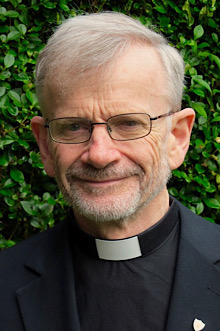
Alexander Aloysius “Alan” McGuckian, SJ, the 33rd Bishop of Down and Connor, is born on February 25, 1953, in Cloughmills, County Antrim, Northern Ireland.
McGuckian is the youngest of six children to Brian McGuckian and his wife Pauline (née McKenna). He is named after his uncle, also Alexander Aloysius McGuckian, who dies five month before he is born. Yet another uncle, Daniel McGuckian, is a priest of the Diocese of Down and Connor and serves as parish priest of Cushendun and then Randalstown until his death in 1980. His father is a successful pig farmer who, alongside his brothers, develops the world’s biggest pig farm.
Two of McGuckian’s brothers are also Jesuit priests, while another brother is a businessman. Both of his sisters predecease him.
McGuckian attends primary school in Cloughmills and secondary school at St. MacNissi’s College, before beginning studies in Irish language and scholastic philosophy at Queen’s University, Belfast (QUB) in 1971, where he is a near-contemporary of future brother bishop Dónal McKeown. He first visits Ranafast, County Donegal, in 1968, and has since become a regular visitor to the Donegal Gaeltacht.
After one year in Belfast, McGuckian enters the Jesuit novitiate at Manresa House in Clontarf, Dublin, during which time he completes a Bachelor of Arts in Latin and Spanish from University College Dublin (UCD) between 1974 and 1977, a Bachelor of Philosophy from Milltown Institute of Theology and Philosophy between 1977 and 1979, and a Master of Divinity and a Licentiate of Sacred Theology from Regis College, Toronto, between 1981 and 1985. He subsequently completes a Master of Arts in Irish translation from Queen’s University, Belfast.
McGuckian is ordained to the priesthood on June 22, 1984, and makes his final profession on February 15, 1997.
Following ordination, McGuckian spends four years as a teacher in Clongowes Wood College and vocations director for the Jesuits, before undertaking a six month period of spiritual renewal in southern India and serving in a shanty town in Quezon City, Philippines.
McGuckian returns to Ireland in 1992, where he is appointed director of the Jesuit Communication Centre, during which he develops Sacred Space, a website which allows people to pray at their computer, in 1999, and Catholic news service CatholicIreland.net in 2004.
McGuckian also serves as editor of both An Timire and Foilseacháin Ábhair Spioradálta, later translating the autobiography of Ignatius of Loyola into Irish under the title Scéal an Oilithrigh. He also co-authors the drama 1912 – A Hundred Years On with Presbyterian historian Philip Orr in 2011, which looks at the experiences of the Ulster Covenant and the wider Home Rule movement from both nationalist and unionist perspectives.
McGuckian also serves as chaplain to many of the Gaelscoileanna in the Diocese of Down and Connor, and subsequently as chaplain to Ulster University campuses in Belfast and Jordanstown. Following the publication of the Living Church Report, which outlines the findings of a synodal process within the diocese, he is appointed by Noël Treanor in 2012 to set up and lead the Living Church Office, whose aim is to realise the hopes and aspirations expressed in the report and subsequently in the upcoming diocesan pastoral plan.
McGuckian is also appointed diocesan director of formation for the permanent diaconate in 2014, and also works during his directorship of the Living Church Office to establish pastoral communities across the diocese, through fostering a culture of co-responsibility for the mission of the Church between clergy and lay people.
McGuckian is appointed Bishop-elect of Raphoe by Pope Francis on June 9, 2017. His appointment makes him the first member of the Jesuits to be appointed a bishop in Ireland.
McGuckian is consecrated by the Archbishop of Armagh and Primate of All Ireland, Eamon Martin, on August 6, 2017, in the Cathedral of St. Eunan and St. Columba, Letterkenny. He uses the name and title Alan Mac Eochagáin, C. Í. when ministering in the Gaeltacht.
In an interview with The Irish Catholic in September 2019, McGuckian says that having a home is as fundamental as the right to life and education, and that the Government must be “pushed” to enshrine a right to housing in the Constitution of Ireland. He also joins a number of church leaders in the West of Ireland on September 16, 2021, in calling on the Irish government to offer reparations to homeowners whose properties are affected by defective concrete blocks.
In an interview with The Irish Catholic in February 2021, McGuckian takes issue with the view held by political leaders that public worship is deemed to be “non-essential” during the COVID-19 pandemic in the Republic of Ireland. Quoting Pope Francis, who states that “the right to worship must be respected, protected and defended by civil authorities like the right to bodily and physical health,” he expresses a need to let political leaders know that public worship is not only central, but also “utterly essential.”
Following a fatal explosion in Creeslough, County Donegal, on October 7, 2022, McGuckian refers to the explosion as “the darkest day in Donegal,” adding that the local community is “living through a nightmare of shock and horror.” He also concelebrates at the Funeral Masses of each of the victims, describing the fact that the parish church would be holding two funerals in the space of three hours as “surreal.”
McGuckian is appointed Bishop of Down and Connor by Pope Francis on February 2, 2024. In his first address following his appointment, he expresses his hope that the restoring of the Northern Ireland Executive will help the most vulnerable in society.


 seamus dubhghaill