D’Arcy is born to a Russian-Jewish mother and an Irish Catholic father. She works in small theatres in Dublin from the age of fifteen and later becomes an actress.
D’Arcy is married in 1957 to English playwright and author John Arden. They write several plays together which are highly critical of the British presence in Ireland. They settle in Galway in 1971 and establish the Galway Theatre Workshop in 1976. The couple has five sons, one of whom predeceases his mother.
The couple writes a number of stage pieces and improvisational works for amateur and student players, including The Happy Haven (1960) and The Workhouse Donkey (1964). She writes and produces many plays, including The Non-Stop Connolly Show (1977).
D’Arcy has also written a number of books, including Tell Them Everything (1981), Awkward Corners (with John Arden, 1988), and Galway’s Pirate Women: A Global Trawl (1996).
As an activist, in 1961, D’Arcy joins the anti-nuclear Committee of 100, led by Bertrand Russell. In 1981, her peace-activism results in her incarceration in Armagh Jail, after defacing a wall at the Ulster Museum. Her book Tell Them Everything (Pluto Press, 1981) tells the story of her time during the Armagh and H-Blockdirty protests and is one of the earliest accounts about the Armagh women, their republicanism and imprisonment.
D’Arcy also directs Yellow Gate Women (2007), a film about the attempts by women of Greenham Common Women’s Peace Camp to outwit the British and United States military at RAF Greenham Common with bolt cutters and legal challenges. Challenging censorship since 1987, she runs a women’s kitchen pirate radio from her home in Galway.
In 2011, D’Arcy refuses to stand for a minute’s silence to honour Police Service of Northern Ireland (PSNI) officer Ronan Kerr, killed by dissident republicans, at an Aosdána meeting. Her actions are deliberate, she tells the media afterwards, which attracts fierce criticism of her perceived support for armed republican groups in Northern Ireland.
Along with Niall Farrell, D’Arcy is arrested in October 2012 for scaling the perimeter fence of Shannon Airport, in protest at the use of the airport as a stopover for U.S. military flights. As a consequence of her trespassing on airport property, she is imprisoned in 2014 after she refuses to sign a bond saying that she will not trespass on non-public parts of Shannon Airport.
Wallace is born into a family of twelve children. He graduates from University College Dublin (UCD) with a teaching qualification. He marries Mary Murphy from Duncormick, County Wexford, in 1979. The couple has two sons, but the marriage ends when the children are young. He has two more children from another relationship in the 1990s.
Prior to entering politics, Wallace owns a property development and construction company completing developments such as the Italian Quarter in the Ormond Quay area of the Dublin quays. The company later collapses into liquidation, with him finally being declared bankrupt on December 19, 2016.
On December 15, 2011, Wallace helps to launch a nationwide campaign against the household charge which is introduced as part of the 2012 Budget.
Wallace is the listed officer of the Independents 4 Change, which is registered to stand for elections in March 2014 and, along with Clare Daly, is one of two MEPs which represent the party in the European parliament. During their time in the Dáil, Wallace and Daly, the Dublin North TD, become friends and political allies, and work together on many campaigns, including opposition to austerity and highlighting revelations of alleged Garda malpractices, including harassment, improper cancellation of penalty points and involvement of officers in the drug trade. They are partially active in protesting the Garda whistleblower scandal, which eventually leads to the resignation of Minister for JusticeFrances Fitzgerald, although she is later cleared of wrongdoing by the Charleton Tribunal.
In July 2014, Wallace and Daly are arrested at Shannon Airport while trying to board a U.S. military aircraft. He says the airport is being used as a U.S. military base and that the government should be searching the planes to ensure that they are not involved in military operations or that there are no weapons on board. He is fined €2,000 for being in an airside area without permission and chooses not to pay. He is sentenced to 30 days in prison in default, and in December 2015 is arrested for non-payment of the fine.
In December 2015, Wallace and independent TDs Clare Daly and Maureen O’Sullivan each put forward offers of a €5,000 surety for a man charged with membership of an unlawful organisation and with possession of a component part of an improvised explosive device.
At the 2016 Irish general election, Wallace stands as an Independents 4 Change candidate and is re-elected, finishing third on the first-preference count with 7,917 votes.
In 2017, Wallace calls on Ireland to join the Boycott, Divestment and Sanctions movement against Israel and “condemn the illegal expansion of Israeli settlements on Palestinian lands as well as the ongoing human rights abuses against Palestinians.”
Wallace is criticised for supporting Venezuela, Ecuador, China, Russia, Belarus and Syria during his period as an MEP. In November 2020, he refers to Belarusian opposition presidential candidate Svetlana Tikhanovskaya as a “pawn of western neoliberalism.” In February 2021, he is reprimanded for using a swear word during a session of the European Parliament. He has referred to Venezuelan opposition leader Juan Guaidó as being an “unelected gobshite.”
In April 2021, Wallace and Daly are called “embarrassments to Ireland” by Fianna Fáil‘s Malcolm Byrne after the two MEPs had travelled to Iraq and visited the headquarters of the Popular Mobilization Forces, an Iraqi militia supported by Iran.
Wallace questions the director general of the Organisation for the Prohibition of Chemical Weapons (OPCW), Fernando Arias, in the European Parliament in April 2021. He accuses the OPCW of falsely blaming the government of Bashar al-Assad for the 2018 Douma chemical attack. He says that, while he does not know what had happened in Douma, the White Helmets were “paid for by the U.S. and UK to carry out regime change in Syria.” Fianna Fáil’s Barry Andrews calls his accusation against the White Helmets a conspiracy theory and disinformation. French MEP Nathalie Loiseau describes his comments as “fake news” and apologises on his behalf to NGO groups in Syria.
In June 2021, Wallace and Daly are among the MEPs censured by the European Parliament’s Democracy Support and Election Coordination Group for acting as unofficial election-monitors in the December 2020 Venezuelan parliamentary election and April 2021 Ecuadorian general election without a mandate or permission from the EU. They are barred from making any election missions until the end of 2021. They are warned that any further such action may result in their ejection from the European parliament under the end of their terms in 2024.
Wallace has stated his opposition to vaccination certificates. He says, “I’m not anti-vax but we’re going down a dangerous path with COVID pass” and expresses concerns about civil liberties. Both Wallace and Daly have refused to present vaccination certs upon entering the European Parliament, resulting in them being reprimanded by the European Parliament.
In April 2022, Wallace and Daly initiate defamation proceedings against RTÉ.
In November 2022, Wallace criticises protests in Iran following the death of Mahsa Amini, accusing some protestors of violence and destruction and saying it “would not be tolerated anywhere.”
In February 2023, Wallace claims on social media that he has “three wine bars in Dublin.” This arouses alarm from his European parliamentary group, as no such assets were listed on his mandatory declaration of financial interests. After the chair of his parliamentary group calls any omission from the declaration “unacceptable” and not “worthy of our political group,” he amends his declaration to state that he is an “advisor” to the three wine bars and receives up to €500 a month in income for this role.
John Arden, English playwright, dies on March 28, 2012, in Galway, County Galway. At the time of his death, he is lauded as “one of the most significant British playwrights of the late 1950s and early 60s.”
Arden is initially associated with the English Stage Company at the Royal Court Theatre in London. His 1959 play, Serjeant Musgrave’s Dance, in which four army deserters arrive in a northern mining town to exact retribution for an act of colonial violence, is considered to be his best. His work is influenced by Bertolt Brecht and epic theatre as in Left-Handed Liberty (1965, on the anniversary of Magna Carta). Other plays include Live Like Pigs, The Workhouse Donkey, and Armstrong’s Last Goodnight, the last of which is performed at the 1963 Chichester Festival by the Royal National Theatre after it was rejected by the Royal Court.
Arden’s 1978 radio play Pearl is considered in a Guardian survey to be one of the best plays in that medium. He also writes several novels, including Silence Among the Weapons, which is shortlisted for the Booker Prize in 1982, and Books of Bale, about the Protestant apologist John Bale. He is a member of the Royal Society of Literature.
With his wife and co-writer Margaretta D’Arcy, Arden pickets the Royal Shakespeare Company (RSC) premiere of his Arthurian play The Island of the Mighty, because they believe the production to be pro-imperialist. They write several plays together which are highly critical of British presence in Ireland, where he and D’Arcy live from 1971 onward.
In 1961, Arden is a founder member of the anti-nuclear Committee of 100, and he also chairs the pacifist weekly Peace News. In Ireland, he is for a while a member of Official Sinn Féin. He is an advocate of civil liberties, and opposes anti-terror legislation, as demonstrated in his 2007 radio play The Scam.
Arden is elected to Aosdána in 2011 before dying in Galway on March 28, 2012. He is waked in a wicker casket.
(Pictured: Photograph of John Arden, 1960 bromide print on card mount, credit to Roger Mayne, National Portrait Gallery, London)
Tod is born on May 18, 1836, in Edinburgh into a well-known Irish Presbyterian family, her uncle being the Rev. Hope Masterton Waddell, one of the earliest Irish Presbyterian missionaries who served with the Scottish Missionary Society in Jamaica and whose great grandfather is the Rev. Charles Masterton, one of the most distinguished minsters of the General Synod of Ulster who ministers at Connor and Rosemary Street, Belfast. She is very proud of her Presbyterian heritage and of her Scottish ancestry.
The daughter of James Banks Tod, an Edinburgh merchant, Tod spends her early years in Edinburgh. She is educated at home by her mother, Maria Isabella Waddell, who comes from County Monaghan. The family moves to Belfast in the 1850s following the death of her father. She and her mother join Elmwood Presbyterian Church. Her Presbyterian background no doubt contributes to her radical views on social issues and women’s rights. She earns her living from writing and journalism, contributing, for example, to the Dublin University Magazine, an independent literary, cultural and political magazine, and to the Banner of Ulster, a Presbyterian newspaper.
Tod becomes one of the leading pioneers in the fight to improve the position of women. She is the only woman called to give evidence to a Select Committee of Enquiry on the reform of the married women’s property law in 1868 and serves on the executive of the Married Women’s Property Committee in London from 1873 to 1874. She successfully campaigns for the repeal of the Contagious Diseases Acts of 1864, 1866 and 1869 which enacted that a woman suspected of being a prostitute could be arrested and forced to undergo medical examination for venereal disease. She sees this legislation as an infringement of a woman’s civil liberties.
Tod is also a strong supporter of the temperance movement and, along with her friend Margaret Byers, forms the Belfast Women’s Temperance Association in 1874. Perhaps she is best known for her tireless campaign to extend the educational provision for middle-class women. For example, in 1878 she organises a delegation to London to put pressure on the Government to include girls in the Intermediate Education Act of 1878. The Ladies’ Collegiate School in Belfast, Alexandra College in Dublin and the Belfast Ladies Institute owe their existence largely to her. She writes a paper entitled “An Advanced Education for Girls in the Upper and Middle Classes” which is presented in 1867 at a meeting of the National Association for the Promotion of Social Science and is among the pamphlets held in the Presbyterian Historical Society of Ireland library.
Tod is also an active campaigner for women’s right to vote, embarking on her first campaign in 1872 and addressing meetings in Belfast, Carrickfergus, Coleraine and Londonderry. Following a meeting in Dublin a suffrage committee is established that later becomes the Dublin Women’s Suffrage Society and in 1873 she forms the North of Ireland Women’s Suffrage Society. She extends her meetings to London, Glasgow and Edinburgh and is a frequent visitor to London to lobby politicians during the parliamentary session.
Tod is very much a staunch opponent of Home Rule, establishing a branch of the London-based Women’s Liberal Federation in Belfast and the Liberal Women’s Unionist Association. She sees unionism as the way to progress. “I knew that all the social work in which I had taken so prominent a part for 20 years was in danger and most of it could not exist a day under a petty legislature of the character which would be inevitable,” she says. “What we dread is the complete dislocation of all society, especially in regard to commercial affairs and organised freedom of action.”
Tod suffers from ill-health in her later days and dies in Belfast of pulmonary illness on December 8, 1896. She is buried in Balmoral Cemetery in South Belfast.
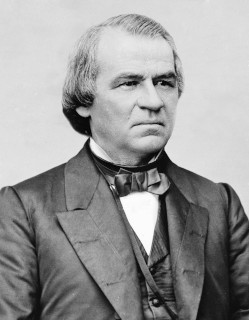
On October 17, 1853, Johnson becomes the 15th Governor of Tennessee serving for four years until November 3, 1857. He is elected by the legislature to the United States Senate on October 8, 1857. During his congressional service, he seeks passage of the Homestead Act of 1862 which is enacted soon after he leaves his Senate seat in 1862.
Southern slave states secede to form the Confederate States of America, which includes Tennessee, but Johnson remains firmly with the Union. He is the only sitting senator from a Confederate state who does not resign his seat upon learning of his state’s secession. In 1862, Lincoln appoints him as military governor of Tennessee after most of it has been retaken. In 1864, he is a logical choice as running mate for Lincoln, who wishes to send a message of national unity in his re-election campaign. Their ticket easily wins the election. He is sworn in as Vice President on March 4, 1865. He gives a rambling speech, after which he secludes himself to avoid public ridicule. Six weeks later, the assassination of Lincoln elevates him to the presidency.
Johnson implements his own form of Presidential Reconstruction, a series of proclamations directing the seceded states to hold conventions and elections to reform their civil governments. Southern states return many of their old leaders and pass Black Codes to deprive the freedmen of many civil liberties, but Congressional Republicans refuse to seat legislators from those states and advance legislation to overrule the Southern actions. Johnson vetoes their bills, and Congressional Republicans override him, setting a pattern for the remainder of his presidency.
Johnson opposes the Fourteenth Amendment which gives citizenship to former slaves. In 1866, he goes on an unprecedented national tour promoting his executive policies, seeking to break Republican opposition. As the conflict grows between the branches of government, Congress passes the Tenure of Office Act in 1867 restricting his ability to fire Cabinet officials. He persists in trying to dismiss Secretary of WarEdwin Stanton but ends up being impeached by the House of Representatives and narrowly avoiding conviction in the Senate. He does not win the 1868 Democratic presidential nomination and leaves office the following year.
Johnson returns to Tennessee after his presidency and gains some vindication when he is elected to the Senate in 1875, making him the only former president to serve in the Senate. In late July 1875, convinced some of his opponents are defaming him in the Ohio gubernatorial race, he decides to travel there to give speeches. He begins the trip on July 28 and breaks the journey at his daughter Mary’s farm near Elizabethton, where his daughter Martha is also staying. That evening he suffers a stroke but refuses medical treatment until the following day. When he does not improve two doctors are sent for from Elizabethton. He seems to respond to their ministrations but suffers another stroke on the evening of July 30 and dies early the following morning at the age of 66.
President Ulysses S. Grant has the “painful duty” of announcing the death of the only surviving past president. Northern newspapers, in their obituaries, tend to focus on Johnson’s loyalty during the war, while Southern ones pay tribute to his actions as president. Johnson’s funeral is held on August 3 in Greeneville. He is buried with his body wrapped in an American flag and a copy of the U.S. Constitution placed under his head, according to his wishes. The burial ground is dedicated as the Andrew Johnson National Cemetery in 1906 and, with his home and tailor’s shop, is part of the Andrew Johnson National Historic Site.




 seamus dubhghaill