Eyre is born around 1720, the second son of Colonel Samuel Eyre of Eyreville, County Galway, a descendant of Colonel John Eyre, who accompanies General Ludlow to Ireland in 1651 and acquires large estates in County Galway, including the Manor of Eyrecourt.
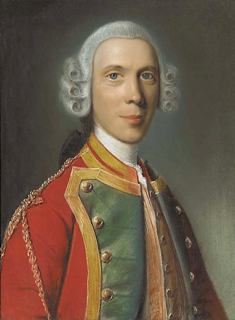
Eyre is that rare man whose military and engineering training occurs entirely in the Americas before he assumes the significant office of Surveyor General of Ireland in 1752. In 1738, he joins the regiment of James Oglethorpe, the founder of the Province of Georgia, and sails to the colony. As a cadet in Oglethorpe’s Regiment, he is sent to the colony’s interior as an agent to the Cherokee Indians. He rises from the rank of cadet to be sub-engineer for Georgia and the Province of South Carolina and in 1740 he is commissioned an ensign. He learns engineering from Major William Cook, the Regiment’s Engineer, and he marries Cook’s daughter Anne, who has accompanied her father to Georgia. The date of the wedding is not documented, but occurs by 1743, by which date both Eyre and Cook have returned to London. In the last two years of his tour of duty, Eyre serves also as the Sub-engineer for South Carolina and Georgia.
In 1744, Eyre is commissioned a lieutenant and joins Trelawney’s Regiment of Foot, headed by Edward Trelawney, Governor of Jamaica. He serves in Jamaica and at Roatán (Rattan) and is in charge of Roatán’s defences until 1748, when the Treaty of Aix-la-Chapelle ends the War of the Austrian Succession and returns the island to Spain. He is promoted to captain in 1748. For the four years after his departure from Roatán and before his resignation from Trelawney’s Regiment, little is known about his activities until he retires from active duty in 1752.
On August 31, 1752, Eyre is appointed Surveyor General of Ireland, having purchased the office from Arthur Jones-Nevill. Joseph Jarratt works as his deputy in this role. He undertakes works at the Royal Barracks in Dublin, but the condition of the barracks is criticised by the Commissioners of the Ordnance for Ireland. As Surveyor General, he is also involved in harbour works at Dún Laoghaire, and is responsible for the rebuilding of the State Apartments at Dublin Castle. In 1763, the office of Surveyor General is abolished, and he is transferred to the new post of Chief Engineer of the Ordnance.
Eyre resigns his commission in 1766 and becomes member of the Irish House of Commons for Thomastown (1761-68) and Fore (1768-1772). He dies on February 22, 1772, from an apoplectic fit brought on by the sudden death of a much loved daughter, at Parliament House, Dublin, while attending a session of the House.
Plant is born into a Church of Ireland farming family in Fethard, County Tipperary, on January 5, 1904, the second eldest child and son in a family of six children. His parents are John William Albert Plant, a farmer, and Catherine Hayden.
One Sunday in 1916, George and his older brother Jimmy are arrested by the Royal Irish Constabulary (RIC) after being seen speaking to two well-known republicans, Seán Hayes and Dan Breen. In custody the two brothers are beaten and mistreated resulting in a hatred of the RIC. He serves with the Irish Republican Army during the Irish War of Independence and with the Anti-Treaty IRA in the Irish Civil War.
In 1923, George and Jimmy leave Ireland for Canada and the United States but continue as active IRA members. In 1929 they return to Ireland and carry out a bank raid in Tipperary on behalf of the IRA. They are arrested two days later at the family farm and subsequently sentenced to seven years in prison. They are released in a general amnesty after the Fianna Fáil and Éamon de Valera election victory in 1932. He is a strong supporter of Seán Russell. In 1939 following the outbreak of World War II, known in Ireland as The Emergency, de Valera is determined to maintain Irish neutrality and is not going to allow the IRA to jeopardize this. The IRA links with Germany and campaign in Britain are severely straining Anglo-Irish relations so emergency legislation is introduced.
Russell, the IRA Chief of Staff, dies in August 1940 after taking ill on board a U-boat and Stephen Hayes from County Wexford becomes IRA Chief of Staff. In late August 1940 an address on Lansdowne Road, Dublin, is raided by the Garda Síochána. Among the men arrested is Michael Devereux, a 24-year-old married truck driver from County Wexford who is also Quartermaster of the IRAs Wexford Brigade. He is released after three days without charge. Shortly afterwards Gardaí in County Wexford find an IRA arms dump. Many in the IRA suspect that Devereux had turned informer, so Stephen Hayes orders Devereux’s execution. George Plant and another man, Michael Walsh from County Kilkenny, are ordered to carry out the order. Devereux meets Plant and Walsh who tell Devereux that Tom Cullimore, the Wexford Brigade’s OC is blamed for the arms dump and that they have shot him. They order Devereux to drive them to an IRA safe house at Grangemockler in south County Tipperary. Devereux, believing he is the prime suspect in a murder, stays willingly at the safe house. A week later, on September 27, 1940, Devereux is invited to go for a walk with Plant and Paddy Davern, the owner of the safe house. Somewhere along the walk Plant accuses Devereux of being an informer and shoots him dead. Plant is arrested nine weeks later on suspicion of IRA membership and brought before the Special Criminal Court in Dublin. On February 10, 1941, Radio Éireann broadcasts a radio appeal for Michael Devereux on behalf of his wife.
In September 1941, Stephen Hayes is accused of being an informer by a group of Northern IRA members led by Seán McCaughey. He manages to escape to a garda station. Shortly afterwards a large force of Garda Síochána and Irish Army descend on the area around the Davern farmhouse where they find Devereux’s car buried under an onion bed and eventually discover Devereux’s body, a year to the day after his death. Two weeks later, Plant, already in prison on IRA membership charges, is charged with Devereux’s murder. A trial is held with a senior IRA officer, Joseph O’Connor, also charged with Devereux’s murder. The first trial collapses after two days when Paddy Davern and Micheal Walsh, two of the prosecution witnesses, refuse to give evidence. This result leads to the court issuing a nolle prosequi order which should have meant the end of the affair, however both men are rearrested and recharged with the same offence, under Emergency Order 41f. Minister for JusticeGerald Boland transfers the case to a Special Military Court with army officers acting as judges. In addition to Plant, Paddy Davern and Michael Walsh are also now charged with Devereux’s murder. The second trial begins at Collins Barracks, Dublin in February 1942 with Seán MacBride, a former IRA Chief of Staff and future government minister as the defendant’s barrister. Davern states his original statement was given at gunpoint but under the new order even statements given under duress are admissible. The court only has two sentencing options – death or acquittal. Joseph O’Connor is acquitted and despite MacBride’s best efforts the other three are sentenced to death. Davern and Walsh have their sentences commuted to life imprisonment and are both released in 1946.
Just one week after sentence is passed, Plant is executed on March 5, 1942, in Portlaoise Prison by a six-man firing squad drawn from the Irish Army. Much bitterness is caused by the treatment of Plant’s relatives. Neither his wife or mother or infant son are allowed to visit him in the week before his execution. Censorship ensures there is little mention in the newspapers, so his family only learns of his execution from a brief radio broadcast shortly before they receive a telegram. He is buried in the grounds of Portlaoise Prison, but is reinterred in 1948, when he is buried with full IRA military honours in his local church St. Johnstown in County Tipperary, and a Celtic cross is erected over his grave.
Plant’s wife moves to the United States where she remarries. His brother Jimmy dies in London in 1978. The Plant’s family farm is now part of the Coolmore Estate.
In 1940, Kerins is sworn into the IRA and is appointed to the GHQ staff in May 1942. At the time, the Fianna Fáil government of Éamon de Valera is determined to preserve Irish neutrality during World War II. Therefore, the IRA’s bombing campaign in England, its attacks against targets in Northern Ireland, and its ties to the intelligence services of Nazi Germany are regarded as severe threats to Ireland’s national security. IRA men who are captured by the Gardaí are interned for the duration of the war by the Irish Army in the Curragh Camp in County Kildare.
On the morning of September 9, 1942, Garda Detective Sergeant Denis O’Brien is leaving his home in Ballyboden, Dublin. He is between his front gate and his car when he is cut down with Thompson submachine guns. O’Brien, an Anti-Treaty veteran of the Irish Civil War, had enlisted in the Garda Síochána in 1933. He is one of the most effective Detectives of the Special Branch division, which has its headquarters at Dublin Castle. The shooting greatly increases public feeling against the IRA, particularly as the murder is carried out in full view of his wife.
Following the arrest of Hugh McAteer in October 1942, Kerins is named Chief of Staff of the IRA. Despite a massive manhunt by Gardaí, he remains at large for two years. He stays at a County Waterford home for two weeks while he is on the run, having given his name as Pat Carney. He is captured several months after he leaves the home.
Kerins had previously left papers and guns hidden at Kathleen Farrell’s house in the Dublin suburb of Rathmines. He telephones the house, as he intends to retrieve them. However, Farrell’s telephone had been tapped by the Gardaí. On June 15, 1944, he is arrested in an early morning raid. He is sleeping when the Gardaí enter his bedroom and does not have an opportunity to reach the Thompson submachine gun which is hidden under his bed.
At a trial before the Special Criminal Court in Collins Barracks, Dublin, Kerins is formally charged on October 2, 1944, for the “shooting at Rathfarnham of Detective Dinny O’Brien.” At the end of his trial, the president of the Military Court delays sentence until later in the day to allow Kerins, if he wishes, to make an application whereby he might avoid a capital sentence. When the court resumes, he says, “You could have adjourned it for six years as far as I am concerned, as my attitude towards this Court will always be the same.” He thus deprives himself of the right to give evidence, to face cross-examination, or to call witnesses.
Kerins is the last IRA member to be executed in the Republic of Ireland. He is buried in the prison yard. In September 1948, his remains are exhumed and released to his family. He is buried in the Republican plot at Rath Cemetery, Tralee, County Kerry.
Plant is the second eldest child and son in a family of six children. His parents are John William Albert Plant, a farmer, and Catherine Hayden.
One Sunday in 1916 George and his older brother Jimmy are arrested by the Royal Irish Constabulary (RIC) after being seen speaking to two well-known republicans, Seán Hayes and Dan Breen. In custody the two brothers are beaten and mistreated resulting in a hatred of the RIC. He serves with the Irish Republican Army during the Irish War of Independence and with the Anti-Treaty IRA in the Irish Civil War.
In 1923 George and Jimmy leave Ireland for Canada and the United States but continue as active IRA members. In 1929 they return to Ireland and carry out a bank raid in Tipperary on behalf of the IRA. They are arrested two days later at the family farm and subsequently sentenced to 7 years in prison. They are released in a general amnesty after the Fianna Fáil and Éamon de Valera election victory in 1932. He is a strong supporter of Seán Russell. In 1939 following the outbreak of World War II, known in Ireland as The Emergency, de Valera is determined to maintain Irish neutrality and is not going to allow the IRA to jeopardize this. The IRA links with Germany and campaign in Britain are severely straining Anglo-Irish relations so emergency legislation is introduced.
Russell, the IRA Chief of Staff, dies in August 1940 after taking ill on board a U-boat and Stephen Hayes from County Wexford becomes IRA Chief of Staff. In late August 1940 an address on Lansdowne Road Dublin is raided by the Garda Síochána. Among the men arrested is Michael Devereux, a 24-year-old married truck driver from County Wexford who is also Quartermaster of the IRAs Wexford Brigade. He is released after three days without charge. Shortly afterwards Gardaí in County Wexford find an IRA arms dump. Many in the IRA suspect that Devereux had turned informer, so Stephen Hayes orders Devereux’s execution. George Plant and another man, Michael Walsh from County Kilkenny, are ordered to carry out the order. Devereux meets Plant and Walsh who tell Devereux that Tom Cullimore, the Wexford Brigade’s OC is blamed for the arms dump and that they have shot him. They order Devereux to drive them to an IRA safe house at Grangemockler in south County Tipperary. Devereux, believing he is the prime suspect in a murder, stays willingly at the safe house. A week later, on September 27, 1940, Devereux is invited to go for a walk with Plant and Paddy Davern, the owner of the safe house. Somewhere along the walk Plant accuses Devereux of being an informer and shoots him dead. Plant is arrested nine weeks later on suspicion of IRA membership and brought before the Special Criminal Court in Dublin. On February 10, 1941, Radio Éireann broadcasts a radio appeal for Michael Devereux on behalf of his wife.
In September 1941 Stephen Hayes is accused of being an informer by a group of Northern IRA members led by Seán McCaughey. He manages to escape to a garda station. Shortly afterwards a large force of Garda Síochána and Irish Army descend on the area around the Davern farmhouse where they find Devereux’s car buried under an onion bed and eventually discover Devereux’s body, a year to the day after his death. Two weeks later, Plant, already in prison on IRA membership charges, is charged with Devereux’s murder. A trial is held with a senior IRA officer, Joseph o’Connor, also charged with Devereux’s murder. The first trial collapses after two days when Paddy Davern and Micheal Walsh, two of the prosecution witnesses, refuse to give evidence. This result leads to the court issuing a nolle prosequi order which should have meant the end of the affair, however both men are rearrested and recharged with the same offence, under Emergency Order 41f. Minister for JusticeGerald Boland transfers the case to a Special Military Court with army officers acting as judges. In addition to Plant, Paddy Davern and Michael Walsh are also now charged with Devereux’s murder. The second trial begins at Collins Barracks, Dublin in February 1942 with Seán MacBride, a former IRA Chief of Staff and future government minister as the defendant’s barrister. Davern states his original statement was given at gunpoint but under the new order even statements given under duress are admissible. The court only has two sentencing options – death or acquittal. Joseph O’Connor is acquitted and despite MacBride’s best efforts the other three are sentenced to death. Davern and Walsh have their sentences commuted to life imprisonment and are both released in 1946.
Just one week after sentence is passed, Plant is executed in Portlaoise Prison by a six-man firing squad drawn from the Irish Army. Much bitterness is caused by the treatment of Plant’s relatives. Neither his wife or mother or infant son are allowed to visit him in the week before his execution. Censorship ensures there is little mention in the newspapers, so his family only learns of his execution from a brief radio broadcast shortly before they receive a telegram. He is buried in the grounds of Portlaoise Prison, but is reinterred in 1948, when he is buried with full IRA military honours in his local church St. Johnstown in County Tipperary, and a Celtic cross is erected over his grave.
Plant’s wife moves to the United States where she remarries. His brother Jimmy dies in London in 1978. The Plant’s family farm is now part of the Coolmore Estate.
Kerins is born in Caherina, Tralee, County Kerry and attends Balloonagh Mercy Convent School and then the CBS, Edward Street. At the age of 13, he wins a Kerry County Council scholarship and completes his secondary education at the Green Christian Brothers and the Jeffers Institute. In 1930, he passes the Intermediate Certificate with honours and the matriculation examination to the National University of Ireland (NUI). He later does a commercial course and takes up employment in a radio business in Tralee.
In 1940, Kerins is sworn into the IRA and is appointed to the GHQ staff in May 1942. At the time, the Fianna Fáil government of Éamon de Valera is determined to preserve Irish neutrality during World War II. Therefore, the IRA’s bombing campaign in England, its attacks against targets in Northern Ireland, and its ties to the intelligence services of Nazi Germany are regarded as severe threats to Ireland’s national security. IRA men who are captured by the Gardaí are interned for the duration of the war by the Irish Army in the Curragh Camp in County Kildare.
On the morning of September 9, 1942, Garda Detective Sergeant Denis O’Brien is leaving his home in Ballyboden, Dublin. He is between his front gate and his car when he is cut down with Thompson submachine guns. O’Brien, an Anti-Treaty veteran of the Irish Civil War, had enlisted in the Garda Síochána in 1933. He is one of the most effective Detectives of the Special Branch division, which has its headquarters at Dublin Castle. The shooting greatly increases public feeling against the IRA, particularly as the murder is carried out in full view of his wife.
Following the arrest of Hugh McAteer in October 1942, Kerins is named Chief of Staff of the IRA. Despite a massive manhunt by Gardaí, he remains at large for two years. He stays at a County Waterford home for two weeks while he is on the run, having given his name as Pat Carney. He is captured several months after he leaves the home.
Kerins had previously left papers and guns hidden at Kathleen Farrell’s house in the Dublin suburb of Rathmines. He telephones the house, as he intends to retrieve them. However, Farrell’s telephone had been tapped by the Gardaí. On June 15, 1944, he is arrested in an early morning raid. He is sleeping when the Gardaí enter his bedroom and does not have an opportunity to reach the Thompson submachine gun which is hidden under his bed.
At a trial before the Special Criminal Court in Collins Barracks, Dublin, Kerins is formally charged on October 2, 1944 for the “shooting at Rathfarnham of Detective Dinny O’Brien.” At the end of his trial, the president of the Military Court delays sentence until later in the day to allow Kerins, if he wishes, to make an application whereby he might avoid a capital sentence. When the court resumes, he says, “You could have adjourned it for six years as far as I am concerned, as my attitude towards this Court will always be the same.” He thus deprives himself of the right to give evidence, to face cross-examination, or to call witnesses.
Despite legal moves initiated by Seán MacBride, public protests, and parliamentary intervention by TDs from Clann na Talmhan, Labour, and Independent Oliver J. Flanagan in Leinster House, the Fianna Fáil government of Éamon de Valera refuses to issue a reprieve. On December 1, 1944 in Mountjoy Prison, Kerins is hanged by British chief executioner Albert Pierrepoint, who is employed by the Irish Government for such occasions.
Kerins is the last IRA member to be executed in the Republic of Ireland. He is buried in the prison yard. In September 1948, his remains are exhumed and released to his family. He is buried in the Republican plot at Rath Cemetery, Tralee, County Kerry.
The National Day of Commemoration is held on the Sunday closest to July 11, the anniversary of the date the truce was signed in 1921 to end the Irish War of Independence.
Leaders from Christian, Coptic Christian, Jewish and Islamic denominations read or sing prayers and readings, and President Higgins lays a laurel wreath. The service is observed by more than 1,000 guests, including Government Ministers, the Council of State, which advises the Taoiseach, members of the judiciary, members of the diplomatic corps, TDs and Senators, representatives of ex-servicemen’s organisations and relatives of the leaders of the 1916 Easter Rising.
The national flag is lowered to half-mast while the “Last Post” and “Reveille” are sounded. After a minute of silence, a gun salute is sounded, and the flag is raised again before the national anthem is played with a fly-by by three Pilatus PC-9 aircraft.
The Army band of the 1st Brigade and pipers play music including “Limerick’s Lament” and “A Celtic Lament” as guests arrive at the quadrangle of the former British Army veterans’ hospital, now the Irish Museum of Modern Art.
The prayer service begins with Imam Sheikh Hussein Halawa of the Islamic Cultural Centre of Ireland, father of Ibrahim Halawa, who is in prison in Cairo, singing verses from the Quran in Arabic and praying in English, “I ask Allah, the Mighty, the Lord, to bless our country, Ireland, and give the people of our country a zeal for justice and strength for forbearance.”
Soloist Sharon Lyons sings hymns between prayers and readings from all denominations, ending with Rabbi Zalman Lent: “May the efforts and sacrifice of those we honour today be transformed into the blessing of people throughout the world.”
Speaking to reporters, Chief of Staff of the Defence ForcesVice AdmiralMark Mellett says more than 650 personnel are serving in eleven countries and on the Mediterranean Sea. “In the Defence Forces we have over 80 people who have given their lives in the cause of peace internationally, and I think it’s a sign of a State that recognises those who give this service,” he says. “The military of our State serve the political and serve the people. And it’s this loyalty to the State which is actually critical, and I’m delighted that we have a day like this.”
Mellett’s views are echoed by former sergeant Denis Barry, who says 47 Irish soldiers died in Lebanon and it is important to pay respects for that sacrifice. “None of us who served ever thought we would see the day we could travel in Lebanon without weapons, heavy armaments or flak jackets.” That United Nations mission paid off, he says.
Former British soldier Ron Hammond says the event reflects positive developments, such as the creation of the veterans’ Union of British and Irish Forces. He served from 1960 to 1980 in the Royal Irish Fusiliers and Royal Irish Rangers, spending time in Germany, Canada, Yemen and north and south Africa. He joined the British rather than the Irish forces because at the time “a home posting in the Defence Forces was Collins Barracks and an overseas posting was the Curragh encampment.”
(From: “Irish military dead honoured in National Day of Commemoration” by Marie O’Halloran, The Irish Times, July 9, 2017)
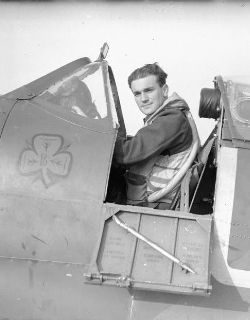
Finucane, born on October 16, 1920 in Rathmines, Dublin, is credited with 28 aerial victories, five probably destroyed, six shared destroyed, one shared probable victory, and eight damaged. Included in his total are twenty-three Messerschmitt Bf 109s, four Focke-Wulf Fw 190s and one Messerschmitt Bf 110. Official records differ over the exact total. After the war, two of Finucane’s victories that had been credited as probables had, in fact, been destroyed, but are not officially included. His total victory count could be as high as 32.
On July 15, Finucane is killed at the age of 21 while leading the Hornchurch Wing in a fighter “Ramrod” operation targeting a German Army camp at Étaples, France. He takes off with his wing at 11:50 AM. The attack is timed to hit the Germans at lunchtime. Crossing the beach at Le Touquet, they target machine gun positions. His plane is hit in the radiator at 12:22 PM. His wingman, Alan Aikman, notifies him of the white plume of smoke and Finucane acknowledges it with a thumbs up. Standard regulations insist the wing carry on the mission even if the leader is in trouble. Radio silence is maintained so the enemy radio-interception services do not become aware that a person of importance has been hit.
Finucane flies slowly out to sea, talking calmly to Aikman as he glides along in his stricken fighter. Finally, some 8 miles off Le Touquet on the French coast, he breaks radio silence and sends his last message. Aikman, flying alongside Finucane, sees him pull back the canopy, and before taking off his helmet, say “This is it Butch.” It is a well–executed landing, but the waves are difficult to predict and the Spitfire‘s nose strikes the water and disappears in a wall of spray. Before he hits the water, witnesses Aikman and Keith Chisholm of 452 Squadron see him release, or perhaps tighten, his parachute release harness and straps. If Finucane did release them, it is possible he could have been thrown forward onto the gun-sight and killed, or knocked unconscious and drowned. The exact circumstances remain unknown.



 seamus dubhghaill