seamus dubhghaill

Promoting Irish Culture and History from Little Rock, Arkansas, USA


Leave a comment

Birth of Uinseann MacEoin, Architect & Republican Campaigner

Uinseann Ó Rathaille MacEoin, Irish architect, journalist, republican campaigner and historian, is born in Pomeroy, County Tyrone, on July 4, 1920.

MacEoin is born Vincent O’Rahilly McGuone to Malachy McGuone, owner of the Central Hotel in Pomeroy and a wine and spirit merchant, and Catherine (née Fox). He has three siblings. Both of his parents are nationalists, and name all their children after leaders of the Easter Rising in 1916. Under the First Dáil in 1918, his father is appointed a judge. This results in him being interned on the prison ship Argenta on Larne Lough from 1922 to 1923. The family moves to Dublin after his release. His father dies in 1933, which leads to his wife running a workingmen’s café in East Essex Street. The family later lives on Marlborough Road, Donnybrook.

MacEoin attends boarding school at Blackrock College and is then articled to the architectural practice of Vincent Kelly in Merrion Square. As an active republican, he lives in a house on Northumberland Road from late 1939 to May 1940 where he helps in the production and distribution of an Irish Republican Army (IRA) weekly newspaper, War News. The IRA is banned by the Irish government in 1936, and its bombing campaign in Britain in 1939 is viewed by the government as a threat to Irish neutrality. MacEoin is among a group of republicans arrested in June 1940 and imprisoned in Arbour Hill Prison for a year. Once released, he is rearrested and interned at the Curragh for three years. He is sentenced to 3-months imprisonment in October 1943 for possession of incriminating documents. He is also charged with possession of ammunition, but testifies he was given the rounds against his will and never appears to have engaged in any violence. During his internment, he is taught the Irish language by Máirtín Ó Cadhain and is exposed to the socialist views of his fellow inmates. It is at this time that he adopts the Irish form of his name, Uinseann MacEoin.

While imprisoned in the 1940s, MacEoin continues his studies by correspondence and qualifies as an architect in 1945 at University College Dublin (UCD). His designs for a memorial garden in 1946 to those who died during the Irish War of Independence are commended. In 1959, he designs the site in Ballyseedy, County Kerry, for a monument by Yann Goulet commemorating those killed in the Irish Civil War and members of the IRA from Kerry who died. In 1948, he qualifies in town planning and takes up a position with Michael Scott‘s architectural practice. He works for a short time with Dublin Corporation, with their housing department, before establishing his own practice in 1955.

During the 1950s, MacEoin is a contributing editor on interior design in Hugh McLaughlin‘s magazine Creation, becoming editor of Irish Architect and Contractor in 1955. He enters into a partnership with Aidan Kelly in 1969 as MacEoin Kelly and Associates. In the early 1970s, he designs a shopping and housing development outside Dundalk, called Ard Easmuinn. Throughout the 1960s and 1970s, he continues as an influential architectural journalist, founding and editing Build from 1965 to 1969, and later Plan. His company, Pomeroy Press, publishes Plan along with other serials such as Stream and Field. He writes a large proportion of the copy in these periodicals, much under his own name, but he also uses pseudonyms, in particular in Plan as “Michael O’Brien.” He writes about his strong views on social housing, national infrastructure, and foreign and slum landlords, often libelously.

Despite his republican and socialist views, MacEoin is a staunch advocate for the preservation of Georgian Dublin, and campaigns for their preservation. On this topic, he writes letters to newspapers, takes part in television and radio discussions, writes comment pieces and editorials, speaks at public hearings, and takes part in direct protests such as sit-ins in buildings including those on Baggot Street, Pembroke Street, Hume Street, and Molesworth Street. He is also an active member of the Irish Georgian Society, and he campaigns actively against the road widening schemes in Dublin the 1970s and 1980s.

MacEoin and his wife purchase five Georgian houses on Mountjoy Square and three on Henrietta Street in the 1960s, all almost derelict. They refurbish them and lease them out, under the company name Luke Gardiner Ltd. He renames the 5 Henrietta Street property James Bryson House. His architectural practice moves into one of the Mountjoy Square houses. Along with fellow campaigners, Mariga Guinness and Deirdre Kelly, this demonstrates that these buildings can be salvaged and are not the dangerous structures other architects and developers claim them to be. He also purchases and saves Heath House, near Portlaoise, County Laois, living there toward the end of his life. He offers free conservation and architectural advice to community groups and is a volunteer on the renovation works on projects including Tailors’ Hall.

MacEoin remains politically active, joining Clann na Poblachta, the Wolfe Tone Societies (WTS), the Dublin Civic Group, the Northern Ireland Civil Rights Association (NICRA) and the Irish Anti-Apartheid Movement. To what extent he is involved in republican or IRA activities after 1945 is not clear. However, in March 1963, he is called a witness to a case in Scotland involving a Glasgow bookmaker by the name of Samuel Docherty and the Royal Bank of Scotland. Docherty claims the bank owes him £50,000. MacEoin testifies that in February 1962 he had travelled with £50,000 in cash from Dublin to lodge to Docherty’s account in the Royal Bank of Scotland in Belfast, as a loan. When asked about the origin of this large sum of money, he states it was supplied by another person but does not divulge that person’s name. This immediately triggers the court’s suspicions, and the judge warns MacEoin he will be contempt of court if he does not name the supplier of the money. He is placed in police custody for the day, and eventually he agrees to give the name in writing in confidence to the judge. The judge ultimately rules that Docherty is guilty of attempted fraud and perjury and that MacEoin’s involvement reeks of criminality. However, no further action is ever brought forward against Docherty or MacEoin.

In Sinn Féin‘s 1971 Éire Nua social and economic programme, MacEoin writes the chapter on “Planning,” and attends meetings in Monaghan in the early 1970s on the Dáil Uladh, a parliament for the 9-county Ulster province. In 1981, during the republican hunger strikes, one of his Mountyjoy Square houses is used as the national headquarters of the National H-Block Committee. Following the 1986 Sinn Féin split, he supports Republican Sinn Féin. He is a founding member of the Constitutional Rights Campaign in 1987, a group which aims to protect the rights of Irish citizens in the European Economic Community (EEC), having campaigned against Ireland joining the EEC in the early 1970s. In 1978, he is sentenced to two weeks in Mountjoy Prison for non-payment of a fine issued for not having a television licence. He had refused to buy one to protest the lack of Irish language programming.

As an environmentalist, MacEoin opposes private car ownership, and advocates for cycleways and the redevelopment of the railway lines. He writes about the “greenhouse effect” as early as 1969. As a hill walker and mountaineer, he claims to be the first Irishman to register successful climbs of all 284 Scottish peaks, known as the Munros, in 1987. He also climbs in the Alps and the Pyrenees.

MacEoin writes three books on his memories, and those of his former comrades: Survivors (1980), on the lives of leading Irish republicans, Harry (1986), a part biography part autobiography of Harry White, and The IRA in the twilight years 1923–48 (1997). He also publishes a novel, Sybil: a tale of innocence (1992) with his publishing house, Argenta, under the name Eoin O’Rahilly. He also interviews and records dozens of Republicans as part of his research for his books. These recordings are later converted into a digital oral history archive held in trust by the Irish Defence Forces.

MacEoin marries Margaret Russell in 1956 in Navan, County Meath. They have a daughter and two sons.

MacEoin dies in a nursing home in Shankill, Dublin, on December 21, 2007. His estate at the time of his death is valued at over €3 million. His son, Nuada, takes over his father’s architectural practice.

Leave a comment

Birth of Irish Republican Colm Murphy

Colm Murphy, Irish republican who is the first person to be convicted in connection with the Omagh bombing, but whose conviction is overturned on appeal, is born on August 18, 1952, in Belleeks, County Armagh, Northern Ireland.

Murphy is an active Irish republican paramilitary from his late teens. In March 1972, he is arrested in Dundalk regarding an assault and is sentenced to two years in prison after the Garda Síochána find a loaded revolver in his car. He is imprisoned in the Curragh Camp but escapes in October 1972 and is not recaptured until May 1973. In June 1976, he is imprisoned again, receiving a three-year sentence for firearms offences and a one-year sentence for Provisional Irish Republican Army membership, both sentences to run concurrently. In July 1983, he is arrested in the United States after attempting to buy a consignment of M60 machine guns to be shipped to Ireland for use by the Irish National Liberation Army (INLA). He receives a five-year prison sentence but returns to Ireland in December 1985 after being released early.

In the late 1980s, Murphy begins investing in property and forms a company named Emerald Enterprises in 1990. He purchases the Emerald Bar public house in Dundalk for IR£100,000, and it later becomes a meeting place for dissident republicans. Other investments included 30 acres of land in Drogheda bought for IR£52,000 in 1995, and his company wins contracts for an IR£11 million development at Dublin City University (DCU) and the multi-million-pound International Financial Services Centre in the Dublin Docklands.

Murphy is arrested by the Gardaí on February 21, 1999, for questioning under anti-terrorist legislation. On February 24, he becomes the first person to be charged in connection with the Omagh bombing, when he appears before Dublin‘s Special Criminal Court and is charged with conspiring to cause an explosion under the terms of Ireland’s Offences Against the State Act, between August 13-16, 1998. He is also charged with membership in an illegal organisation, the Real Irish Republican Army (RIRA).

On October 10, 2000, the BBC television show Panorama names Murphy as one of four people connected with the Omagh bombing, along with Seamus Daly and Liam Campbell. In 2001, he undertakes legal action against the BBC and Daily Mail publishers Associated Newspapers for contempt of court. The action against Associated Newspapers is settled on July 31, 2001, and the newspaper releases a statement saying Murphy is entitled to be presumed innocent of the charges against him until proven guilty.

Murphy’s trial begins at Special Criminal Court in Dublin on October 12, 2001. The court hears that Murphy had supplied two mobile phones which were used during the bombing. One witness, Murphy’s second cousin, retracts his evidence and the judge calls the conduct of two detectives outrageous, saying they had persistently lied under cross-examination. Despite this, on January 22, 2002, he is convicted of conspiring to cause the Omagh bombing, and on January 25 is sentenced to 14 years imprisonment with the judge describing him as a long-time republican extremist.

On January 21, 2005, Murphy’s conviction is overturned and a new trial ordered, due to the invasion of Murphy’s presumption of innocence, and alteration of Gardaí interview notes and evidence presented by two officers. A week later, his legal case against the BBC is resolved, with the BBC issuing a statement that Murphy “was fully entitled to maintain his innocence of the charges against him and to test the evidence against him at his trial.”

On October 23, 2006, two Gardaí officers are found not guilty of perjuring themselves during Murphy’s trial. On May 23, 2007, it is announced that Murphy is suffering from short-term memory loss resulting from a car accident in 1988. His lawyers attempt to prevent a retrial taking place, on the grounds that his condition interferes with his right to a fair hearing. The Court of Criminal Appeal is scheduled to hear his case again in October 2008. Following a retrial held in January 2010, he is acquitted on February 24, 2010.

In 2009, Murphy is one of four men found by a civil court to be liable for the Omagh bombing in a case taken by relatives of the victims. On July 7, 2011, in Belfast High Court, Lord Justice Malachy Higgins directs a retrial of the civil claims against Murphy. He questions evidence surrounding emails from U.S. undercover agent David Rupert while overturning the judgment on Murphy. The paucity of the email evidence, the lack of consistency in the emails or at least ambiguity, the possibility of initials referring to someone other than Murphy and the fact that they refer on occasions to double hearsay considerably weaken the emails as evidence, he says. Following a civil retrial on March 20, 2013, Murphy and Seamus Daly are found liable for involvement in the bombing.

Murphy dies peacefully of degenerative lung disease at the age of 70 on April 18, 2023, at Our Lady of Lourdes Hospital in Drogheda, County Louth.


Leave a comment

Repeal of the Declaratory Act 1719

The Declaratory Act 1719, which had given Great Britain the right to legislate for Ireland and had denied the appellate jurisdiction of the Irish House of Lords, is repealed on June 21, 1782.

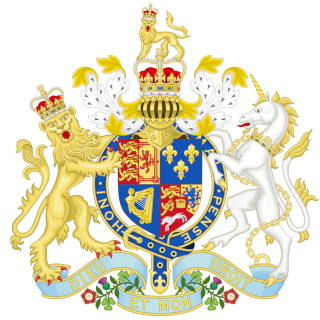
An Act for the better securing the dependency of the Kingdom of Ireland on the Crown of Great Britain (long title) is an Act passed by the Parliament of Great Britain which declares that it has the right to pass laws for the Kingdom of Ireland, and that the British House of Lords has appellate jurisdiction for Irish court cases. It becomes known as the Declaratory Act, and opponents in the Irish Patriot Party refer to it as the Sixth of George I, from the regnal year it is passed. Legal and political historians have also called it the Dependency of Ireland on Great Britain Act 1719 or the Irish Parliament Act, 1719. Prompted by a routine Irish lawsuit, it is aimed at resolving the long-running dispute between the British and the Irish House of Lords as to which is the final court of appeal from the Irish Courts. Along with Poynings’ Law, the Declaratory Act becomes a symbol of the subservience of the Parliament of Ireland, and its repeal is long an aim of Irish statesmen, which is finally achieved for Anglican Irish as part of the Constitution of 1782.

In 1709, the Irish Court of Exchequer hears a lawsuit between Maurice Annesley and his cousin Hester Sherlock over which of them have the right to possession of certain lands at Naas, County Kildare. The court finds in Annesley’s favour. Mrs. Sherlock appeals to the Irish House of Lords which upholds her appeal. Annesley then invokes the long-disputed jurisdiction of the British House of Lords to hear appeals from the Irish courts, and that house pronounces in his favour. The Court of Exchequer duly complies with the decree of the British House, but Mrs. Sherlock appeals again to the Irish house, which orders the Barons of the Exchequer to comply with its own decree and, when they refuse, imprison them for contempt of Court. The political uproar is out of all proportion to the importance of the lawsuit itself.

The bill has its second reading in the Commons on March 4, 1719, where it is chiefly opposed on the grounds that it appears to have no purpose beyond increasing the power of the House of Lords. Other objections include an argument that the preamble and the enacting section of the bill are contradictory, and that Ireland has historically had an independent judiciary. It is supported by Joseph Jekyll and Philip Yorke, and carries 140 votes to 83. It is then passed on March 26, 1719.

Section I of the Act notes that the Irish House of Lords had recently “assumed to themselves a Power and Jurisdiction to examine, correct and amend” judgements of the Irish courts, which it holds to be illegal. As such, it declares that the Kingdom of Ireland is subordinate to and dependent upon the British crown, and that the King, with the advice and consent of the Parliament of Great Britain, has “full power and authority to make laws and statutes of sufficient validity to bind the Kingdom and people of Ireland.” Section II declares that the House of Lords of Ireland has no jurisdiction to judge, affirm or reverse any judgement, sentence or decree made in any court within the Kingdom of Ireland, and that all proceedings before the House upon any such matter are declared to be null and void to all intents and purposes whatsoever.

The Irish House of Lords is understandably infuriated by the curtailment of its powers, and the Barons of the Exchequer, though they are soon released from custody, are subject to intense vilification. While many people think that the Irish House of Lords had brought about the crisis by its own high-handed behaviour, the “Sixth of George I” remains a source of grievance for decades.

The Declaratory Act 1719 provides a model for the American Colonies Act 1766, which is also known as the “Declaratory Act” and is a similar source of grievance in the Thirteen Colonies. The British defeat in the subsequent American Revolutionary War prompts a more conciliatory tone towards Ireland, and the Declaratory Act 1719 is repealed in its entirety when the Repeal of Act for Securing Dependence of Ireland Act 1782 receives royal assent on June 21, 1782.


Leave a comment

Birth of Arthur Wolfe, 1st Viscount Kilwarden

Arthur Wolfe, 1st Viscount Kilwarden KC, Anglo-Irish peer, politician and judge, who held office as Lord Chief Justice of Ireland, is born on January 19, 1739, at Forenaughts House, Naas, County Kildare.

Wolfe is the eighth of nine sons born to John Wolfe (1700–60) and his wife Mary (d. 1763), the only child and heiress of William Philpot, a successful merchant at Dublin. One of his brothers, Peter, is the High Sheriff of Kildare, and his first cousin Theobald is the father of the poet Charles Wolfe.

Wolfe is educated at Trinity College Dublin, where he is elected a Scholar, and at the Middle Temple in London. He is called to the Irish Bar in 1766. In 1769, he marries Anne Ruxton (1745–1804) and, after building up a successful practice, takes silk in 1778. He and Anne have four children, John, Arthur, Mariana and Elizabeth.

In 1783, Wolfe is returned as Member of Parliament for Coleraine, which he represents until 1790. In 1787, he is appointed Solicitor-General for Ireland, and is returned to Parliament for Jamestown in 1790.

Appointed Attorney-General for Ireland in 1789, Wolfe is known for his strict adherence to the forms of law, and his opposition to the arbitrary measures taken by the authorities, despite his own position in the Protestant Ascendancy. He unsuccessfully prosecutes William Drennan in 1792. In 1795, Lord Fitzwilliam, the new Lord Lieutenant of Ireland, intends to remove him from his place as Attorney-General to make way for George Ponsonby. In compensation, Wolfe’s wife is created Baroness Kilwarden on September 30, 1795. However, the recall of Fitzwilliam enables Wolfe to retain his office.

In January 1798, Wolfe is simultaneously returned to Parliament for Dublin City and Ardfert. However, he leaves the Irish House of Commons when he is appointed Chief Justice of the Kings Bench for Ireland and created Baron Kilwarden on July 3, 1798.

After the Irish Rebellion of 1798, Wolfe becomes notable for twice issuing writs of habeas corpus on behalf of Wolfe Tone, then held in military custody, but these are ignored by the army and forestalled by Tone’s suicide in prison. In 1795 he had also warned Tone and some of his associates to leave Ireland to avoid prosecution. Tone’s godfather, Theobald Wolfe of Blackhall (the father of Charles Wolfe), is Wolfe’s first cousin, and Tone may have been Theobald’s natural son. These attempts to help a political opponent are unique at the time.

After the passage of the Acts of Union 1800, which he supports, Wolfe is created Viscount Kilwarden on December 29, 1800. In 1802, he is appointed Vice-Chancellor of the University of Dublin.

In 1802 Wolfe presides over the case against Town Major Henry Charles Sirr in which the habitual abuses of power used to suppress rebellion are exposed in court.

In the same year Wolfe orders that the well-known Catholic priest Father William Gahan be imprisoned for contempt of court. In a case over the disputed will of Gahan’s friend John Butler, 12th Baron Dunboyne, the priest refuses to answer certain questions on the ground that to do so would violate the seal of the confessional, despite a ruling that the common law does not recognize the seal of the confessional as a ground for refusing to give evidence. The judge apparently feels some sympathy for Gahan’s predicament, as he is released from prison after only a few days.

During the Irish rebellion of 1803, Wolfe, who had never been forgiven by the United Irishmen for the execution of William Orr, is clearly in great danger. On the night of July 23, 1803, the approach of the Kildare rebels induces him to leave his residence, Newlands House, in the suburbs of Dublin, with his daughter Elizabeth and his nephew, Rev. Richard Wolfe. Believing that he will be safer among the crowd, he orders his driver to proceed by way of Thomas Street in the city centre. However, the street is occupied by Robert Emmet‘s rebels. Unwisely, when challenged, he gives his name and office, and he is rapidly dragged from his carriage and stabbed repeatedly with pikes. His nephew is murdered in a similar fashion, while Elizabeth is allowed to escape to Dublin Castle, where she raises the alarm. When the rebels are suppressed, Wolfe is found to be still alive and is carried to a watch-house, where he dies shortly thereafter. His last words, spoken in reply to a soldier who called for the death of his murderers, are “Murder must be punished; but let no man suffer for my death, but on a fair trial, and by the laws of his country.”

Wolfe is succeeded by his eldest son John Wolfe, 2nd Viscount Kilwarden. Neither John nor his younger brother Arthur, who dies in 1805, have male issue, and on John’s death in 1830 the title becomes extinct.

(Pictured: Portrait of Lord Chief Justice of Ireland, Arthur Wolfe (later Viscount Kilwarden) by Hugh Douglas Hamilton, between 1797 and 1800, Gallery of the Masters)


2 Comments

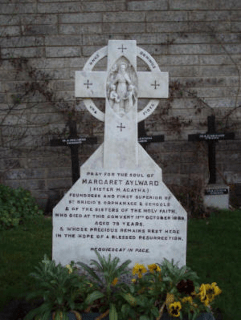
Birth of Margaret Aylward, Founder of the Sisters of the Holy Faith

Margaret Louisa Aylward, Roman Catholic nun, philanthropist, and founder of the Sisters of the Holy Faith, is born to a wealthy merchant family on November 23, 1810, in Thomas Street in Waterford, County Waterford.

Aylward is educated by the Ursuline nuns in Thurles, County Tipperary. After doing some charitable work in Waterford in her early years, she joins her sister in the Sisters of Charity in 1834 as a novice. She leaves the novitiate in 1836 and returns to Waterford to continue her charity work in a secular role. She again attempts to join a religious order in 1846 when she enters the Ursuline novitiate in Waterford, however she leaves after two months.

By 1851, Aylward has moved to Dublin where she is active in re-energising the Ladies’ Association of the Society of St. Vincent de Paul. The Great Famine leads to a large-scale movement of people from rural areas into cities, including Dublin, which leads to increased pressure on the charitable institutions of these areas. Her efforts are part of this wider charitable effort to help the poor, particularly Catholics who are seen to be at risk of coercive religious conversion (known as Souperism). This association is concerned with the “temporal as well as the spiritual relief of the sick poor in Dublin.”

The Ladies’ Association of St. Vincent de Paul opens St. Brigid’s in 1856, an orphanage which has an anti-proselytising mission and claims to rescue Catholic children from Protestant agencies. The Ladies’ Association often comes into dispute with those involved in the Irish Church Missions (ICM) and the ragged schools in Dublin, with members of the Ladies’ Association distributing crucifixes to children attending the Protestant-run ragged schools and visiting the homes of parents who send their children to them. The women involved in St. Brigid’s Orphanage organise themselves into a society called the Daughters of St. Brigid. However, while the establishment of St. Brigid’s brings Aylward closer to religious orders, historian Maria Luddy notes that in the 1850s, she is not concerned with the establishment of a religious community, rather she wants to “live in a community of women who were united by their religious convictions but did not necessarily desire to take formal religious vows.”

There is a growth in religious orders for women in Ireland from the early nineteenth century due to a relaxing of anti-Catholic Penal Laws. These include the Irish Sisters of Charity who are established in 1815 under Mary Aikenhead, the Sisters of Loreto order (1822) under Frances Ball, and Catherine McAuley‘s Sisters of Mercy (1831). Archbishop Paul Cullen of Dublin is an important figure in persuading leaders of religious communities of women, like Catherine McAuley, to formally organise as religious congregations in order to continue their charitable work and be respectable. While Aylward is resistant to this idea for a while, she eventually agrees. In 1857 the Sisters of the Holy Faith are established, and in 1869 the order are approved by Pope Pius IX.

Aylward is arrested in 1860 for “failing to produce a child named Mary Matthews, who had been taken away and concealed from her parents for the purpose of being brought up in the Roman Catholic faith.” Matthews had been placed with a nurse in Saggart, County Dublin, when her father had died, and her mother had emigrated to The Bahamas. When her mother returns, Aylward is notified by Matthews’ foster mother that she is missing. Aylward is acquitted of the charge of kidnapping but is found to be in contempt of court and serves six months in jail. She continues her work after her release.

Aylward (now Sister Mary Agatha) dies on October 11, 1889. She had continued wearing her own clothes and travelling after taking her religious vows.

Historian Margaret Helen Preston argues that Aylward is unusual for the time that she lives in because she does not believe that poverty results from sin. Aylward refers to the poor as the “Elect of God” and argues that God sees the poor as special because of their difficult circumstances.

The Sisters of the Holy Faith still work around the world.