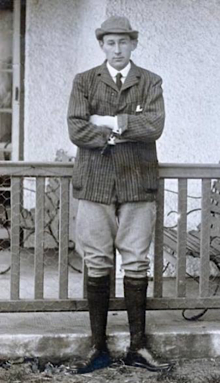
Moore is the eldest son of Queen Victoria‘s honorary physician in Ireland, Dr. William Moore of Rosnashane, Ballymoney, and Sidney Blanche Fuller. His ancestors came to Ulster during the Plantation of Ulster, settling at Ballymoney, at which time they were Quakers. The Moore Lodge estate is inherited from a relative. The family owns several other houses: Moore’s Grove and Moore’s Fort. He goes on to become a Deputy Lieutenant for County Antrim and a Justice of the Peace.
In 1903, Moore is one of the first landowners of Ireland to sell off their estates under the land acts. By the early 1920s he owns a Belfastpied-à-terre called “Glassnabreedon,” in the village of Whitehouse, four miles north of Belfast. This house is once owned by the son of Nicholas Grimshaw, Ireland’s first cotton pioneer.
Moore becomes a member of the General Synod of the Church of Ireland and is a founder member of the Ulster Council. He is a passionate Orangeman: his vehemence in defending Ulster’s right to oppose Irish Home Rule is said to alarm even those who share his views. Speaking in England on March 10, 1913, he makes his feelings clear on the possibility of Irish Home Rule: “I have no doubt, if Home Rule is carried, its baptism in Ireland will be a baptism in blood.” He shows little respect for English politicians, and has nothing but contempt for Southern Unionists. The eventual political settlement in 1921 meets with his approval.
Moore dies at his home, Moore Lodge, in Ballymoney on November 28, 1944, less than a week after his 80th birthday. He is buried in the family burial ground, “Lamb’s Fold,” two days later.
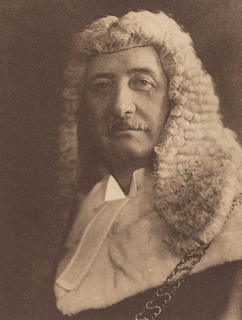
Babington is called to the Irish Bar in 1900. He briefly lectures in Equity at King’s Inns, and it is during this time, in 1910, that he re-arranges and re-writes R.E. Osborne’s Jurisdiction and Practice of County Courts in Ireland in Equity and Probate Matters. He takes silk in 1917.
In 1947, Babington chairs the Babington Agricultural Enquiry Committee, named in his honour, which is established in 1943 to examine agriculture in Northern Ireland. The committee’s first recommendation under Babington’s leadership is that Northern Ireland should direct all its energies to the production of livestock and livestock products and to their efficient processing and marketing.
Babington retires from the judiciary in 1949, taking up the chairmanship of the Northern Ireland Transport Tribunal, which exists until 1967, established under the Ulster Transport Act – promoting a car-centred transport policy – and which is largely responsible for the closure of the Belfast and County Down Railway. He endorses the closure on financial grounds and is at cross purposes with his co-chair, Dr. James Beddy, who advises against the closure, citing the disruption of life in the border region between the north and the south as his primary reason in addition to financial grounds.
Babington also chairs a government inquiry into the licensing of clubs, the proceeds of which results in new regulatory legislation at Stormont. While Attorney General, he is a proponent of renaming Northern Ireland as “Ulster.”
Babington is critical of the newly proposed Irish constitution, in which the name of the Irish state is changed to “Ireland,” laying claim to jurisdiction over Northern Ireland.
Michael McDunphy, Secretary to the President of Ireland, then Douglas Hyde, recalls Ernest Alton‘s correspondence with Babington on the question of Irish unity, in which Alton and Babington are revealed to be at cross purposes. The discussion is used as an example by Brian Murphy, in Forgotten Patriot: Douglas Hyde and the Foundation of the Irish Presidency, as an example of the office of the Irish President becoming embroiled in an initiative involving Trinity College Dublin and a senior Northern Ireland legal figure, namely Babington.
Babington writes to Alton, then Provost of Trinity College, Dublin, expressing his view that, as Murphy summarises, “… Severance between the two parts of Ireland could not continue, that it was the duty of all Irishmen to work for early unification and that in his opinion Trinity College was a very appropriate place in which the first move should be made.” When Alton arrives to meet with Hyde, it emerges, after conversing with Hyde’s secretary McDunphy, that he and Babington are at cross purposes. “It soon became clear that the united Ireland contemplated by Mr. [sic] Justice Babington of the Northern Ireland Judiciary was one within the framework of the British Commonwealth of Nations, involving recognition of the King of England as the Supreme Head, or as Dr. Alton put it, the symbol of unity of the whole system,” writes McDunphy.
Babington is a keen golfer. He is an international golfer from 1903 to 1913, during which he is runner-up in the Irish Amateur Golf Championships in 1909 and one of the Irish representatives at an international match in 1913. The Babington Room in the Royal Portrush Golf Club is named after him, as is the 18th hole on the course as a result of the key role he plays in shaping its history.
Babington dies at the age of 94 on April 10, 1972 at his home, Creevagh, Portrush, County Antrim.
He marries firstly Mary Halloran of Cloyne, County Cork, in 1845. She dies in 1901. In the year of his retirement, he remarries Florence Henrietta Gore, widow of Edward Croker. He has no children. James Joyce remarks in Ulysses that his second marriage at the age of 85 infuriates his nephew, who had been waiting patiently for years to inherit his money.
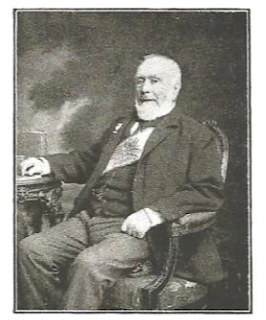
Despite his many years of service on the Bench, Chatterton does not seem to be highly regarded as a judge. On his retirement the Bar pays tribute to his good qualities but adds several qualifications: “there might have been on the Bench lawyers more profound, reasoners more acute…” In his first decade on the Bench, Chatterton has to endure the continual denigration of Jonathan Christian, the Lord Justice of Appeal in Chancery. Christian is notoriously bitter-tongued, and while he despises most of his colleagues, he seems to have a particular dislike of Chatterton. He regularly votes on appeal to overturn his judgments, and frequently adds personal insults. Nor does he confine his attacks to the courtroom: there is controversy in 1870 when remarks of Christian that Chatterton is “lazy, stupid, conceited and so incompetent that he ought to be pensioned off” find their way into The Irish Times. The hint about pensioning off Chatterton is not taken up, no doubt because he enjoys the confidence of the Lord Chancellor of Ireland, Thomas O’Hagan, 1st Baron O’Hagan, who is also on bad terms with Christian. In an appeal from Chatterton in 1873, the two appeal judges clash publicly, with O’Hagan reprimanding Christian for insulting a judge who is not there to defend himself.
Chatterton becomes involved in controversy in 1885, over the first attempt to rename Sackville Street to O’Connell Street. Dublin Corporation votes for the name change, but it arouses considerable objections from local residents, one of whom seeks an injunction. Chatterton grants the injunction on the ground that the corporation has exceeded its statutory powers. Rather unwisely, he also attacks the merits of the decision, accusing the Corporation of “sentimental notions.” The corporation is angered by both the decision and the criticisms: while it may have been a coincidence, the fact that Temple Street is briefly renamed Chatterton Street is interpreted by some as an insult to the judge, since the street is much frequented by prostitutes. The controversy is short-lived as the corporation is granted the necessary statutory powers in 1890, and the new name becomes official in 1924, by which time it has gained popular acceptance.

 seamus dubhghaill