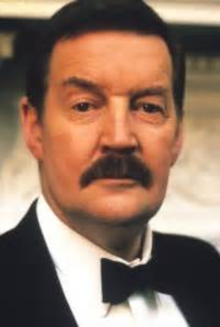
McAnally is born on March 30, 1926, in Buncrana, a seaside town located on the Inishowen peninsula of County Donegal. The son of a bank manager, he is educated at Saint Eunan’s College in Letterkenny where he writes, produces and stages a musical called “Madame Screwball” at the age of sixteen. He enters St. Patrick’s College, Maynooth at the age of 18 but leaves after a short time having decided that the priesthood is not his vocation. He joins the Abbey Theatre in 1947 where he meets and marries actress Ronnie Masterson.
The couple later forms Old Quay Productions and present an assortment of classic plays in the 1960s and 1970s. McAnally makes his theatre debut in 1962 with A Nice Bunch of Cheap Flowers and gives a well-received performance as George in Who’s Afraid of Virginia Woolf?, opposite Constance Cummings, at the Piccadilly Theatre.
On television he is a familiar face, often in glossy thriller series like television series The Avengers, Man in a Suitcase, and Strange Report. In 1968 he takes the title role in Spindoe, a series charting the return to power of an English gangster, Alec Spindoe, after a five-year prison term. This is a spin-off from another series, The Fellows (1967) in which McAnally had appeared in several episodes as the Spindoe character. He could render English accents very convincingly.
McAnally regularly acts in the Abbey Theatre and at Irish festivals, but in the last decade of life he achieves award-winning notice on TV and films. His impressive performance as Cardinal Altamirano in the film The Mission (1986) earns him Evening Standard and BAFTA awards. He earns a second BAFTA award for his role in the BBC’s A Perfect Spy (1987). In 1988 he wins the BAFTA for Best Actor for his performance in A Very British Coup, a role that also brings him a Jacob’s Award. In the last year of his life, he portrays the father of Christy Brown, played by Daniel Day-Lewis, in the Academy Award-winning film, My Left Foot (1989).
McAnally dies suddenly of a heart attack on June 15, 1989, at the age of 63, at his home in County Wicklow which he shares with Irish actress Britta Smith. He remains married to actress Ronnie Masterson until his death, although they reside in different homes. He receives a posthumous BAFTA award for Best Supporting Actor for his last film, My Left Foot, in 1990.
At the time of his death, McAnally is due to play “Bull McCabe” in Jim Sheridan‘s film The Field. The part eventually goes to Richard Harris who receives an Academy Award nomination for his performance. McAnally had also been cast in the lead role of First and Last, a drama about a man who walked from Land’s End to John o’ Groats. Filming is almost a third of the way done when he dies, but the whole play has to be re-filmed, with Joss Ackland taking the role instead.
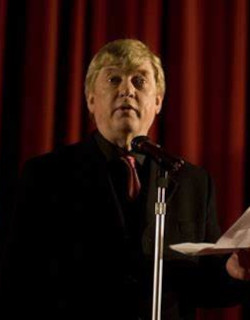
Born on May 2, 1951, Dwyer is originally from Saint John’s Park in Tralee, County Kerry. His mother, Mary, outlives him. He has two sisters, Anne and Maria. As a young man in the early 1970s he takes part in the Tralee Film Society, for which he provides notes to The Kerryman. At this time, he is employed by the County Library in Tralee. He begins working for In Dublin followed by the Sunday Tribune and The Sunday Press.
Dwyer first travels to the Cannes Film Festival in 1982 and attends every one until 2009, months before his death. In 1985, he co-founds the Dublin Film Festival and directs it until the mid-1990s. In 2002, he co-founds the Dublin International Film Festival, of which he is the chairman. In later life he serves on the board of the Irish Museum of Modern Art.
In the 1990s, Dwyer presents the film show Freeze Frame for public service broadcaster RTÉ. The show results from a friendship he had formed with Alan Gilsenan and Martin Mahon of Yellow Asylum Films. He is also known for his appearances on the radio shows Morning Ireland and The Marian Finucane Show. The editor of The Irish Times, Geraldine Kennedy, speaking after Dwyer’s death, says he was an “enthusiastic advocate” of both national and international cinema and had once said he was “one of those lucky people in life who was able to pursue his interests and call them work.”
Dwyer becomes unwell following a trip to the Cannes Film Festival in May 2009. He takes a break from writing for The Irish Times, returning in December 2009 to contribute his first, and what is to be his last ever, piece in six months to weekly entertainment supplement The Ticket. The article is a review of cinema in 2009 and of the 2000s, and in his contribution, he references the ill health which had haunted him for much of the previous year and which had prevented him from viewing any cinema releases between June and September.
A ceremony takes place at the Church of the Holy Name in Ranelagh where Dwyer lived. The event is attended by notable politicians, journalists, artists, actors, writers and musicians. RTÉ newsreader Aengus Mac Grianna, a colleague of Jennings, reads a tribute to Dwyer. Daniel Day-Lewis gives a very special tribute at the church service to his dear friend of over 20 years, calling for the Jameson International Dublin Film Festival to be renamed in Dwyer’s honour.
Dwyer is cremated after the funeral on January 5, 2010.
Christy Brown, Irish writer and painter who has cerebral palsy and is able to write or type only with the toes of one foot, dies on September 7, 1981, in Parbrook, Somerset, England. His most recognized work is his autobiography, My Left Foot (1954).
Brown is born into a working-class Irish family at the Rotunda Hospital in Dublin on June 5, 1932. He is one of 22 siblings of parents Bridget Fagan and Patrick Brown. After his birth, doctors discover that he has severe cerebral palsy, a neurological disorder which leaves him almost entirely spastic in his limbs. Though urged to commit him to a hospital, his parents are unswayed and subsequently determined to raise him at home with their other children. During his adolescence, social worker Katriona Delahunt becomes aware of his story and begins to visit the Brown family regularly. She brings him books and painting materials as, over the years, he has shown a keen interest in the arts and literature. He has also demonstrated extremely impressive physical dexterity since, soon after discovering several household books, he had learned to both write and draw himself with his left leg, the only limb over which he has unequivocal control.
Brown quickly matures into a serious artist. Although he famously receives almost no formal schooling during his youth, he does attend St. Brendan’s School-Clinic in Sandymount intermittently. At St. Brendan’s he comes in contact with Dr. Robert Collis, a noted author. Collis discovers that Brown is also a natural novelist and, later, helps use his own connections to publish My Left Foot, by then a long-gestating autobiographical account of Brown’s struggle with everyday life amidst the vibrant culture of Dublin.
When My Left Foot becomes a literary sensation, one of the many people who write letters to Brown is married American woman Beth Moore. Brown and Moore become regular correspondents and, in 1960, he holidays in North America and stays with Moore at her home in Connecticut. When they meet again in 1965, they began an affair. Brown journeys to Connecticut once more to finish his magnum opus, which he had been developing for years. He finally does so in 1967 with help from Moore, who introduces and administers a strict working regimen, mostly by denying him alcohol until a day’s work is completed. The book, Down All the Days, is published in 1970. It is an ambitious project drawn largely from a playful expansion of My Left Foot. It becomes an international best-seller, translated into fourteen languages. The Irish Times reviewer Bernard Share claims the work is “the most important Irish novel since Ulysses.”
Down All the Days is followed by a series of other novels, including A Shadow on Summer (1972), Wild Grow the Lilies (1976) and A Promising Career (published posthumously in 1982). He also publishes three poetry collections: Come Softly to My Wake, Background Music and Of Snails and Skylarks. All the poems are included in The Collected Poems of Christy Brown.
Brown’s fame continues to spread internationally, and he becomes a prominent celebrity. Upon his return to Ireland, he is able to use proceeds from the sales of his books to design and move into a specially constructed home outside Dublin with his sister’s family. Though he and Beth had planned to marry and live together at the new home, and though Moore had informed her husband of these plans, it is around this time that he begins an affair with Englishwoman Mary Carr, whom he meets at a party in London. He then terminates his affair with Moore and marries Carr at the Registry Office, Dublin, in 1972. They move to Stoney Lane, Rathcoole, County Dublin, to Ballyheigue, County Kerry and then to Somerset. He continues to paint, write novels, poetry and plays. His 1974 novel, A Shadow on Summer, is based on his relationship with Moore, whom he still considers a friend.
Brown’s health deteriorates after marrying Carr. He becomes mainly a recluse in his last years, which is thought to be a direct result of Carr’s influence and perhaps abusive nature. He dies at the age of 49 on September 7, 1981, after choking during a lamb chop dinner. His body is found to have significant bruising, which leads many to believe that Carr had physically abused him. Further suspicions arise after Georgina Hambleton’s biography, The Life That Inspired My Left Foot, reveals a supposedly more accurate and unhealthier version of their relationship. The book portrays Carr as an abusive alcoholic and habitually unfaithful. He is buried in the Glasnevin Cemetery in Dublin.
The Anglo-Irish rock band The Pogues pay tribute to Christy Brown with a song titled “Down All the Days.” It is the seventh track on their 1989 recording Peace and Love. Similarly, U2 releases a song titled “Down All the Days” with the 20th anniversary edition of Achtung Baby. The Men They Couldn’t Hang also writes a song “Down All the Days” which appears on their Silver Town album also released in 1989.
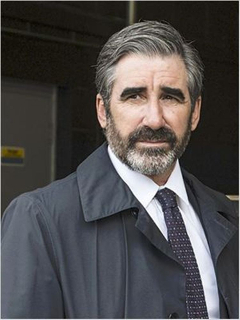
Lynch is the eldest of five children of an Irish father and an Italian mother from Trivento in the Province of Campobasso. His younger sister Susan and his nephew Thomas Finnegan are also actors. He attends St. Colman’s College, Newry and begins acting in Irish language-medium plays at school during the early years of the conflict in Northern Ireland.
Lynch plays the part of football legend George Best in the 2000 film Best. He plays the lead in the Australian feature Angel Baby, winning the Australian Film Institute award for best leading actor and the Australian Film Critics Association award for best actor of 1995. He is nominated for a Satellite Film Award for the film Moll Flanders in 1996. He works with acclaimed Belgian director Marion Hänsel on her adaptation of Booker-nominated author Damon Galgut‘s novel, The Quarry (1998), which wins Best Film at the Montreal World Film Festival. He wins Best Actor for the lead role in Best at the Fort Lauderdale Film Festival in 2000.
Lynch is also a novelist. His first novel, Torn Water, is published in November 2005 by the 4th Estate, a literary imprint of HarperCollins Publishers LLC, and his second, Falling Out of Heaven, is published on May 13, 2010, by the same publisher.
Growing up in London, he excels on stage at the National Youth Theatre, before being accepted at the Bristol Old Vic Theatre School, which he attends for three years. Despite his traditional actor training at the Bristol Old Vic, he is considered to be a method actor, known for his constant devotion to and research of his roles. He often remains completely in character for the duration of the shooting schedules of his films, even to the point of adversely affecting his health. He is one of the most selective actors in the film industry, having starred in only five films since 1998, with as many as five years between roles. Protective of his private life, he rarely gives interviews and makes very few public appearances.
In 2008, while receiving the Academy Award for Best Actor for There Will Be Blood from Helen Mirren, who presented the award, Day-Lewis kneels before her and she taps him on each shoulder with the Oscar statuette, to which he quips, “That’s the closest I’ll come to ever getting a knighthood.” In November 2014, Day-Lewis is formally knighted by Prince William, Duke of Cambridge at Buckingham Palace for services to drama.
The son of a bank manager, McAnally is educated at Saint Eunan’s College in Letterkenny where he writes, produces and stages a musical called “Madame Screwball” at the age of sixteen. He enters St. Patrick’s College, Maynooth at the age of 18 but leaves after a short time having decided that the priesthood is not his vocation. He joins the Abbey Theatre in 1947 where he meets and marries actress Ronnie Masterson.
The couple later forms Old Quay Productions and present an assortment of classic plays in the 1960s and 1970s. McAnally makes his theatre debut in 1962 with A Nice Bunch of Cheap Flowers and gives a well-received performance as George in Who’s Afraid of Virginia Woolf?, opposite Constance Cummings, at the Piccadilly Theatre.
On television he is a familiar face, often in glossy thriller series like television series The Avengers, Man in a Suitcase, and Strange Report. In 1968 he takes the title role in Spindoe, a series charting the return to power of an English gangster, Alec Spindoe, after a five-year prison term. This is a spin-off from another series, The Fellows (1967) in which McAnally had appeared in several episodes as the Spindoe character. He could render English accents very convincingly.
McAnally regularly acts in the Abbey Theatre and at Irish festivals, but in the last decade of life he achieves award-winning notice on TV and films. His impressive performance as Cardinal Altamirano in the film The Mission (1986) earns him Evening Standard and BAFTA awards. He earns a second BAFTA award for his role in the BBC’s A Perfect Spy (1987). In 1988 he wins the BAFTA for Best Actor for his performance in A Very British Coup, a role that also brings him a Jacob’s Award. In the last year of his life, he portrays the father of Christy Brown, played by Daniel Day-Lewis, in the Academy Award-winning film, My Left Foot (1989).
McAnally dies suddenly of a heart attack on June 15, 1989, at the age of 63, at his home in County Wicklow which he shares with Irish actress Britta Smith. He remains married to actress Ronnie Masterson until his death, although they reside in different homes. He receives a posthumous BAFTA award for his last film in 1990.
At the time of his death, McAnally is due to play “Bull McCabe” in Jim Sheridan‘s film The Field. The part eventually goes to Richard Harris who receives an Academy Award nomination for his performance. McAnally had also been cast in the lead role of First and Last, a drama about a man who walked from Land’s End to John o’ Groats. Filming is almost a third of the way done when he dies, but the whole play has to be re-filmed, with Joss Ackland taking the role instead.
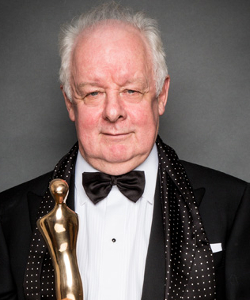
Jim Sheridan, Irish playwright, screenwriter, film director, and film producer, is born in Dublin on February 6, 1949. In the few years from 1989 to 1993, Sheridan makes three acclaimed films set in Ireland (My Left Foot, The Field, and In the Name of the Father) that between them receive a remarkable 13 Academy Award nominations. Sheridan has personally received six Academy Award nominations. In addition to the above-mentioned films, he is also known for the films The Boxer and In America.
Sheridan is born to Anna and Peter Sheridan Snr and raised in the inner city of Dublin. He is the brother of playwright Peter Sheridan. The family runs a lodging house, while Anna Sheridan works at a hotel and Peter Sheridan Snr is a railway clerk with CIÉ. Sheridan’s early education is at a Christian Brothers school. In 1969 he attends University College Dublin to study English and History. He becomes involved in student theater there, where he meets Neil Jordan, who also is later to become an important Irish film director. After graduating from UCD in 1972, Sheridan and his brother begin writing and staging plays, and together found the Project Theatre Company.
Sheridan returns to Ireland in the late 1980s. In 1989, he directs My Left Foot, which becomes a critical and commercial success and wins Daniel Day-Lewis and Brenda Fricker Academy Awards. He follows that with The Field starring Richard Harris in 1990, then with In the Name of the Father in 1993, a fictionalized re-telling of the case of the Guildford Four. The film wins the Golden Bear at the 44th Berlin International Film Festival.
In 1996 he co-writes Some Mother’s Son with Terry George. The Boxer, with Daniel Day-Lewis, is nominated for a Golden Globe Award for best film drama in 1997. In 2003, he releases the semi-autobiographical In America, which tells the story of a family of Irish immigrants trying to succeed in New York. The film receives positive reviews and earns Samantha Morton and Djimon Hounsou Academy Award nominations. In 2005 he releases Get Rich or Die Tryin’, a film starring rap star 50 Cent. He is connected with the upcoming film adaptation of Artemis Fowl and is rumoured to have written the screenplay and been asked to direct it.
Sheridan has a wife, Fran, and three daughters, Naomi Sheridan, Kirsten Sheridan, and Tess Sheridan, with whom he has collaborated, most notably with Naomi and Kirsten on the screenplay for In America.
Christy Brown, writer and painter who has cerebral palsy and is able to write or type only with the toes of one foot, is born into a working-class Irish family at the Rotunda Hospital in Dublin on June 5, 1932. His most recognized work is his autobiography, My Left Foot, which is later made into a 1989 Academy Award-winning film of the same name, starring Daniel-Day Lewis as Brown.
After his birth, doctors discovered that he has severe cerebral palsy, a neurological disorder which leaves him almost entirely spastic in his limbs. Though urged to commit him to a hospital, Brown’s parents are unswayed and subsequently determined to raise him at home with their other children. During Brown’s adolescence, social worker Katriona Delahunt becomes aware of his story and begins to visit the Brown family regularly. She brings Christy books and painting materials as, over the years, he has shown a keen interest in the arts and literature. He has also demonstrated extremely impressive physical dexterity since, soon after discovering several household books, Christy learns to both write and draw himself using his left leg, the only limb over which he had unequivocal control.
Brown quickly matures into a serious artist. Although Brown famously receives almost no formal schooling during his youth, he does attend St. Brendan’s School-Clinic in Sandymount intermittently. At St. Brendan’s he comes in contact with Dr. Robert Collis, a noted author. Collis discovers that Brown is also a natural novelist and later uses his own connections to publish My Left Foot, by then a long-gestating autobiographical account of Brown’s struggle with everyday life amidst the vibrant culture of Dublin.
In 1965, after My Left Foot has become a literary sensation, Brown meets and begins corresponding with Beth Moore, a married American woman, and they begin an affair. She helps push Brown to complete his book Down All the Days, which is published in 1970 and includes a dedication to Moore.
During this time, Brown’s fame continues to spread internationally, and he becomes a prominent celebrity. Upon his return to Ireland, he is able to use proceeds from the sales of his books to design and move into a specially constructed home outside Dublin with his sister’s family. It is around this time that Brown begins an affair with Englishwoman Mary Carr, whom he marries in 1972 at the Registry Office in Dublin. He continues to paint, write novels, poetry, and plays. His 1974 novel, A Shadow on Summer, is based on his relationship with Moore, whom he still considers a friend.
Brown’s health deteriorates after marrying Carr. He becomes a recluse in his final years, which is thought to be a direct result of Carr’s influence and perhaps abusive nature. Brown dies in Parbrook, Somerset, England on September 7, 1981, at the age of 49 after choking during a lamb chop dinner. His body is found to have significant bruising, which leads many to believe that Carr has physically abused him. Further suspicions arise after Georgina Hambleton’s biography, The Life That Inspired My Left Foot, reveals a supposedly more accurate and unhealthier version of their relationship. The book portrays Carr as an abusive alcoholic and habitually unfaithful. Brown is buried in Dublin’s Glasnevin Cemetery.
Day-Lewis is the son of Frank Day-Lewis, Church of Ireland Rector of the parish, and Kathleen Blake. His father takes the surname “Day-Lewis” as a combination of the surnames of his own birth father (Day) and his adoptive father (Lewis). After the death of his mother in 1906, Day-Lewis is brought up in London by his father, with assistance of an aunt, spending summer holidays with relatives in County Wexford. He is educated at Sherborne School and at Wadham College, Oxford. In Oxford, Day-Lewis becomes part of the circle gathered around W. H. Auden and helps him to edit Oxford Poetry 1927. His first collection of poems, Beechen Vigil, appears in 1925.
In 1928, Day-Lewis marries Constance Mary King, the daughter of a Sherborne teacher, and works as a schoolmaster in three schools, including Larchfield School in Helensburgh, Scotland. During the 1940s he has a long and troubled love affair with the novelist Rosamond Lehmann. His first marriage is dissolved in 1951, and he marries actress Jill Balcon, daughter of Michael Balcon.
During World War II he works as a publications editor in the Ministry of Information, an institution satirised by George Orwell in his dystopian Nineteen Eighty-Four. During this time his work is now no longer as heavily influenced by Auden, and he develops a more traditional style of lyricism. Some critics believe that he reaches his full stature as a poet in Word Over All (1943), when he finally distances himself from Auden. After the war he joins the publisher Chatto & Windus as a director and senior editor.
In her teens, Fricker aspires to follow her parents’ footsteps into journalism. Before becoming an actress, she is assistant to the art editor of TheIrish Times, with hopes to become a reporter. At age 19, she becomes an actress “by chance,” as her feature film career begins with a small uncredited part in the 1964 film Of Human Bondage, based on the 1915 novel by W. Somerset Maugham. She also appears in Tolka Row, Ireland’s first ever soap opera.
One of Fricker’s first TV roles is as staff nurse Maloney in Coronation Street, debuting on January 10, 1977. Fricker comes to wider public attention in the United Kingdom in another nursing role, as Megan Roach in the BBC One television drama series Casualty, appearing in 65 episodes. After making cameo appearances in three additional episodes, Fricker’s final appearance as Megan is in August 2010, when her character takes a lethal cocktail of drugs to end her life.
Fricker finds international acclaim after she wins the 1989 Academy Award for Best Supporting Actress for her performance as Christy Brown‘s mother in My Left Foot, becoming the first Irish actress to win an Oscar. The film is a triumph for Irish film making. Daniel Day-Lewis wins best actor for his portrayal of the disabled Brown while director Jim Sheridan receives numerous Best Director nominations at various film festivals.
She rejoins Sheridan to make the 1990 film The Field, starring alongside Richard Harris as Maggie McCabe. She continues her television work during this period, starring in the Australian-produced short series Brides of Christ (1991). She then co-stars in the 1992 TV miniseries Seekers alongside Josette Simon and produced by Sarah Lawson.
Buoyed by her Oscar win, Fricker goes on to appear in several high profile Hollywood films, most notably in Home Alone 2: Lost in New York. The following year she portrays May Mackenzie in So I Married an Axe Murderer, and next portrayed Joseph Gordon Levitt’s character’s motherly caretaker Maggie in Angels in the Outfield. One of her last Hollywood film roles comes with A Time to Kill, as Ethel Twitty, loyal secretary to Matthew McConaughey‘s Jake Brigance. She then focuses almost exclusively on film and television work in Canada and the British Isles.
In July 2014, Fricker tentatively retires from acting. Previously married to director Barry Davies, Fricker currently lives in the Liberties in Dublin.






![(Newscom TagID: mrpphotos209322) [Photo via Newscom]](https://seamusdubhghaill.com/wp-content/uploads/2016/02/brenda-fricker.jpg?w=225)
 seamus dubhghaill