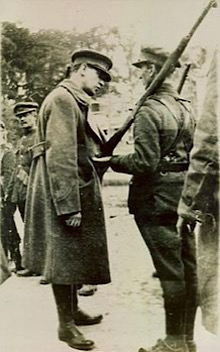
Nationalist forces enter Newcastle West, County Limerick, on Monday, August 7, 1922, after a twelve-hour battle, in which twelve anti-Treaty Irish Republican Army (IRA) members, sometimes referred to as Irregulars, are killed. The casualties of the Nationalists are less than those of the Irregulars.
Taking little respite after Sunday’s labors, the Nationals advance from Rathkele on Monday morning, and by midday are in sight of their fresh objective. Armored cars enter the town and machine gun fire is directed against a party of Irregulars, causing many casualties.
When the artillery goes into action against the headquarters of the Irregulars, the Irregulars flee precipitately along Cord road.
Owing to the slow progress in the operations in Southern Ireland, the meeting of Dáil Éireann, scheduled to open Saturday, is postponed again.
The official army bulletin announces that the Nationals captured Castle Island on Saturday, August 5. It says that the counties of Cork and Kerry with a part of South Tipperary and a small area in County Waterford are the only districts held by the Irregulars with any degree of security.
The streets of Dublin are lined with great crowds of people on Tuesday, August 8, for the military funeral of nine National Army soldiers who were killed in fighting the Republican Irregulars in County Kerry. Michael Collins, Chairman of the Provisional Government, and all the leading officers of the army in Dublin march beside the hearses. Each coffin is covered with the Republican tricolour. There are many clergymen and other civilians in the funeral procession.
Prominent Catholics of Dublin and Belfast are trying to effect a better understanding between the Ulster and Free State Governments, according to the Daily Mail. This newspaper further states that all efforts to this end, which have all been taken with the advice and approval of leading English Catholics, are without official character.
A message from Strabane, County Tyrone, received by the Exchange Telegraph Company on August 8 states that a settlement between the Ulster Government and the Free State authorities is imminent, the terms of agreement having been practically arranged in negotiations proceeding in London.
In Downing Street, however, all knowledge of any such Irish negotiations is disclaimed and a telegram from Belfast quotes Ulster Government officials as denying that a settlement with the Free State is imminent.
The Free State Government is also unaware of any negotiations for a settlement between the Ulster Government and the Free State authorities. It is further states that such negotiations are unlikely to take place.
(From: “Irish Irregulars Routed With Loss,” The New York Times, August 9, 1922 | Pictured: General Michael Collins inspects a soldier at Newcastle West, County Limerick, August 8, 1922)
Ervine leaves Orangefield High School at age 14 and joins the Orange Order at age 18, however his membership does not last long. The following year he joins the Ulster Volunteer Force (UVF), believing this to be the only way to ensure the defence of the Protestant community after the events of Bloody Friday.
Ervine is arrested in November 1974, while an active member of the UVF. He is driving a stolen car containing five pounds of commercial explosives, a detonator and fuse wire. After seven months on remand in Crumlin Road Gaol he is found guilty of possession of explosives with intent to endanger life. He is sentenced to 11 years and imprisoned at The Maze.
While in prison, Ervine comes under the influence of Gusty Spence who makes him question what his struggle is about and unquestionably changes Ervine’s direction. After much study and self-analysis, he emerges with the view that change through politics is the only option. He also becomes friends with Billy Hutchinson while in prison.
Ervine is released from prison in 1980 and takes up full-time politics several years later. He stands in local council elections as a Progressive Unionist Party (PUP) candidate in 1985 Northern Ireland local elections. In 1996, he is elected to the Northern Ireland Forum from the regional list, having been an unsuccessful candidate in the Belfast East constituency. In 1998, he is elected to the Northern Ireland Assembly to represent Belfast East and is re-elected in 2003. He is also a member of Belfast City Council from 1997.
Ervine plays a pivotal role in bringing about the loyalist ceasefire of October 1994. He is part of a delegation to Downing Street in June 1996 that meets then British Prime MinisterJohn Major to discuss the loyalist ceasefire.
On January 21, 2002, Sinn Féin‘s four MPs take the historic step of signing up to use the facilities of the House of Commons, whose authority over Northern Irelandrepublicans have been fighting for almost a century. Party policy is also changed to allow MPs to sit in the Irish Parliament, the Dáil.
Amid concern among some republicans that the move comes close to recognising British rule, Sinn Féin president and Belfast West MP, Gerry Adams, insists that his party will never take its seats at Westminster. “There will never ever be Sinn Féin MPs sitting in the British houses of parliament,” he tells a Westminster press conference.
However, flanked by his three fellow Sinn Féin MPs, Martin McGuinness (Mid Ulster), Pat Doherty (West Tyrone) and Michelle Gildernew (Fermanagh and South Tyrone), Adams says taking up seats in the Dáil is a very different proposition from doing so the Commons. No Sinn Féin member would take the loyalty oath to the Queen, needed to take up a seat in Parliament, but that was a mere side issue to the key question of sovereignty, he says. Even if the oath were amended, the party would still refuse to take its seats because republicans do not recognise parliament’s jurisdiction over Northern Ireland.
“There are lots of things which there can be no certainty of and there are some things of which we can be certain,” Adams says. “There will never, ever be Sinn Féin MPs sitting in the British Houses of Parliament. The transfer of power by London and Dublin to the Assembly in the north … is all proof of where we see the political centre of gravity on the island of Ireland and that is in the island of Ireland.”
Adams insists his party’s presence in the Commons is a “temporary” measure until they can join the parliament of a united Ireland.
A ban on MPs using Commons facilities without taking the loyalty oath was lifted in December 2001 to Conservative fury. Tories end three decades of cross-party cooperation over the move, which also entitles Sinn Féin’s four MPs to allowances of £107,000 a year each.
Shadow Secretary of State for Northern IrelandQuentin Davies claims Adams plans to use the cash for party political campaigning – something forbidden by Westminster rules. He accuses British Prime MinisterTony Blair of “deliberately contributing to a great propaganda coup in which … the British Government are licking their boots.” The Prime Minister’s spokesman says Blair acknowledges “many victims do feel very strongly about what has happened, but the Prime Minister’s view is that this peace process has saved many lives.”
Sitting alongside a giant Irish tricolour inside his new office, Adams likens his presence there to that of MPs who had served in the British Army and intelligence services – suggesting some of them still do. He also dismisses concerns about the misuse of the money, accusing those “complaining loudest” of being from parties “indicted for corruption and sleaze.”
Sinn Féin’s move into their new offices coincides with a “routine” meeting with the Prime Minister in Downing Street to discuss the peace process. The Sinn Féin president uses publicity surrounding the controversial move to issue a new challenge to Blair to tackle the loyalist “killing campaign.” Adams is joined in Downing Street by his three fellow Sinn Féin MPs.
“There have been 300 bombs over the last nine or ten months,” Adams says. “The British Prime Minister has to face up to the reality that the threat to the peace process within Northern Ireland comes from within loyalism.”
Adams blames Betty Boothroyd‘s decision to bar Sinn Féin MPs from using Commons facilities for the current controversy. “We are here, elected, with our mandate renewed and increased,” he adds.
Adams is asked how he would react if he met former Cabinet minister Lord Tebbit and his wife, who was badly injured by the 1984 Provisional Irish Republican Army (IRA) bomb attack at the Tories conference at the Grand Brighton Hotel in Brighton, at the Commons. “I don’t ignore anyone. As someone who has been wounded and shot and someone whose house has been bombed, I understand precisely how others who have suffered more than me feel about all of this,” Adams replies. “I would like to think that as part of building a peace process that all of us agree there must be dialogue.”
(Pictured: from left, Sinn Fein MPs Michelle Gildernew, Martin McGuinness, Gerry Adams and Pat Doherty)
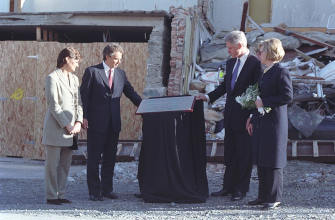
Following the unveiling, they walk through the town’s main street, Market Street, which bore the brunt of the explosion. Clinton, First LadyHillary Clinton, who earlier placed a wreath at the newly-unveiled plaque, Blair and his wife Cherie meet and shake hands with many of the crowd, who are clearly pleased to see them. They also visit Watterson’s drapers shop, where three members of staff had been killed, and lay a wreath.
Earlier, in the town’s leisure centre, they meet the victims of the Omagh bombing, and the family and friends of those who died. Blair and Clinton spend about an hour talking to people in Omagh. They meet some of the people who had been injured in the blast, including a group who have been released from hospital for the day especially to meet the president. Una McGurk is discharged from the Altnagelvin Area Hospital in Derry, and sisters Laura and Nicola Hamilton from the Ulster Hospital in Dundonald, on the outskirts of east Belfast. Thirty-four people remain in hospital, three – two women and a man – in critical conditions.
Downing Street later says the Blairs and Clintons were “deeply moved” by their meeting in the gymnasium. The prime minister’s official spokesman says Blair found the courage and determination of the people he met “positively inspirational.”
The first person Clinton speaks to is a young girl who has both eyes covered with bandages. He also meets a boy wearing a Leeds United F.C. shirt who is unable to shake the president’s hand because both his hands are still bandaged.
Before arriving in Omagh, Clinton puts the issue of decommissioning at the top of his priorities for change in Northern Ireland. He says these priorities are “To decommission weapons of war that are obsolete in a Northern Ireland at peace, to move forward with a formation of an executive council, adapt your police force so it has the confidence, respect and support of all the people, to end street justice, because defining crime, applying punishment and enforcing the law, must be left to the peoples’ elected representatives, the courts and the police, and to pursue early release for prisoners whose organisations have truly abandoned violence and to help them find a productive, constructive place in society.”
(From: “Clinton consoles bomb victims,” BBC News, news.bbc.co.uk, September 4, 1998)
In a March 4, 2008, announcement, the Rev. Ian Paisley signals the end of an era by announcing he will retire as First Minister of Northern Ireland. He also confirms he is stepping down as leader of the Democratic Unionist Party (DUP), the party he founded in the early 1970s. The news represents a huge moment in the politics and recent history of Northern Ireland, removing from the scene as it does one of its most striking figures.
The 81-year-old announces he will quit both posts following an international investment conference in Belfast in May 2008 but will remain as an MP and Assembly member.
“I came to this decision a few weeks ago when I was thinking very much about the conference and what was going come after the conference,” Paisley tells Ulster Television. “I thought that it is a marker, a very big marker and it would be a very appropriate time for me to bow out.”
Paisley denies he is leaving in part over allegations that his son, Ian Paisley Jr., lobbied Downing Street on behalf of a wealthy party member. He says his son has been “wrongly accused.” He is also weakened over defeat in a recent by-election – an indication that a section of the DUP’s electorate is uneasy about his historic decision to share power with Sinn Féin.
Significantly, Paisley does not back any contender in the DUP leadership contest to succeed him. “This is not the Church of Rome. I have no right to say who will succeed me. I will not be like Putin in Russia saying to the president – ‘this is the way you have to go.’ When I make a break it will be [a] break.”
Paisley defends his decision to enter into government with Sinn Féin. “It was the right thing to do because it was the only thing to do to save us from a united Ireland. We were threatened that we would be more Irish in our rulership, that there would be more Dublin say in government. That was what the British government threatened. We managed to put that to a rest.”
“We have laid to rest that and republicans have come to see that they have to put up with Paisley and his clan. We took what was meant for our destruction and turned it into our salvation.”
Speaking from Dubai the previous night, the deputy First Minister, Martin McGuinness, says, “It wasn’t unexpected. It was the right decision to go into sharing power with Sinn Féin which changed the politics of Ireland forever.”
The Sinn Féin MP describes Paisley as “courageous” for agreeing to enter into the power-sharing government. “We have had a positive and constructive working relationship,” McGuinness said.
Paisley’s fiercest critic within unionism, the ex-DUP MEP, Jim Allister, claims opposition to his power-sharing with Sinn Féin and his relationship with McGuinness means that Paisley “jumped before he was pushed.”
Allister’s new party, Traditional Unionist Voice (TUV), split the DUP vote in a by-election in February 2008 and cost the party a council seat in County Down. It was Paisley’s first electoral test since he agreed to share power with Sinn Féin following the St. Andrews Agreement at the end of 2006.
In April 2008, Peter Robinson is chosen to succeed Paisley as leader of the Democratic Unionist Party. The 36 DUP members of the Northern Ireland Assembly unanimously select Robinson, who has been MP for Belfast East since 1979 and Paisley’s deputy since 1980. He is the Minister of Finance and Personnel in the Northern Ireland Executive – Northern Ireland’s power-sharing government – for the previous year.
(From: “Paisley to step down as Ulster’s first minister” by Henry McDonald, Ireland correspondent, The Guardian, March 4, 2008)
During the Troubles, as part of its armed campaign against British rule in Northern Ireland, the Provisional Irish Republican Army repeatedly uses homemade mortars against targets in Northern Ireland. The IRA carries out many attacks in England, but none involve mortars. In December 1988, items used in mortar construction and technical details regarding the weapon’s trajectory are found during a raid in Battersea, South West London, by members of the Metropolitan Police Anti-Terrorist Branch. In the late 1980s, British Prime Minister Margaret Thatcher is top of the IRA’s list for assassination, following the failed attempt on her life in the Brighton hotel bombing.
Security around Downing Street is stepped up following increased IRA activity in England in 1988. Plans to leave a car bomb on a street near Downing Street and detonate it by remote control as Thatcher’s official car is driving by had been ruled out by the IRA Army Council owing to the likelihood of civilian casualties.
The Army Council instead sanctions a mortar attack on Downing Street and, in mid-1990, two IRA members travel to London to plan the attack. One is knowledgeable about the trajectory of mortars and the other, from the IRA’s Belfast Brigade, is familiar with their manufacture. An active service unit (ASU) purchases a Ford Transit van and rents a garage, and an IRA co-ordinator procures the explosives and materials needed to make the mortars. The IRA unit begins making the mortars and cutting a hole in the roof of the van for the mortars to be fired through. Once preparations are complete, the two IRA members return to Ireland, as the IRA leadership considers them valuable personnel and does not wish to risk them being arrested in any follow-up operation by the security services. In November 1990, Thatcher unexpectedly resigns from office, but the Army Council decides the planned attack should still go ahead, targeting her successor, John Major. The IRA plans to attack when Major and his ministers are likely to be meeting at Downing Street and wait until the date of a planned cabinet meeting is publicly known.
On arrival, the driver parks the van and leaves the scene on a waiting motorcycle. Several minutes later, at 10:08 AM, as a policeman is walking towards the van to investigate it, three mortar shells are launched from a Mark 10 homemade mortar, followed by the explosion of a pre-set incendiary device. This device is designed to destroy any forensic evidence and set the van on fire. Each shell is four and a half feet long, weighs 140 pounds, and carries a 40-pound payload of the plastic explosiveSemtex. Two shells land on Mountbatten Green, a grassed area near the Foreign and Commonwealth Office. One explodes and the other fails to detonate. The third shell explodes in the back garden of 10 Downing Street, 30 yards from the office where the cabinet is meeting. Had the shell struck 10 Downing Street itself, it is likely the entire cabinet would have been killed. On hearing the explosion, the cabinet ducks under the table for cover. Bomb-proof netting on the windows of the cabinet office muffle the force of the explosion, which scorches the back wall of the building, smashes windows and makes a crater several feet deep in the garden.
Once the sound of the explosion and aftershock has died down, the room is evacuated, and the meeting reconvenes less than ten minutes later in the Cabinet Office Briefing Rooms (COBR). No members of the cabinet are hurt, but four people receive minor injuries, including two police officers injured by flying debris. Immediately after the attack, hundreds of police officers seal off the government district, from the Houses of Parliament to Trafalgar Square. Until 6:00 PM, civilians are kept out of the area as forensic experts combed the streets and government employees are locked in behind security gates.
The IRA claims responsibility for the attack with a statement issued in Dublin, saying, “Let the British government understand that, while nationalist people in the six counties [Northern Ireland] are forced to live under British rule, then the British Cabinet will be forced to meet in bunkers.” John Major tells the House of Commons that “Our determination to beat terrorism cannot be beaten by terrorism. The IRA’s record is one of failure in every respect, and that failure was demonstrated yet again today. It’s about time they learned that democracies cannot be intimidated by terrorism, and we treat them with contempt.” Leader of the OppositionNeil Kinnock also condemns the attack, stating, “The attack in Whitehall today was both vicious and futile.” The head of the Metropolitan Police Anti-Terrorist Branch, Commander George Churchill-Coleman, describes the attack as “daring, well planned, but badly executed.”
A further statement from the IRA appears in An Phoblacht, with a spokesperson stating “Like any colonialists, the members of the British establishment do not want the result of their occupation landing at their front or back doorstep … Are the members of the British cabinet prepared to give their lives to hold on to a colony? They should understand the cost will be great while Britain remains in Ireland.” The attack is celebrated in Irish rebel culture when the band The Irish Brigade releases a song titled “Downing Street,” to the tune of “On the Street Where You Live,” which includes the lyrics “while you hold Ireland, it’s not safe down the street where you live.”
On December 9, 1994, Sinn Féin, the political wing of the Irish Republican Army (IRA), holds its first formal talks with the British Government in over 70 years. The negotiations take place in Belfast, almost one year after Britain and Ireland began an uncertain program to try to resolve the conflict in Northern Ireland. The first session is held at Stormont, a gigantic, columned edifice on top of a hill on the outskirts of Belfast that houses the old Northern Ireland parliament.
Although the announcement of the negotiations is not a surprise, it still sets off an exciting ripple that history is in the making. British officials have conducted secret talks with Sinn Féin leaders in the past, but never before have they sat down openly at the same table with them.
In both a letter to the Sinn Féin leader, Gerry Adams, and in a three-paragraph statement, Downing Street pointedly refers to the meeting as “exploratory dialogue.” This is in keeping with London‘s position that it is simply joining in “talks about talks,” not a full negotiating session, which must involve all parties to the conflict.
For 25 years the IRA has been fighting in the name of the Roman Catholic minority of 650,000 in Northern Ireland. It wants to link Ulster, the six counties of Northern Ireland that remain British after partition, to the Irish Republic, a move opposed by most of the province’s 950,000 Protestants.
The announcement of talks evoke a predictable pattern of responses across Northern Ireland’s political spectrum. Adams, who works to persuade the IRA to go along with a unilateral cease-fire that was declared on September 1, welcomes it. “The opportunity to realize a lasting peace, which will benefit all of the people of Ireland, has never been greater,” he says in a statement. Adams had been accusing London of foot-dragging on the peace effort. Now, he says, it is time to move on to “the next phase of dialogue — multilateral talks led by both Governments.”
The Ulster Unionist Party (UUP), the main Protestant political group in Northern Ireland, is skeptically accepting, as it has been all along. John Taylor, a UnionistMember of Parliament, says the talks will at least establish whether “Sinn Féin really is to become a normal political party.”
The Rev. Ian Paisley, a Member of Parliament whose Democratic Unionist Party (DUP) has become a rejectionist front, continues to oppose talks or any move smacking of compromise. He tells the House of Commons that “a vast majority of people” resent the decision to talk to “the men of blood.”
Sinn Féin is represented at the talks by Martin McGuinness, a veteran IRA political leader who took part in secret contacts that broke up the previous year. In 1972, together with Adams, he was flown to London for a meeting with William Whitelaw, who was then Secretary of State for Northern Ireland. Those talks eventually failed.
Adams is in Washington, D.C. on Wednesday, December 7. He attends a meeting at the White House, his first one there, with Anthony Lake, President Bill Clinton‘s National Security Advisor. Seven weeks earlier, Britain protests vigorously at the thought of Adams visiting the White House. But events moved so swiftly that he gains a kind of legitimacy that is hard for Whitehall to deny. His visa to the United States, good for three months, allows several visits.
The Government team of civil servants, in contrast to higher-level ministers, are led by Quentin Thomas, deputy secretary of the British administration called the Northern Ireland Office.
Going into the negotiations, the key question is what will be discussed. On the British side, the top of the agenda is how to get the IRA to turn over its considerable stash of 100 tons of arms and explosives. There is nothing, of course, that Sinn Féin is less likely to agree to at the outset. So should the British make this a condition for multilateral talks to begin, the two sides will meet an obstacle right away.
McGuinness says that the issue of IRA weapons has to be considered “in the context of us removing the causes of conflict, the reason why people use armed force in our society.”
From its side, Adams says Sinn Féin wants to discuss being treated with “a parity of esteem” with the other parties, and “the release of all political prisoners.”
The British Government says that it will soon hold talks with the so-called loyalist paramilitaries on the Protestant side. And it indicates it will have no objection if elected Sinn Féin councillors attend a major international investment conference in Belfast on December 13 and 14.
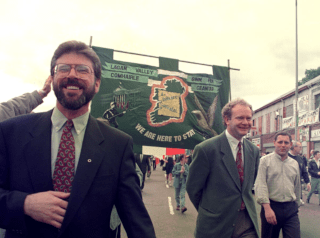
(From: “Britain and I.R.A. Group to Begin Talks in Northern Ireland” by John Darnton, The New York Times, December 2, 1994 | Pictured: Gerry Adams and Martin McGuinness lead a Republican parade in Belfast, commemorating 25 years of British troops on the streets of Northern Ireland in 1994)
Francis Stevenson, Private Secretary to Lloyd George recalls, “I have never seen David so excited as he was before de Valera arrived at 4:30. He kept walking in and out of my room… As I told him afterwards, he was bringing up all his guns! He had a big map of the British Empire hung up on the wall in the Cabinet room, with its great blotches of red all over it. This was to impress de Valera with the greatness of the British Empire and to get him to recognise it, and the King.” De Valera apparently is not impressed.
When de Valera, Richard Barton and Art O’Brien arrive at Downing Street, “cheers were raised, Sinn Féin flags were displayed, and the crowd sang Irish airs.” As the meeting goes on, a “large crowd of Irish sympathisers knelt in the rain at Whitehall, at the end of Downing Street, recited the Rosary, and sang several hymns. Before the prayers started, they sang “Ireland a Nation.” According to a reporter covering the event, the singing of Irish songs and the praying never ceases.
Six days later, Britain makes its first formal proposal. The main negotiations take place in December culminating with the signing of the Anglo-Irish Treaty on December 6, 1921.
(From: Stair na hÉireann | History of Ireland, http://www.stairnaheireann.net, July 14, 2016 | Photo credit: National Library of Ireland collection, dated Thursday, July 14, 1921 (at approximately 5:30 PM), outside Downing Street as de Valera meets Lloyd George, at the first of four meetings held between the two in July 1921.)
Ervine is born into a Protestant working-class family in east Belfast on July 21, 1953. He leaves Orangefield High School at age 14 and joins the Orange Order at age 18, however his membership does not last long. The following year he joins the Ulster Volunteer Force (UVF), believing this to be the only way to ensure the defence of the Protestant community after the events of Bloody Friday.
Ervine is arrested in November 1974, while an active member of the UVF. He is driving a stolen car containing five pounds of commercial explosives, a detonator and fuse wire. After seven months on remand in Crumlin Road Gaol he is found guilty of possession of explosives with intent to endanger life. He is sentenced to 11 years and imprisoned in The Maze.
While in prison, Ervine comes under the influence of Gusty Spence who makes him question what his struggle is about and unquestionably changes Ervine’s direction. After much study and self-analysis, he emerges with the view that change through politics is the only option. He also becomes friends with Billy Hutchinson while in prison.
Ervine is released from prison in 1980 and takes up full-time politics several years later. He stands in local council elections as a Progressive Unionist Party (PUP) candidate in 1985 Northern Ireland local elections. In 1996 he is elected to the Northern Ireland Forum from the regional list, having been an unsuccessful candidate in the Belfast East constituency. In 1998, he is elected to the Northern Ireland Assembly to represent Belfast East and is re-elected in 2003. He is also a member of Belfast City Council from 1997.
As dusk falls the ambush takes place on a road at Dus a’ Bharraigh in the townland of Shanacashel, Kilmichael Parish, near Macroom.
Just before the Auxiliaries in two lorries come into view, two armed IRA volunteers, responding late to Barry’s mobilisation order, drive unwittingly into the ambush position in a horse and sidecar, almost shielding the British forces behind them. Barry manages to avert disaster by directing the car up a side road and out of the way. The Auxiliaries’ first lorry is persuaded to slow down by the sight of Barry placing himself on the road in front of a concealed Command Post, wearing an IRA officer’s tunic given to him by Paddy O’Brien. Concealed on the south side of the road are six riflemen, whose instructions are to prevent the enemy taking up positions on that side. Another six riflemen are positioned some way off as an insurance group, should a third Auxiliary lorry appear.
The first lorry, containing nine Auxiliaries, slows almost to a halt close to their intended ambush position, at which point Barry gives the order to fire. He throws a Mills bomb that explodes in the open cab of the first lorry. A savage close-quarter fight ensues. According to Barry’s account, some of the British are killed using rifle butts and bayonets in a brutal and bloody encounter. This part of the engagement is over relatively quickly with all nine Auxiliaries dead or dying.
While this part of the fight is going on, a second lorry also containing nine Auxiliaries has driven into the ambush position. This lorry’s occupants, at a more advantageous position than Auxiliaries in the first lorry because of their distance from the ambushing group, dismount to the road and exchange fire with the IRA, killing Michael McCarthy. Barry then brings the Command Post soldiers who had completed the attack on the first lorry to bear on this group. Barry claimed these Auxiliaries called out a surrender and that some dropped their rifles but opened fire again with revolvers when three IRA men emerged from cover, killing volunteer Jim O’Sullivan instantly and mortally wounding Pat Deasy. Barry then orders his men to open fire and not stop until told to do so. Barry ignores a subsequent attempt by remaining Auxiliaries to surrender and keeps his men firing until he believes all the Auxiliaries are dead.
At the conclusion of the fight, it is observed that two IRA volunteers, Michael McCarthy and Jim O’Sullivan, are dead and that Pat Deasy, brother of Liam Deasy, is mortally wounded. Although the IRA fighters think they had killed all of the Auxiliaries, two actually survive, one very badly injured and another who escapes and is later captured and shot dead. Among the 16 British dead on the road at Kilmichael is Francis Crake, commander of the Auxiliaries in Macroom, probably killed at the start of the action by Barry’s Mills bomb.
Many IRA volunteers are deeply shaken by the severity of the action, referred to by Barry as “the bloodiest in Ireland,” and some are physically sick. Barry attempts to restore discipline by making them form-up and perform drill, before marching away. Barry himself collapses with severe chest pains on December 3 and is secretly hospitalized in Cork. It is possible that the ongoing stress of being on the run and commander of the flying column, along with a poor diet as well as the intense combat at Kilmichael contribute to his illness, diagnosed as heart displacement.
The political fallout from the Kilmichael ambush outweighs its military significance. While the British forces in Ireland can easily absorb 18 casualties, the fact that the IRA had been able to wipe out a whole patrol of elite Auxiliaries is for them deeply shocking. The British forces in the West Cork area take their revenge on the local population by burning several houses, shops and barns in Kilmichael, Johnstown and Inchigeelagh, including all of the houses around the ambush site. On December 3, three IRA volunteers are arrested by the British Essex Regiment in Bandon, beaten and killed, and their bodies dumped on the roadside.
For the British government, the action at Kilmichael is an indication that the violence in Ireland is escalating. Shortly after the ambush, barriers are placed on either end of Downing Street to protect the Prime Minister‘s office from IRA attacks. On December 10, as a result of Kilmichael, martial law is declared for the counties of Cork, Kerry, Limerick and Tipperary.
The British military now has the power to execute anyone found carrying arms and ammunition, to search houses, impose curfews, try suspects in military rather than civilian courts and to intern suspects without trial. On December 11, in reprisal for Kilmichael and other IRA actions, the centre of Cork city is burned by Auxiliaries, British soldiers and Black and Tans, and two IRA men are assassinated in their beds. In separate proclamations shortly afterwards, the authorities sanction “official reprisals” against suspected Sinn Féin sympathisers and the use of hostages in military convoys to deter ambushes.
(Pictured: The Kilmichael Ambush Monument at the ambush site)







 seamus dubhghaill