seamus dubhghaill

Promoting Irish Culture and History from Little Rock, Arkansas, USA


Leave a comment

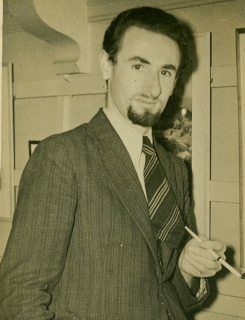
Birth of Patrick Hennessy, Irish Realist Painter

Patrick Anthony Hennessy RHA, Irish realist painter known for his highly finished still lifes, landscapes and trompe-l’œil paintings, is born in Cork, County Cork, on August 28, 1915. The hallmark of his style is his carefully observed realism and his highly finished surfaces, the result of a virtuoso painting technique.

Hennessy is the son of John Hennessy an army sergeant major from County Kerry and Bridget Hennessy from Cork. His father is killed in World War I at the Battle of Passchendaele in 1917. In 1921, when he is five years old, his mother remarries in Cork. Her second husband is a Scot named John Duncan and shortly afterwards the whole family moves to Arbroath, Scotland, where Duncan has relatives.

Hennessy is educated in Arbroath at St. Thomas RC Primary School followed by secondary education at Arbroath High School, where he begins to show an aptitude for art, leaving in 1933 with the Dux for Art and an accompanying medal. In the autumn of 1933 he enrolls at the Dundee of Jordanstone College of Art & Design, for a four-year Diploma course in Drawing and Painting under James McIntosh Patrick and Edward Baird. Here he meets Harry Robertson Craig who becomes his lifelong companion. He plays a full part in the social activities of the college, winning a fancy-dress award at the Christmas revels in 1935 and producing a ballet “Paradise Lost” the following year. He gains a First-Class Pass in each year of the course along with winning first prize in 1934 and 1936 for work done during the summer vacation. He graduates with a First-Class Distinction in 1937.

Having gained a scholarship, Hennessy continues his studies at the Dundee of Jordanstone College of Art & Design for a further year by doing a Post-Graduate Diploma course in Drawing and Painting. Within a month of gaining his Post-Graduate Diploma he holds his first joint exhibition at the Art Galleries in Arbroath. In June 1938 he is awarded the Annual Travelling Scholarship for further studies in Paris and Italy. In Paris he meets up with the artists Robert Colquhoun and Robert MacBryde, whom he had met the previous year, the three travelling south together to Marseilles towards the end of that year. On his return to Scotland he is selected for the residential summer school course at Hospitalfield House near Arbroath under James Cowie. Two of his paintings, a still life and a self-portrait, are accepted that year by the Royal Scottish Academy for their Annual Exhibition. However, by the autumn of 1939 with war looming and feeling somewhat disenchanted on his return to Scotland, he decides to return to Ireland.

On arrival in Dublin Hennessy is offered an exhibition in December 1939 at the Country Shop on St. Stephen’s Green which is opened by Mainie Jellett. This attracts favourable attention. During the early 1940s he lives at various addresses in and around Dublin with frequent trips to Cork. In 1940 he is invited to join the Society of Dublin Painters and holds regular annual exhibitions of his work there during the 1940s and early 1950s. These exhibitions are supplemented by an eclectic mix of commissions, mostly portraits which he undertakes during this period. In 1941 he has three of his paintings accepted by the Royal Hibernian Academy (RHA) for their annual exhibition. This is the beginning of a long relationship with the RHA. He exhibits there virtually every year from 1941 until 1979, the year before his death.

From the early 1940s onwards, Hennessey’s work sometimes incorporates a homosexual visual subtext. He re-unites with Harry Robertson Craig in 1946 and soon after they move to Crosshaven, County Cork, and later to Cobh. In 1947, Time magazine selects him as one of Ireland’s outstanding painters, in recognition of the important position he has then attained in the art world. In 1948 he has an exhibition at the Victor Waddington Gallery, Dublin, and that same year is elected an associate of the Royal Hibernian Academy and a full member the following year. In 1950 his painting De Profundis is selected for the Contemporary Irish Painting exhibition that tours North America. As a result of this tour, the American public and critics begin to take notice of his work. In 1951 he visits Italy, taking in Venice and Sicily and returning to Dublin with many of his canvases painted abroad. One of these paintings, Bronze Horses of St. Marks, is exhibited at the Royal Academy of Arts in London in 1954.

In 1956, a friend of Hennessy, David Hendriks, opens the Ritchie Hendriks Gallery on St. Stephen’s Green, Dublin and it is this gallery that is to be the main outlet for his work over the following 22 years. In October 1956 the Thomas Agnew Gallery in London holds an exhibition of his work comprising 38 of his paintings. However, during the winter of 1959 he becomes seriously ill with pneumonia. As a consequence of this, in the autumn of that year he and Craig decide to winter in Morocco. This is the beginning of a new era in both their lives. They would never again spend a full year in Ireland. His exhibitions at the Ritchie Hendriks Gallery had for many years enjoyed favourable reviews from the art critics but in the 1960s this changes with critics claiming his paintings to be dull, repetitive and suggest he needs to explore new areas. Despite the barrage of criticism, in 1965 the Guildhall Gallery in Chicago offers him a major exhibition. Shortly after this exhibition takes place in 1966, he becomes one of the artists on permanent display at the gallery with an annual exhibition. The North American market is extremely lucrative for him and by the end of the decade he is selling more of his work in the United States than in Ireland. In 1968 he finally moves to Tangier, Morocco on a permanent basis and in 1970 sells his studio on Raglan Lane, Dublin.

In Morocco, Hennessy paints prolifically for nine years to keep up with demand from the Hendriks Gallery and Guildhall Gallery along with the RHA. In 1975 the Guildhall Gallery mounts a highly successful Retrospective of his work. In 1978 he has his last exhibition in Dublin at the Hendriks Gallery. By this time he has moved to the Algarve, Portugal and is beginning to have health problems.

In November 1980, with his health deteriorating, Craig brings Hennessy to a hospital in London for treatment. However, on December 30, 1980 he dies from cancer. Following cremation his ashes are buried in nearby Golders Green Crematorium. He leaves his entire estate to Harry Robertson Craig with the proviso that on Craig’s death the Royal Hibernian Academy should be the beneficiary. This legacy has been used to set up the annual Hennessy Craig Scholarship for aspiring artists.

Hennessy falls into the category of painter who develops a distinctive personal style, labelled at various times in his life as a Traditional Realist, Romantic, Photo Realist, Illusionary and Surrealist. However, he always remains intrinsically himself. His subjects range from still life and interiors to landscapes and portraits.

Examples of Hennessy’s work can be found in the public collections of the Crawford Art Gallery, the Dublin City Gallery The Hugh Lane, the Irish Museum of Modern Art (IMMA), the Limerick City Gallery of Art (LCGA), the National Gallery of Ireland (NGI), the National Self-Portrait Collection of Ireland (NSPCI) at the University of Limerick (UL), and in the collections of University College Cork (UCC) and University College Dublin (UCD).

Leave a comment

Birth of Cecil King, Painter & Collector

Cecil King, painter and collector, is born on February 22, 1921, at Rathdrum, County Wicklow.

King is the son of Henry King, businessman, of Rathdrum, and Susan King (née Crowe). He is educated at the Church of Ireland Ranelagh School, Athlone, and at Mountjoy School, Clontarf, Dublin (1936–39). Subsequently he joins the printing firm of W. & S. McGowan in Dundalk, where he goes on to become a director. During the 1940s his interest in amateur drama leads him to take classes at the Gaiety School of Acting in Dublin, where his fellow students include Milo O’Shea and Eamonn Andrews. Around this time, he is also involved in An Óige (the Irish Youth Hostel Association), in which he serves as honorary national secretary and honorary treasurer. This involvement leads him to travel extensively from the late 1940s around Europe, where he visits many major art museums and galleries.

King begins to acquire works of art, by both European and Irish artists, and by the mid-1950s he has amassed one of the most important collections of modern art in Ireland. Around 1954 he himself begins to paint, under the guidance of Barbara Warren and the English artist Neville Johnson. In his early work he focuses on urban scenes, often based on the area of Ringsend, Dublin, where he uses subdued tones to produce poetic images of a sombre mood. Even here his interest in the formal qualities of painting – such as the flatness of the picture surface and the juxtaposition of areas of colour on it, which becomes a defining feature of his art – is evident. In 1964 he leaves his successful business career behind in order to devote himself entirely to art, a bold move considering the limited audience for modern art that exists in Ireland at the time. In his own words he recalls how “Painting was what I wanted to do, I realised I didn’t need a car. I could do without an awful lot of things.” (Sunday Independent, November 7, 1982)

By this time, King is working in a fully abstract style. However, he still draws his inspiration from the external world, particularly the milieu of the circus. A painting such as Trapeze (1976; Allied Irish Bank collection) shows how he responds to acrobatic performance, not in any literal or figurative sense, but to the tensions and balances inherent within it. The overall effect is to convey to the viewer the essence of anticipation of the performance. Indeed, his works can create an almost physical sense of involvement on the part of the viewer. This is especially true of his Berlin Suite, a series of screen-prints produced as a result of a visit to East Berlin and published by Editions Alecto of London (1970). He is also inspired to produce a number of paintings on this theme of the claustrophobia of the divided city. Ultimately, he aspires to create works which, with their economy and restraint, achieve a meticulously balanced harmony. This concern leads him, in such works as the Baggot Street Series, to move away from even the most veiled figurative references, evidence for the fact that he constantly strives to further his artistic explorations.

King often works seven days a week. This quiet determination contributes in no small part to the international standing he soon achieves, as does his prolific record as an exhibitor. Writing a foreword to an exhibition of his work at Kilkenny in 1975, the critic William Packer finds that King’s art “confounds the expectations we might have of Irish art, for it is far from local in ambition, accomplishment, and seriousness.” He mounts over twenty-five one-man exhibitions and contributes to a large number of group shows in Ireland and abroad. A significant proportion of his output is to be found in galleries in Europe and the United States, including the Museum of Modern Art, New York, and the Tate Gallery, London. He is also represented in the major public and corporate collections in Ireland, such as the Irish Museum of Modern Art, Ulster Museum, Trinity College Dublin (TCD), Crawford Municipal Gallery, Dublin City Gallery The Hugh Lane, Arts Council, Aer Lingus, Bank of Ireland, Allied Irish Bank, and ESB. In fact, King, with his hard-edge abstract style, is one of the very few artists working in Ireland at the time whose work is comparable to that of the major (principally American) international exponents of abstraction. The term “hard-edge,” applied to King’s style, may however belie the subtlety he could achieve in terms of his handling of colour and texture. This is particularly true of his works in the media of pastel and tapestry, while his last paintings show a tendency towards more expressive brushwork and a more complex approach to colour.

King enjoys a happy relationship with Oliver Dowling from 1960 to the time of his death, at Dún Laoghaire, County Dublin, on April 7, 1986, having suffered a heart attack just three days before an exhibition of his work is due to open in Dublin at the Oliver Dowling Gallery. His legacy is not alone artistic: he also makes a significant contribution to the promotion of modern art in Ireland in his capacity as a member of the organising committee for the Rosc exhibition since its inception in the 1960s, where his wide knowledge of international art is much respected. A member of Aosdána, he twice serves as commissioner for the Department of Foreign Affairs cultural committee. He is also generous in his encouragement of young artists, whose work he regularly adds to his own collection.

(From: “King, Cecil” by Rebecca Minch, Dictionary of Irish Biography, http://www.dib.ie, May 2012 | Pictured: Abstract, Oil on Canvas by Cecil King)


Leave a comment

National Gallery of Ireland Act, 1854

A statutory provision, the National Gallery of Ireland Act, 1854, is made on August 10, 1854, for the establishment of a national gallery of paintings, sculpture, and fine arts in Ireland.

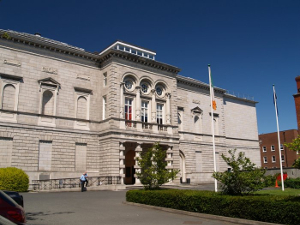
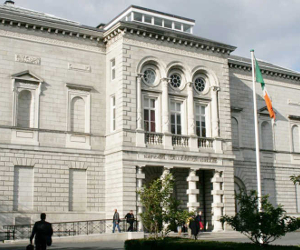
The National Gallery of Ireland, which opens its doors ten years later, houses the national collection of Irish and European art. It is located in the centre of Dublin with one entrance on Merrion Square, beside Leinster House, and another on Clare Street. The Gallery has an extensive, representative collection of Irish painting and is also notable for its Italian Baroque and Dutch masters painting.

The façade of the National Gallery copies the Natural History building of the National Museum of Ireland which is already planned for the facing flank of Leinster House. The building itself is designed by Francis Fowke, based on early plans by Charles Lanyon.

The Gallery is unlucky not to have been founded around an existing collection, but through diligent and skillful purchase, by the time it opens it has 125 paintings. In 1866 an annual purchase grant is established and by 1891 space is already limited. In 1897, the Dowager Countess of Milltown indicates her intention of donating the contents of Russborough House to the Gallery. This gift includes about 223 paintings, 48 pieces of sculpture, 33 engravings, much silver, furniture and a library, and prompts construction from 1899 to 1903 of what is now called the Milltown Wing, designed by Thomas Newenham Deane.

At around this time Henry Vaughan leaves 31 watercolours by J.M.W. Turner with the requirement that they can only be exhibited in January, this to protect them from the ill-effects of sunlight. Though modern lighting technology has made this stipulation unnecessary, the Gallery continues to restrict viewing of the Vaughan bequest to January and the exhibition is treated as something of an occasion.

Another substantial bequest comes with the untimely death in the sinking of the RMS Lusitania of Hugh Lane (1875–1915), since 1914 director of the Gallery. Not only does he leave a large collection of pictures, but he also leaves part of his residual estate, and the Lane Fund has continued to contribute to the purchase of art works to this day. In addition to his involvement in the Gallery, Hugh Lane has also hoped to found a gallery of modern art, something only realised after his death in Dublin City Gallery The Hugh Lane. George Bernard Shaw also makes a substantial bequest, leaving the Gallery a third of royalties of his estate in gratitude for the time he spent there as a youth.

The Gallery is again extended in 1962 with a new wing designed by Frank DuBerry of the Office of Public Works. This opens in 1968 and is now named the Beit Wing. In 1978 the Gallery receives from the government the paintings given to the nation by Alfred Chester Beatty and in 1987 the Sweeney bequest purchases fourteen works of art including paintings by Pablo Picasso and Jack Butler Yeats. The same year the Gallery is once again given some of the contents of Russborough House when Alfred Beit donates 17 masterpieces, including paintings by Diego Velázquez, Bartolomé Esteban Murillo, Jan Steen, Johannes Vermeer and Henry Raeburn.

In the 1990s a lost Caravaggio, The Taking of Christ, known through replicas, is discovered hanging in a Jesuit house of studies in Leeson Street in Dublin by Sergio Benedetti, senior conservator of the gallery. The Jesuits generously allow this painting to be exhibited in the Gallery and the discovery is the cause of national excitement. In 1997 Anne Yeats donates sketchbooks by her uncle Jack Yeats and the Gallery now includes a Yeats Museum. Denis Mahon, a well-known art critic, promises the Gallery part of his rich collection and eight painting from his promised bequest are on permanent display, including Jacob Blessing the Sons of Joseph by Guercino.


Leave a comment

Opening of the National Gallery of Ireland

national-gallery-of-ireland

The National Gallery of Ireland, home of the national collection of Irish and European art, opens on January 30, 1864. It is located in the centre of Dublin with one entrance on Merrion Square, beside Leinster House, and another on Clare Street. The Gallery has an extensive, representative collection of Irish painting and is also notable for its Italian Baroque and Dutch masters painting.

In 1853 an exhibition, the Great Industrial Exhibition, is held on the lawns of Leinster House in Dublin. Among the most popular exhibits is a substantial display of works of art organised and underwritten by the railway magnate William Dargan. The enthusiasm of the visiting crowds demonstrates a public need for art, and it is decided to establish a permanent public art collection as a lasting monument of gratitude to Dargan. The moving spirit behind the proposal is the barrister John Edward Pigot (1822-1871), son of David Richard Pigot, Chief Baron of the Irish Exchequer, and he becomes one of the first Governors of the Gallery. The façade of the National Gallery copies the Natural History building of the National Museum of Ireland which is already planned for the facing flank of Leinster House. The building itself is designed by Francis Fowke, based on early plans by Charles Lanyon.

The Gallery is unlucky not to have been founded around an existing collection, but through diligent and skilful purchase, by the time it opens it has 125 paintings. In 1866 an annual purchase grant is established and by 1891 space is already limited. In 1897, the Dowager Countess of Milltown indicates her intention of donating the contents of Russborough House to the Gallery. This gift includes about 223 paintings, 48 pieces of sculpture, 33 engravings, much silver, furniture, and a library, and prompts construction from 1899 to 1903 of what is now called the Milltown Wing, designed by Thomas Newenham Deane.

At around this time Henry Vaughan leaves 31 watercolours by J.M.W. Turner with the requirement that they can only be exhibited in January, this to protect them from the ill-effects of sunlight. Though modern lighting technology has made this stipulation unnecessary, the Gallery continues to restrict viewing of the Vaughan bequest to January and the exhibition is treated as something of an occasion.

Another substantial bequest comes with the untimely death in the sinking of the RMS Lusitania of Hugh Lane, director of the Gallery since 1914. Not only does he leave a large collection of pictures, but he also leaves part of his residual estate, and the Lane Fund has continued to contribute to the purchase of art works to this day. In addition to his involvement in the Gallery, Lane has also hoped to found a gallery of modern art, something only realised after his death in Dublin City Gallery The Hugh Lane. George Bernard Shaw also makes a substantial bequest, leaving the Gallery a third of royalties of his estate in gratitude for the time he spent there as a youth.

The Gallery is again extended in 1962 with a new wing designed by Frank DuBerry of the Office of Public Works. This opens in 1968 and is now named the Beit Wing. In 1978 the Gallery receives from the government the paintings given to the nation by Chester Beatty and in 1987 the Sweeney bequest brings fourteen works of art including paintings by Pablo Picasso and Jack Butler Yeats. The same year the Gallery is once again given some of the contents of Russborough House when Alfred Beit donates 17 masterpieces, including paintings by Diego Velázquez, Bartolomé Esteban Murillo, Jan Steen, Johannes Vermeer, and Henry Raeburn.

In the 1990s a lost Caravaggio, The Taking of Christ, known through replicas, is discovered hanging in a Jesuit house of studies in Leeson Street in Dublin by Sergio Benedetti, senior conservator of the gallery. The Jesuits generously allow this painting to be exhibited in the Gallery and the discovery is the cause of national excitement. In 1997 Anne Yeats donates sketchbooks by her uncle, Jack Yeats, and the Gallery now includes a Yeats Museum. Denis Mahon, well known art critic, promises the Gallery part of his rich collection and eight paintings from his promised bequest are on permanent display, including Jacob Blessing the Sons of Joseph by Rembrandt.

The collection currently contains about 14,000 artworks, including approximately 2,500 oil paintings, 5,000 drawings, 5,000 prints, and some sculpture, furniture, and other works of art.