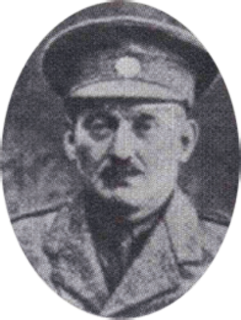
Shanahan is born in Hollyford on October 27, 1874. At some point he moves to Dublin, where he is a licensed vintner, maintaining an Irish pub in the notorious Montored-light district.
Shanahan is involved in the Easter Rising in Dublin in April 1916. This leads to him having legal difficulties over the licence of his public house. He consults the lawyer and politician Tim Healy who comments:
“I had with me today a solicitor with his client, a Dublin publican named Phil Shanahan, whose licence is being opposed, and whose house was closed by the military because he was in Jacob’s during Easter week. I was astonished at the type of man – about 40 years of age, jolly and respectable. He said he ‘rose out’ to have a ‘crack at the English’ and seemed not at all concerned at the question of success or failure. He was a Tipperary hurler in the old days. For such a man to join the Rebellion and sacrifice the splendid trade he enjoyed makes one think there are disinterested Nationalists to be found. I thought a publican was the last man in the world to join a rising! Alfred Byrne, MP, was with him, and is bitter against the Party. I think I can save Shanahan’s property.”
Shanahan is elected for Dublin Harbour at the 1918 United Kingdom general election in Ireland, defeating Alfred Byrne. Like other Sinn Féin MPs, he does not take his seat at Westminster, but becomes a member of the revolutionary Dáil. He represents Dublin Harbour in the First Dáil from 1919 to 1921. He is arrested and detained in custody by the British government in April 1920 but is released in time to attend the next meeting of the Dáil on June 29, 1920.
During the Irish War of Independence, Billy Dunleavy recalls, “The IRA were the best men we ever had at that time. The Tans used to go around in the tenders with a wire over the top and if it was going by up there in Talbot Street they’d (IRA) say, ‘Get out of the way, quick!’ and they’d throw a hand grenade into the car. Now Phil Shanahan, he owned a pub over there on the corner, he was a great man and he used to hide them after they’d been out on a job. He had cellars and all the IRA men used to go there and hide their stuff.”
As a member of the Irish Parliamentary Party (IPP), Harrington represents Westmeath from February 1883 to November 1885. In 1885 he is elected for the new constituency of Dublin Harbour, which he represents until his death. He serves as Lord Mayor of Dublin three times from 1901 to 1904.
Harrington owns two newspapers, United Ireland and the Kerry Sentinel, and is a member of the so-called Bantry band of prominent nationalist politicians from the Bantry vicinity. They are also more pejoratively known as the Pope’s brass band. Tim Healy is another prominent member of this unofficial group.
In 1884, Harrington publishes a pamphlet, “Maamtrasna Massacres – Impeachment of the Trials,” in which he dismantles the Crown Prosecution’s case against the eight men accused of the murders of the Joyce family on August 17, 1882. He provides evidence that Crown Prosecutor George Bolton had deliberately suppressed evidence that would have acquitted Maolra Seoighe (English: Myles Joyce), who was hanged, and four men who were sentenced to twenty years of penal servitude.
Thereafter Harrington becomes excluded from Redmond’s closed circle of confidants, retains sympathy with O’Brien, and represents the interests of the tenant farmers at the 1902 Land Conference negotiations which lead to the enactment of the unprecedented WyndhamLand Purchase (Ireland) Act 1903.
On September 7, 1901, as the Lord Mayor of Dublin, Harrington kicks off at the official ceremony to open Bohemian F.C.‘s new home, Dalymount Park.
Harrington retains the party nomination for the Dublin Harbour constituency in the January 1910 United Kingdom general election, largely because of local divisions about who should succeed him and because an O’Brienite offer to pay his election expenses deters rivals from going to the polls. He decides that the finely balanced result of the general election means that every nationalist vote would be required at Westminster. He therefore travels to London, but shortly after attending the parliamentary party meeting on February 23 he suffers a stroke. After some days’ recuperation he is brought home to Dublin, but his condition deteriorates and he dies on March 12, 1910, at his home, 70 Harcourt Street. He is buried near the Parnell circle at Glasnevin Cemetery.
Harrington is celebrated by a statue erected in 2001 at the east end of Castletownbere near the Millbrook bar.
Shanahan is involved in the Easter Rising in Dublin in April 1916. This leads to him having legal difficulties over the licence of his public house. He consults the lawyer and politician Tim Healy who comments:
“I had with me today a solicitor with his client, a Dublin publican named Phil Shanahan, whose licence is being opposed, and whose house was closed by the military because he was in Jacob’s during Easter week. I was astonished at the type of man – about 40 years of age, jolly and respectable. He said he ‘rose out’ to have a ‘crack at the English’ and seemed not at all concerned at the question of success or failure. He was a Tipperary hurler in the old days. For such a man to join the Rebellion and sacrifice the splendid trade he enjoyed makes one think there are disinterested Nationalists to be found. I thought a publican was the last man in the world to join a rising! Alfred Byrne, MP, was with him, and is bitter against the Party. I think I can save Shanahan’s property.”
Shanahan is elected for Dublin Harbour at the 1918 Irish general election, defeating Alfred Byrne. Like other Sinn Féin MPs, he does not take his seat at Westminster, but becomes a member of the revolutionary Dáil. He represents Dublin Harbour in the First Dáil from 1919 to 1921. He is arrested and detained in custody by the British government in April 1920 but is released in time to attend the next meeting of the Dáil on June 29, 1920.
During the Irish War of Independence, Billy Dunleavy recalls, “The IRA were the best men we ever had at that time. The Tans used to go around in the tenders with a wire over the top and if it was going by up there in Talbot Street they’d (IRA) say, ‘Get out of the way, quick!’ and they’d throw a hand grenade into the car. Now Phil Shanahan, he owned a pub over there on the corner, he was a great man and he used to hide them after they’d been out on a job. He had cellars and all the IRA men used to go there and hide their stuff.”
Byrne is born on March 17, 1882, the second of seven children born to Thomas Byrne, an engineer, and Fanny Dowman. His childhood home is at 36 Seville Place, a terraced house with five rooms just off the North Strand in Dublin. He drops out of school at the age of thirteen and is soon juggling jobs as a grocer’s assistant and a bicycle mechanic. Eventually he uses his savings to buy a pub on Talbot Street. He marries Elizabeth Heagney in 1910.
Byrne becomes an Alderman on Dublin Corporation in 1914. He is a member of the Dublin Port and Docks Board, a significant position for a politician from the Dublin Harbour constituency. In the records of the Oireachtas his occupation is given as company director. He is elected as MP for Dublin Harbour as a candidate of the Irish Parliamentary Party (IPP) in a by-election on October 1, 1915, following the death of William Abraham. The Easter Rising in 1916 is followed by the rapid decline of the Irish Parliamentary Party and the rise of Sinn Féin. At the 1918 Irish general election he is defeated by a Sinn Féin candidate, Philip Shanahan.
Byrne is elected as an Independent TD supporting the Anglo-Irish Treaty for the Dublin Mid constituency at the general election to the Third Dáil in 1922. From 1923 to 1928 he represents Dublin City North. In 1928 he is elected for a six-year term as a member of Seanad Éireann. He vacates his Dáil seat on December 4, 1928. He resigns from the Seanad on December 10, 1931, and returns to the Dáil in 1932. He remains a TD until his death in 1956, representing Dublin City North (1932–37) and Dublin North-East (1937–56). In several elections he secures more votes than any other politician in the country.
Byrne is elected as Lord Mayor of Dublin in 1930, serving in the post for nine consecutive years. When cycling or walking around the city he dispenses lollipops to children, who are often seen chasing him down the street. With a handshake and a few words for all, his eternal canvassing soon earns him the first of his nicknames: the Shaking Hand of Dublin. Married with eight children, he treats the people of Dublin as his second family. Every morning, he finds up to fifty people waiting for him in the Mansion House. None have appointments. All are met. He answers 15,000 letters in his first year as Lord Mayor. Many are from Dubliners looking for a job, a house, some advice or a reference. One morning in 1931 a journalist watches the Lord Mayor attend to his correspondence. Within an hour he accepts “seventeen invitations to public dinners, one invitation to a public entertainment and eight invitations to public functions.” Then he dictates forty-three sympathetic letters to men and women looking for employment.
In 1937, children between the ages of eight and eleven years old are being sentenced to spend up to five years in Industrial Schools. Their crime is stealing a few apples from an orchard. When Byrne says such sentences are “savage,” a judge responds with a defence of the Industrial School system, urging an end to “ridiculous Mansion House mummery.” He stands firm: “For the punishment of trifling offences the home of the children is better than any institution.” In 1938, he is favoured by the press for the presidency of Ireland, a ceremonial role created in the new Constitution, but he is outgunned by the political establishment.
When, in 1935, Byrne becomes the first Lord Mayor of Dublin to visit North America in 40 years, he is granted the freedom of Toronto, and The New York Times hails the arrival of a “champion showman.” He often extends a hand of friendship to Britain. He also improves relations between Dublin, until recently the centre of British authority, and the rest of the country. One night Dublin Fire Brigade gets an urgent call for assistance from Clones, County Monaghan. As Lord Mayor, he feels obliged to join the men on top of the fire engine as they set off on the 85-mile journey in the middle of the night.
In August 1936, Byrne addresses the inaugural meeting of the anti-communistIrish Christian Front, some of whose members later express anti-Semitic views. In 1938, as Lord Mayor, he presents a gift of a replica of the Ardagh Chalice to Italian naval cadets visiting Dublin on board two warships, who had been welcomed by the Irish government despite the protests of Dubliners. A photograph exists of Byrne giving a fascist salute along with Eoin O’Duffy, commander of the Blueshirts, around 1933.
In 1954, Byrne is elected as Lord Mayor for a record tenth time. This time he does not live in the Mansion House, but stays in Rathmines with his family, taking the bus to work each morning. He is just as devoted to the job. When flooding damages 20,000 houses in Fairview and North Strand, he rises from his sick bed to organise a relief fund. His final term as Lord Mayor comes to an end in 1955. Shortly afterwards, Trinity College Dublin awards him an honorary Doctor of Law, describing him as a “champion of the poor and needy, and a friend of all men.”
Byrne dies on March 13, 1956. His funeral is the largest seen in Dublin for many years. TheEvening Herald reports that “Traffic in O’Connell Street was held up for almost 20 minutes to allow the cortege of over 150 motor cars to pass, and at all the junctions along the route to Glasnevin people silently gathered to pay tribute to one of Dublin’s most famous sons.” The members of the Dáil stand and observe a short silence as a mark of respect. A telegram is sent to his widow from the Mayor of New York City, Robert F. Wagner Jr., expressing deepest sympathy, and stating “that Ald. Byrne had attained high office of Lord Mayor many times, but he never lost contact with the poor and the underprivileged, whose champion he was.”
The by-election caused by Byrne’s death, is won by his son, Patrick Byrne. Two other sons, A. P. Byrne and Thomas Byrne, are also TDs for various Dublin constituencies. Alfie Byrne Road in Clontarf is named after him. The Dublin Bay North branch of Young Fine Gael is renamed “Alfie Byrne YFG.”
Two warships, the Rhathemus and the Dee, steam into Dublin Harbour, carrying around 3,000 British troops to ensure the mass rally in favour of Repeal of the Union does not take place. The nationalist newspaper, the Freeman’s Journal, alleges that the troops have been summoned to “cut the people down” and “run riot in the blood of the innocent.”
O’Connell, the charismatic leader of the Repeal Association, has always insisted that his movement is non-violent. On the banning of the meeting and the arrival of troops, he frantically moves to call it off and to prevent “the slaughter of the people.”
Handbills are posted around the streets of Dublin advising his supporters of the meeting’s cancellation. A prominent Dublin builder and O’Connell supporter, Peter Martin, is sent to Clontarf to dismantle the platform erected there. Other activists are sent on horseback to the roads leading into the city to send back the thousands converging on Clontarf for the meeting.
The following day passes without incident. The Freeman’s Journal rages against the “corrupt and impotent Government that has perverted the form of law for the purpose of robbing the people.”
The Warder, a Dublin unionist newspaper, had been urging the suppression of the “plainly illegal under common law” O’Connellite mass meetings for months. The newspaper stops short of calling for civil war in the run–up to the meeting. Now it declares itself satisfied. It congratulates the Conservative government for belatedly seeing sense.
By contrast, the Repeal camp is deeply split. Many, particularly those Young Irelanders grouped around The Nation, blame O’Connell for capitulation to the threat of force and for his unwillingness to confront the British government. They break from him acrimoniously the following year.
With the cancellation of the Clontarf meeting, O’Connell’s strategy of mass mobilisation in pursuit of Irish self government is over. He himself is arrested on charges of “seditious conspiracy” three days later.
(From: “Today in Irish History, The Repeal Meeting at Clontarf is Banned, 8 October 1843, John Dorney, The Irish Story (theirishstory.com), October 8, 2011)



 seamus dubhghaill