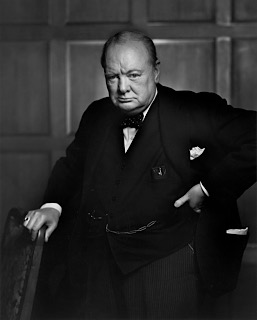
On November 5, 1940, British Prime MinisterWinston Churchill addresses the House of Commons of the United Kingdom to report on Britain’s wartime situation after six months in office. While the speech’s main focus is on the resilience of British cities and the ongoing Battle of Britain, he does note the loss of certain overseas ports, including Irish ones, as part of the broader context of Allied shipping losses and strategic vulnerability, bemoaning the fact that the Irish ports had been returned to the Republic of Ireland government in 1938.
Churchill becomes Prime Minister on May 10, 1940, following the fall of France and the evacuation at Dunkirk. By late November, Britain is engaged in the Battle of Britain, with the Luftwaffe targeting industrial centres and ports across the country. The night before the speech, November 4, is the first night in eight weeks without air raids over London, but the Luftwaffe has shifted focus to other strategic locations.
While the Hansard record for November 5, 1940 does not list Irish ports by name, Churchill’s remarks on shipping losses and the vulnerability of ports are part of his broader assessment of the war’s impact on Britain’s global trade and naval operations. “The fact that we cannot use the South and West Coasts of Ireland to refuel our flotillas and aircraft and thus protect the trade by which Ireland as well as Great Britain lives, is a most heavy and grievous burden and one which should never have been placed on our shoulders, broad though they be.”
Military losses of approximately 300 killed and 500 wounded.
Minimal infrastructure damage to vital services like water, fuel, electricity, and gas.
There are challenges in transportation but they are improving.
Extensive plans are underway for shelters and winter preparations.
The mention of Irish ports in Churchill’s speech underscores the global nature of the war and the strategic importance of Ireland as a neutral but vital Allied base. The loss of such ports would have implications for naval operations, supply routes, and Britain’s ability to sustain its war effort.
To read the full text of Churchill’s November 5, 1940 speech, it is preserved in the National Churchill Museum’s 1940 speeches collection and in the UK Parliament’s Hansard archives.
Remaining active during the interwar years, Dill serves as chief assistant to the commandant of the Staff College (1919–22) before commanding the Welsh Border Brigade, TA (1922–23), and 2nd Infantry Brigade at Aldershot (1923–26). In late 1926, he is appointed army instructor at the newly established Imperial Defence College. A period in India follows as general staff officer of the Western Command (1929–31), based at Quetta. On return to England, he is promoted to major general and made commandant of the Staff College. Appointments as commander of the British forces in Palestine and Transjordan (1936–37) and the Aldershot Command (1937–39) follow. During this period, he shows a remarkable ability to both train and inspire those under his command. Most of his colleagues expect him to become the new chief of the Imperial General Staff and are surprised when Major General Lord Gort, junior to Dill in both rank and seniority, is appointed to the post.
At the outbreak of World War II Dill commands I CorpsBritish Expeditionary Force (BEF) in France and is made a full general. In April 1940, he is made vice-CIGS and in May takes over as CIGS. His initial period in office is not a happy one, and he has to inform the public of setbacks in both Norway and France. His workload is enormous, and after the evacuation at Dunkirk in late May he devotes himself to preparing the defences of Britain against invasion. He clashes with Winston Churchill throughout 1941, advocating a more cautious and realistic approach to the situations in North Africa, Greece, and Crete.
The workload begins to affect his health adversely, and in November 1941 it is announced that he will resign as CIGS on reaching the age of 60 and serve as governor-designate of Bombay with the rank of field marshal. He seeks to be more actively involved in the war effort, however, and in December 1941 he visits the United States with Churchill, remaining there as head of the British joint staff mission in Washington, D.C. He plays a significant role in promoting Anglo–American military cooperation and attends the Casablanca, Quebec, and Tehran conferences.
Dill first marries (1907) Ada Maud Le Mottée, daughter of Col. William Le Mottée of the 18th Regiment. Their son, Major John de Guerin Dill, serves as an artillery officer throughout World War II. In October 1941, Dill marries Nancy Isabelle Charrington, widow of Brigadier Denis Walter Furlong. Dill’s honours include a GCB (1942), an honorary degree from Princeton University (1944), the Howland Memorial Prize of Yale University (1944), and a posthumous Distinguished Service Medal (DSM) from the United States government. There are portraits of him in Cheltenham College and the Imperial War Museum, and a statue in Washington, D.C.
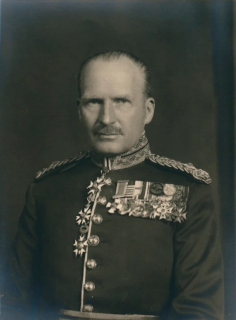
(From: “Dill, Sir John Greer” by David Murphy, Dictionary of Irish Biography, http://www.dib.ie, October 2009 | Pictured: Sir John Greer Dill, bromide print, 1932, by Walter Stoneman, National Portrait Gallery, London)