seamus dubhghaill

Promoting Irish Culture and History from Little Rock, Arkansas, USA


Leave a comment

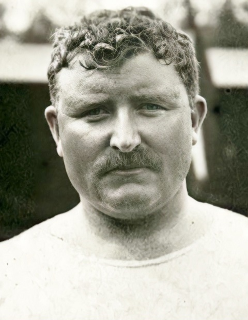
Death of Pat McDonald, Irish American Track & Field Athlete

Patrick Joseph McDonald, Irish American track and field athlete, dies in New York City on May 16, 1954. He is a member of the Irish American Athletic Club and of the New York City Police Department, working as a traffic cop in Times Square for many years. He is also part of a group of Irish American athletes known as the “Irish Whales.”

McDonald was born Patrick Joseph McDonnell in Killard, County Clare, on July 29, 1878. When his sister lands at Ellis Island after her sea voyage from Ireland, immigration officials pin a name tag on her with her name spelled “McDonald.” Taking no chances of being deported, she and all the McDonnells who come after her, accept the name McDonald.

Inspired by the feats of his countrymen John Flanagan, Matt McGrath, and Martin Sheridan, McDonald initially has aspirations of becoming a hammer thrower but shows more aptitude as a shot putter. After placing second to Ralph Rose at the USA Outdoor Track and Field Championships in 1909 and 1910, he takes the title in Rose’s absence in 1911 and defeats Rose at the 1912 championships.

McDonald competes for the United States in the 1912 Summer Olympics held in Stockholm, Sweden, in the shot put where he once again defeats Rose and wins the gold medal. He also takes part in the shot put competition where the distance thrown with each hand is added together. This is the only time this event is held in the Olympic program, and he finishes second behind Rose.

McDonald returns eight years later, after World War I, to compete in the 1920 Summer Olympics in Antwerp, Belgium. Here he wins the gold medal in the 56-lb. weight throw in the second and final time this competition is held in the Olympic program.

McDonald continues to be a nationally competitive athlete well into his 50s. At the age of 54, he beats his old rival Matt McGrath to win the weight throw for distance at the 1933 USA Outdoor Track and Field Championships. It is his 26th senior national championship meet, and the Omaha World-Herald notes that he has gray hair at the time of his last victory.

McDonald dies in New York City at the age of 75 on May 16, 1954. He is interred at Gate of Heaven Cemetery in Hawthorne, New York.

McDonald is inducted into the National Track and Field Hall of Fame in 2012.


Leave a comment

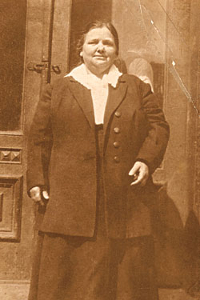
Death of Kathleen Snavely, World’s Oldest Irish-Born Woman

Kathleen Hayes Rollins Snavely, the world’s oldest ever Irish-born woman, dies on July 6, 2015, at the age of 113 years and 140 days in a nursing home in Syracuse, New York, her hometown since leaving Ireland as a 19-year-old immigrant in 1921. Her grandniece attributes her long life to hard work, love, family and the odd Manhattan cocktail.

Born on February 16, 1902, Snavely is the 16th oldest person in the world at the time of her death and the sixth oldest in the United States.

A native of Feakle, County Clare, Snavely is listed on the 1911 Irish Census as an eight-year-old scholar. Her father Patrick (42) is described as an agricultural labourer and there are three other members at her family home: mother Ellen and her sisters Anna May (9) and Lena (1).

A successful businesswoman, Snavely founds and runs a dairy in Syracuse with her first husband, Roxie Rollins. She outlives him by 47 years and her second husband, Jesse Snavely, by 27 years. She also outlives some of her second husband’s children. She has none of her own but has an extended close family.

“She was a pull-yourself-up person,” her grandniece Donna Moore tells The Irish Times. “She came over to a whole new world at 19 and left everything she knew and loved behind.” Asked about the secret of her aunt’s long life, Moore says, “Her spirit, hard work and two good loves – her two wonderful husbands, a wonderful family and maybe the occasional Manhattan.”

Snavely arrives in New York City on September 30, 1921, on the Scythia, from Queenstown, now Cobh, in County Cork, according to the immigration records at Ellis Island, then a hub for new emigrants.

Snavely marries Rollins, a young cook, in 1924 and they open the Seneca Dairy in 1933 during the depths of the Great Depression. She lives through two world wars and eighteen American presidents.

Moore says she and her husband Bruce meet her grandaunt for the last time in April 2015. Still business savvy at the age of 113, Snavely chides her grandniece for not selling another relative’s house more quickly to avoid the costs of holding on to the property. “She yelled at me for not selling the house,” she says. “She always had a laugh.”

Moore says that Snavely continues to check her financial statements on monthly visits from her lawyer right up to her death. “She was a wonderful lady, sharp as a tack,” she says. “She was very quick-witted and a very nice, very caring person. Everybody liked her. She just had a way about her. It is the end of an era in our family.”

(From: “Oldest Irish person Kathleen Snavely dies a 113” by Simon Carswell, The Irish Times, http://www.irishtimes.com, July 7, 2015)


Leave a comment

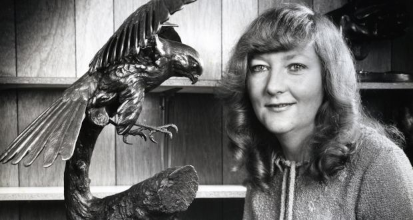
Death of Jeanne Rynhart, Sculptor & Creator of the Molly Malone Statue

Jeanne Patricia Rynhart (nee Scuffil), Irish sculptor and creator of the Molly Malone statue, dies in Cork, County Cork, on June 9, 2020.

Rynhart is born Jeanne Scuffil in Dublin on March 17, 1946, to Kathleen Connolly and Frederick Scuffil, a sign writer for the Guinness Brewery. She is an apprentice to George Collie RHA for two years and then attends the National College of Art and Design, graduating in 1969 before moving to Coventry, England, where she continues her studies in fine art and sets up a studio with sculptor John Letts. She returns to Ireland in 1981, moving to Ballylickey, near Bantry in County Cork, where she establishes the Rynhart Fine Art gallery and workshop with her husband, Derek.

One of the first bronze craft studios in Ireland, the Rynhart pieces include both small figurative cold cast bronze sculptures of flower sellers, fishermen, horses, sailing boats and musical instruments as well as bronze life-size statues, smelted in a foundry. Her busts of Oscar Wilde and Jonathan Swift are in the Dublin Writers Museum and a Rynhart bust of James Joyce is in New York Public Library.

Rynhart creates the Molly Malone statue for the 1988 Dublin Millennium celebrations. The statue is controversial at the time of its unveiling due to the statue’s revealing dress. Registrar of Aosdána, Adrian Munnelly, writes to the An Bord Fáilte criticising it. The statue is defended by the Lord Mayor of Dublin Ben Briscoe. Rynhart herself writes in The Irish Times that the clothing and appearance are accurate for women of that era. The statue has since become one of the most popular tourist attractions in Dublin and is fondly regarded by locals.

Rynhart also sculpts a statue commemorating the original Rose of Tralee, Mary O’Connor, which stands in Tralee Town Park. In 1993, she produces two statues in honour of Annie Moore, the first passenger processed through the Ellis Island immigration station on January 1, 1892. The statues are located at the Cobh Heritage Centre in Cork and Ellis Island in New York City. The Ellis Island statue is dedicated by the then-President of Ireland, Mary Robinson.

In 1994, Rynhart’s daughter Audrey joins the business. In 2010, Audrey and her husband, Les Elliott, take over the running of the business which is now based in their studio in Glengarriff, County Cork. From then onwards, Rynhart continues to do some modelling work but has largely retired.

Rynhart dies on June 9, 2020, aged 74, in Schull Community Hospital, Cork, following a short illness. She is buried in the Abbey Cemetery, Bantry, and is survived by her husband, Derek, daughter, Audrey, son, Barry, and grandchildren, Lydia and Sophie.


Leave a comment

Annie Moore Becomes First Immigrant Processed Through Ellis Island

On January 1, 1892, Annie Moore, a 15-year-old Irish émigré from County Cork, becomes the first immigrant to the United States to pass through federal immigrant inspection at the Ellis Island station in New York Harbor.

Over 12 million immigrants are processed at the station that eventually closes in 1954. Third class and steerage passengers are processed at the Ellis Island station. First- and Second-class passengers are generally processed on the boats they arrive on as they are seen to be of lesser “risk.”

Moore arrives from County Cork aboard the Guion Line steamship Nevada in 1892. Her brothers, Anthony and Philip, who journey with her, have just turned 15 and 12, respectively. As the first person to pass inspection at the newly opened facility, she is presented with an American $10 gold piece from an American official.

Moore’s parents, Matthew and Julia, had come to the United States in 1888 and were living at 32 Monroe Street in Manhattan. Annie marries a son of German Catholic immigrants, Joseph Augustus Schayer (1876-1960), a salesman at Manhattan’s Fulton Fish Market, with whom she has eleven children, five of whom survive to adulthood. The rest all die before the age of three.

Moore dies of heart failure on December 6, 1924, at age 47 and is buried in Calvary Cemetery, Queens. Her previously unmarked grave is identified in August 2006. On October 11, 2008, a dedication ceremony is held at Calvary which celebrates the unveiling of a marker for her grave, a Celtic cross made of Irish blue limestone.

A woman named “Annie Moore” who died near Fort Worth, Texas, in 1924 had long been thought to be the one whose arrival marked the beginning of Ellis Island. Further research, however, establishes that the Annie Moore in Texas was born in Illinois.

The Irish American Cultural Institute presents an annual Annie Moore Award “to an individual who has made significant contributions to the Irish and/or Irish American community and legacy.” She is also honored by two statues sculpted by Jeanne Rynhart. One stands at Cobh Heritage Centre (formerly Queenstown), her port of departure, and another at Ellis Island, her port of arrival. The image is meant to represent the millions who pass through Ellis Island in pursuit of the American dream.

(Pictured: Statue of Annie Moore and her brothers on the quayside in Cobh, County Cork)


Leave a comment

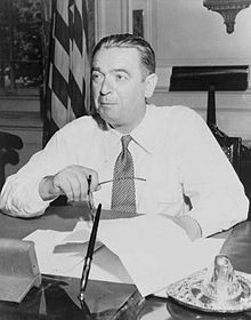
Birth of William O’Dwyer, 100th Mayor of New York City

william-o-dwyer

William O’Dwyer, Irish American politician and diplomat who serves as the 100th Mayor of New York City, holding that office from 1946 to 1950, is born in Bohola, County Mayo on July 11, 1890.

O’Dwyer studies at St. Nathy’s College, Ballaghaderreen, County Roscommon. He emigrates to the United States in 1910, after abandoning studies for the priesthood. He sails to New York City as a steerage passenger on board the liner Philadelphia and is inspected at Ellis Island on June 27, 1910. He first works as a laborer, then as a New York City police officer, while studying law at night at Fordham University Law School. He receives his degree in 1923 and then builds a successful practice before serving as a Kings County (Brooklyn) Court judge. He wins election as the Kings County District Attorney in November 1939 and his prosecution of the organized crime syndicate known as Murder, Inc. makes him a national celebrity.

After losing the mayoral election to Fiorello La Guardia in 1941, O’Dwyer joins the United States Army for World War II, achieving the rank of brigadier general as a member of the Allied Commission for Italy and executive director of the War Refugee Board, for which he receives the Legion of Merit. During that time, he is on leave from his elected position as district attorney and replaced by his chief assistant, Thomas Cradock Hughes, and is re-elected in November 1943.

In 1945, O’Dwyer receives the support of Tammany Hall leader Edward V. Loughlin, wins the Democratic nomination, and then easily wins the mayoral election. He establishes the Office of City Construction Coordinator, appointing Park Commissioner Robert Moses to the post, works to have the permanent home of the United Nations located in Manhattan, presides over the first billion-dollar New York City budget, creates a traffic department and raises the subway fare from five cents to ten cents. In 1948, he receives The Hundred Year Association of New York‘s Gold Medal Award “in recognition of outstanding contributions to the City of New York.” In 1948, he receives the epithets “Whirling Willie” and “Flip-Flop Willie” from U.S. Representative Vito Marcantonio of the opposition American Labor Party while the latter is campaigning for Henry A. Wallace.

Shortly after his re-election to the mayoralty in 1949, O’Dwyer is confronted with a police corruption scandal uncovered by the Kings County District Attorney, Miles McDonald. O’Dwyer resigns from office on August 31, 1950. Upon his resignation, he is given a ticker tape parade up Broadway‘s Canyon of Heroes in the borough of Manhattan. President Harry Truman appoints him U.S. Ambassador to Mexico. He returns to New York City in 1951 to answer questions concerning his association with organized crime figures and the accusations follow him for the rest of his life. He resigns as ambassador on December 6, 1952, but remains in Mexico until 1960.

O’Dwyer visits Israel for 34 days in 1951 on behalf of his Jewish constituents. Along with New York’s Jewish community, he helps organize the first Israel Day Parade.

William O’Dwyer dies in New York City on November 24, 1964, in Beth Israel Hospital, aged 74, from heart failure. He is interred at Arlington National Cemetery, Section 2, Grave 889-A-RH.


Leave a comment

The Closing of Ellis Island

Ellis Island, the gateway to America, shuts it doors on November 12, 1954, after processing more than 12 million immigrants, including an estimated two million Irish, since opening in 1892. Today, an estimated 40 percent of all Americans can trace their roots through Ellis Island, located in New York Harbor off the New Jersey coast and named for merchant Samuel Ellis, who owned the land in the 1770s.

On January 2, 1892, 15-year-old Annie Moore, from County Cork, becomes the first person to pass through the newly opened Ellis Island, which President Benjamin Harrison designates as America’s first federal immigration center in 1890. Prior to the opening of Ellis Island the processing of immigrants has been handled by individual states.

Not all immigrants who sail into New York have to go through Ellis Island. First- and second-class passengers submit to a brief shipboard inspection and then disembarked at the piers in New York or New Jersey, where they pass through customs. People in third class, though, are transported to Ellis Island, where they undergo medical and legal inspections to ensure they do not have a contagious disease or some condition that might make them a burden to the government. Only two percent of all immigrants are denied entrance into the United States.

Immigration to Ellis Island peaks between 1892 and 1924, during which time the 3.3-acre island is enlarged with landfill and additional buildings are constructed to handle the massive influx of immigrants. During the busiest year of operation, 1907, over 1 million people are processed at Ellis Island.

With the United States’ entrance into World War I, immigration declines and Ellis Island is used as a detention center for suspected enemies. Following the war, Congress passes quota laws and the Immigration Act of 1924, which sharply reduces the number of newcomers allowed into the country and also enables immigrants to be processed at U.S. consulates abroad. After 1924, Ellis Island switches from a processing center to serving other purposes, such as a detention and deportation center for illegal immigrants, a hospital for wounded soldiers during World War II and a Coast Guard training center. In November 1954, the last detainee, a Norwegian merchant seaman, is released and Ellis Island officially closes.

Beginning in 1984, Ellis Island undergoes a $160 million renovation, the largest historic restoration project in U.S. history. In September 1990, the Ellis Island Immigration Museum opens to the public and today is visited by almost 2 million people every year.


Leave a comment

Annie Moore Departs Queenstown for the United States

annie-moore

Fifteen-year-old Annie Moore departs Queenstown, now Cobh, County Cork, on December 20, 1891, and becomes the first immigrant to the United States to pass through the Ellis Island facility in New York Harbor.

Her parents, Matthew and Julia Moore, had come to the United States in 1888 and are living at 32 Monroe Street in Manhattan. Moore departs from Queenstown aboard the S.S. Nevada, one of 148 steerage passengers. Accompanied by her brothers, Anthony and Philip, she spends twelve days at sea, including Christmas Day, arriving in New York City on Thursday evening, December 31. It is reported that her arrival is on her 15th birthday, but records in Ireland reveal that her birthday is in May, and she is actually seventeen.

Ellis Island officially opens on January 1, 1892, and, as the first person to be processed at the newly opened facility, Moore is presented with an American $10 gold piece from an American official. All three children are soon reunited with their parents in New York. From 1820 to 1920, more than 4 million people leave their native shores of Ireland bound for the Port of New York and a new life in America.

Moore marries a son of German immigrants, Joseph Augustus Schayer, an employee at Manhattan’s Fulton Fish Market, with whom she has at least eleven children. She dies of heart failure on December 6, 1924, and is buried in Calvary Cemetery, Queens. Her previously unmarked grave is identified in August 2006. On October 11, 2008, a dedication ceremony is held at Calvary which celebrates the unveiling of a marker for her grave, a Celtic cross made of Irish Blue Limestone.

The Irish American Cultural Institute presents an annual Annie Moore Award “to an individual who has made significant contributions to the Irish and/or Irish American community and legacy.” Moore’s story is told in the song “Isle of Hope, Isle of Tears,” written by Brendan Graham. The song has been performed by Ronan Tynan and by The Irish Tenors, of which Tynan was formerly a member. Other artists performing the song include Seán Keane, Sean & Dolores Keane, Daniel O’Donnell, Celtic Thunder, Irish tenor Brian Dunphy, Celtic Woman, and Tommy Fleming.

A woman named “Annie Moore” who died near Fort Worth, Texas in 1924 had long been thought to be the one whose arrival marked the beginning of Ellis Island. Further research, however, established that the Annie Moore in Texas was born in Illinois.