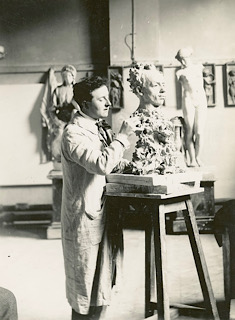
Power is born to Henry Power, a watchmaker, and Mary (née Atkins), an embroideress. He has one older brother, and one younger sister. He attends a Christian Brothersnational school in North Brunswick Street. As a child he plays in local clay brickyards and sculpts busts of his friends. After finishing his primary school education, he trains with a firm of sculptors run by Edward Smyth. In 1884, he enrolls as an evening pupil at the Dublin Metropolitan School of Art (DMSA), later attending as a full-time student from 1906 to 1911. During his time at the DMSA he is taught and strongly influenced by John Hughes, Oliver Sheppard and William Orpen. He wins a number of prizes during his time at the DMSA, including medals, three scholarships, book prizes, and the national gold medal for the best modeling of a nude figure, in Ireland, Scotland, and the Channel Islands in 1911.
Power marries Agnes Kelly in 1903. The couple has ten children, four daughters and six sons, including May and James who also become sculptors.
Power establishes his own stone-carving business in 1912 from his new home at 18 Geraldine Street, Phibsborough, Dublin. As the firm grows, it moves to premises nearby at 15 Berkeley Street from 1930. He executes a wide range of works, including monuments and architectural features in bronze, marble, and stone. Among his notable works are the figure of “Science” designed by Sheppard from the façade of the new Royal College of Science for Ireland (later Government Buildings) on Merrion Street, Dublin, carved motifs and sphinxes for the Gresham Hotel, O’Connell Street, and four statues on the dome of Christ the King church, Carndonagh, County Donegal.
Power is considered the leading Irish sculptor of the 1920s and 1930s. He is a nationalist and promotes the use of Irish materials such as limestone from Durrow and Connemara marble. He is noted for his academic realist style. He exhibits regularly with the Royal Hibernian Academy from 1906, becoming an associate member in 1911, and a full member in 1919. Among those he models sculptures for are James Stephens (1913), W. B. Yeats (1918), and Lord Dunsany (1920). Among his patrons are Oliver St. John Gogarty, and through Gogarty he is commissioned to model a number of prominent Irish nationalists. Gogarty asks him to carve a portrait of Terence MacSwiney in 1920, while MacSwiney is on hunger strike in HM Prison Brixton, London. Smuggled into the prison to do a thumbnail sketch, Power then carves a portrait in the form of a life mask.
On Gogarty’s recommendation, Power is commissioned by the Irish Free State government to create portraits of a number of leading politicians including Arthur Griffith (1922), Michael Collins (1936), and Austin Stack (1939). He is also privately commissioned to execute a portrait of Éamon de Valera in 1944. Among his monumental works are sculptures of Tom Kettle (1919) at St. Stephen’s Green, Dublin, Christ the King in Gort, County Galway, (1933), Pádraic Ó Conaire (1935) at Eyre Square, Galway, and W. B. Yeats (1939) at Sandymount Green, Dublin. He is one of the artists invited to submit designs for the new coinage of the Irish Free State in 1928.
Power dies in Dublin on July 10, 1945, following complications from a double hernia. His is buried in Glasnevin Cemetery, Dublin.
Hayes-McCoy is born to Thomas Hayes-McCoy and Mary Kathleen Hayes-McCoy (née Wallace). His grandfather, Thomas Hayes-McCoy, is a Dubliner who as a child came to Galway in 1834 and is later a well-known Parnellite. His maternal grandfather, Thomas Burke, is a Galway artist. He grows up on Eyre Square where his father runs a gentleman’s hairdressing business. His two older siblings are Ignatius and Marguerite. The latter receives a PhD-degree in History at University College Galway (UCG), and later teaches at the Galway Technical School.
Hayes-McCoy receives his early education from the Patrician Brothers, Galway. His earliest notebook of 1927 and a manuscript history of Poland of the same year, now at the National Library of Ireland (NLI), testify to an early interest in history and heritage. From 1928 to 1932 he is a student scholarship holder at University College Galway, graduating in 1932 with a Bachelor of Commerce, and a Bachelor of Arts, with first-class honours in both, and a specialisation in “History, Ethics, Politics” for the latter. Mary Donovan O’Sullivan is one of his professors of history, and Liam Ó Briain, professor of Romance languages, is a stimulating influence. At this time, Hayes-McCoy is a member of the Republican Club, a committee member of the Literary and Debating Society, and in 1931 he is one of the founding members of a new Irish Students’ Association.
Hayes-McCoy pursues his PhD at the University of Edinburgh, and then spends two years at the Institute of Historical Research, London, in the Tudor seminar of J. E. Neale, rewriting his PhD and eventually publishing it as Scots mercenary forces in Ireland, 1565–1603 (Dublin and London, 1937), with a foreword by Eoin MacNeill. This is characterised by meticulous archival research, and it anticipates by sixty years the much-vaunted New British History of the late twentieth century by tracing the interconnections between events in England, Ireland, and Scotland.
In the absence of an academic post, Hayes-McCoy becomes an assistant keeper in the Art and Industrial Division at the National Museum of Ireland (1939–1959), with a responsibility for the Military History, and the Irish War of Independence collections. One of his first tasks is to prepare a standing exhibition on Irish history before 1916. His research, long-standing personal interest in the military, and his curatorial experience, helps form an expert knowledge of historical Irish warfare. This leads to his role in co-founding The Military History Society of Ireland in 1949 whose journal, The Irish Sword, he edits. He describes the vagaries of setting up such a body, its reception, and the historiographical considerations attendant on it, in a paper published posthumously in The Irish Sword.
On August 19, 1941, Hayes-McCoy marries Mary Margaret “May” O’Connor, daughter of C.J. and M.B. O’Connor of New Ross/Enniscorthy. They have three daughters and two sons: Mary, Ann, Ian, Robert, Felicity. The family home is in Dublin.
Earning high reputation by continued research and by publishing leads to Hayes-McCoy’s receipt of the D.Litt. degree from the National University, and to his membership in the Royal Irish Academy in 1950. In his professional career, apart from the broad spectrum of press publications, he publishes prolifically. The works that are judged most influential, are his Scots mercenary forces in Ireland 1565–1603 (1937), the papers “The early history of guns in Ireland” (1938–1939), “Strategy and tactics in Irish warfare, 1593–1601” (1941), “The army of Ulster, 1593–1601” (1951), the controversial “Gaelic society in Ireland in the late sixteenth century” (1963), and the monographs “Irish battles” (London 1969), and “A history of Irish flags from earliest times” (Dublin 1979). A member of the Irish Manuscripts Commission, his most notable contribution is the publication “Ulster and other Irish maps, c.1600” (Dublin 1964).
In 1946, Hayes-McCoy is appointed to a committee of eight historians to advise on setting up the Bureau of Military History, a body established for the creation and compilation of material on the history of the Irish movements for independence, 1913–1921, specifically from witness statements. The committee is also to further offer guidance and oversee progress of the Bureau in coordination with the Ministry of Defence. It subsequently expresses concerns about the state’s role and methods in the collection of statements.
Having begun writing for the press at an early stage, Hayes-McCoy’s public position at the Museum encourages him to go further. He has broad involvement with local history groups to whom he presents papers, and also works for newspapers and for radio and television. To the national and Galway press he usually contributes articles on military aspects of Irish history, as well as book reviews, but he also uses them as a platform to engage with what he sees are flaws in the education of history in Ireland which during his lifetime is constrained by a certain degree of political and cultural state control.
During the 1940s and 1950s, Hayes-McCoy becomes involved in a number of paratheatrical events of national significance one of which – the “Pageant of St.Patrick” for which he writes the script (An Tóstal 1954) – is realised on an immense scale. He scripts these works to begin with and is later principally engaged as historical consultant. In that capacity, he collaborates in 1955 and 1956 with Micheál Mac Liammóir and Denis Johnston on their scripts for pageants on St. Patrick and on the Táin Bó Cuailgne, at times finding it difficult to square the historical liberties taken by these artists with his own role.
On Irish radio and television Hayes-McCoy is most active in the mid-1960s, editing and contributing to Thomas Davis lectures series, writing scripts for a series of thirty children’s programmes on all aspects of Irish history, and preparing/contributing on air to the television series “Irish battles” and “The long winter.” As well as writing for RTÉ, Ireland’s national broadcaster, he contributes scripts to BBC Northern Ireland‘s schools radio programmes.
In 1959, Hayes-McCoy succeeds to the chair of his former history professor at UCG with the full remit of lecturing, administering examinations to undergraduates, and supervising postgraduate theses. Among his students who continue in the field of history are Nicholas Canny, Martin Coen, Patrick Melvin, Peter Toner, Tony Claffey, and Breandán Ó Bric. After his appointment to UCG, the family home remains in Dublin, and he commutes to Galway weekly during term time.
In the early 1960s, Hayes-McCoy becomes a spokesperson for the movement rekindled by the Old Galway Society to preserve the landmark “Lion’s Tower” in the city. The ultimate failure of the campaign informs his regret, expressed a year later, that Ireland is forgetful about its past and that “we don’t bother to find out about it or to maintain our ancient heritage,” and, on a perceived spirit of conformity, “take my own city of Galway, it is now more prosperous than it was, but it is no longer distinctive. I do not believe that it is essential for progress that we should lose our heritage.”
While at one time member and secretary of the London Sinn Féin office and informed by a pride of country and place, Hayes-McCoy’s professional and private outlook are marked by a distrust of nationalism or of any antagonising national agendas compromising genuine scholarship. In a paper drafted on tendencies in modern historical studies, he criticises the two historiographical extremes, each to be avoided, each unfortunately characteristic of the moment – extreme de-bunking and extreme “adding for effect.” “A history is a record of fact; to add pseudo-facts is as grave a sin as to leave out real facts that may change the colour of the whole.”
Hayes-McCoy’s abiding pastime is drawing. Among his papers in the James Hardiman Library, NUI Galway are approximately 40 items with predominantly maritime subjects, and he has a special regard for the history of ships, and a romantic liking of the sea. He also has a lifelong interest in Robert Louis Stevenson, Sir Walter Scott, and their works, and in the Pre-Raphaelite movement.
Hayes-McCoy’s middle age is marked by intermittent ill health. He dies on November 27, 1975, in his room at the Great Southern Hotel, Eyre Square, Galway.
Hayes-McCoy’s papers are held at the James Hardiman Library, National University of Ireland, Galway.
Pádraic Ó Conaire, Irish writer and journalist whose production is primarily in the Irish language, dies in Dublin on October 6, 1928. In his lifetime he writes 26 books, 473 stories, 237 essays and 6 plays. His acclaimed novel Deoraíocht has been described by Angela Bourke as “the earliest example of modernist fiction in Irish.”
Ó Conaire is born in the Lobster Pot public house on the New Docks in Galway, County Galway, on February 28, 1882. His father is a publican, who owns two premises in the town., and his mother is Kate McDonagh. He is orphaned by the age of eleven. He spends a period living with his uncle in Gairfean, Ros Muc, Connemara. The area is in the Gaeltacht (Irish-speaking area) and Ó Conaire learns to speak Irish fluently.
Ó Conaire emigrates to London in 1899 where he gets a job with the Board of Education and becomes involved in the work of the Gaelic League. A pioneer in the Gaelic revival in the last century, he and Pádraig Pearse are regarded as being the two most important Irish language short story writers during the first decades of the 20th century.
Ó Conaire marries Molly Ní Mhanais, with whom he has four children: Eileen (b. 22 Feb 1905), Patrick (b. 3 Nov 1906), Kathleen (b. 24 Feb 1909), and Mary Josephine (b. 28 Jul 1911), who dies of diphtheria in 1922.
Ó Conaire returns to Ireland in 1914, leaving his family in London. Living mostly in Galway, he earns a meagre living through writing, teaching at Gaeltacht summer schools, and as an occasional organiser for the Gaelic League.
Ó Conaire dies at the age of 46 on October 6, 1928, while on a visit to Dublin, after complaining of internal pains while at the head office of the Gaelic League. His fellow poet Frederick Robert Higgins writes a celebrated Lament for Pádraic Ó Conaire.
Ó Conaire has family still living to this day in England, as well as in Galway and Canada. The Ó Conaire surname is still strong in the Ros Muc area.
Ó Conaire’s short story M’asal Beag Dubh is the inspiration for an Internet-based satire on the football transfer market. The fictitious character Masal Bugduv is created. The name sounds similar to the Gaelic pronunciation of M’asal Beag Dubh. Journalists who did not fact check quite as thoroughly as they should have missed the satire and tell the world of the up-and-coming Moldovan star.
A statue of Ó Conaire’s is unveiled in 1935 by Éamon de Valera in Eyre Square in the heart of Galway City. It is popular with tourists until it is decapitated by four men in 1999. It is repaired at a cost of £50,000 and moved to Galway City Museum in 2004. A bronze replica of the statue is unveiled in Eyre Square in November 2017.
Mellows is born at Hartshead Military Barracks, Ashton-Under-Lyne, Lancashire, England, to William Joseph Mellows, a British Armynon-commissioned officer, and Sarah Jordan, of Inch, County Wexford. His family moves to 10 Annadale Avenue, Fairview, Dublin, in February 1895 when Sergeant Mellows is transferred there, however Liam remains in Wexford with his grandfather Patrick Jordan due to ill health. He attends the military school in Wellington Barracks in Cork and the Portobello garrison school in Dublin but ultimately refuses a military career much to his father’s disappointment, instead working as a clerk in several Dublin firms, including the Junior Army & Navy Stores on D’Olier Street.
A nationalist from an early age, Mellows approaches Thomas Clarke, who recruits him to Fianna Éireann, an organisation of young republicans.
Mellows leads roughly 700 Volunteers in abortive attacks on Royal Irish Constabulary stations at Oranmore and Clarinbridge in County Galway and takes over the town of Athenry. However, his men are very badly armed and supplied and they disperse after a week, when British troops and the cruiser HMS Gloucester are sent west to attack them.
After this insurrection fails, Mellows escapes to the United States, where he is arrested and detained without trial in The Tombs in Lower Manhattan, New York, on a charge of attempting to aid the German side in World War I. After his release in 1918, he works with John Devoy and helps to organise Éamon de Valera’s fund-raising visit to America in 1919–1920.
Mellows returns to Ireland to become Irish Republican Army “Director of Supplies” during the Irish War of Independence, responsible for buying arms. At the 1918 general election of December, he is elected to the First Dáil as a Sinn Féin candidate for both East Galway and for North Meath. He considers the Anglo-Irish Treaty as signed to be a betrayal of the Irish Republic. A conference of 9 TDs is deputed to meet privately on January 5, 1922, to resolve the dispute and to achieve a unified front by compromise. The four other anti-Treaty TDs say there is agreement but Mellows does not and is seen thereafter by pro-Treaty TDs as one of their most implacable opponents. The following day the Dáil votes to approve the Treaty by a majority of 64 to 57.
Mellows is one of the more strident TDs on the approach to the Irish Civil War. In June 1922, he and fellow republicans Rory O’Connor, Joe McKelvey and Richard Barrett, among others, enters the Four Courts, which has been occupied by anti-Treaty forces since April. However, they are bombarded by pro-Treaty Free State forces and surrender after two days. Mellows has a chance to escape along with Ernie O’Malley but does not take it. Imprisoned in Mountjoy Gaol, Mellows, O’Connor, McKelvey and Barrett are executed by firing squad on December 8, 1922, in reprisal for the shooting of TD Seán Hales. Mellows is buried in Castletown cemetery, County Wexford, a few miles from Arklow. An annual commemoration ceremony is held at his grave site, in which a wreath is laid by a member of the Liam Mellows Commemoration committee.
Mellows is commemorated by statues in Oranmore and Eyre Square in Galway, in the official name of the Irish Defence Forces army barracks at Renmore and in the naming of Mellows Bridge in Dublin. Mellows Avenue in Arklow is named in his honour. He is also commemorated in the names of two hurling clubs, one in Galway and one in Wexford, and by Unidare RFC in Ballymun and their “Liam Mellows Perpetual Cup.”
“A great natural resource, a fine legal mind, an inspiration to aspiring women, a model of the loving yet autonomous wife, a consistent champion of children and a good soul,” is how the president of National University of Ireland Galway, Dr. Patrick Fottrell, summarises her contribution, quoting from the American writer Letty Cottin Pogrebin.
Dr. Fottrell pays tribute to her work as a lawyer, academic and public servant, and says she has championed the rights of women and children, while also showing a strong commitment to Northern Ireland.
In her speech, delivered to mark the university’s 150th anniversary, Clinton speaks about the continuing quest for peace.
Clinton flies into Shannon Airport early in the morning for her two-day Irish visit. Security is tight, but discreet.
About 100 protesters at the main entrance to NUI Galway miss Clinton’s arrival at the campus, and move to Eyre Square by the time she leaves for Belfast.
However, using megaphones, members of the NO to War campaign, the Socialist Party, several students and representatives of the arts community manage to drown out the Army Band of the 4th Western Brigade as the robed university procession proceeds to the conferring ceremony at Aras na Mac Leinn, performed to 1,000 invited guests.




 seamus dubhghaill