seamus dubhghaill

Promoting Irish Culture and History from Little Rock, Arkansas, USA


Leave a comment

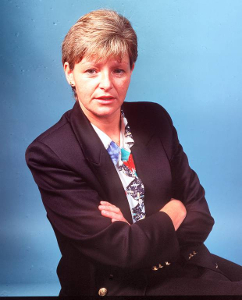
Birth of Crime Reporter Veronica Guerin

Veronica Guerin, Irish crime reporter, is born in Artane, Dublin, on July 5, 1958. Guerin attends Catholic school where she excels in athletics and later studies accountancy at Trinity College, Dublin. She plays for both the Ireland women’s national basketball team and Republic of Ireland women’s national football team, representing the latter in a match against England at Dalymount Park in May 1981.

After she graduates, her father employs her at his company but, following his death three years later, she changes professions and starts a public relations firm in 1983, which she runs for seven years. In 1983–84, she serves as secretary to the Fianna Fáil group at the New Ireland Forum. She serves as Charles Haughey‘s personal assistant, and becomes a family friend, taking holidays with his children. In 1987 she serves as election agent and party treasurer in Dublin North for Seán Haughey.

In 1990, she changes careers again, switching to journalism as a reporter with The Sunday Business Post and Sunday Tribune, working under editor Damien Kiberd. Craving first-hand information, she pursues a story directly to the source with little regard for her personal safety, to engage those she deems central to a story. This allows her to build close relationships with both the legitimate authorities, such as the Garda Síochána, and the criminals, with both sides respecting her diligence by providing highly detailed information. She also reports on Irish Republican Army activities in the Republic of Ireland.

From 1994 onwards, she begins to write about criminals for the Sunday Independent. Using her accountancy knowledge to trace the proceeds of illegal activity, she uses street names or pseudonyms for organized crime figures to avoid Irish libel laws.

When she begins to cover drug dealers, and gains information from convicted drugs criminal John Traynor, she receives numerous death threats. The first violence against her occurs in October 1994, when two shots are fired into her home after her story on murdered crime kingpin Martin Cahill is published. Guerin dismisses the “warning.” The day after writing an article on Gerry “The Monk” Hutch, on January 30, 1995, she answers her doorbell to a man pointing a revolver at her head. The gunman misses and shoots her in the leg. Regardless, she vows to continue her investigations.

On September 13, 1995, convicted criminal John Gilligan, Traynor’s boss, attacks her when she confronts him about his lavish lifestyle with no source of income. He later calls her at home and threatens to kidnap and rape her son and kill her if she writes anything about him.

On the evening of June 25, 1996, Gilligan drug gang members Charles Bowden, Brian Meehan, Kieran ‘Muscles’ Concannon, Peter Mitchell and Paul Ward meet at their distribution premises on the Greenmount Industrial Estate. The following day, while driving her red Opel Calibra, Guerin stops at a red traffic light on the Naas Dual Carriageway near Newlands Cross, on the outskirts of Dublin, unaware she is being followed. She is shot six times, fatally, by one of two men sitting on a motorcycle.

About an hour after Guerin is murdered, a meeting takes place in Moore Street, Dublin, between Bowden, Meehan, and Mitchell. Bowden later denies under oath in court that the purpose of the meeting is the disposal of the weapon but rather that it was an excuse to appear in a public setting to place them away from the incident.

At the time of her murder, Traynor is seeking a High Court order against Guerin to prevent her from publishing a book about his involvement in organised crime. Guerin is killed two days before she is due to speak at a Freedom Forum conference in London.

Guerin’s funeral is attended by Ireland’s Taoiseach John Bruton, and the head of the armed forces. It is covered live by Raidió Teilifís Éireann. On July 4, labour unions across Ireland call for a moment of silence in her memory, which is duly observed by people around the country. Guerin is buried in Dardistown Cemetery, County Dublin.


Leave a comment

Oscar Traynor Leads Anti-Treaty IRA Occupation of O’Connell Street

On June 29, 1922, during the Irish Civil War, Oscar Traynor leads Anti-Treaty members of the Irish Republican Army‘s (IRA) 1st Dublin Brigade to occupy O’Connell Street in order to help the Four Courts garrison. His men also take up positions in York Street, South Circular Road, Capel Street, Parnell Square, and Dolphin’s Barn.

Traynor is an Irish politician and republican born into a strongly nationalist family in Dublin on March 21, 1886. He serves in a number of cabinet positions, most notably as the country’s longest-serving Minister for Defence. He is educated by the Christian Brothers in Dublin. In 1899 he is apprenticed to John Long, a famous woodcarver. As a young man he is a noted footballer and tours Europe as a goalkeeper with Belfast Celtic F.C. whom he plays with from 1910 to 1912.

Traynor joins the Irish Volunteers and takes part in the Easter Rising in 1916, following which he is interned in Wales. During the Irish War of Independence, he is brigadier of the Dublin Brigade of the Irish Republican Army. He leads the attack on The Custom House in 1921 and an ambush on the West Kent Regiment at Claude Road, Drumcondra on June 16, 1921, when the Thompson submachine gun is fired for the first time in action. When the Irish Civil War breaks out in June 1922, Traynor takes the republican side.

The Dublin Brigade is split however, with many of its members following Michael Collins in taking the pro-Treaty side. On June 29, 1922, Traynor and his supporters occupy O’Connell Street in an attempt to help the republicans who have occupied the Four Courts but are under attack by Free State forces. Traynor and his men hold out for a week of street fighting before making their escape. He organises guerilla activity in south Dublin and County Wicklow, before being captured by Free State troops in September. He is then imprisoned for the remainder of the war.

On March 11, 1925, Traynor is elected to Dáil Éireann in a by-election as a Sinn Féin Teachta Dála (TD) for the Dublin North constituency, though he does not take his seat due to the abstentionist policy of Sinn Féin. He is re-elected as one of eight members for Dublin North in the June 1927 Irish general election but just one of six Sinn Féin TDs. Once again, he does not take his seat. He does not contest the second general election called that year but declares his support for Fianna Fáil. He stands again in the 1932 general election and is elected as a Fianna Fáil TD for Dublin North.

In 1936 Traynor is first appointed to the Cabinet as Minister for Posts and Telegraphs. In September 1939 he is appointed Minister for Defence and holds the portfolio until February 1948. In 1948 he becomes President of the Football Association of Ireland, a position he holds until his death. He serves as Minister for Defence in several Fianna Fáil governments and as Minister for Justice, where he is undermined by his junior minister, and later Taoiseach, Charles Haughey, before he retires in 1961.

Oscar Traynor dies on December 15, 1963, in Dublin at the age of seventy-seven. He has a road named in his memory on the Coolock to Santry stretch in North Dublin.

(Pictured: Oscar Traynor in Dublin in July 1922)


Leave a comment

State Funeral for Former Taoiseach Charles J. Haughey

A State funeral is held in Dublin at noon on June 16, 2006, for former Taoiseach Charles J. Haughey followed by burial at St. Fintan’s Cemetery, Sutton, Dublin.

Large crowds turned out for the proceedings including VIP guests, members of the Fianna Fáil party and members of the Oireachtas, who begin arriving at the church at 10:00 AM, although some members of the public begin queuing for a chance to get into the church as early as 8:00 AM. Taoiseach Bertie Ahern, accompanied by his aide-de-camp, arrive at 11:45 AM, followed shortly afterwards by the Lord Mayor of Dublin, Cllr. Catherine Byrne. Many members of the public watch and listen to the service outside the church on loudspeakers and big screens.

Approximately 2,000 people pack into the large church for the two-hour service, which includes contributions from members of Haughey’s family and from the Fianna Fail Teachta Dála (TD) Brian Lenihan, Haughey’s friend P.J. Mara and the poet Brendan Kennelly. The majority of seating in the church is reserved for friends of the Haughey family and members of the public from the Dublin North Central constituency that he represented for nearly 40 years.

The requiem Mass is celebrated by the Archbishop of Dublin, Dr. Diarmuid Martin, and by Haughey’s brother, Fr. Eoghan Haughey, OMI. Minister of State Brian Lenihan, the son of former tánaiste Brian Lenihan, conducts the first reading, while the second reading is delivered by Haughey’s daughter Eimear Mulhern. Members of Haughey’s family, including his son, Ciarán, and old friends such as his former political adviser, P.J. Mara, read prayers. Haughey’s son, Seán, who inherited his father’s seat in Dáil Éireann, gives his personal reflections on his father’s life as does poet Brendan Kennelly near the end of the ceremony.

After the solemn Requiem Mass, the coffin is removed from the church by Military Police pallbearers from the 2nd Military Police Company at Cathal Brugha Barracks, followed by President Mary McAleese and her husband, the immediate Haughey family, the Lord Mayor, the Taoiseach and Tánaiste Mary Harney.

The funeral cortege forms outside the church. Soldiers drawn from the 2nd Eastern Brigade battalion carry the Tricolour and the brigade’s flag, escorted by 24 military cadets from the Curragh Military College. Military Police pallbearers carry the coffin to the graveside, where they remove the Tricolour before the prayer service begins.

Taoiseach Bertie Ahern delivers a graveside oration in which he says Haughey was “blessed with a strong intellect, natural charisma and driving spirit which was to make him the dominant public figure in the late 20th century Ireland.” A Naval Service firing party fires three volleys over the grave, while the Defence Forces‘ Band plays the Last Post and Reveille.


Leave a comment

Erskine Childers Elected Fourth President of Ireland

In a political upset, Erskine Hamilton Childers defeats Tom O’Higgins by a very narrow margin and is elected as the fourth President of Ireland on May 30, 1973.

Incumbent president Éamon de Valera is 90 years old and constitutionally barred from seeking a third term. His party, Fianna Fáil, seeks to get former Tánaiste Frank Aiken to run for the presidency, but he declines. Under pressure, former Tánaiste Erskine H. Childers agrees to run. The odds-on favourite is Fine Gael deputy leader, Tom O’Higgins, who had come within 1% of defeating Éamon de Valera in the 1966 presidential election.

Childers is a controversial nominee, owing not only to his British birth and upbringing but to his Protestantism. However, on the campaign trail his personal popularity proves enormous. In a political upset, Erskine H. Childers wins the presidency by 635,867 votes to 578,771.

Childers, though 67, quickly gains a reputation as a vibrant, extremely hard-working president, and becomes highly popular and respected. However, he has a strained relationship with the incumbent government, led by Taoiseach Liam Cosgrave of Fine Gael. Childers has campaigned on a platform of making the presidency more open and hands-on, which Cosgrave views as a threat to his own agenda as head of government. He refuses to co-operate with Childers’ first priority upon taking office, the establishment of a think tank within Áras an Uachtaráin to plan the country’s future. Childers considers resigning from the presidency, but is convinced to remain by Cosgrave’s Foreign MinisterGarret FitzGerald. However, Childers remains detached from the government. Whereas previously, presidents had been briefed by taoisigh once a month, Cosgrave briefs President Childers and his successor, Cearbhall Ó Dálaigh, on average once every six months.

Though frustrated about the lack of power he has in the office, Childers plays an important behind-the-scenes role in easing the Northern Ireland conflict as former Northern Ireland Prime Minister Terence O’Neill meets secretly with Childers at Áras an Uachtaráin on at least one occasion.

Prevented from transforming the presidency as he desires, Childers instead throws his energy into a busy schedule of official visits and speeches, which is physically taxing. On November 17, 1974, just after making a speech to the Royal College of Physicians in Dublin, Childers suffers a heart attack. He dies the same day at Mater Misericordiae University Hospital.

Childers’s state funeral in St. Patrick’s Cathedral, Dublin, is attended by world leaders including the Earl Mountbatten of Burma (representing Queen Elizabeth II), the Prime Minister of the United Kingdom and leader of the Opposition, and presidents and crowned heads of state from Europe and beyond. He is buried in the grounds of the Church of Ireland Derralossary church in RoundwoodCounty Wicklow.


Leave a comment

First Lady Hillary Clinton Receives Freedom of Galway

First Lady of the United States Hillary Rodham Clinton becomes the first woman to be granted the Freedom of Galway city on May 12, 1999, following in the footsteps of her country’s former presidents, John F. Kennedy and Ronald Reagan. Clinton also receives an honorary doctorate of laws.

“A great natural resource, a fine legal mind, an inspiration to aspiring women, a model of the loving yet autonomous wife, a consistent champion of children and a good soul,” is how the president of National University of Ireland Galway, Dr. Patrick Fottrell, summarises her contribution, quoting from the American writer Letty Cottin Pogrebin.

Dr. Fottrell pays tribute to her work as a lawyer, academic and public servant, and says she has championed the rights of women and children, while also showing a strong commitment to Northern Ireland.

In her speech, delivered to mark the university’s 150th anniversary, Clinton speaks about the continuing quest for peace.

Clinton flies into Shannon Airport early in the morning for her two-day Irish visit. Security is tight, but discreet.

About 100 protesters at the main entrance to NUI Galway miss Clinton’s arrival at the campus, and move to Eyre Square by the time she leaves for Belfast.

However, using megaphones, members of the NO to War campaign, the Socialist Party, several students and representatives of the arts community manage to drown out the Army Band of the 4th Western Brigade as the robed university procession proceeds to the conferring ceremony at Aras na Mac Leinn, performed to 1,000 invited guests.

The protesters, including the film-maker Lelia Doolan, writer Dervla Murphy, poet Rita Ann Higgins, Carol Fox of the Campaign for Nuclear Disarmament, and Micheline Sheehy-Skeffington of NUI Galway, circulate a petition calling on the Government to honour Fianna Fáil‘s election commitment to hold a referendum on membership of Partnership for Peace (PfP).

(From The Irish Times, May 13, 1999)


Leave a comment

Birth of Michael D. Higgins, Ninth President of Ireland

Michael Daniel Higgins, politician, human rights activist, university lecturer, poet, and the ninth and current President of Ireland, is born in LimerickCounty Limerick, on April 18, 1941. He takes office on November 11, 2011, following victory in the 2011 Irish presidential election.

At age five Higgins is separated from his parents, whose struggle to make ends meet is partly the product of his father’s ill health. He is raised in modest means by relatives in County Clare and starts his working life as a clerk in a bank. With a loan from a benefactor, he enters University College Galway, now National University of Ireland, Galway, at age 20 and continues his study with the benefit of scholarships. He serves as president of the student council and becomes involved with the Fianna Fáil party. Under the influence of politician Noël Browne, he soon switches allegiance to socialism and the Labour Party. An unashamed intellectual, Higgins continues his studies at Indiana University Bloomington and the University of Manchester. Before beginning a career in politics, he lectures in sociology and political science at Galway and is a visiting professor at Southern Illinois University Carbondale.

Twice Higgins runs unsuccessfully for a seat in the Dáil Éireann, the lower house of the Oireachtas, before being appointed to Seanad Éireann, the upper house, by Taoiseach Liam Cosgrave in 1973. Higgins is then elected to represent Galway West in the Dáil (1981–82) and serves another term in the Seanad (1983–87), representing the National University of Ireland, before becoming a fixture in the Dáil in the seat for Galway West (1987–2011). He also serves two terms as the mayor of Galway (1982–83, 1991–92). Early on he earns a reputation as a leftist firebrand who opposes participation in coalition government. His radical commitment to human rights and to peace and justice in places such as NicaraguaEl Salvador, and Cambodia, as well as his advocacy of progressive issues such as equal pay for women and the rights of people with disabilities, remain constant, but he mellows over the years to accept coalition rule.

In 1993, in the Fianna Fáil–Labour coalition government led by Albert Reynolds, Higgins becomes the minister for arts, culture, and the Gaeltacht (the districts in which the Irish language and the traditional national culture are best preserved). In that capacity he champions the Irish film industry and is responsible for the creation of the first Irish-language television station, Teilifís na Gaeilge (TG4). A poet who publishes four books of poetry before his election as president, Higgins earns a reputation as an impassioned and eloquent orator in both Irish and English.

By 2003, when he takes over the leadership of the Labour Party, the diminutive Higgins has become something of a national icon, known to most people simply as “Michael D.” He seeks Labour’s nomination for the presidency in 2004 unsuccessfully, but in 2011 he is elected the ninth president of Ireland with some 40 percent of the first-preference votes. In the process he bests heavily favoured independent Seán Gallagher, who stumbles badly in a televised debate just before the election, as well as Martin McGuinness, a former Irish Republican Army (IRA) leader who steps down temporarily as the deputy first minister of Northern Ireland to run.


Leave a comment

Birth of Irish Politician Mary MacSwiney

Mary MacSwiney, Irish politician and educationalist, is born in London on March 27, 1872, to an Irish father and English mother. In 1927, she becomes leader of Sinn Féin when Éamon de Valera resigns from the presidency of the party.

MacSwiney returns to Ireland with her family at the age of six and is educated at St. Angela’s School in Cork. At the age of twenty, she obtains a teaching post at a private school in England and studies for a Teaching Diploma at the University of Cambridge, which is normally reserved for men.

Influenced by her younger brother Terence MacSwiney‘s staunch Irish republicanism, MacSwiney joins the Gaelic League and Inghinidhe na hÉireann. She is a founder member of Cumann na mBan when it is formed in 1914 in Cork and becomes a National Vice-President of the organisation. She leads the denunciation of British rule at the Convention of November 1914. In 1916, she is arrested and imprisoned following the Easter Rising and is also dismissed from her teaching position due to her republican activities. Several months later, upon her release from prison, she and her sister Annie re-found Scoil Íte, a sister school to Patrick Pearse‘s St. Enda’s School, and she remains involved with the school for the rest of her life.

MacSwiney supports the Irish War of Independence in 1919–21. After the death of her brother Terence in October 1920 on hunger strike during the height of the war, she is elected for Sinn Féin to the Cork Borough constituency in 1921. She gives evidence in Washington, D.C., before the American Commission on Conditions in Ireland. For nine months she and Terence’s widow, Muriel, tour the United States lecturing and giving interviews.

MacSwiney is active in her friendship with Harry Boland and de Valera, whom she cultivates assiduously. In October 1921, a second delegation is to be sent to London which for the first time includes Michael Collins. MacSwiney, who remains implacably opposed, pleads with de Valera to be allowed to go. She is refused as de Valera thinks her to be “too extreme.” She strongly opposes the Anglo-Irish Treaty, debating during December 1921 to January 1922 to resume the war. On December 21 she speaks for three hours, criticising the agreement from all angles.

MacSwiney is arrested at Nell Ryan’s home, a safe house, at 40 Herbert Park, Ballsbridge, on November 4, 1922, when it is raided by Free State soldiers. She is interned at Mountjoy Gaol and immediately goes on hunger strike. Cumann na mBan organizes vigils outside the prison in protest of Mary’s and the others internment. The Women’s Prisoner’s Defence League is formed in August 1922 to protect their rights. During the hunger strike she refuses doctor’s visits and is resigned to her death. Her condition is critical, and she is given the Last Rites by a Catholic priest. The Government is not prepared to allow strikers die, so she is released.

En route to Liam Lynch‘s funeral, MacSwiney is again arrested when the car in which she is riding is stopped and she is recognised. She is taken with Kate O’Callaghan to Kilmainham Gaol. Fearless of death, she begins another protest. They continued to be interned without charge, but it is explained she is distributing anti-government propaganda. After nineteen days of hunger strike, she is due to be released on April 30, 1923. The Governor allows O’Callaghan to go but stays a decision on MacSwiney. Most of the women on hunger strike are sent to the North Dublin Union.

MacSwiney retains her seat at the 1923 Irish general election and, along with other Sinn Féin members, refuses to enter the Dáil Éireann.

In March 1926 the party holds its Ardfheis. MacSwiney and Father Michael O’Flanagan lead the section from which Éamon de Valera and Fianna Fáil break away. De Valera has come to believe that abstentionism is not a workable tactic and now sees the need to become the elected government of the Dáil. The conference instructs a joint committee of representatives from the two sections to arrange a basis for co-operation. That day, it issues a statement declaring “the division within our ranks is a division of Republicans.” The next day, de Valera’s motion to accept the Free State Constitution, contingent upon the abolition of the Oath of Allegiance, narrowly fails by a vote of 223 to 218. However, de Valera takes the great majority of Sinn Féin support with him when he founds Fianna Fáil.

MacSwiney continues to maintain a republican position until her death. By then she is vice-president of Sinn Féin and Cumann na mBan but loses her seat at the June 1927 Irish general election. When lack of funds prevents Sinn Féin contesting the second election called that year, MacSwiney declares “no true Irish citizen can vote for any of the other parties.”

Mary MacSwiney dies at her home in Cork on March 8, 1942. Her stance, both before and after the Treaty, may be summed up by her statement, “A rebel is one who opposes lawfully constituted authority and that I have never done.”


Leave a comment

Birth of Brendan Behan, Irish Republican, Poet & Writer

brendan-behan

Brendan Francis Aidan Behan, Irish Republican, poet, short story writer, novelist, and playwright who writes in both English and Irish, is born in Dublin on February 9, 1923.

Behan is widely regarded as one of the greatest Irish writers and poets of all time. He is also an Irish republican and a volunteer in the Irish Republican Army (IRA). Born in Dublin into a staunchly republican family, he becomes a member of the IRA’s youth organisation Fianna Éireann at the age of fourteen. However, there is also a strong emphasis on Irish history and culture in the home, which means he is steeped in literature and patriotic ballads from an early age. Behan eventually joins the IRA at sixteen, which leads to his serving time in a borstal youth prison in the United Kingdom. He is also imprisoned in Ireland. During this time, he takes it upon himself to study and he becomes a fluent speaker of the Irish language. Subsequently released from prison as part of a general amnesty given by the Fianna Fáil government in 1946, Behan moves between homes in Dublin, Kerry, and Connemara, and also resides in Paris for a time.

In 1954, Behan’s first play, The Quare Fellow, is produced in Dublin. It is well received, however, it is the 1956 production at Joan Littlewood‘s Theatre Workshop in Stratford, London, that gains Behan a wider reputation. This is helped by a famous drunken interview on BBC television. In 1958, Behan’s play in the Irish language, An Giall, has its debut at Dublin’s Damer Theatre. Later, The Hostage, Behan’s English-language adaptation of An Giall, meets with great success internationally. Behan’s autobiographical novel, Borstal Boy, is published the same year and becomes a worldwide best-seller.

He marries Beatrice Ffrench-Salkeld in 1955. By early March 1964, after developing diabetes, the end is in sight. Collapsing at the Harbour Lights bar, he is transferred to the Meath Hospital in central Dublin, where he dies at the age 41 on March 20, 1964. He is given an IRA guard of honour, which escorts his coffin. It is described by several newspapers as the biggest funeral since those of Michael Collins and Charles Stewart Parnell.


Leave a comment

First Edition of the “Irish Independent” Printed

irish-independent-first-issue

The first edition of the Irish Independent, flagship publication of Independent News & Media (INM) and Ireland’s largest-selling daily newspaper, is printed on January 2, 1905.

The Irish Independent is formed in 1905 as the direct successor to the Daily Irish Independent, an 1890s pro-Parnellite newspaper, and is launched by William Martin Murphy, a controversial Irish nationalist businessman, staunch anti-Parnellite and fellow townsman of Charles Stewart Parnell‘s most venomous opponent, Bantry’s Timothy Michael Healy.

During the Great Dublin Lockout of 1913, in which Murphy is the leading figure among the employers, the Irish Independent vigorously sides with its owner’s interests, publishing news reports and opinion pieces hostile to the strikers, expressing confidence in the unions’ defeat and launching personal attacks on the leader of the strikers, James Larkin. The Irish Independent describes the 1916 Easter Rising as “insane and criminal” and famously calls for the shooting of its leaders. In December 1919, during the Irish War of Independence, a group of twenty Irish Republican Army (IRA) men destroy the printing works of the paper, angered at its criticism of the IRA’s attacks on members of the Dublin Metropolitan Police and British government officials. In 1924, the traditional nationalist newspaper, the Freeman’s Journal, merges with the Irish Independent. Until October 1986 the paper’s masthead over the editorial contains the words “incorporating the Freeman’s Journal.”

For most of its history, the Irish Independent is seen as a nationalist, Catholic, anti-Communist, newspaper which gives its political allegiance to the Pro-Treaty party Cumann na nGaedheal and later its successor party, Fine Gael. During the Spanish Civil War, the Irish Independent‘s coverage is strongly pro-Franco, and the paper criticizes the De Valera government for not intervening on behalf of the Spanish Nationalists.

In the 1970s, the Irish Independent is taken over by former Heinz chairman Tony O’Reilly. Under his leadership, it becomes a more populist, market liberal newspaper — populist on social issues but economically right-wing. By the mid-nineties its allegiance to Fine Gael has ended. In the 1997 general election, it endorses Fianna Fáil under a front-page editorial entitled “It’s Payback Time.” While it suggests its headline refers to the fact that the election offers a chance to “pay back” politicians for their failings, its opponents suggest that the “payback” actually refers to its chance to get revenge for the refusal of the Rainbow Coalition to award the company a mobile phone licence.

In late 2004, Independent Newspapers moves from their traditional home in Middle Abbey Street to a new office, “Independent House” in Talbot Street, with the printing facilities already relocated to the Citywest business park near Tallaght.

On September 27, 2005, a fortnight after the paper publishes its centenary edition, it is announced that editor Vinnie Doyle will step down after 24 years in the position. He is replaced by Gerry O’Regan, who has until then been editor of the Irish Independent‘s sister paper, the Evening Herald. The newspaper’s previous editor Stephen Rae is also formerly editor of the Evening Herald and is appointed editor in September 2012. Fionnan Sheahan is appointed editor in January 2015.

In January 2008, at the same time as completing the purchase of Today FM, Ireland’s last national radio station independent of Denis O’Brien and state broadcaster RTÉ, O’Brien increases his INM shareholding to become the company’s second-largest shareholder behind Tony O’Reilly. In May 2008, O’Brien ousts O’Reilly and acquires a majority shareholding. Traditionally a broadsheet newspaper, it introduces an additional compact size in 2004 and in December 2012, following O’Brien’s takeover, it is announced that the newspaper will become compact only.

(Pictured: the first edition of the Irish Independent)


Leave a comment

Death of Dan Breen, Irish Patriot & Politician

Irish republican Dan Breen (1967)

Daniel “Dan” Breen, volunteer in the Irish Republican Army during the Irish War of Independence and the Irish Civil War, dies in Dublin on December 27, 1969. In later years, he was a Fianna Fáil politician.

Breen is born in Grange, Donohill parish, County Tipperary, on August 11, 1894. His father dies when he is six, leaving the family very poor. He is educated locally before becoming a plasterer and later a linesman on the Great Southern Railways.

Breen is sworn into the Irish Republican Brotherhood in 1912 and the Irish Volunteers in 1914. On January 21, 1919, the day the First Dáil meets in Dublin, Breen takes part in the Soloheadbeg Ambush. The ambush party of eight men, led by Seán Treacy, attacks two Royal Irish Constabulary (RIC) men who are escorting explosives to a quarry. The two policemen, James McDonnell and Patrick O’Connell, are fatally shot during the incident. The ambush is considered to be the first incident of the Irish War of Independence.

During the conflict, the British put a £1,000 price on Breen’s head, which is later increased to £10,000. He quickly establishes himself as a leader within the Irish Republican Army (IRA). He is known for his courage. On May 13, 1919 he helps rescue his comrade Seán Hogan at gunpoint from a heavily guarded train at Knocklong station in County Limerick. Breen, who is wounded, remembers how the battalion is “vehemently denounced as a cold-blooded assassins” and roundly condemned by the Catholic Church. After the fight, Treacy, Séamus Robinson, and Breen meet Michael Collins in Dublin, where they are told to make themselves scarce although they do not necessarily agree.

Breen and Sean Treacy shoot their way out through a British military cordon in the northern suburb of Drumcondra (Fernside). They escape, only for Treacy to be killed the next day. Breen is shot at least four times, twice in the lung.

The British reaction is to make Tipperary a “Special Military Area,” with curfews and travel permits. Volunteer GHQ authorises entrerprising attacks on barracks. The British policy forces Breen and Treacy to retreat to Dublin. They join Michael Collins’ Squad of assassins, later known as the Dublin Guard, and Dublin becomes the centre of the war.

Breen is present in December 1919 at the ambush in Ashtown beside Phoenix Park in Dublin where Martin Savage is killed while trying to assassinate the Lord Lieutenant of Ireland, Viscount John French. The IRA hides behind hedges and a dungheap as the convoy of vehicles drives past. They have been instructed to ignore the first car but this contains their target, Lord French. Their roadblock fails as a policeman removes the horse and cart intended to stop the car.

Breen utterly rejects the Anglo-Irish Treaty, which makes him, like many others, angry and embittered. In the June 1922 elections Breen is nominated as a candidate by both the pro- and anti-Treaty sides, but is not elected.

Breen is elected to Dáil Éireann at the 1923 general election as a Republican anti-Treaty Teachta Dála (TD) for the Tipperary constituency. Following the Anglo-Irish Treaty, Breen joins the Anti-Treaty IRA in the civil war, fighting against those of his former comrades in arms who support the Treaty. He is arrested by the National Army of the Irish Free State and interned at Limerick Prison. He spends two months there before going on hunger strike for six days followed by a thirst strike of six days, prompting his release.

Breen writes a best-selling account of his guerrilla days, My Fight for Irish Freedom, in 1924. He represents Tipperary from the Fourth Dáil in 1923 as a Republican with Éamon de Valera and Frank Aiken. He is defeated in the June 1927 general election and travels to the United States where he opens a prohibition speakeasy. In 1932 he returns to Ireland and regains his seat as a member of Fianna Fáil in the Dáil at that year’s general election. During World War II he is said to hold largely pro-Axis views. He represents his Tipperary constituency without a break until his retirement at the 1965 election.

Breen dies in Dublin on December 27, 1969 and is buried in Donohill, near his birthplace. His funeral is the largest seen in west Tipperary since that of his close friend and comrade-in-arms Seán Treacy at Kilfeacle in October 1920. An estimated attendance of 10,000 mourners assemble in the tiny hamlet, giving ample testimony to the esteem in which he was held.

Breen is the subject of a 2007 biography Dan Breen and the IRA by Joe Ambrose.