seamus dubhghaill

Promoting Irish Culture and History from Little Rock, Arkansas, USA


Leave a comment

Birth of Cathal Brugha, Revolutionary & Politician

Cathal Brugha, Irish revolutionary and politician, is born in Dublin on July 18, 1874. He is active in the Easter Rising, the Irish War of Independence, and the Irish Civil War and is the first Ceann Comhairle (chairman) of Dáil Éireann as well as the first President of Dáil Éireann, then the title of the chief of government.

Born Charles William St. John Burgess, Brugha is the tenth of fourteen children and is educated at the Jesuit Belvedere College but is forced to leave at the age of sixteen because of the failure of his father’s business.

In 1899 Brugha join the Gaelic League, and he subsequently changes his name from Charles Burgess to Cathal Brugha. He meets his future wife, Kathleen Kingston, at an Irish class in Birr, County Offaly and they marry in 1912. They have six children, five girls and one boy. Brugha becomes actively involved in the Irish Republican Brotherhood (IRB) and in 1913 he becomes a lieutenant in the Irish Volunteers. He leads a group of twenty Volunteers to receive the arms smuggled into Ireland in the Howth gun-running of 1914.

He is second-in-command at the South Dublin Union under Commandant Éamonn Ceannt in the Easter Rising of 1916. On the Thursday of Easter Week, being badly wounded, he is unable to leave when the retreat is ordered. Brugha, weak from loss of blood, continues to fire upon the enemy and is found by Eamonn Ceannt singing “God Save Ireland” with his pistol still in his hands. He is initially not considered likely to survive. He recovers over the next year but is left with a permanent limp.

Brugha is elected speaker of Dáil Éireann at its first meeting on January 21, 1919, and he reads out the Declaration of Independence in Irish, which ratifies “the establishment of the Irish Republic.” On the following day, he is appointed president of the ministry pro tempore. He retains this position until April 1, 1919, when Éamon de Valera takes his place.

In October 1917 Brugha becomes Chief of Staff of the Irish Republican Army and holds that post until March 1919. He is elected as a Sinn Féin MP for the County Waterford constituency at the 1918 general election. In January 1919, Sinn Féin MPs refuse to recognise the Parliament of the United Kingdom and instead assemble at the Mansion House in Dublin as a revolutionary parliament called Dáil Éireann. Due to the absence of Éamon de Valera and Arthur Griffith, Brugha presides over the first meeting of Dáil Éireann on January 21, 1919.

Brugha has differences with Michael Collins, who, although nominally only the IRA’s Director of Intelligence, has far more influence in the organisation as a result of his position as a high-ranking member of the Irish Republican Brotherhood, an organisation that Brugha sees as undermining the power of the Dáil and especially the Ministry for Defence. Brugha opposes the oath of allegiance required for membership of the IRB and, in 1919, his proposition that all Volunteers should swear allegiance to the Irish Republic and the Dáil is adopted.

At a top-level IRA meeting in August 1920, Brugha argues against ambushes of Crown forces unless there is first a call to surrender, but it is dismissed as unrealistic by the brigade commanders present. Brugha also has the idea of moving the front line of the war to England but is opposed by Collins.

On January 7, 1922, Brugha votes against the Anglo-Irish Treaty. During the Treaty debates, he points out that Collins has only a middling rank in the Department of Defence, which supervises the IRA even though Arthur Griffith hails him as “the man who had won the war.” He leaves the Dáil and is replaced as Minister for Defence by Richard Mulcahy.

In the months between the Treaty debates and the outbreak of Civil War, Brugha attempts to dissuade his fellow anti-treaty army leaders including Rory O’Connor, Liam Mellows and Joe McKelvey from taking up arms against the Free State. When the IRA occupies the Four Courts, he and Oscar Traynor call on them to abandon their position. When they refuse, Traynor orders the occupation of the area around O’Connell Street in the hope of easing the pressure on the Four Courts and of forcing the Free State to negotiate.

On June 28, 1922, Brugha is appointed commandant of the forces in O’Connell Street. The outbreak of the Irish Civil War ensues in the first week of July when Free State forces commence shelling of the anti-treaty positions.

Most of the anti-Treaty fighters under Oscar Traynor escape from O’Connell Street when the buildings they are holding catch fire, leaving Brugha in command of a small rearguard. On July 5, he orders his men to surrender but refuses to do so himself. He then approaches the Free State troops, brandishing a revolver. He sustains a bullet wound to the leg which severs a major artery.

Cathal Brugha dies on July 7, 1922, eleven days before his 48th birthday. He has been re-elected as an anti-Treaty Teachta Dála (TD) at the 1922 Irish general election but dies before the Dáil assembles. He is buried in Glasnevin Cemetery.


Leave a comment

Oscar Traynor Leads Anti-Treaty IRA Occupation of O’Connell Street

On June 29, 1922, during the Irish Civil War, Oscar Traynor leads Anti-Treaty members of the Irish Republican Army‘s (IRA) 1st Dublin Brigade to occupy O’Connell Street in order to help the Four Courts garrison. His men also take up positions in York Street, South Circular Road, Capel Street, Parnell Square, and Dolphin’s Barn.

Traynor is an Irish politician and republican born into a strongly nationalist family in Dublin on March 21, 1886. He serves in a number of cabinet positions, most notably as the country’s longest-serving Minister for Defence. He is educated by the Christian Brothers in Dublin. In 1899 he is apprenticed to John Long, a famous woodcarver. As a young man he is a noted footballer and tours Europe as a goalkeeper with Belfast Celtic F.C. whom he plays with from 1910 to 1912.

Traynor joins the Irish Volunteers and takes part in the Easter Rising in 1916, following which he is interned in Wales. During the Irish War of Independence, he is brigadier of the Dublin Brigade of the Irish Republican Army. He leads the attack on The Custom House in 1921 and an ambush on the West Kent Regiment at Claude Road, Drumcondra on June 16, 1921, when the Thompson submachine gun is fired for the first time in action. When the Irish Civil War breaks out in June 1922, Traynor takes the republican side.

The Dublin Brigade is split however, with many of its members following Michael Collins in taking the pro-Treaty side. On June 29, 1922, Traynor and his supporters occupy O’Connell Street in an attempt to help the republicans who have occupied the Four Courts but are under attack by Free State forces. Traynor and his men hold out for a week of street fighting before making their escape. He organises guerilla activity in south Dublin and County Wicklow, before being captured by Free State troops in September. He is then imprisoned for the remainder of the war.

On March 11, 1925, Traynor is elected to Dáil Éireann in a by-election as a Sinn Féin Teachta Dála (TD) for the Dublin North constituency, though he does not take his seat due to the abstentionist policy of Sinn Féin. He is re-elected as one of eight members for Dublin North in the June 1927 Irish general election but just one of six Sinn Féin TDs. Once again, he does not take his seat. He does not contest the second general election called that year but declares his support for Fianna Fáil. He stands again in the 1932 general election and is elected as a Fianna Fáil TD for Dublin North.

In 1936 Traynor is first appointed to the Cabinet as Minister for Posts and Telegraphs. In September 1939 he is appointed Minister for Defence and holds the portfolio until February 1948. In 1948 he becomes President of the Football Association of Ireland, a position he holds until his death. He serves as Minister for Defence in several Fianna Fáil governments and as Minister for Justice, where he is undermined by his junior minister, and later Taoiseach, Charles Haughey, before he retires in 1961.

Oscar Traynor dies on December 15, 1963, in Dublin at the age of seventy-seven. He has a road named in his memory on the Coolock to Santry stretch in North Dublin.

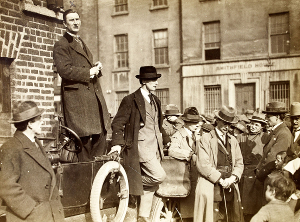
(Pictured: Oscar Traynor in Dublin in July 1922)


1 Comment

Execution of IRA Officer Joe McKelvey

joe-mckelvey

Joe McKelvey, Irish Republican Army (IRA) officer, is executed by firing squad along with three other Anti-Treaty militants, on December 8, 1922, during the Irish Civil War.

McKelvey is born into a nationalist family in Stewartstown, County Tyrone. He has a keen interest in the Gaelic Athletic Association and the Irish language. He studies as an accountant and gains some of the qualifications necessary for this profession, but never fully qualifies. He works for a time at the Income Tax Office on Queen’s Square in Belfast and later finds work in Belfast’s engineering industry with Mackies on Springfield Road. He joins the Irish Republican Brotherhood and the Irish Volunteers, which after 1919, become known as the Irish Republican Army (IRA). He is a founding member of the O’Donovan Rossa Club, Belfast, founded in 1916 on the Falls Road. Each year the club honours him with a juvenile hurling blitz, an invitational competition which is participated in by clubs throughout Ireland.

McKelvey participates in the Irish War of Independence (1919–1921) against the British, in which he commands the IRA’s Belfast Brigade. On August 22, 1920, he helps to organise the killing of Royal Irish Constabulary (RIC) Detective Oswald Swanzy in Lisburn. The killing itself is carried out by IRA men from Cork, but McKelvey arranges a taxi to carry the assassins to and from the scene and disposes of their weapons. In reprisal for this shooting, 300 Catholic homes in Lisburn are burned out. McKelvey is forced to lie low in Dublin for some time after these events.

In March 1921, the IRA is re-organised by its leadership in Dublin into Divisions and McKelvey is appointed commander of the Third Northern Division, responsible for Belfast and the surrounding area. In May 1921, McKelvey’s command suffers a severe setback, when fifty of his best men are sent to County Cavan to train and link up with the IRA units there, only to be surrounded and captured by the British Army on Lappanduff hill on May 9. In most of Ireland, hostilities are ended with a truce declared on July 11, 1921.

McKelvey is alone among the leadership of the Belfast IRA in going against the acceptance of the Anglo-Irish Treaty. Most of his comrades support Michael Collins‘ assurances that, although the Treaty accepts the partition of Northern Ireland from the rest of the country, this is only a temporary concession which will be dealt with later. McKelvey does not accept this. As a result, he leaves his command as head of the IRA Third Northern Division and joins the Anti-Treaty IRA in Dublin.

In March 1922, McKelvey participates in the anti-Treaty IRA‘s repudiation of the authority of the Dáil, the civil government of the Irish Republic declared in 1919, and is elected to the IRA Army Executive. In April 1922 he helps command the occupation of the Four Courts in defiance of the new Irish Free State. This action helps to spark the civil war between pro- and anti-Treaty factions. McKelvey is among the most hardline of the anti-Treaty republicans and briefly, in June 1922, becomes IRA Chief of Staff, replacing Liam Lynch.

On June 28, 1922, the new Irish Free State government shells the Four Courts to assert its authority over the militants defending it. The Republicans in the Four Courts surrender after two days of fighting and McKelvey is captured. He is held for the following five months in Mountjoy Prison in Dublin.

On December 8, 1922, Joe McKelvey is executed by firing squad along with three other Anti-Treaty militants, Rory O’Connor, Liam Mellows, and Richard Barrett. The executions are ordered in reprisal for the Anti-Treaty IRA’s murder of Sean Hales, a Pro-Treaty member of the Third Dáil.


Leave a comment

Cathal Brugha Fatally Wounded by Sniper

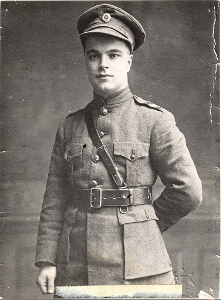
cathal-brugha

Cathal Brugha, a leading figure in the Anti-Treaty Irish Republican Army (IRA), is shot by a sniper on July 5, 1922, as he appears in the doorway of the Hammam Hotel during the Irish Civil War. He dies two days later.

Brugha is born in Dublin of mixed Roman Catholic and Protestant parentage. He is the tenth of fourteen children and is educated at the Jesuit Belvedere College but is forced to leave at the age of sixteen because of the failure of his father’s business.

In 1899, Brugha joins the Gaelic League, and subsequently changes his name from Charles Burgess to Cathal Brugha. He becomes actively involved in the Irish Republican Brotherhood (IRB) and in 1913 he becomes a lieutenant in the Irish Volunteers. He leads a group of twenty Volunteers to receive the arms smuggled into Ireland in the Howth gun-running of 1914.

Brugha is second-in-command at the South Dublin Union under Commandant Éamonn Ceannt in the Easter Rising of 1916. On the Thursday of Easter Week, being badly wounded, he is unable to leave when the retreat is ordered. Brugha, weak from loss of blood, continues to fire upon the enemy and is found by Éamonn Ceannt singing God Save Ireland with his pistol still in his hands. Initially not considered likely to survive, he recovers over the next year but is left with a permanent limp.

During the War of Independence, Brugha organises an amalgamation of the Irish Volunteers and the Irish Citizen Army into the Irish Republican Army (IRA). He proposes a Republican constitution at the 1917 Sinn Féin convention which is unanimously accepted. In October 1917, he becomes Chief of Staff of the Irish Republican Army and holds that post until March 1919.

Brugha is elected speaker of Dáil Éireann at its first meeting on January 21, 1919, and he reads out the Declaration of Independence in Irish. On the following day, he is appointed president of the ministry pro tempore and retains this position until April 1, 1919, when Éamon de Valera takes his place.

In the months between the Anglo-Irish Treaty debates and the outbreak of Civil War, Brugha attempts to dissuade his fellow anti-treaty army leaders, including Rory O’Connor, Liam Mellows, and Joe McKelvey, from taking up arms against the Free State. When the IRA occupies the Four Courts, he and Oscar Traynor call on them to abandon their position. When they refuse, Traynor orders the occupation of the area around O’Connell Street in the hope of easing the pressure on the Four Courts and of forcing the Free State to negotiate.

On 28 June 1922, Brugha is appointed commandant of the forces in O’Connell Street. The outbreak of the Irish Civil War ensues in the first week of July when Free State forces commence shelling of the anti-treaty positions.

Most of the anti-Treaty fighters under Oscar Traynor escape from O’Connell Street when the buildings they were holding catch fire, leaving Brugha in command of a small rearguard. On 5 July, he orders his men to surrender but refuses to do so himself. He then approaches the Free State troops, brandishing a revolver. He sustains a bullet wound to the leg which severs a major artery, ultimately causing him to bleed to death on July 7, 1922, eleven days before his 48th birthday. He is buried in Glasnevin Cemetery.


Leave a comment

Anti-Treaty Forces Abandon The Four Courts

free-state-troops-fire-on-the-four-courtsAnti-Treaty forces abandon The Four Courts in Dublin on June 30, 1922, after two days of bombardment under the orders of Michael Collins.

The occupation of the Four Courts by Anti-Treaty forces in April 1922 makes real the threat of violence that has existed only as a subtext to the treaty debates. That real fighting does not break out until the subsequent decision by the Pro-Treaty forces to forcibly retake the position in June 1922 shows just how reluctant the parties are to engage in more violence.

However, once the decision to fight is made neither side show much restraint. The shelling of the Four Courts and the ferocity of the fighting around the rest of Dublin during the initial phase of the war shows that neither side will balk at killing former friends if that is what is required.

Tragically, on the morning of June 30, a massive explosion destroys the western wing of the Four Courts and the Irish Public Records Office which houses official documents, archives, and artifacts from almost 1,000 years of Irish history. The explosion is thought to have been caused by fires from the artillery bombardment setting off munitions stored there. Free State troops, however, claim that the building is mined.

After two days of heavy fighting that sees the complex more or less destroyed, the Anti-Treaty forces, at this point under the command of Ernie O’Malley after Paddy O’Brien is wounded by shrapnel, surrenders. Their surrender is at the order of the senior commander of Anti-Treaty forces in the city, Oscar Traynor, who sends word that he cannot break through to help them.

They march out of a burning and wrecked Four Courts a compelling symbol for the damage the Civil War is to bring to the young state over the upcoming months and years. Members of the Irish Republican Army (IRA) Army Executive Liam Mellows, Rory O’Connor, Joe McKelvey, and Dick Barret are among the prisoners, but O’Malley himself escapes.


Leave a comment

Executions of Èamonn Ceannt, Michael Mallin, Seán Heuston, & Con Colbert

colbert-ceannt-mallin-heuston

Irish patriots Èamonn Ceannt, Michael Mallin, Seán Heuston, and Cornelius “Con” Colbert are executed by firing squad in the Stonebreakers Yard at Kilmainham Gaol on May 8, 1916, as the executions following the 1916 Easter Rising continue.

Éamonn Ceannt, one of the seven signatories of the Proclamation of the Irish Republic, is born in Ballymoe, Glenamaddy in County Galway in 1881. Prior to the Rising, Ceannt is an employee of the Dublin Corporation. He is a co-founder of the Irish Volunteers, partaking in the successful Howth gun-running operation of 1914. His involvement in republican activities is complemented by his interest in Irish culture, specifically Irish language and history, although he is also an accomplished uilleann piper. Ceannt is appointed Director of Communications of the Provisional Government and is Commandant of the Fourth Battalion of the Irish Volunteers, who are stationed at the South Dublin Union, now the site of St. James’s Hospital. Ceannt has about 100 men with him, including his second-in-command Cathal Brugha, and W.T. Cosgrave who goes on later to become Taoiseach. Ceannt and his men at the South Dublin Union take part in some of the fiercest fighting in the rebellion and hold out against far superior numbers of British troops.

Michael Mallin, a silk weaver by trade, is born in Dublin on December 1, 1874. Mallin is the Chief of Staff of the Irish Citizen Army (ICA), second in command only to James Connolly. He trains and drills the ICA and is the Commandant of the St. Stephen’s Green Royal College of Surgeons garrison during the Rising. Countess Markievicz is his second in command. This location sees less action than some of the other sites chosen by the rebels because the British concentrate their efforts on the most strategically important targets such as the General Post Office (GPO) and Four Courts. Mallin surrenders on April 30.

Seán Heuston, born in Dublin on February 21, 1891, is responsible for the organisation of Fianna Éireann in Limerick. Along with Con Colbert, Heuston is involved in the education of the schoolboys at Scoil Éanna, organising drill and musketry exercises. Heuston is the Officer Commanding of the Volunteers in the Mendicity Institution on the south side of Dublin. With 26 Volunteers under his command, they hold their position for two days. With his position becoming untenable against considerable numbers, and the building almost completely surrounded, Heuston sends a dispatch to Connolly informing him of their position. It is soon after sending this dispatch that Heuston decides to surrender. Heuston Railway Station in Dublin is named after him.

Con Colbert is born on October 19, 1888, at Monalena in Limerick, and is one of the younger generations of Irish republicans who take part in the Easter Rising. Prior to the Easter Rising he is an active member of the republican movement. He is one of the founding members of Fianna Éireann. A dedicated pioneer, Colbert is known not to drink or smoke. During the Rising, Colbert is the commander of a group of Volunteers stationed at Watkin’s Brewery on Ardee Street, and later at Jameson’s Distillery on Marrowbone Lane. They hold their position until receiving the order to surrender from Patrick Pearse.


Leave a comment

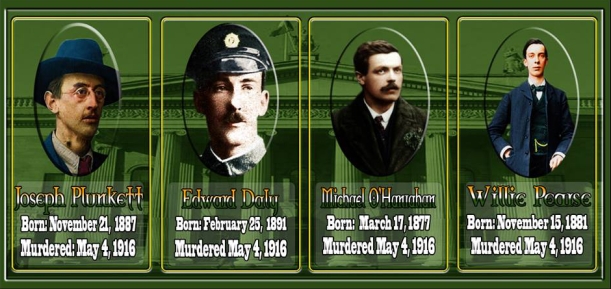
Executions of Edward Daly, Michael O’Hanrahan, Joseph Mary Plunkett, & William Pearse

plunkett-daly-ohanrahan-pearse

The executions of leaders and participants of the 1916 Easter Rising by the British continue as Edward Daly, Michael O’Hanrahan, Joseph Mary Plunkett, and William Pearse are executed by firing squad in the Stonebreakers Yard at Kilmainham Gaol in Dublin on May 4, 1916.

Edward Daly is born in Limerick in 1891 to a family that has a history of republican activity. His uncle, John Daly, had taken part in the rebellion of 1867. Edward Daly leads the First Battalion during the 1916 Easter Rising, which raids the Bridewell and Linenhall Barracks, eventually seizing control of the Four Courts. A close friend of Tom Clarke, their ties are made even stronger by the marriage of Clarke to Daly’s sister.

Michael O’Hanrahan is born in Wexford in 1877. As a young man, O’Hanrahan shows great promise as a writer, becoming heavily involved in the promotion of the Irish language. He founds the first Carlow branch of the Gaelic League, and publishes two novels, A Swordsman of the Brigade and When the Norman Came. Like many of the other executed leaders, he joins the Irish Volunteers from their inception and is second in command to Thomas MacDonagh at Jacob’s Biscuit Factory during the Rising, although this position is largely usurped by the arrival of John MacBride.

Joseph Mary Plunkett is born in Dublin in 1887, the son of a papal count. Plunkett is initially educated in England, though he returns to Ireland and graduates from University College Dublin in 1909. After his graduation, Plunkett spends two years traveling due to ill health, returning to Dublin in 1911. Plunkett shares Thomas MacDonagh’s enthusiasm for literature and is an editor of the Irish Review. Along with MacDonagh and Edward Martyn, he helps to establish an Irish national theatre. He joins the Irish Volunteers in 1913, subsequently gaining membership of the Irish Republican Brotherhood in 1914. Plunkett travels to Germany to meet Roger Casement in 1915. During the planning of the Rising, Plunkett is appointed Director of Military Operations, with overall responsibility for military strategy. Plunkett is stationed in the General Post Office during the Rising. Seven hours prior to his execution, Plunkett marries his sweetheart, Grace Gifford, in the prison chapel.

William “Willie” Pearse, the younger brother of Patrick, is born in Dublin in 1881. Willie shares his brother’s passion for an independent Ireland. He assists Patrick in running St. Enda’s School. The two brothers are extremely close and fight alongside each other in the General Post Office. He is not one of the planners of the revolt, nor is he one of its commanders. Willie is merely one of the soldiers involved with the Dublin actions. No other participant in Dublin whose actions or responsibilities are similar to Willie’s is executed in the days following the Rising, save perhaps John MacBride, whose earlier service with the Boers probably marks him for death. It seems likely that the sole reason Willie is executed by the British government is for the crime of being Patrick’s brother. It is repugnant British excesses such as this that soon reverse the Irish people’s initially negative opinion of the 1916 Easter Rising.


Leave a comment

The Beginning of the 1916 Easter Rising

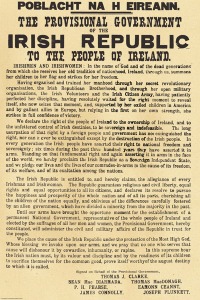
proclamation-of-independence

The Easter Rising, also known as the Easter Rebellion, begins in Dublin on April 24, 1916, and lasts for six days. The Rising, organised by seven members of the Military Council of the Irish Republican Brotherhood, is launched to end British rule in Ireland and establish an independent Irish Republic while the United Kingdom is heavily engaged in World War I. It is the most significant uprising in Ireland since the Irish Rebellion of 1798, and the first armed action of the Irish revolutionary period.

Shortly before midday, members of the Irish Volunteers, led by schoolmaster and Irish language activist Patrick Pearse and joined by the smaller Irish Citizen Army of James Connolly and 200 women of Cumann na mBan, seize key locations in Dublin and proclaim an Irish Republic. The rebels’ plan is to hold Dublin city centre, a large, oval-shaped area bounded by the Grand Canal to the south and the Royal Canal to the north, with the River Liffey running through the middle.

The rebels march to the General Post Office (GPO) on O’Connell Street, Dublin’s main thoroughfare, and occupy the building and hoist two republican flags. Pearse stands outside and reads the Proclamation of the Irish Republic.

Elsewhere in Dublin, some of the headquarters battalion under Michael Mallin occupy St. Stephen’s Green, where they dig trenches and barricade the surrounding roads. The 1st battalion, under Edward “Ned” Daly, occupy the Four Courts and surrounding buildings, while a company under Seán Heuston occupies the Mendicity Institution across the River Liffey from the Four Courts. The 2nd battalion, under Thomas MacDonagh, occupies Jacob’s Biscuit Factory. The 3rd battalion, under Éamon de Valera, occupy Boland’s Mill and surrounding buildings. The 4th battalion, under Éamonn Ceannt, occupy the South Dublin Union and the distillery on Marrowbone Lane. From each of these garrisons, small units of rebels establish outposts in the surrounding area.

There are isolated actions in other parts of Ireland, with attacks on the Royal Irish Constabulary barracks at Ashbourne, County Meath and in County Galway, and the seizure of the town of Enniscorthy, County Wexford. Due to a last-minute countermand issued on Saturday, April 22, by Volunteer leader Eoin MacNeill, the number of rebels who mobilise is much lower than expected.

The British Army brings in thousands of reinforcements as well as artillery and a gunboat. There is fierce street fighting on the routes into the city centre, where the rebels put up stiff resistance, slowing the British advance and inflicting heavy casualties. Elsewhere in Dublin, the fighting mainly consists of sniping and long-range gun battles. The main rebel positions are gradually surrounded and bombarded with artillery.

With much greater numbers and heavier weapons, the British Army suppresses the Rising, and Pearse agrees to an unconditional surrender on Saturday, April 29. Almost 500 people are killed during Easter Week. About 54% are civilians, 30% are British military and police, and 16% are Irish rebels. More than 2,600 are wounded. Many of the civilians are killed as a result of the British using artillery and heavy machine guns, or mistaking civilians for rebels. Others are caught in the crossfire in a crowded city. The shelling and the fires leave parts of inner-city Dublin in ruins.

After the surrender the country remains under martial law. About 3,500 people are taken prisoner by the British, many of whom have played no part in the Rising, with 1,800 of them being sent to internment camps or prisons in Britain. Most of the leaders of the Rising are executed following courts-martial. The Rising brings physical force republicanism back to the forefront of Irish politics, which for nearly 50 years has been dominated by constitutional nationalism. It, and the British reaction to it, leads to increased popular support for Irish independence. In December 1918, republicans, represented by the reconstituted Sinn Féin party, win a landslide victory in the general election to the British Parliament. They do not take their seats but instead convene the First Dáil and declare the independence of the Irish Republic, which ultimately leads to the Irish War of Independence.


Leave a comment

Occupation of the Four Courts in Dublin

occupation-of-four-courtsAbout 200 Anti-Treaty Irish Republican Army militants led by Rory O’Connor occupy the Four Courts in the centre of Dublin on April 14, 1922 in defiance of the Provisional Government. They intend to provoke the British troops, who are still in the country, to attack them, which they believe will restart the war with Britain and re-unite the Irish Republican Army against their common enemy. They also occupy other smaller buildings regarded as being associated with the former British administration, such as the Ballast Office and the Freemasons’ Hall in Molesworth Street, but the Four Courts remains the focus of interest. On June 15, O’Connor sends out men to collect the rifles that belong to the mutineers of the Civic Guards.

Winston Churchill and the Cabinet of the United Kingdom apply pressure on the Provisional Government to dislodge the rebels in Four Courts, considering their presence there as a violation of the Anglo-Irish Treaty. Michael Collins, President of the Provisional Government Cabinet, tries desperately to persuade O’Connor and his men to leave the building over the next three months. At the Third IRA Convention, the executive is split over whether the Irish Government should demand that all British troops leave within 72 hours. The motion is defeated, but the IRA splits into two factions opposed to the government, one conciliatory, led by Liam Lynch, Sean Moylan, and Liam Deasy, and the other less moderate, led by Tom Barry and Joe McKelvey.

During the month of June 1922, the Provisional Government engages in intense negotiations with the British Cabinet, seeking to diffuse the threat of imminent civil war. However, the conservative British Cabinet refuses to cooperate.

On June 22, 1922, arch-Unionist Sir Henry Wilson is assassinated by two IRA men, both former British soldiers, Reginald Dunne and Joseph O’Sullivan. It is considered by some that this is done on the orders of Michael Collins, who has been a close friend of Dunne in the London Irish Republican Brotherhood. David Lloyd George writes an angry letter to Collins which includes the line “…still less can Mr. Rory O’Connor be permitted to remain his followers and his arsenal in open rebellion in the heart of Dublin… organizing and sending out from this centre enterprises of murder not only in the area of your Government…”

On June 28, 1922, after the Four Courts garrison has kidnapped J.J. “Ginger” O’Connell, a general in the new Free State Army, Collins begins shelling the Four Courts with borrowed British artillery. O’Connor and 130 men surrender on July 3 and are arrested and imprisoned at Mountjoy Prison. This incident sparks the Irish Civil War as fighting breaks out around the country between pro and anti-treaty factions.


Leave a comment

The Founding of Cumann na mBan

cumann-na-mban

Cumann na mBan, an Irish republican women’s paramilitary organisation, is formed in Dublin on April 2, 1914.

In 1913, a number of women decide to hold a meeting in Wynn’s Hotel, Dublin, for the purpose of discussing the possibility of forming an organisation for women who would work in conjunction with the recently formed Irish Volunteers. A meeting led by Kathleen Lane-O’Kelly on April 2, 1914, marks the foundation of Cumann na mBan. Branches, which pledge to the Constitution of the organisation, are formed throughout the country and are directed by the Provisional Committee.

The primary aims of Cumann na mBan, as stated in its constitution, are to “advance the cause of Irish liberty and to organize Irishwomen in the furtherance of this object,” to “assist in arming and equipping a body of Irish men for the defence of Ireland” and to “form a fund for these purposes, to be called ‘The Defence of Ireland Fund.'”

Recruits come from diverse backgrounds, mainly white-collar workers and professional women, but with a significant proportion also from the working class. In September 1914, the Irish Volunteers split over John Redmond‘s appeal for its members to enlist in the British Army. The majority of Cumann na mBan members support the 10,000 to 14,000 volunteers who rejected this call and who retain the original name, the Irish Volunteers.

On April 23, 1916, when the Military Council of the Irish Republican Brotherhood finalises arrangements for the Easter Rising, it integrates Cumann na mBan, along with the Irish Volunteers and Irish Citizen Army, into the “Army of the Irish Republic.”

On the day of the Rising, Cumann na mBan members arrive armed with both a Webley revolver and a typewriter, entering the General Post Office (GPO) on O’Connell Street in Dublin with their male counterparts. By nightfall, women insurgents are established in all the major rebel strongholds throughout the city. The majority of the women work as Red Cross workers, are couriers, or procure rations for the men. Members also gather intelligence on scouting expeditions, carry despatches, and transfer arms from dumps across the city to insurgent strongholds. A number of Cumann na mBan members die during the Rising.

At the Four Courts, they help to organise the evacuation of buildings at the time of surrender and destroy incriminating papers. On April 29, the leaders at the GPO decide to negotiate surrender. Patrick Pearse, the overall Commandant-General, asks Cumann na mBan member Elizabeth O’Farrell to act as a go-between. Under British military supervision she brings Pearse’s surrender order to the rebel units still fighting in Dublin. Over 70 women, including many of the leading figures in Cumann na mBan, are arrested after the insurrection, and many of the women who are captured fighting are imprisoned in Kilmainham Gaol. All but twelve are released by May 8, 1916.

Revitalized after the Rising and led by Countess Markievicz, Cumann na mBan takes a leading role in popularising the memory of the 1916 leaders, organising prisoner relief agencies, opposing conscription, and canvassing for Sinn Féin in the 1918 general election, in which Markievicz is elected Teachta Dála.

Cumann na mBan supports the Provisional wing in the 1969-1970 split in the Irish Republican Army (IRA) and Sinn Féin. In Northern Ireland, Cumann na mBan is integrated into the mainstream IRA during the conflict, although they continue to exist as a separate organisation in the Republic of Ireland. In 1986, Cumann na mBan opposes the decision by the IRA and Sinn Féin to drop the policy of abstentionism and aligns itself with Republican Sinn Féin and the Continuity IRA.

In 2014, Cumann na mBan celebrates the Centenary of its foundation in Wynn’s Hotel, Dublin, the site of their founding in 1914. The U.K. Home Office in March 2015 lists Cumann na mBan as a group linked to Northern Ireland related terrorism. However, it is not so listed in 2008 by the U.S. State Department.