seamus dubhghaill

Promoting Irish Culture and History from Little Rock, Arkansas, USA


Leave a comment

Death of Irish Dramatist Seán O’Casey

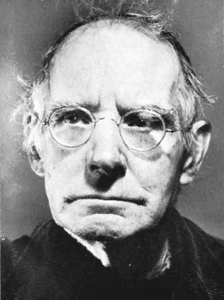
Seán O’Casey, Irish dramatist and memoirist, dies of a heart attack in Torquay, Devon, England on September 18, 1964. A committed socialist, he is the first Irish playwright of note to write about the Dublin working classes.

O’Casey is born John Casey at 85 Upper Dorset Street, in the northern inner-city area of Dublin on March 30, 1880. He is a member of the Church of Ireland, baptised on July 28, 1880 in St. Mary’s parish and confirmed at St. John the Baptist Church in Clontarf. He is an active member of Saint Barnabas until his mid-twenties, when he drifts away from the church.

As O’Casey’s interest in Irish nationalism grows, he joins the Gaelic League in 1906 and learns the Irish language. At this time, he Gaelicises his name from John Casey to Seán Ó Cathasaigh. He also learns to play the Uilleann pipes and is a founder and secretary of the St. Laurence O’Toole Pipe Band. He joins the Irish Republican Brotherhood, and becomes involved in the Irish Transport and General Workers Union, established by James Larkin to represent the interests of the unskilled labourers who inhabit the Dublin tenements. In March 1914 he becomes General Secretary of Larkin’s Irish Citizen Army. On July 24, 1914 he resigns from the ICA, after his proposal to deny dual membership to both the ICA and the Irish Volunteers is rejected.

In 1917, his friend Thomas Ashe dies in a hunger strike and it inspires him to write. He spends the next five years writing plays. O’Casey’s first accepted play, The Shadow of a Gunman, is performed at the Abbey Theatre in 1923. This is the beginning of a relationship that is to be fruitful for both theatre and dramatist but which ends in some bitterness. It is followed by Juno and the Paycock (1924) and The Plough and the Stars (1926).

The Plough and the Stars is not well received by the Abbey audience. There is a riot reported on the fourth night of the show. His depiction of sex and religion offends some of the actors who refused to speak their lines. W.B. Yeats intervenes and describes the audience as “shaming themselves.”

In 1928, Yeats rejects O’Casey’s fourth play, The Silver Tassie, for the Abbey. It is an attack on imperialist wars and the suffering they cause. The Abbey refuses to perform it. The plays O’Casey writes after this include the darkly allegorical and highly controversial Within the Gates (1934), which is set within the gates of a busy city park based on London’s Hyde Park. It closes not long after opening and is another box office failure.

Over the next twenty years, O’Casey writes The Star Turns Red (1940), Purple Dust (1943), Red Roses for Me (1943), Oak Leaves and Lavender (1945), Cock-a-Doodle Dandy (1949), The Bishop’s Bonfire (1955), and The Drums of Father Ned (1958). In 1959, O’Casey gives his blessing to a musical adaptation of Juno and the Paycock by American composer Marc Blitzstein. The musical, retitled Juno, is a commercial failure, closing after only 16 Broadway performances. Also in 1959, George Devine produces Cock-a-Doodle Dandy at the Royal Court Theatre and it is also successful at the Edinburgh International Festival and has a West End run.

On September 18, 1964, at the age of 84, O’Casey dies of a heart attack, in Torquay, Devon. He is cremated at the Golders Green Crematorium.


Leave a comment

Patrick Pearse Opens St. Edna’s School

pearse-museum

St. Enda’s School, or Scoil Éanna, a secondary school for boys set up in Ranelagh, Dublin, by Irish nationalist Patrick Pearse, is opened on September 8, 1908.

Pearse, generally known as a leader of the 1916 Easter Rising, has long been critical of the educational system in Ireland, which he believes teaches Irish children to be good Englishmen. He has for years been committed to the preservation of the Irish language, mostly through the Gaelic League, and is dearly concerned about the language’s future. A trip abroad to Belgium and his observations of bi-lingual education there inspires him to attempt a similar experiment at home.

Pearse is not a practical businessman, but he is never one to let lack of finances get in the way of his plans. With promises from prominent nationalists as proponents of Irish heritage that they will give him whatever limited financial support they can, and, when applicable, will enroll their children in his school, Pearse establishes his school, which officially opens on September 8, 1908, in Cullenswood House, Ranelagh, a suburb of Dublin.

The school proves a successful experiment but is never to fully escape the shadow of looming financial woes. In fact, the school would not have survived the crucial first few years without the devoted aid of his good friend and assistant headmaster Thomas MacDonagh, and the solid dedication of Pearse’s brother Willie.

St. Enda’s teaches many of the classes in Irish and particularly stresses the arts and dramatics. Everything is given an Irish approach. After two years the school is doing quite well. Thrilled with his creation and concerned that Cullenswood House is not a location that does St. Enda’s justice, Pearse moves the school to the Hermitage in Rathfarnham, substantially further from Dublin than Cullenswood House. In 1910 St. Enda’s opens its doors at the Hermitage but proves to be a financial disaster. With bankruptcy looming Pearse is forced to look to the United States for further funding which only keeps the school barely in solvency.

Pearse is a person who shows extreme dedication to a project once it catches his interest, but this leaves him unable to fully devote himself to multiple tasks. His involvement in the Irish Volunteers in 1913, and his active participation in the Irish Republican Brotherhood shortly thereafter, leaves St. Enda’s with a less devoted master than it had previously.

Following the execution of the Pearse brothers after the rising, their mother reopens St. Enda’s back at Cullenwood House. The school then returns to the Hermitage in 1919. The international fame the Easter Rising gives Pearse and his martyrdom makes raising funds easier than before and Margaret Pearse raises enough money to buy the property Pearse could never afford in his lifetime. However, without the leadership of either of the Pearse brothers, St. Enda’s could not last, and it eventually closes its doors for good in 1935. Today the Hermitage stands as the Pearse Museum, dedicated to the memory of the school’s founder.

(Pictured: The Pearse Museum in Rathfarnham)


Leave a comment

Founding of the Gaelic League

conradh-na-gaeilge-logo

The Gaelic League (Irish: Conradh na Gaeilge), a social and cultural organisation which promotes the Irish language in Ireland and worldwide is founded in Dublin on July 31, 1893.

Conradh na Gaeilge is founded by Douglas Hyde, the son of a Church of Ireland rector from Frenchpark, County Roscommon, with the aid of Eugene O’Growney, Eoin MacNeill, Thomas O’Neill Russell, and others. The organisation develops from Ulick Bourke‘s earlier Gaelic Union and becomes the leading institution promoting the Gaelic Revival, carrying on efforts like the publishing of the Gaelic Journal. The League’s first newspaper is An Claidheamh Soluis (The Sword of Light) and its most noted editor is Patrick Pearse. The motto of the League is Sinn Féin, Sinn Féin amháin (Ourselves, Ourselves alone).

The League encourages female participation from the start and a number of women play a prominent role. They are not restricted to subordinate roles, but play an active part in leadership, although males are in the overwhelming majority. Local notables, such as Lady Gregory in Galway, Lady Esmonde in County Wexford, and Mary Spring Rice in County Limerick, and others such as Norma Borthwick, found and lead branches in their communities. At the annual national convention in 1906 women are elected to seven of the forty-five positions on the Gaelic League executive. Executive members include Máire Ní Chinnéide, Úna Ní Fhaircheallaigh (who writes pamphlets on behalf of the League), Bean an Doc Uí Choisdealbha, Máire Ní hAodáin, Máire de Buitléir, Nellie O’Brien, Eibhlín Ní Dhonnabháin, and Eibhlín Nic Néill.

Though apolitical, the organisation attracts many Irish nationalists of different persuasions, much like the Gaelic Athletic Association. It is through the League that many future political leaders and rebels first meet, laying the foundation for groups such as the Irish Volunteers. However, Conradh na Gaeilge does not commit itself entirely to the national movement until 1915, causing the resignation of Douglas Hyde, who feels that the culture of language should be above politics. Most of the signatories of the 1916 Proclamation are members. It still continues to attract many Irish Republicans. Seán Mac Stíofáin, the first chief of staff of the Provisional IRA was a prominent member in his later life.

After the foundation of the Irish Free State in 1922, the organisation has a less prominent role in public life as Irish is made a compulsory subject in state-funded schools. It does unexpectedly bad in the Irish Seanad election of 1925, when all the candidates it endorses are defeated, including Hyde.


Leave a comment

Cathal Brugha Fatally Wounded by Sniper

cathal-brugha

Cathal Brugha, a leading figure in the Anti-Treaty Irish Republican Army (IRA), is shot by a sniper on July 5, 1922, as he appears in the doorway of the Hammam Hotel during the Irish Civil War. He dies two days later.

Brugha is born in Dublin of mixed Roman Catholic and Protestant parentage. He is the tenth of fourteen children and is educated at the Jesuit Belvedere College but is forced to leave at the age of sixteen because of the failure of his father’s business.

In 1899, Brugha joins the Gaelic League, and subsequently changes his name from Charles Burgess to Cathal Brugha. He becomes actively involved in the Irish Republican Brotherhood (IRB) and in 1913 he becomes a lieutenant in the Irish Volunteers. He leads a group of twenty Volunteers to receive the arms smuggled into Ireland in the Howth gun-running of 1914.

Brugha is second-in-command at the South Dublin Union under Commandant Éamonn Ceannt in the Easter Rising of 1916. On the Thursday of Easter Week, being badly wounded, he is unable to leave when the retreat is ordered. Brugha, weak from loss of blood, continues to fire upon the enemy and is found by Éamonn Ceannt singing God Save Ireland with his pistol still in his hands. Initially not considered likely to survive, he recovers over the next year but is left with a permanent limp.

During the War of Independence, Brugha organises an amalgamation of the Irish Volunteers and the Irish Citizen Army into the Irish Republican Army (IRA). He proposes a Republican constitution at the 1917 Sinn Féin convention which is unanimously accepted. In October 1917, he becomes Chief of Staff of the Irish Republican Army and holds that post until March 1919.

Brugha is elected speaker of Dáil Éireann at its first meeting on January 21, 1919, and he reads out the Declaration of Independence in Irish. On the following day, he is appointed president of the ministry pro tempore and retains this position until April 1, 1919, when Éamon de Valera takes his place.

In the months between the Anglo-Irish Treaty debates and the outbreak of Civil War, Brugha attempts to dissuade his fellow anti-treaty army leaders, including Rory O’Connor, Liam Mellows, and Joe McKelvey, from taking up arms against the Free State. When the IRA occupies the Four Courts, he and Oscar Traynor call on them to abandon their position. When they refuse, Traynor orders the occupation of the area around O’Connell Street in the hope of easing the pressure on the Four Courts and of forcing the Free State to negotiate.

On 28 June 1922, Brugha is appointed commandant of the forces in O’Connell Street. The outbreak of the Irish Civil War ensues in the first week of July when Free State forces commence shelling of the anti-treaty positions.

Most of the anti-Treaty fighters under Oscar Traynor escape from O’Connell Street when the buildings they were holding catch fire, leaving Brugha in command of a small rearguard. On 5 July, he orders his men to surrender but refuses to do so himself. He then approaches the Free State troops, brandishing a revolver. He sustains a bullet wound to the leg which severs a major artery, ultimately causing him to bleed to death on July 7, 1922, eleven days before his 48th birthday. He is buried in Glasnevin Cemetery.


Leave a comment

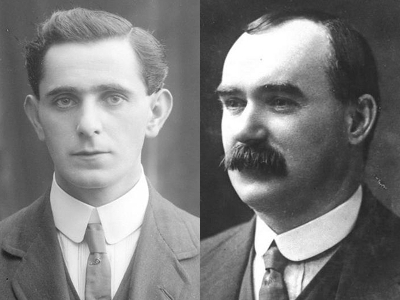
Executions of Seán MacDiarmada & James Connolly

macdiarmada-connolly

The British army executes Seán MacDiarmada and James Connolly, the last of the Easter Rising leaders to be executed in Dublin, in the Stonebreaker’s Yard at Kilmainham Gaol on May 12, 1916.

Seán MacDiarmada is born in 1884 in Leitrim. He emigrates to Glasgow in 1900 and from there to Belfast in 1902. A member of the Gaelic League, he is acquainted with Bulmer Hobson. He joins the Irish Republican Brotherhood (IRB) in 1906 while still in Belfast, transferring to Dublin in 1908 where he assumes managerial responsibility for the IRB newspaper Irish Freedom in 1910. Although MacDiarmada is afflicted with polio in 1912, he is appointed as a member of the provisional committee of Irish Volunteers from 1913 and is subsequently drafted onto the military committee of the IRB in 1915. During the Rising, MacDiarmada serves in the General Post Office (GPO). Following the surrender, MacDiarmada nearly escapes execution by blending in with the large body of prisoners. He is eventually recognised by Daniel Hoey of G Division and faces a court-martial on May 9.

James Connolly is born in Edinburgh in 1868. Connolly is first introduced to Ireland as a member of the British Army. Despite returning to Scotland, the strong Irish presence in Edinburgh stimulates Connolly’s growing interest in Irish politics in the mid-1890s, leading to his emigration to Dublin in 1896 where he founds the Irish Socialist Republican Party. He spends much of the first decade of the twentieth century in America. He then returns to Ireland to campaign for worker’s rights with James Larkin. A firm believer in the perils of sectarian division, Connolly campaigns tirelessly against religious bigotry. In 1913, Connolly is one of the founders of the Irish Citizen Army. During the Easter Rising he is appointed Commandant-General of the Dublin forces, leading the group that occupies the General Post Office.

The treatment accorded to Connolly is particularly despicable. Crippled by an infected wound in the ankle, he is carried to Kilmainham Gaol, tied to a chair, and shot. As the men are loading their rifles, Connolly forgives the men of the army firing squad for their actions. Shaken by their distasteful task, a ragged volley of shots resounds from their rifles. He is the last of the leaders to be executed.


Leave a comment

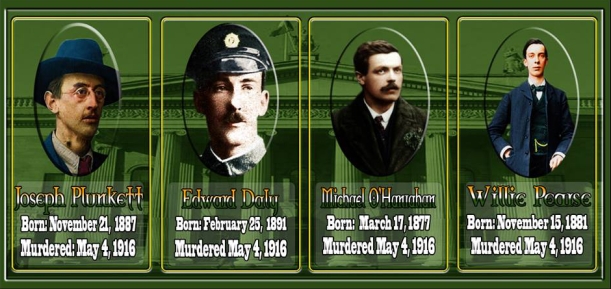
Executions of Edward Daly, Michael O’Hanrahan, Joseph Mary Plunkett, & William Pearse

plunkett-daly-ohanrahan-pearse

The executions of leaders and participants of the 1916 Easter Rising by the British continue as Edward Daly, Michael O’Hanrahan, Joseph Mary Plunkett, and William Pearse are executed by firing squad in the Stonebreakers Yard at Kilmainham Gaol in Dublin on May 4, 1916.

Edward Daly is born in Limerick in 1891 to a family that has a history of republican activity. His uncle, John Daly, had taken part in the rebellion of 1867. Edward Daly leads the First Battalion during the 1916 Easter Rising, which raids the Bridewell and Linenhall Barracks, eventually seizing control of the Four Courts. A close friend of Tom Clarke, their ties are made even stronger by the marriage of Clarke to Daly’s sister.

Michael O’Hanrahan is born in Wexford in 1877. As a young man, O’Hanrahan shows great promise as a writer, becoming heavily involved in the promotion of the Irish language. He founds the first Carlow branch of the Gaelic League, and publishes two novels, A Swordsman of the Brigade and When the Norman Came. Like many of the other executed leaders, he joins the Irish Volunteers from their inception and is second in command to Thomas MacDonagh at Jacob’s Biscuit Factory during the Rising, although this position is largely usurped by the arrival of John MacBride.

Joseph Mary Plunkett is born in Dublin in 1887, the son of a papal count. Plunkett is initially educated in England, though he returns to Ireland and graduates from University College Dublin in 1909. After his graduation, Plunkett spends two years traveling due to ill health, returning to Dublin in 1911. Plunkett shares Thomas MacDonagh’s enthusiasm for literature and is an editor of the Irish Review. Along with MacDonagh and Edward Martyn, he helps to establish an Irish national theatre. He joins the Irish Volunteers in 1913, subsequently gaining membership of the Irish Republican Brotherhood in 1914. Plunkett travels to Germany to meet Roger Casement in 1915. During the planning of the Rising, Plunkett is appointed Director of Military Operations, with overall responsibility for military strategy. Plunkett is stationed in the General Post Office during the Rising. Seven hours prior to his execution, Plunkett marries his sweetheart, Grace Gifford, in the prison chapel.

William “Willie” Pearse, the younger brother of Patrick, is born in Dublin in 1881. Willie shares his brother’s passion for an independent Ireland. He assists Patrick in running St. Enda’s School. The two brothers are extremely close and fight alongside each other in the General Post Office. He is not one of the planners of the revolt, nor is he one of its commanders. Willie is merely one of the soldiers involved with the Dublin actions. No other participant in Dublin whose actions or responsibilities are similar to Willie’s is executed in the days following the Rising, save perhaps John MacBride, whose earlier service with the Boers probably marks him for death. It seems likely that the sole reason Willie is executed by the British government is for the crime of being Patrick’s brother. It is repugnant British excesses such as this that soon reverse the Irish people’s initially negative opinion of the 1916 Easter Rising.


Leave a comment

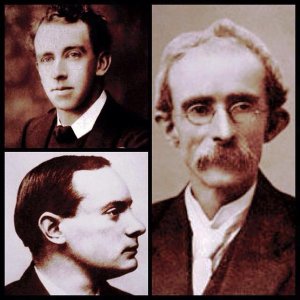
Executions of Patrick Pearse, Thomas Clarke, & Thomas MacDonagh

pearse-clarke-mac-donagh

Patrick Pearse, Thomas Clarke, and Thomas MacDonagh are executed by firing squad in the Stonebreakers’ Yard at Kilmainham Gaol in Dublin on May 3, 1916. Pearse, Clarke, and MacDonagh are three of the seven signatories of the Proclamation of the Irish Republic.

Just three days after the end of the 1916 Easter Rising, the first military courts martial sits on May 2, 1916. Pearse, Clarke, and MacDonagh are immediately sentence to death. The three are taken that evening to the disused Kilmainham Gaol and are shot at dawn the following morning.

Patrick Pearse is born in Dublin in 1879, becoming interested in Irish cultural matters in his teenage years. In 1898, Pearse becomes a member of the Executive Commmittee of the Gaelic League. He graduates from the Royal University of Ireland in 1901 with a degree in Arts and Law. Pearse’s literary output is constant, and he publishes extensively in both Irish and English, becoming the editor of An Claidheamh Soluis, the newspaper of the Gaelic League. He is a keen believer in the value of education, and establishes two schools, Coláiste Éanna and Coláiste Íde, devoted to the education of Irish children through the Irish language.  Pearse is one of the founding members of the Irish Volunteers and the author of the Proclamation of the Irish Republic. He is Commander in Chief of the Irish forces and headquartered in the General Post Office (GPO) during the 1916 Easter Rising.

Thomas Clarke is born on the Isle of Wight in 1857, the son of a soldier in the British army. During his time in America as a young man, he joins Clan na Gael, later enduring fifteen years (1883-1898) of penal servitude for his role in a bombing campaign in London. In 1907, having returned from a second sojourn in America, his links with Clan na Gael in America copper-fastens his importance to the revolutionary movement in Ireland. He holds the post of Treasurer to the Irish Republican Brotherhood (IRB) and is a member of the Supreme Council from 1915. Clarke is the first signatory of the Proclamation of the Irish Republic through deference to his seniority. Clarke is also stationed at the GPO during Easter Week. Clarke tells his wife during his final night that he is relieved he is going to be executed because his greatest dread is that he would be sent back to prison.

Thomas MacDonagh is a native of Tipperary, born in 1878. He spends the early part of his career as a teacher. He moves to Dublin to study and is the first teacher on the staff at St. Enda’s School, the school he helps to found with Patrick Pearse. MacDonagh is well versed in literature, his enthusiasm and erudition earning him a position in the English department at University College Dublin. His play When the Dawn is Come is produced at the Abbey Theatre. He is appointed director of training for the Irish Volunteers in 1914, later joining the Irish Republican Brotherhood (IRB). MacDonagh is appointed to the IRB military committee in 1916. He is commander of the Second Battalion of Volunteers that occupies Jacob’s Biscuit Factory and surrounding houses during the Rising.

Immediately after the executions, Irish Parliamentary Party leader John Redmond warns British Prime Minister Herbert Asquith that “if any more executions take place in Ireland the position will become impossible for any constitutional party or leader.”

Asquith himself warns Sir John Maxwell that “anything like a large number of executions would…sow the seeds of lasting trouble in Ireland.”

These warnings fall upon deaf ears as thirteen additional executions take place in the following days.


Leave a comment

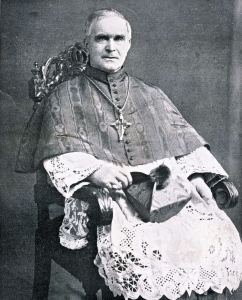
Birth of Cardinal Joseph MacRory in County Tyrone

cardinal-joseph-macrory

Joseph MacRory, an Irish Cardinal of the Roman Catholic Church who serves as Archbishop of Armagh from 1928 until his death in 1945, is born in Ballygawley, County Tyrone, on March 19, 1861.

MacRory is one of ten children of Francis MacRory, a farmer, and his wife, Rose Montague. He studies at St. Patrick’s College, Armagh, and St. Patrick’s Pontifical University, Maynooth. He is ordained to the priesthood on September 13, 1885, and serves as the first president of St. Patrick’s Academy, Dungannon from 1886 to 1887. MacRory teaches Scripture and Modern Theology at St. Mary’s College, Oscott in England until 1889, when he is appointed Professor of Scripture and Oriental Languages at his alma mater of Maynooth College. In 1906, he co-founds the Irish Theological Quarterly. In 1912, he is made Vice-President of Maynooth.

On August 9, 1915, MacRory is appointed Bishop of Down and Connor by Pope Benedict XV and receives his episcopal consecration on November 14 from Cardinal Michael Logue. During his tenure, his life is threatened repeatedly due to the turbulent atmosphere in Belfast. He is a member of the Irish Convention from 1917 to 1918.

MacRory is promoted to Archbishop of Armagh and thus Primate of All Ireland on June 22, 1928, in succession to Patrick O’Donnell. He is elevated to the cardinalate on December 16, 1929, by Pope Pius XI.

MacRory is the papal legate at the 1933 laying of the foundation stone of Liverpool Metropolitan Cathedral in England. He also serves as one of the cardinal electors who participate in the 1939 papal conclave which ultimately selects Pope Pius XII.

MacRory is a strenuous opponent of social injustice, National Socialism, Protestantism, and the Partition of Ireland. It is MacRory who suggests to Eoin O’Duffy that he raise an Irish Brigade to aid Generalissimo Francisco Franco during the Spanish Civil War. In 1940, he voices strong objections to conscription in the North.

MacRory is a supporter of the Gaelic League. Errigal Ciarán GAC, one of the most famous GAA clubs in Ireland, plays at Cardinal MacRory Park in Dunmoyle, County Tyrone, which is built in 1956 in his honour.

After a brief illness, Cardinal MacRory dies on October 13, 1945, at the age of 84 from a heart attack at Ara Coeli, the residence in Armagh. He is interred in St. Patrick’s Cathedral Cemetery, Armagh.


Leave a comment

Birth of Irish Revolutionary Leader Seán Mac Diarmada

sean-mac-diarmada

Seán Mac Diarmada, Irish political activist and revolutionary leader also known as Seán MacDermott, is born in Corranmore, near Kiltyclogher in County Leitrim on February 28, 1883. He is one of the seven leaders of the Easter Rising of 1916 and a signatory of the Proclamation of the Irish Republic.

Mac Diarmada is educated by the Irish Christian Brothers. He moves to Dublin in 1908, by which time he already has a long involvement in several Irish separatist and cultural organisations, including Sinn Féin, the Irish Republican Brotherhood (IRB), the Ancient Order of Hibernians, and the Gaelic League. He is soon promoted to the Supreme Council of the IRB and is eventually elected secretary.

In 1910, he becomes manager of the radical newspaper Irish Freedom, which he founds along with Bulmer Hobson and Denis McCullough. He also becomes a national organiser for the IRB and is taken under the wing of veteran Fenian Tom Clarke and the two become nearly inseparable. Shortly afterward, Mac Diarmada is stricken with polio and is forced to walk with a cane.

In November 1913, Mac Diarmada is one of the original members of the Irish Volunteers and continues to work to bring the organisation under IRB control. Mac Diarmada is arrested in Tuam, County Galway, in May 1915 under the Defense of the Realm Act 1914 for giving a speech against enlisting into the British Army.

Following his release in September 1915, Mac Diarmada joins the secret Military Committee of the IRB, which is responsible for planning the rising.

Due to his disability, Mac Diarmada has little participation in the fighting of Easter week but is stationed at the headquarters in the General Post Office (GPO), as one of the Provisional Republican Government. Following the surrender on April 29, 1916, he nearly escapes execution by blending in with the large body of prisoners but is eventually identified by Daniel Hoey of G Division. Following a May 9 court-martial, Mac Diarmada, at the age of 33, is executed by firing squad in Kilmainham Gaol. Before his execution, Mac Diarmada writes, “I feel happiness the like of which I have never experienced. I die that the Irish nation might live!”

In September 1919, Hoey is shot dead by Michael Collins‘s Squad. Likewise, the British Officer who ordered Mac Diarmada to be shot rather than imprisoned, is also killed in Cork on Collins’s order during the Irish War of Independence.

Seán MacDermott Street in Dublin, Sligo Mac Diarmada railway station in Sligo, and Páirc Seán Mac Diarmada, the Gaelic Athletic Association stadium in Carrick-on-Shannon, County Leitrim, are named in his honour. Sean MacDermott tower in Ballymun, demolished in 2005, is also named after him. In his hometown of Kiltyclogher a statue inscribed with his final written words is erected in the village centre and his childhood home has become a national monument.

Mac Diarmada will be portrayed by actor Colin Morgan in the 2016 Irish historical biopic drama film, The Rising, written by Kevin McCann and Colin Broderick.


Leave a comment

Birth of IRA Leader Seán Treacy

sean-allis-treacy

Seán Allis Treacy, one of the leaders of the Third Tipperary Brigade of the Irish Republican Army during the Irish War of Independence, is born on February 14, 1895, in Soloheadbeg, County Tipperary.

Treacy leaves school at the age of 14 and works as farmer while also developing deep patriotic convictions. He is a member of the Gaelic League, and of the Irish Republican Brotherhood (IRB) from 1911 and the Irish Volunteers from 1913.

He is picked up in the mass arrests following the Easter Rising in 1916. He spends much of the following two years in prison, where he goes on hunger strike on several occasions.

In 1918, Treacy is appointed Vice Officer-Commanding of the 3rd Tipperary Brigade of the Irish Volunteers, which becomes the Irish Republican Army in 1919.

On January 21, 1919, Treacy and Dan Breen, together with Seán Hogan, Séamus Robinson, and five other volunteers, help to ignite the conflict that is to become the Irish War of Independence. They ambush and shoot dead Constables Patrick MacDonnell and James O’Connell of the Royal Irish Constabulary (RIC), who are guarding a transport of gelignite explosives, during the Soloheadbeg Ambush near Treacy’s home. Treacy leads the planning of the ambush and briefs the brigade’s OC Robinson on his return from prison in late 1918. Robinson supports the plans and agrees they will not go to GHQ for permission to undertake the attack.

As a result of the Soloheadbeg Ambush, South Tipperary is placed under martial law and declared a Special Military Area under the Defence of the Realm Act. After Soloheadbeg ambush party member Seán Hogan is arrested on May 12, 1919, Treacy, Breen, and Séamus Robinson are joined by five men from the IRA’s East Limerick Brigade to organise Hogan’s rescue. Hogan is brought to the train which is intended to take him from Thurles to Cork city on May 13, 1919. As the train steams across the Tipperary border and into County Limerick, the IRA party boards the train in Knocklong. A close-range struggle ensues on the train. Treacy and Breen are seriously wounded in the gunfight and two RIC men die, but Hogan is rescued. His rescuers rush him into the village of Knocklong where a butcher cuts off his handcuffs using a cleaver.

A search for Treacy and the others is mounted across Ireland. Treacy leaves Tipperary for Dublin to avoid capture. In Dublin, Michael Collins employs Treacy on assassination operations with “the Squad“. In the summer of 1920, he returns to Tipperary and organises several attacks on RIC barracks before again moving his base of operations to Dublin.

By spring 1920 the political police of both the Crimes Special Branch of the Royal Irish Constabulary (RIC) and G-Division (Special Branch) of the Dublin Metropolitan Police (DMP) have been effectively neutalised by IRA counterintelligence operatives working for Michael Collins. The British thoroughly reorganise their administration at Dublin Castle and begin to import dozens of professional secret service agents from all parts of the British Empire into Ireland to track down IRA operatives and Sinn Féin leaders.

On October 11, 1920, Treacy and Breen are holed up in a safe house on the north side of Dublin when it is raided by a police unit. In the ensuing shootout, two senior British officers are wounded and die the next day while Treacy and Breen are wounded, Breen seriously. Treacy and Breen manage to escape through a window and shoot their way through the police cordon.

Treacy is discovered at the Republican Outfitters shop at 94 Talbot Street on October 14 a British Secret Service surveillance team led by Major Carew and Lt. Gilbert Price. They were stalking him in hopes that he would lead them to Collins or to other high-value IRA targets. Treacy realises that he is being followed and runs for his bicycle but grabs the wrong bike, taking one that is far too big for him, and falls. Price draws his pistol and closes in on Treacy. Treacy draws his parabellum automatic pistol and shoots Price and another British agent before he is hit in the head, dying instantly.

Treacy is buried at Kilfeacle graveyard where, despite a large presence of British military personnel, a volley of shots is fired over the grave.