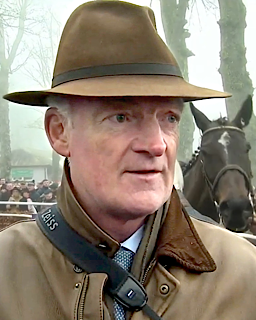
Mullins is the trainer of the 2005 Grand National winner “Hedgehunter” and the 2011 and 2013 Champion Hurdle winner “Hurricane Fly.” He also trains “Vautour” in the 2016 Ryanair Chase. He is also trainer of the six-time David Nicholson Mares’ Hurdle champion, “Quevega.” In the 2015 Cheltenham Festival, he trains eight winners, a joint record at the Cheltenham Festival which Gordon Elliott equals in 2018. He is the leading-most winning trainer at the Cheltenham Festival, becoming the first trainer to saddle 100 winners when “Jasmin De Vaux” wins the 2024 Champion Bumper. In 2022, he trains a new record of ten winners at the festival.
Mullins’ longlasting relationship with Gigginstown House Stud comes to an end on September 28, 2016. Despite this he is the Irish Champion trainer in the 2016/17 season.
Mullins wins both the 2005 Grand National with “Hedgehunter” and the 2019 Irish Grand National with “Burrows Saint,” each of which is ridden by Ruby Walsh. In the 2022/23 season he becomes Irish National Hunt Champion trainer for the 17th time.
Mullins wins the British jump racing Champion Trainer title in the 2023–24 season, becoming the first trainer based in Ireland to win the championship since Vincent O’Brien in 1954. He successfully defends his title in 2024-25, beating long-time leader Dan Skelton on the last afternoon of the National Hunt season.
Mullins son, Patrick, is an amateur jockey riding mainly in Ireland for his father and acting as assistant trainer to him. Patrick rides “Nick Rockett” to the 2025 Grand National title. Mullins’ wife, Jackie, is a successful amateur rider. With his wife, he is invited to ride in the King’s procession at Royal Ascot 2023.
In September 1914 Cregan goes to Dublin to study music in the Leinster School of Music, under Madame Coslett Heller. It is while she is in Dublin that she becomes friends with the Ryan family, who are strong nationalists as well as interested in the Gaelic League and Sinn Féin. She begins to sing for concerts which are fundraisers for the Irish Volunteers. The last concert is just two weeks before the Easter Rising.
During Easter week Cregan is sent to Tralee with “automatics and ammunition” by Seán Mac Diarmada. While she is carrying a violin case of munitions, she is also carrying details for the wireless technology needed for communicating with the SS Aud, the boat which is carrying more weapons for the rebellion. The communications with the SS Aud go wrong when the car carrying the Volunteers goes off a pier and the occupants are drowned. She is still in the area to assist with the surviving Volunteer, who unfortunately knows nothing of the details for the SS Aud. She is not easily able to get back to Dublin, because owing to the Rising the city is cut off. By the time she gets back, her friends have been arrested.
When Cregan is going to school in Dublin she is also working in a school in Rathmines. Like many of the teachers, she loses her job after the rising because of her connection to the rebels. However, she is able to get new positions over the next few years in both Ballyshannon and Portstewart until she marries. In Ballyshannon she experiences the early expressions of support and sympathy, but Portstewart is a Unionist enclave with many houses flying union flags on polling day in 1918.
Cregan is a member of Cumann na mBan and with them is active during the Irish War of Independence. She is given a medal for her participation. On July 23, 1919, she marries Dr. James Ryan in Athenry, County Galway. His entire family had been deeply involved in the Easter Rising, as well as the Irish War of Independence and the Irish Civil War. They have three children, Eoin, who becomes a Senator, Nuala (Colgan) and Seamus.
The family is initially based in Wexford during the War. The house is often raided when the British soldiers are looking for her husband and Cregan herself is arrested in February 1921 for refusing to put up martial law posters. Later the family sells the house and remains mobile while she works for the Sinn Féin government, and her husband is in prison. It is during this time that she works as a courier to the continent and to London. After the war, they purchase Kindlestown House in Delgany, County Wicklow, where they remain for the rest of their lives.
Cregan’s first book for children is Old John and gains her considerable international success and attention. Sean Eoin is also published in Irish and is illustrated by Jack Butler Yeats. Her work is also aired on the BBC and RTÉ. Rathina wins the Downey Award in the United States in 1943. She also writes two plays: Hunger strike (1933), based on experience of her husband’s involvement in such a strike, which is broadcast on Radio Éireann on May 5, 1936, and Curlew’s call (1940).
Cregan dies on November 9, 1975, in St. Vincent’s Hospital, Dublin, and is buried in Redford cemetery near her home in County Wicklow.
(Pictured: Máirín Cregan and her husband, Dr. James Ryan)
Keeping command of a small band, Byrne seizes Goresbridge on June 23 but has to deplore the murder of several prisoners and other atrocities committed by his men in revenge for the torture and executions that had been visited upon the peasantry by the yeomanry and government militia. After further skirmishes he joins Joseph Holt and Michael Dwyer in taking to the Wicklow Mountains to continue a guerrilla resistance.
After Holt accepts transportation to Australia in November, Byrne, assisted by his sister, escapes to Dublin. He recalls of his sister, “If I had not remarked a long scar on her neck, she would not have mentioned anything herself. A yeoman … threatened to cut her throat with his sabre if she did not tell instantly the place in which I was hiding. The cowardly villain, no doubt, would have put his threat in execution had not some of his comrades interfered to prevent him.”
In the winter of 1802-03, Byrne enters into the plans of Robert Emmet and Anne Devlin for a renewed uprising. In his Memoirs he describes a meeting he arranged between Robert Emmet and the Wexford rebel leader Thomas Cloney at Harold’s Cross Green, Dublin, just prior to Emmet’s Rebellion, “I can never forget the impression this meeting made on me at the time – to see two heroic patriots, equally devoted to poor Ireland, discussing the best means of obtaining her freedom.”
In July 1803, the plans unravel when Anne Devlin’s cousin, Michael Dwyer, still holding out in Wicklow, recognises that there are neither the promised arms nor convincing proof of an intended French landing. In the north Thomas Russell and James Hope find no enthusiasm for a renewal of the struggle in what in 1798 are the strongest United Irish and Catholic Defender districts.
In Dublin, with their preparations revealed by an accidental explosion of a rebel arms depot, Emmet proceeds with a plan to seize the centres of government. The rising, for which for Byrne turns out with Emmet and Malachy Delaney in gold-trimmed green uniforms, is broken up after a brief confrontation in Thomas Street.
Two days after the fight in Thomas Street, Byrne meets with the fugitive Emmet and agrees to go to Paris to procure French assistance. But in Paris he finds Napoleon‘s attentions focused elsewhere. The First Consul uses a cessation of hostilities with Britain to pursue a very different venture, the re-enslavement of Haiti.
Byrne is commissioned as a captain in Napoleon’s Irish Legion. But at a time when he is convinced that “all Catholic Ireland” is “ready to rise the moment a rallying point was offered,” the Irish exiles cannot deflect the First Consul from other priorities. Rather than in Ireland, with his diminishing Irish contingent, he is to see action in the Low Countries, Germany and Spain.
Byrne rises to the rank of brigadier general and is awarded the Legion of Honour in 1813. Following the Bourbon Restoration, with fellow legionnaire John Allen, he narrowly avoids deportation as a foreign Bonapartist. An introduction to the Prince de Broglie, then vice-president of the Chamber of Deputies, and two audiences with the Minister of War, Marshal Henri Clarke, the Duke of Feltre, contribute to the latter’s decision to quash the deportation order. In August 1817 Byrne is naturalised as a French citizen.
For much of the next decade Byrne finds himself effectively retired on half pay. Returned to active military service in 1828, he distinguishes himself in the French expedition to Morea during the Greek War of Independence. He retires in 1835 with the rank of Chef de Bataillion.
In the 1840s, Byrne is Paris correspondent for The Nation in Dublin, the Young Irelander newspaper that does much to rehabilitate the memory of the United Irishmen.
In his last years Byrne writes his Memoirs, which are an account of his participation in the Irish Rebellion and his time in the Irish Legion of Napoleon. These are first published in three volumes in 1863, but there have been many subsequent reprints. Against the portrayal of 1798 as a series of disjointed, unconnected risings, his memoirs present the United Irishmen as a cohesive revolutionary organisation whose aim of a democratic, secular, republic had captured the allegiance of a great mass of the Irish people.
Byrne dies at his house in the rue Montaigne (now rue Jean Mermoz, 8th arrondissement, near Champs-Élysées), Paris on January 24, 1862, and is buried in Montmartre Cemetery. His grave there is marked by a Celtic Cross, however this headstone appears to be a 1950s replacement for an earlier one.
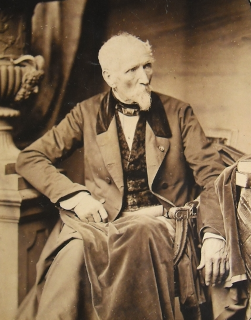
(Pictured: Miles Byrne (1780-1862), United Irishman. Photograph taken by an unknown photographer in Paris in February 1859. The photograph now resides in Áras an Uachtaráin, the residence of the President of Ireland, in Dublin.)
Mary Ellen Cregan is born to Morgan Cregan and Ellen O’Shea. Her father is a stonemason from Limerick. The family are strong believers in the Gaelic revival movement and Cregan herself learns the Irish language and performs songs at Gaelic League concerts. Although she goes to primary school locally, she goes away to secondary school to St. Louis Convent in Carrickmacross, County Monaghan. After finishing school, she becomes a teacher, working in Goresbridge, County Kilkenny from 1911 to 1914.
In September 1914 Cregan goes to Dublin to study music in the Leinster School of Music, under Madame Coslett Heller. It is while she is in Dublin that she becomes friends with the Ryan family, who are strong nationalists as well as interested in the Gaelic League and Sinn Féin. She begins to sing for concerts which are fundraisers for the Irish Volunteers. The last concert is just two weeks before the Easter Rising.
During Easter week Cregan is sent to Tralee with “automatics and ammunition” by Seán Mac Diarmada. While she is carrying a violin case of munitions, she is also carrying details for the wireless technology needed for communicating with the SS Aud, the boat which is carrying more weapons for the rebellion. The communications with the SS Aud go wrong when the car carrying the Volunteers goes off a pier and the occupants are drowned. She is still in the area to assist with the surviving Volunteer, who unfortunately knows nothing of the details for the SS Aud. She is not easily able to get back to Dublin, because owing to the Rising the city is cut off. By the time she gets back, her friends have been arrested.
When Cregan is going to school in Dublin she is also working in a school in Rathmines. Like many of the teachers, she loses her job after the rising because of her connection to the rebels. However, she is able to get new positions over the next few years in both Ballyshannon and Portstewart until she marries. In Ballyshannon she experiences the early expressions of support and sympathy, but Portstewart is a Unionist enclave with many houses flying union flags on polling day in 1918.
Cregan is a member of Cumann na mBan and with them is active during the Irish War of Independence. She is given a medal for her participation. On July 23, 1919, she marries Dr. James Ryan in Athenry, County Galway. His entire family had been deeply involved in the Easter Rising, as well as the Irish War of Independence and the Irish Civil War. They have three children, Eoin, who becomes a Senator, Nuala (Colgan) and Seamus.
The family is initially based in Wexford during the War. The house is often raided when the British soldiers are looking for her husband and Cregan herself is arrested in February 1921 for refusing to put up martial law posters. Later the family sells the house and remains mobile while she works for the Sinn Féin government, and her husband is in prison. It is during this time that she works as a courier to the continent and to London. After the war, they purchase Kindlestown House in Delgany, County Wicklow, where they remain for the rest of their lives.
Cregan’s first book for children is Old John and gains her considerable international success and attention. Sean Eoin is also published in Irish and is illustrated by Jack Butler Yeats. Her work is also aired on the BBC and RTÉ. Rathina wins the Downey Award in the United States in 1943. She also writes two plays: Hunger strike (1933), based on experience of her husband’s involvement in such a strike, which is broadcast on Radio Éireann on May 5, 1936, and Curlew’s call (1940).
Cregan dies on November 9, 1975, in St. Vincent’s Hospital, Dublin, and is buried in Redford cemetery near her home in County Wicklow.
(Pictured: Máirín Cregan and her husband, Dr. James Ryan)


 seamus dubhghaill